
Is China Still a Developing Country?
The latest round of UN climate talks concluded last weekend without a resolution, once again bringing to the fore the issue of whether China should be considered a rich country as the world’s largest polluter. Western countries insist the current system of categorizing countries between developing and developed is outdated and China should be held to commitments along developed world lines.
In grappling for a better way to describe the developing world, it should be borne in mind that the weight of history rests primarily on the shoulders of the West, that a hefty portion of China’s emissions is due to her ‘factory to the world’ status, and China’s is still far below the West on a per capita basis. How to better address the responsibilities of large developing countries such as China and India while holding the West accountable to history are both critical if the world is to reach a new climate pact by 2015.
China has long maintained that a new deal binding all countries to specific targets by 2020, must be based on the principle of ‘common but differentiated responsibility’ that keeps the current division between developed and developing countries. Mr Su Wei, China’s lead negotiator, said China is still very poor given its low per capita incomes (of $5,400) and the more than 100 million people that live under China’s official poverty line (of <US$1 a day).
Statistics on greenhouse gas (GHG, mainly CO2) emissions vary significantly although they point to a general trend of rapidly rising emissions in the developing world in contrast to stagnation and even reduction in the developed world. 2009 data released by the International Energy Agency (IEA) in early 2011 showed China emitting 7.7 billion tonnes, more than the US and Canada combined with the US declining for two consecutive years. China’s share of the world’s 31 billion tonnes now approaches 25% while the US has fallen to about 20%.
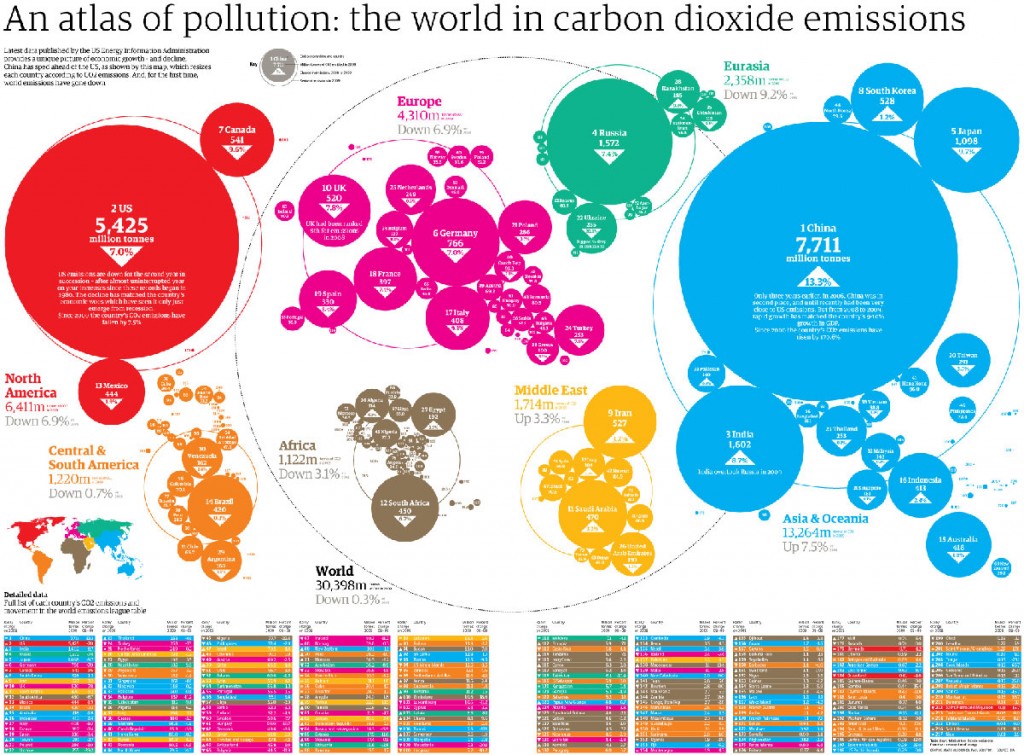
(This graphic, provided by the Guardian newspaper, understates the US’s 2009 emissions)
Per capita wise, it’s another story. The US retains the top spot with 17.67 tonnes per person compared to China’s 5.83 tonnes, well below the median European figure of 7.14 but higher than the world average of 4.49. India has a small imprint of 1.38 tonnes due to its lack of manufacturing, the backwardness of its agriculture, and much lower levels of consumption generally. In the developed world, Canada’s value is close to America’s at 16.15 tonnes and much higher than Germany’s 9.3 and Japan’s 8.64.
Fast forward to 2011 (according to the latest IEA figures), China consolidated its top emitter position through her hunger for coal. Industrialized Organization for Economic Cooperation and Development (OECD) countries’ emissions diminished slightly (0.6%) as did the EU (1.9%) and US (1.7%). The global recession, the European financial crisis, along with an unusually warm winter explain EU’s drop while in the US, it is the ongoing switch from coal to gas-powered electricity. Interestingly, the combined earthquake-tsunami-nuclear disaster that forced a nuclear power rethink in Japan caused emissions to jump by 2.4%.
Meanwhile, in the developing world, India climbed swiftly up the ranks of the largest polluters with a rise of 8.7% that enabled it to surpass Russia as the 4th largest emitter, after China, US and EU. But, per capita, China is still 63% and India 15% of OECD levels.
Dr Faith Birol, IEA’s chief economist, had some kind words for China’s efforts in emissions reduction. “China’s carbon intensity – the amount of CO2 emitted per unit of GDP – fell 15% between 2005 and 2011. Had these gains not been made, China’s CO2 emissions in 2011 would have been higher by 1.5 Gt (gigatonnes = billion tonnes)…What China has done over such a short period of time to improve energy efficiency and deploy clean energy is already paying major dividends to the global environment.”
China’s progress notwithstanding, world total emissions of 31.6 billion tonnes last year is just 1 billion shy of the tipping point set in 2017 the IEA has calculated to have a 50% chance of limiting average global temperature rises to 2o C. Thus, how the world deals with China’s rise as the largest developing country could be the single most important issue in the climate talks ahead.
LNG Exports Good for BC
The Vancouver Sun featured a story on BC LNG exports and Kitimat that shares the view of a previous post.
http://www.vancouversun.com/technology/exports+good+news+story/6683992/story.html
Xiao Sa’s Epic Journey
Here is a heart warming story that has a huge following on Weibo and got a lot of international press.
‘Little Sa’ winds her way up to Lhasa
Updated: 2012-05-26 08:07
By Zheng Jinran in Beijing and Daqiong in Lhasa (China Daily)
|
|||||||||


The homeless dog, known as Xiao Sa, has been following a team of cyclists for 24 days along 1,833 kilometers of highway from Kangding, Sichuan province, to Lhasa in Tibet.

|
|
A dog nicknamed Xiao Sa has become a Web celebrity after she ran more than 1,800 kilometers on the Qinghai-Tibet Plateau. Provided to China Daily |
Nobody knows where the white dog came from or how long she has been straying on highway G318.
Netizens call her the “dog with determination” and the micro blog “Go Go Xiao Sa” recording her life has attracted more than 37,000 followers in two weeks.
A picture of Xiao Sa in the arms of a young man in front of the Potala Palace on Thursday night drew more than 4,000 comments congratulating the small dog and expressing dreams of going to Lhasa.
The young man in the picture is Zhang Heng, 22, a student in Wuhan, Hubei province. As his graduation trip, he decided to face the challenge of riding to Lhasa alone.
On the way he met a lonely dog.
“She was lying, tired, on the street around Yajiang, Sichuan province,” he said. “So we fed her, and then she followed our team.
They thought she was following for fun, but found she insisted on sticking around them day and night.
“We felt she might want to come along with us, so we decided to bring her along to the end.”
A week later, Zhang and his buddies opened a micro blog account for her.
“We thought the dog was encouraging us, and wanted others to know its story,” he said.
They created the name Xiao Sa by combining xiao meaning “little” with the last syllable of Lhasa.
During their journey, Xiao Sa, Zhang and his team covered more than 1,700 kilometers and climbed 10 mountains higher than 4,000 meters.
Xiao Sa just ran up the mountains or along dirt roads.
“Many people stopped cycling in some sections, then took the bus, but the dog made it,” he said.
Zhang put the dog on the back of the bike when the team was riding downhill.
“The speed can reach 70 kilometers per hour, impossible for the dog to catch us.”
Many other people cycling this road had learned of the dog.
“I’ve heard about her from other friends who rode to Lhasa on the road before I met her,” said Wang Penghao, 24, from Jiuzhaigou, Sichuan province. “They told me to take care of her if I saw her, and give her some food and water like they did.”
“She followed us for three days, running behind our team but sometimes leading us. She’s very smart and knows the route, because she never got lost even when we passed through mountains.”
After following Wang, the dog lagged behind and met another cyclist, Wang Zi, on May 4.
“She may be the first dog who ran to Lhasa along this route,” said Wang Zi, who was followed by the dog one day.
“I have a special feeling about her, especially when I found she was never lost, waited for us at milestones on the road, and ran all the time, making me feel that she never feels tired,” he said.
Wang Zi will continue to the foot of Qomolangma, known as Mount Everest in the West, after he arrives in Lhasa.
“If possible, I would like to take the dog with me, taking her to see a more splendid scene.”
Zhang Heng, who accompanied Xiao Sa for 20 days, called her “a buddy and a friend”.
“I would like to take the dog home and take care of her. She has been a stray on the road for a long time. She needs a home.”
Contact the writers at zhengjinran@chinadaily.com.cn and daqiong@chinadaily.com.cn
Foreigners and Illegal Immigration in China
Beijing police launched a 100-day campaign last week to crack down on illegal foreign residents, undocumented foreigner workers, and those foreigners who have otherwise overstayed their visas.
Similar to the tactics adopted ahead of the 2008 Beijing Olympics, the police are doing house-to-house and on-the-street spot checks in neighbourhoods frequented by expats such as the bar street in Sanlitun and the university corridor in Haidian District. The police said it was part of the on-going battle against foreigner-related crime and generally, the campaign has been well-received by netizens. Beijing is home to about 120,000 foreigners, the vast majority of who have proper papers.
Foreign communities have sprouted across China, notably in Beijing, Shanghai, and Guangzhou but major enclaves are emerging in Guangdong, Shandong, Liaoning, Fujian, Zhejiang, Guangxi, and Yunnan. Within Beijing’s Wangjing ‘Koreatown’ resides tens of thousands of Koreans. Some 50,000 Japanese call Shanghai’s Gubei District home, more than in New York.
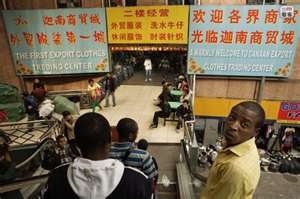 (‘African Zone’ in Guangzhou)
Yiwu, China’s export hub to the Middle East, hosts tens of thousands of Arab traders each year while Guangzhou’s ‘African Zone’ houses an estimated 200,000 African peddlers who have set up shop and live there mostly legally. All told, in late 2010, about 800,000 foreigners were living over the long term in China. With the world economy sputtering and Europe in the doldrums, I am sure that figure has only jumped over the past two years.
The top ten countries of foreigners residing in China
Rank Country Numbers Rank Country Numbers
1. Republic of Korea 120,750 6. Canada 19,990
2. United States 71,493 7. France 15,087
3. Japan 66,159 8. India 15,051
4. Myanmar 39,776 9. Germany 14,446
5. Vietnam 36,205 10. Australia 13,286
(Data from National Bureau of Statistics of China, April 29, 2011 ) The Brookings Institution
A report by Beijing Today (an English supplement of Beijing Youth Daily) last summer cited a Beijing prosecutor’s office statement that from 2009-2011, 94 of 98 drug trafficking cases involved foreigners, accounting for 2/3 of all smuggling. Foreign traffickers came mainly from Third World countries, especially central and southern Africa, the Golden Triangle, and the Golden Crescent but few from the West. Interestingly, their clients were predominantly foreign students at the Beijing Language and Culture University and Peking University.
In line with the Beijing police action, authorities in the Yanbian Korean Autonomous Prefecture along the North Korean border launched a simultaneous campaign to weed out illegal immigrants who have fled hunger and repression in the hermit kingdom. China regards them as economic migrants, not political refugees, and thus repatriates them back to North Korea under a bilateral agreement. South Korean Christian NGOs and international rights groups have urged the Chinese government to change its policies on humanitarian grounds.
According to South Korean sources, there are between 10,000 to 15,000 North Koreans believed to be residing in Yanbian along with more than 10,000 South Koreans, many of whom have set up operations, often illegally, to help them, even smuggling some out to South Korea via Indochina. China’s Legal Daily reported that about 200,000 foreigners visited Yanbian in 2011, but only 5,600 had permanent residence visas.
In China’s southern provinces of Yunnan, Guangxi, and Guangdong, the problem is primarily illegal economic migration from Myanmar, Cambodia, Vietnam, and other Indochinese countries. Much like their Mexican counterparts in the US, they invariably end up on vegetable farms, factory workshops, and construction sites toiling for paltry wages that are nonetheless much higher than in their home countries.
Many Indochinese migrants have Chinese ancestry and speak southern Chinese dialects that allow them to blend in easily. Statistics are patchy but the Guangxi border patrol, for instance, reported catching more than 1800 illegals in China and stopping almost 5,000 at the border in 2009. But, this represents a fraction of the tens of thousands that cross porous borders undetected each year.
The Chinese authorities caught some 20,000 illegals last year, and while that’s a drop in the bucket compared to the estimated 11.5 million living and working in the US, the problem will only get worse as China’s economy grows and evolves. A Brookings Institution report last fall proclaimed that international immigrants now constitute a ‘fourth section’ of China’s population (in addition to rural farmers, urban residents, and migrant workers). The study suggests China has little experience with immigration and no special laws regulating transnational migrants.
The report cites tinkering of current foreigner administration rules to deal with local immigration problems. In Yunnan, for example, in an attempt to better register and certify wives from Myanmar, governments along the border have introduced pilot programs to provide flexible ‘blue cards’ for cross-border brides. The programs encourage legal registration and provide rural cooperative medical care and other benefits. However, beyond these local trials, China needs a wholly new immigration strategy, Brookings argues.
Major immigration reform, which the authorities are currently mulling, would entail national programs to attract international talent; new laws and regulations for legal migration and preventing illegal; establishing a ‘State Administration of Immigration’ and ‘Office of Refugee Affairs’; promoting cooperation between national and local governments and international organizations and NGOs; and needless to say, augmenting police and border guard enforcement.
“In brief, Chinese government functions must be reconstructed – or constructed from scratch – to better adapt to China’s transformation from a traditional migrant sending country to a receiving country”, the report concluded.
Yang Rui’s Rant
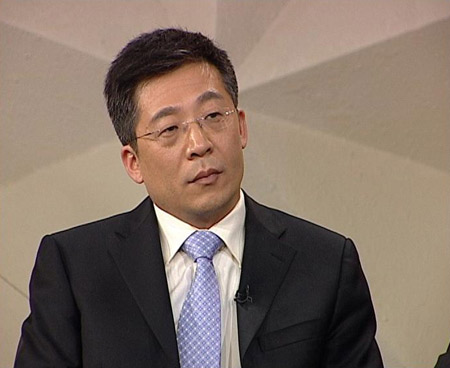
Prime time CCTV ‘Dialogue’ talk show host Yang Rui’s rant about cleaning out ‘foreign trash’ last week went viral over the blogosphere with netizens, Chinese and foreign, calling for his sacking. Commenting on the Beijing Public Security Bureau’s crackdown on foreigners overstaying their visas in a Weibo (micro-blog) post, Mr Yang delivered a tirade against foreigners that rivals the xenophobia reminiscent of the Cultural Revolution.
“The Public Security Bureau wants to clean out the foreign trash: To arrest foreign thugs and protect innocent girls…(to) cut off the foreign snake heads. People who can’t find jobs in the US and Europe come to China to grab our money, engage in human trafficking and spread deceitful lies…Foreign spies seek out Chinese girls to mask their espionage. We kicked out that ‘foreign bitch’ (‘pofu’), (referring to Al-Jazeera’s former Beijing English Bureau Chief Melissa Chan who was denied a visa extension). We should shut up those who demonize China and send them packing”, wrote Mr Yang.
Understandably, netizens vented their fury at Mr Yang, with some even linking his remarks to the infamous anti-foreigner Boxer Rebellion at the turn of the 20th Century. Clearly surprised by the outcry, Mr Yang issued a response to the Wall Street Journal: “…Most (foreigners) are friendly. They travel, do business and make a living here honestly. But some are not…After looking at (videos of foreigner misbehavior), I termed these expats ‘foreign trash’…It was a reaction of the moment and nothing more…My posting of May 16 is a wake-up call. Western and Chinese, no one should be above the law…I want to separate (the bad apples) from the silent majority in the expat communities who obey and respect our culture and society.”
Reflecting on recent ‘ugly foreigner’ incidents – such as a Youku video showing a young inebriated Englishman apparently trying to sexually assault a Chinese woman in Beijing and another of a Russian cellist for the Beijing Symphony Orchestra acting obnoxiously and bad-mouthing a fellow passenger on the Shenyang to Beijing high-speed rail – the Economist magazine points out that such incidents have stoked indignation among Chinese toward the antics of unruly and otherwise repulsive foreigners, albeit who constitute a tiny fraction of the broader community.
The magazine also discussed the almost schizophrenic swings in the Chinese psyche toward foreigners. I would add that this bipolar behavior owes in large part to the century and a half of humiliation the Chinese have suffered at the hands of foreign powers and the extra-territorial privileges enjoyed by expats during the heydays of the foreign concessions. On the one hand, Chinese often fête foreigners (especially whites from rich Western countries) for any interest they show toward Chinese language and culture. But, on the other, as Mr Yang’s diatribe shows, admiration can easily turn into hatred and unfounded denigration of foreigners and their influence.
The English and Chinese editions of Global Times, while denouncing Mr Yang’s brazen comments as being too ‘harsh’, said it was unfair for netizens to unleash rage at the authorities’ crackdown on expat criminals and illegal immigrants onto one person. “We reiterate that we don’t think Yang was right in posting his message as it was, but we think the demand for his dismissal is harsher than his message.” The paper cited the example of CNN host Jack Cafferty viciously attacking Chinese leaders in 2008 as “basically the same bunch of goons and thugs they’ve been for the last 50 years”. Despite the fact that he said it on air (and Mr Yang had made his message on his personal Weibo), Cafferty was not dismissed.
The same could be said of conservative radio personality Rush Limbaugh’s mocking of President Hu Jintao during his visit to Washington in January 2011. After complaining that Hu’s speech was not being properly translated, that “Hu Jintao was just going ching chong, ching chong, cha”, Limbaugh launched a lengthy imitation of Hu’s dialect that was seen as disgustingly racist by many in American politics and media.
Calling Limbaugh’s performance an embarrassment to the country, Andrew Leonard, a blogger and Salon.com editor wrote: “I’m sure the clip is already surging through the Chinese Internet and millions of Chinese citizens are contemplating that one of the heroes of a newly ascendant Republican Party is a nativist ignoramus intent on purposely humiliating the current leader of the world’s next great superpower.”
I will focus on foreigners and illegal immigration in China in my next post.
Chinese Businessmen to Travel Most by 2015
From the Economist
The Chinese businessman hits the road
May 22nd 2012, 12:11 by A.B.
CHINA will be the world’s biggest business-travel market by 2015, according to the Global Business Travel Association (GBTA). Chinese GDP is expected to grow by 8.2% this year and by 8.9% in 2013, and the GBTA reckons spending on business travel will rise even faster—by 17% (to $202 billion) this year, and by 21% (to $245 billion) in 2013. With business-travel spending growing more slowing in the US, the American market could be overtaken by the Chinese in the next few years.
Michael McCormick, the chief operating officer of the GBTA, confirmed the reason for the rise: “We forecast significant increases in business travel by Chinese citizens over the next two years with at least two-thirds of the growth being real increases in trips and spending as opposed to rising travel prices.”
The Chinese government certainly seems to be doing its bit to encourage business travel. As we noted in November, under the terms of its 2011-2015 five-year plan China will spend in the region of 1.5 trillion yuan ($237 billion) on airports, with plans to expand 91 of its 175 current facilities and to build another 56. Combine that with the 8,000 km of new high-speed rail track due to be laid by 2015 and you have a country where the needs of the business traveller are being met in a way that could make many in the West rather jealous.
Spending on business travel in 2011, $ bn
1) United States 250. 2) China 182. 3) Japan 65. 4) United Kingdom 38. 5) Germany 35. 6) France 34. 7) Italy 33. 8) South Korea 30. 9) Brazil 28. 10) Canada 22.
The Lai Changxing Saga

Last week’s life-sentencing of Lai Changxing, China’s most prolific smuggler and criminal mastermind, ended a 12 year extradition battle between China and Canada that saw him exhaust all legal channels in trying to stay in Canada. Dubbed a ‘robber baron’, ‘Robin Hood’, and ‘Great Gatsby’ by some in the Western press, we should recall his crimes, lest people paint him as a tragic-hero caught up in the intricate web of local corruption in China.
Diminutive in stature and growing up destitute with little formal education, Lai became a ‘big man’ in Xiamen, engaging in illicit activities on the one hand and donating generously to local charities, projects, and causes on the other. Using his Yuanhua Group (Fairwell Group in English) as a front during the boom days of the Xiamen Special Economic Zone, Lai ran an extensive smuggling operation, protected from investigation and prosecution through the masterful cultivation of local and central officials via bribes and vice.
Expending a tiny fraction of his ill-gotten gain, he managed to have officials look the other way and even act as his scouts. At the height of his power, he built a seven-storey ‘red mansion’ especially for them offering gifts, booze, and girls. The more prominent big-wigs to be dragged down include Ji Shengde, a high-ranking People’s Liberation Army general and son of former Secretary-General of the State Council Ji Pengfei, Li Jizhou, a top cop, and Hu Ganlu, in charge of immigration.
Over a five year period before the warrants went out for his arrest, Mr Lai’s syndicate smuggled everything from cigarettes and luxury cars to commodities such as refined oil, chemicals and textiles worth US$4.35 billion, evading more than US$2.22 billion in duties and other charges, the Xiamen Intermediate People’s Court announced at his sentencing. Some analysts believe his ring may have moved as much as $10 billion in contraband to avoid $3.6 billion in taxes and fees.
In the summer of 1999, Lai was tipped off that tough corruption and crime buster Premier Zhu Rongji was out to nab him. He immediately boarded a boat fleeing to Hong Kong where he had emigrated years earlier. In a matter of days, he and his family landed in Vancouver where he lived a life of luxury for 12 years in a $1 million-dollar home and sent his kids to private schools. Most galling to many Chinese was that, while exploiting the Canadian judicial system to the max, he could go gambling at Canadian casinos and was even granted a permit to work as a consultant for a Vancouver real-estate company.
Over the past decade, the Chinese government had made repeated requests for his extradition, including a letter from President Jiang Zemin in 2001 vowing that he would not be executed. But, his case languished in Canadian courts until a Vancouver federal court finally ruled that he should not be considered a refugee and be deported. His life-sentence in China led the Canadian government to express its approval, stating that China had indeed lived up to its assurances.
Kitimat and LNG Exports
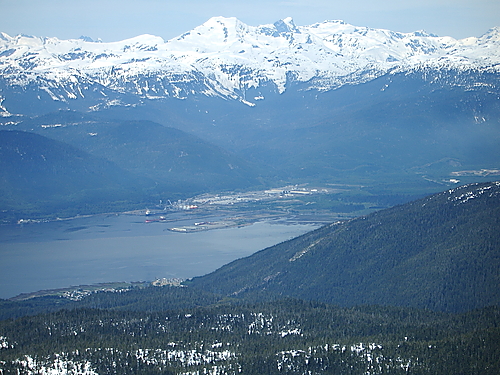
With the Canadian media fixated on the noisy debate over Northern Gateway and development of Alberta’s oil sands, Asian oil giants are quietly pursuing shale gas and other opportunities that could transform Canada into a credible liquefied natural gas (LNG) exporter.
In early February, PetroChina, China’s largest oil and gas company, agreed to acquire 20% of Royal Dutch Shell’s wholly-owned Groundbirch properties in the Montney region of northeastern British Columbia that can double its current production of 5.1 million m3 per day. Considered one of the most promising shale gas developments in North America, analysts say the Montney area has the potential of producing 142 million m3 of low cost gas a day. Last summer, PetroChina walked away from a $5.4 billion bid for Encana’s British Columbia shale gas properties due to differences over price.
The PetroChina purchase itself is not as important as what it portends for shipments of Canadian gas to hungry Asian markets. Just a couple days ago, Royal Dutch Shell announced that it is partnering with PetroChina, Japan’s Mitsubishi, and South Korea’s Kogas to build LNG Canada, a major LNG export terminal in Kitimat BC. While the price tag is not known, the facility will initially be able to process 6 million tonnes of LNG (8.76 billion m3 of gas) a year with room for expansion.
But, currently, there are three other competing LNG projects slated for Kitimat: Encana Corp. and US partners Apache Corp. and EOG Resources are preparing to start up a terminal of similar size by 2015; Calgary-based Progress Energy Resources Corp. and Malaysia’s Petronas are pursuing a proposal; and the Haisia First Nation and Houston-based LNG Partners are looking at a facility called BC LNG.
LNG exports face less political and environmental controversy than sending Alberta oil sands based bitumen via the Northern Gateway pipeline. Moreover, since LNG Canada involves a consortium of Shell and East Asian companies, opponents will be hard-pressed to single out PetroChina for criticism.
China is in the midst of game-changing domestic gas price reforms and spending billions on gas imports and infrastructure to cut down on the use of coal. This has forced China’s state oil and gas companies to scramble in buying up local distributors and foreign assets. In December last year, China launched a pilot project in Guangdong and Guangxi provinces to link city natural gas prices with prices of imported fuel oil and liquefied petroleum gas which inevitably boosts overall gas prices.
During the current 12th Five-Year Plan period (2011-2015), the government is projecting a jump in gas consumption from 100 billion m3 in 2010 to 260 billion m3 by 2015. Higher prices encourage vigorous imports, which according to industry analysis, could amount to 1/2 of China’s total consumption by 2030 from 30% today. If this bears out, China would displace Japan as the world’s biggest natural gas importer.
Writing in the Energy Bridge journal, Robert Johnson, head of energy and natural resources research at the Eurasia Group, said China’s gas price reforms and expanding gas import market represents an unprecedented opportunity for Kitimat. China has many pipeline and LNG import options and is looking to diversify its imports.
In addition, in light of US successes in shale gas, China desires to leverage Canadian exploration expertise and technology to tap into its own proven unconventional gas reserves of 2.8 trillion m3 (as of 2010). In March, China’s Ministry of Land and Resources disclosed that China may hold as much as 25.08 trillion m3 of potentially recoverable shale gas. The US Energy Information Administration puts the figure even higher at 36.12 trillion m3.
But, even with Kitimat up and running, Canada remains a small player in the world of LNG export. Other countries, notably Australia, wants to significantly ratchet up its already large LNG exports, in light of a government report claiming that the country may have enough shale gas to double its total gas resource base.
In the 2010-11 financial year, Australia exported 20 million tonnes of LNG worth $10.47 billion and with the new Pluto LNG project coming on line, exports are expected to grow by 19% in 2012-13. With around 11.05 trillion m3 in conventional natural gas, excluding shale, Australia may surpass Qatar as the world’s top LNG exporter by 2020. Another $170 billion in LNG export infrastructure is under construction.
China Up, Europe Down in Latest BBC Poll
Europe less, China more popular in global BBC poll

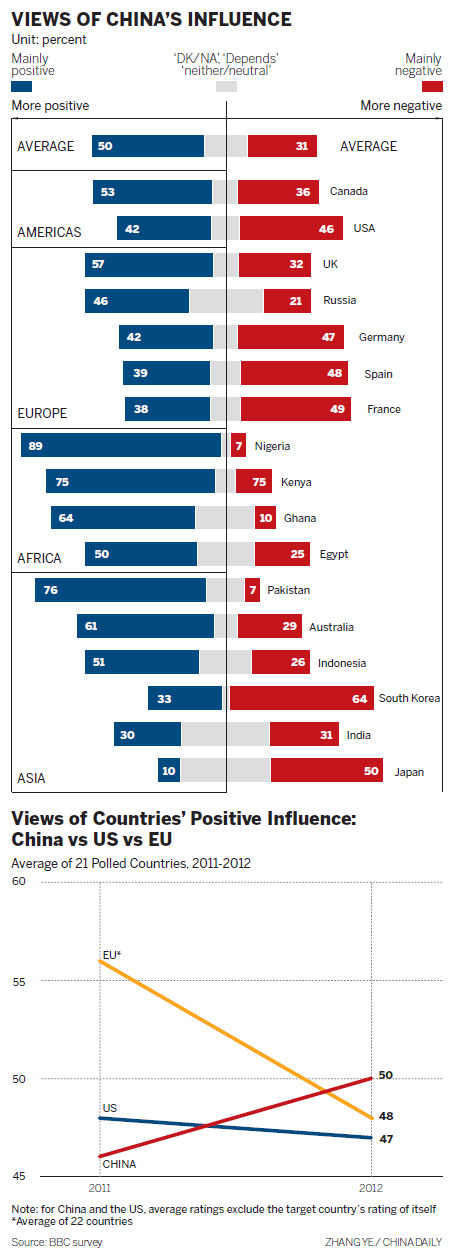
The percentage of those surveyed giving positive views of EU influence dropped by an average of 8% – from 56% to 48% – since the last poll in 2011.
Views of China, on the other hand, improved significantly, allowing it to overtake the EU. Japan replaced Germany as the most popular country.
The poll was based on the answers of about 24,000 people in 22 countries.
Respondents were asked to rate the influence in the world of 16 countries and the EU as either “mostly positive” or “mostly negative”.
Ratings of the EU and many European countries dropped across the countries surveyed in both 2011 and 2012, when 27 countries were surveyed. Positive views of Britain fell by by 6% and of France by 4%.
“The turmoil in the EU, long seen as an attractive bastion of political and economic stability, has raised doubts in people’s minds about its continued ability to be a global leader,” the head of polling company GlobeScan, Chris Coulter, said. “Hopes are turning to China.”
Germany, the most positively regarded nation last year, saw its positive ratings drop from 60% to 56%, putting it in second place behind Japan, which rose 2% to 58%.
Positive views of China rose from 46% to 50%, with the biggest rises recorded in Britain, Australia, Canada, and Germany.
Views of the US remain broadly unchanged, the poll suggests, with 47% of respondents giving positive views and 33% negative views, compared to 48% and 31% in 2010.
Europe less, China more popular in global BBC poll
The percentage of those surveyed giving positive views of EU influence dropped by an average of 8% – from 56% to 48% – since the last poll in 2011.
Views of China, on the other hand, improved significantly, allowing it to overtake the EU. Japan replaced Germany as the most popular country.
The poll was based on the answers of about 24,000 people in 22 countries.
Respondents were asked to rate the influence in the world of 16 countries and the EU as either “mostly positive” or “mostly negative”.
Ratings of the EU and many European countries dropped across the countries surveyed in both 2011 and 2012, when 27 countries were surveyed. Positive views of Britain fell by by 6% and of France by 4%.
“The turmoil in the EU, long seen as an attractive bastion of political and economic stability, has raised doubts in people’s minds about its continued ability to be a global leader,” the head of polling company GlobeScan, Chris Coulter, said. “Hopes are turning to China.”
Germany, the most positively regarded nation last year, saw its positive ratings drop from 60% to 56%, putting it in second place behind Japan, which rose 2% to 58%.
Positive views of China rose from 46% to 50%, with the biggest rises recorded in Britain, Australia, Canada, and Germany.
Views of the US remain broadly unchanged, the poll suggests, with 47% of respondents giving positive views and 33% negative views, compared to 48% and 31% in 2010.
Europe less, China more popular in global BBC poll
The percentage of those surveyed giving positive views of EU influence dropped by an average of 8% – from 56% to 48% – since the last poll in 2011.
Views of China, on the other hand, improved significantly, allowing it to overtake the EU. Japan replaced Germany as the most popular country.
The poll was based on the answers of about 24,000 people in 22 countries.
Respondents were asked to rate the influence in the world of 16 countries and the EU as either “mostly positive” or “mostly negative”.
Ratings of the EU and many European countries dropped across the countries surveyed in both 2011 and 2012, when 27 countries were surveyed. Positive views of Britain fell by by 6% and of France by 4%.
“The turmoil in the EU, long seen as an attractive bastion of political and economic stability, has raised doubts in people’s minds about its continued ability to be a global leader,” the head of polling company GlobeScan, Chris Coulter, said. “Hopes are turning to China.”
Germany, the most positively regarded nation last year, saw its positive ratings drop from 60% to 56%, putting it in second place behind Japan, which rose 2% to 58%.
Positive views of China rose from 46% to 50%, with the biggest rises recorded in Britain, Australia, Canada, and Germany.
Views of the US remain broadly unchanged, the poll suggests, with 47% of respondents giving positive views and 33% negative views, compared to 48% and 31% in 2010.
China Oil Needs and Northern Gateway
China’s robust growth over the past 30 years has lifted some half a billion people into the middle class that is climbing swiftly up the consumption ladder. More meat, better clothing, new cars and homes, and more leisure all translate into rising oil intake.
GDP drives oil consumption
According to the latest figures from the IMF, China’s 2011 nominal per capita GDP stands at about US$5,400 (using purchasing power parity (ppp), it climbs to $7,400) while its oil consumption has risen to about 2.7 barrels per person/year from barely 1/2 barrel at the outset of the reform era. Despite the big hike, it is still almost 10 times less than what the average American gobbles up. (Canadians ingest even more.)

The world’s second largest oil consumer, China’s oil imports in April were down slightly from a year before, hovering around 9.31 million barrels per day (bpd). The International Energy Agency (IEA) forecasts that China’s demand will grow by 4.1% this year. By 2015, the IEA earlier estimated, China’s oil use will rise some 70% over 2009 levels, accounting for 42% of global demand over that period. A more recent analysis by Barclays Capital argues that China’s consumption could be significantly higher than the IEA forecast, possibly reaching as much as 13.6 million bpd.
A recent review by Rice University projected that China’s oil demand would likely catch up to the US by 2040 (even though per capita wise China would still be much lower than the US), owing in large part to the exponential growth of car ownership. By that time, the research boldly predicted, there could be as many as 770 million (mostly gas powered) vehicles on Chinese roads (12 times that of 2009).
Foreign Sources of China’s oil
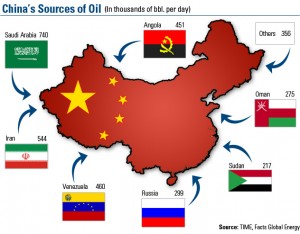
So, China needs lots of oil and its thirst gets harder to quench by the year. But, where does China it from? Canada supplies on average a paltry 10,000 bpd in spot sales to China. A University of Alberta paper released last January recommending much closer energy relations between China and Alberta estimated in order to meet a modest 3% of China’s needs by 2015, Canada would need to multiply current supply by 40-fold (to reach 400,000+ bpd). This graphic shows China’s main sources as of early 2010.
In terms of investments, since 2005, China has signed at least 30 deals with over 19 countries worth more than US$60 billion. In April, 2010, for instance, China signed a US$20 billion mega-deal with Venezuela to finance more exploration and production in Venezuela’s Orinoco Belt. Over the past two years, PetroChina, Sinopec, and China National Petroleum Corp. (CNPC), parent of PetroChina, have invested in excess of $10 billion in Canadian oil and gas (notably oil sands), to bring total Chinese FDI in Canada to $14.1 billion.
Margaret Cornish, a Beijing based consultant and author of a recent report for the Canadian Council of Chief Executives (CCCE) on Chinese state-owned enterprise (SOE) investment in Canada, stressed that Chinese SOEs are ‘profit-driven to the core”, much like their private sector counterparts in the West. They buy and sell oil and minerals on a regional basis to the highest bidder rather than automatically directing their product homeward. Ms Cornish said Canadians should be thrilled that Chinese companies are providing a much needed boost to Canada’s oil and gas sector.
Northern Gateway and Alberta oil sands
Due to our unique relationship to the US government and reliance on the American market, which takes virtually all of Canadian output, Canada sells its Select crude at $30 a barrel less than world prices. While not a ‘silver bullet’, Paul Stanway wrote in the Vancouver Sun, Enbridge’s Northern Gateway project could add as much as $270 billion to the Canadian economy over the next 30 years, generating $2.6 billion in local, provincial and federal taxes. In addition, there would be $4.3 billion in wages and some $400 million in jobs and contracts for the First Nations.
The Canadian Energy Research Institute (CERI) made some valuations about the impact of oil sands development in major study released last May. Over a 25 year period (2010-2035), the operation of new oil sands projects would lead to over $2 trillion (sic) in ‘initial outlays’ (initial capital, operations, maintenance, and sustaining capital). Total GDP impact for Canada and the US would be in the neighbourhood of $2.6 trillion ($2.1 trillion for Canada and $521 billion for the US). Direct, indirect, and induced jobs in Canada would grow from 75,000 in 2010 to 905,000 in 2035. Taxes for Canada and taxes plus royalties for Alberta would total $766 billion.
The University of Alberta report thus concludes: “the most critical issue in rebranding Alberta/Canada as a credible long-term supplier [to the Chinese and broader Asian market] is progress on either or both the Northern Gateway and Kinder-Morgan pipeline projects…It is essential that we are able, soon and persuasively, to present potential Asian customers with a sense of momentum and that these projects will be tackled successfully, and that Canada’s commitment to diversifying its customer base is real and, again, long-term in nature.”
The estimated cost of Northern Gateway is $5.5 billion with the capacity of moving 525,000 bpd of oil sands-derived crude 1,177 km (731 miles) from near Edmonton across the Rockies to Kitimat, BC, where it would be loaded onto super-tankers bound for China and other parts of East Asia.
Fingers are crossed for approval by early 2014?!