
China Oil Needs and Northern Gateway
China’s robust growth over the past 30 years has lifted some half a billion people into the middle class that is climbing swiftly up the consumption ladder. More meat, better clothing, new cars and homes, and more leisure all translate into rising oil intake.
GDP drives oil consumption
According to the latest figures from the IMF, China’s 2011 nominal per capita GDP stands at about US$5,400 (using purchasing power parity (ppp), it climbs to $7,400) while its oil consumption has risen to about 2.7 barrels per person/year from barely 1/2 barrel at the outset of the reform era. Despite the big hike, it is still almost 10 times less than what the average American gobbles up. (Canadians ingest even more.)

The world’s second largest oil consumer, China’s oil imports in April were down slightly from a year before, hovering around 9.31 million barrels per day (bpd). The International Energy Agency (IEA) forecasts that China’s demand will grow by 4.1% this year. By 2015, the IEA earlier estimated, China’s oil use will rise some 70% over 2009 levels, accounting for 42% of global demand over that period. A more recent analysis by Barclays Capital argues that China’s consumption could be significantly higher than the IEA forecast, possibly reaching as much as 13.6 million bpd.
A recent review by Rice University projected that China’s oil demand would likely catch up to the US by 2040 (even though per capita wise China would still be much lower than the US), owing in large part to the exponential growth of car ownership. By that time, the research boldly predicted, there could be as many as 770 million (mostly gas powered) vehicles on Chinese roads (12 times that of 2009).
Foreign Sources of China’s oil
So, China needs lots of oil and its thirst gets harder to quench by the year. But, where does China it from? Canada supplies on average a paltry 10,000 bpd in spot sales to China. A University of Alberta paper released last January recommending much closer energy relations between China and Alberta estimated in order to meet a modest 3% of China’s needs by 2015, Canada would need to multiply current supply by 40-fold (to reach 400,000+ bpd). This graphic shows China’s main sources as of early 2010.
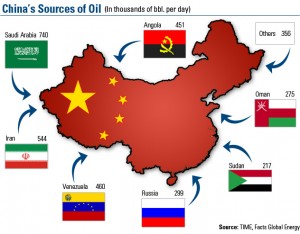
In terms of investments, since 2005, China has signed at least 30 deals with over 19 countries worth more than US$60 billion. In April, 2010, for instance, China signed a US$20 billion mega-deal with Venezuela to finance more exploration and production in Venezuela’s Orinoco Belt. Over the past two years, PetroChina, Sinopec, and China National Petroleum Corp. (CNPC), parent of PetroChina, have invested in excess of $10 billion in Canadian oil and gas (notably oil sands), to bring total Chinese FDI in Canada to $14.1 billion.
Margaret Cornish, a Beijing based consultant and author of a recent report for the Canadian Council of Chief Executives (CCCE) on Chinese state-owned enterprise (SOE) investment in Canada, stressed that Chinese SOEs are ‘profit-driven to the core”, much like their private sector counterparts in the West. They buy and sell oil and minerals on a regional basis to the highest bidder rather than automatically directing their product homeward. Ms Cornish said Canadians should be thrilled that Chinese companies are providing a much needed boost to Canada’s oil and gas sector.
Northern Gateway and Alberta oil sands
Due to our unique relationship to the US government and reliance on the American market, which takes virtually all of Canadian output, Canada sells its Select crude at $30 a barrel less than world prices. While not a ‘silver bullet’, Paul Stanway wrote in the Vancouver Sun, Enbridge’s Northern Gateway project could add as much as $270 billion to the Canadian economy over the next 30 years, generating $2.6 billion in local, provincial and federal taxes. In addition, there would be $4.3 billion in wages and some $400 million in jobs and contracts for the First Nations.
The Canadian Energy Research Institute (CERI) made some valuations about the impact of oil sands development in major study released last May. Over a 25 year period (2010-2035), the operation of new oil sands projects would lead to over $2 trillion (sic) in ‘initial outlays’ (initial capital, operations, maintenance, and sustaining capital). Total GDP impact for Canada and the US would be in the neighbourhood of $2.6 trillion ($2.1 trillion for Canada and $521 billion for the US). Direct, indirect, and induced jobs in Canada would grow from 75,000 in 2010 to 905,000 in 2035. Taxes for Canada and taxes plus royalties for Alberta would total $766 billion.
The University of Alberta report thus concludes: “the most critical issue in rebranding Alberta/Canada as a credible long-term supplier [to the Chinese and broader Asian market] is progress on either or both the Northern Gateway and Kinder-Morgan pipeline projects…It is essential that we are able, soon and persuasively, to present potential Asian customers with a sense of momentum and that these projects will be tackled successfully, and that Canada’s commitment to diversifying its customer base is real and, again, long-term in nature.”
The estimated cost of Northern Gateway is $5.5 billion with the capacity of moving 525,000 bpd of oil sands-derived crude 1,177 km (731 miles) from near Edmonton across the Rockies to Kitimat, BC, where it would be loaded onto super-tankers bound for China and other parts of East Asia.
Fingers are crossed for approval by early 2014?!