
Foreigners and Illegal Immigration in China
Beijing police launched a 100-day campaign last week to crack down on illegal foreign residents, undocumented foreigner workers, and those foreigners who have otherwise overstayed their visas.
Similar to the tactics adopted ahead of the 2008 Beijing Olympics, the police are doing house-to-house and on-the-street spot checks in neighbourhoods frequented by expats such as the bar street in Sanlitun and the university corridor in Haidian District. The police said it was part of the on-going battle against foreigner-related crime and generally, the campaign has been well-received by netizens. Beijing is home to about 120,000 foreigners, the vast majority of who have proper papers.
Foreign communities have sprouted across China, notably in Beijing, Shanghai, and Guangzhou but major enclaves are emerging in Guangdong, Shandong, Liaoning, Fujian, Zhejiang, Guangxi, and Yunnan. Within Beijing’s Wangjing ‘Koreatown’ resides tens of thousands of Koreans. Some 50,000 Japanese call Shanghai’s Gubei District home, more than in New York.
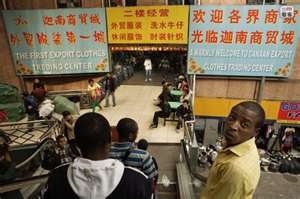 (‘African Zone’ in Guangzhou)
Yiwu, China’s export hub to the Middle East, hosts tens of thousands of Arab traders each year while Guangzhou’s ‘African Zone’ houses an estimated 200,000 African peddlers who have set up shop and live there mostly legally. All told, in late 2010, about 800,000 foreigners were living over the long term in China. With the world economy sputtering and Europe in the doldrums, I am sure that figure has only jumped over the past two years.
The top ten countries of foreigners residing in China
Rank Country Numbers Rank Country Numbers
1. Republic of Korea 120,750 6. Canada 19,990
2. United States 71,493 7. France 15,087
3. Japan 66,159 8. India 15,051
4. Myanmar 39,776 9. Germany 14,446
5. Vietnam 36,205 10. Australia 13,286
(Data from National Bureau of Statistics of China, April 29, 2011 ) The Brookings Institution
A report by Beijing Today (an English supplement of Beijing Youth Daily) last summer cited a Beijing prosecutor’s office statement that from 2009-2011, 94 of 98 drug trafficking cases involved foreigners, accounting for 2/3 of all smuggling. Foreign traffickers came mainly from Third World countries, especially central and southern Africa, the Golden Triangle, and the Golden Crescent but few from the West. Interestingly, their clients were predominantly foreign students at the Beijing Language and Culture University and Peking University.
In line with the Beijing police action, authorities in the Yanbian Korean Autonomous Prefecture along the North Korean border launched a simultaneous campaign to weed out illegal immigrants who have fled hunger and repression in the hermit kingdom. China regards them as economic migrants, not political refugees, and thus repatriates them back to North Korea under a bilateral agreement. South Korean Christian NGOs and international rights groups have urged the Chinese government to change its policies on humanitarian grounds.
According to South Korean sources, there are between 10,000 to 15,000 North Koreans believed to be residing in Yanbian along with more than 10,000 South Koreans, many of whom have set up operations, often illegally, to help them, even smuggling some out to South Korea via Indochina. China’s Legal Daily reported that about 200,000 foreigners visited Yanbian in 2011, but only 5,600 had permanent residence visas.
In China’s southern provinces of Yunnan, Guangxi, and Guangdong, the problem is primarily illegal economic migration from Myanmar, Cambodia, Vietnam, and other Indochinese countries. Much like their Mexican counterparts in the US, they invariably end up on vegetable farms, factory workshops, and construction sites toiling for paltry wages that are nonetheless much higher than in their home countries.
Many Indochinese migrants have Chinese ancestry and speak southern Chinese dialects that allow them to blend in easily. Statistics are patchy but the Guangxi border patrol, for instance, reported catching more than 1800 illegals in China and stopping almost 5,000 at the border in 2009. But, this represents a fraction of the tens of thousands that cross porous borders undetected each year.
The Chinese authorities caught some 20,000 illegals last year, and while that’s a drop in the bucket compared to the estimated 11.5 million living and working in the US, the problem will only get worse as China’s economy grows and evolves. A Brookings Institution report last fall proclaimed that international immigrants now constitute a ‘fourth section’ of China’s population (in addition to rural farmers, urban residents, and migrant workers). The study suggests China has little experience with immigration and no special laws regulating transnational migrants.
The report cites tinkering of current foreigner administration rules to deal with local immigration problems. In Yunnan, for example, in an attempt to better register and certify wives from Myanmar, governments along the border have introduced pilot programs to provide flexible ‘blue cards’ for cross-border brides. The programs encourage legal registration and provide rural cooperative medical care and other benefits. However, beyond these local trials, China needs a wholly new immigration strategy, Brookings argues.
Major immigration reform, which the authorities are currently mulling, would entail national programs to attract international talent; new laws and regulations for legal migration and preventing illegal; establishing a ‘State Administration of Immigration’ and ‘Office of Refugee Affairs’; promoting cooperation between national and local governments and international organizations and NGOs; and needless to say, augmenting police and border guard enforcement.
“In brief, Chinese government functions must be reconstructed – or constructed from scratch – to better adapt to China’s transformation from a traditional migrant sending country to a receiving country”, the report concluded.
Its surpassing how many Canadians are in China, Ranked #6 in the world.