
Is China Still a Developing Country?
The latest round of UN climate talks concluded last weekend without a resolution, once again bringing to the fore the issue of whether China should be considered a rich country as the world’s largest polluter. Western countries insist the current system of categorizing countries between developing and developed is outdated and China should be held to commitments along developed world lines.
In grappling for a better way to describe the developing world, it should be borne in mind that the weight of history rests primarily on the shoulders of the West, that a hefty portion of China’s emissions is due to her ‘factory to the world’ status, and China’s is still far below the West on a per capita basis. How to better address the responsibilities of large developing countries such as China and India while holding the West accountable to history are both critical if the world is to reach a new climate pact by 2015.
China has long maintained that a new deal binding all countries to specific targets by 2020, must be based on the principle of ‘common but differentiated responsibility’ that keeps the current division between developed and developing countries. Mr Su Wei, China’s lead negotiator, said China is still very poor given its low per capita incomes (of $5,400) and the more than 100 million people that live under China’s official poverty line (of <US$1 a day).
Statistics on greenhouse gas (GHG, mainly CO2) emissions vary significantly although they point to a general trend of rapidly rising emissions in the developing world in contrast to stagnation and even reduction in the developed world. 2009 data released by the International Energy Agency (IEA) in early 2011 showed China emitting 7.7 billion tonnes, more than the US and Canada combined with the US declining for two consecutive years. China’s share of the world’s 31 billion tonnes now approaches 25% while the US has fallen to about 20%.
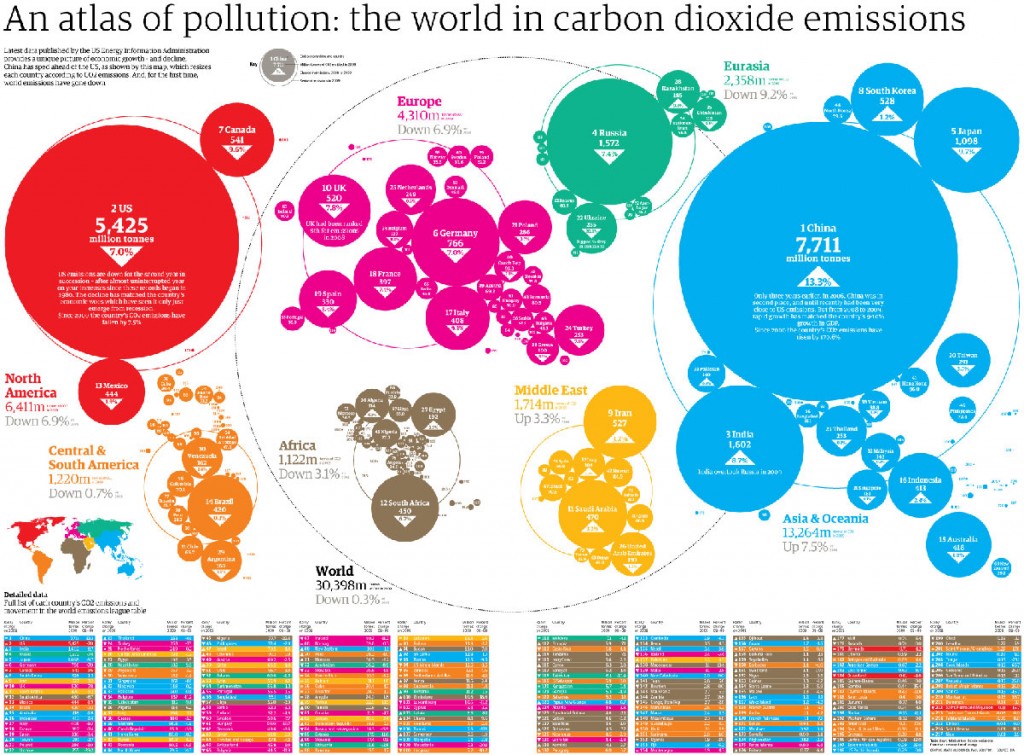
(This graphic, provided by the Guardian newspaper, understates the US’s 2009 emissions)
Per capita wise, it’s another story. The US retains the top spot with 17.67 tonnes per person compared to China’s 5.83 tonnes, well below the median European figure of 7.14 but higher than the world average of 4.49. India has a small imprint of 1.38 tonnes due to its lack of manufacturing, the backwardness of its agriculture, and much lower levels of consumption generally. In the developed world, Canada’s value is close to America’s at 16.15 tonnes and much higher than Germany’s 9.3 and Japan’s 8.64.
Fast forward to 2011 (according to the latest IEA figures), China consolidated its top emitter position through her hunger for coal. Industrialized Organization for Economic Cooperation and Development (OECD) countries’ emissions diminished slightly (0.6%) as did the EU (1.9%) and US (1.7%). The global recession, the European financial crisis, along with an unusually warm winter explain EU’s drop while in the US, it is the ongoing switch from coal to gas-powered electricity. Interestingly, the combined earthquake-tsunami-nuclear disaster that forced a nuclear power rethink in Japan caused emissions to jump by 2.4%.
Meanwhile, in the developing world, India climbed swiftly up the ranks of the largest polluters with a rise of 8.7% that enabled it to surpass Russia as the 4th largest emitter, after China, US and EU. But, per capita, China is still 63% and India 15% of OECD levels.
Dr Faith Birol, IEA’s chief economist, had some kind words for China’s efforts in emissions reduction. “China’s carbon intensity – the amount of CO2 emitted per unit of GDP – fell 15% between 2005 and 2011. Had these gains not been made, China’s CO2 emissions in 2011 would have been higher by 1.5 Gt (gigatonnes = billion tonnes)…What China has done over such a short period of time to improve energy efficiency and deploy clean energy is already paying major dividends to the global environment.”
China’s progress notwithstanding, world total emissions of 31.6 billion tonnes last year is just 1 billion shy of the tipping point set in 2017 the IEA has calculated to have a 50% chance of limiting average global temperature rises to 2o C. Thus, how the world deals with China’s rise as the largest developing country could be the single most important issue in the climate talks ahead.