
The Atlantic on ‘A Bite of China’
The Atlantic Monthly online edition featured a blog on ‘A Bite of China’ that dovetails with my previous post on the series. Other than this blog, it’s interesting that the Western press on the whole did not see the newsworthiness of the hugely successful documentary.
IEA: China Gas Consumption to Spike
This projection is much lower than the Chinese government’s plans for gas consumption by 2015 ( as mentioned in a previous post).
IEA: China natural gas demand to double by 2017
KUALA LUMPUR, Malaysia (AP) — The International Energy Agency says it expects global demand for natural gas to grow 2.7 percent a year over the next five years as Chinese consumption doubles.
The Paris-based IEA said Tuesday that China’s demand for natural gas will likely grow 13 percent a year through 2017.
The IEA said U.S. consumption will probably grow 13 percent by 2017 while European demand will increase by 7.9 percent.
The IEA said North America will likely become a net exporter of liquefied natural gas over the next five years.
Replica of an Entire Austrian Village
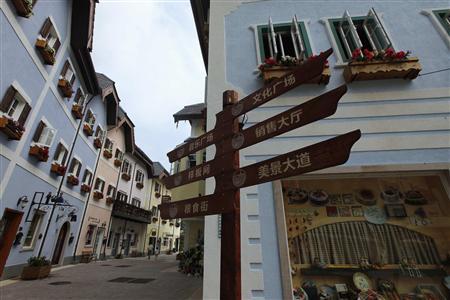
A Chinese mining tycoon spent US$940 million to build a complete replica of picturesque Austrian village Hallstatt in Huzhou, Guangdong, near the Pearl River Delta. Crazy you say? It’s going to make a bucket of money for the entrepreneur and send thousands of Chinese tourists to see the real McCoy!
Here’s a Reuters video report. http://www.reuters.com/video/2012/06/04/born-in-austria-made-in-china?videoId=235812726
Are Chinese Students Safe in Canada?
 (murder victim Lin Jun)
The grisly murder and dismemberment of Lin Jun, a Chinese engineering student at Montreal’s Concordia University, allegedly at the hands of gay porn psychopath Eric Clinton Newman alias Luka Rocco Magnotta, sent shock waves across China. Netizens wondered aloud not only about the safety of Chinese students abroad but whether it was racially motivated.
Just over a year ago, many recalled, York University student Liu Qian’s killing was partially witnessed on Skype by her boyfriend in China. She had been living in a supposedly safe student housing complex just minutes from the main campus. Last April, two Chinese graduate engineering students at the University of Southern California were gunned down and killed in their car outside the lot where one of the victims lived.
The Chinese Embassy in Ottawa along with the Consulate in Montreal immediately warned Chinese students and nationals in Canada on business or pleasure to be on their guard. Canadian Foreign Affairs Minister John Baird expressed his “deepest condolences” to the Chinese Ambassador, denouncing the “senseless killing” and promised to keep him abreast of developments.
Most appalling for netizens was that Magnotta had apparently videotaped the gruesome act and posted it on Edmonton-based “Best Gore” a day after the murder. The 10-minute flick showed a man killing an Asian with an ice pick and after dismembering the corpse, defiling it sexually and seemingly cannibalizing some body parts.
Some of gory details ended up on Chinese forums and micro blogs, leading web users to call for a boycott of the segments. Sina Weibo, one of China’s leading blogging sites, announced that it has been filtering videos and picture galleries for any inappropriate scenes. Anyone found loading lurid content would have their posts deleted and even barred from Weibo altogether.
Currently, more than 50,000 Chinese students live and study in Canada, helping to prop up many Canadian universities that are teetering under the weight of rising costs and a rapidly shrinking domestic student base. Just as important, almost 1/4 million Chinese vacationed in Canada last year. With the Chinese government and media sounding alarm bells about the safety of its citizens in Canada (and other Western countries), Canadian efforts to lure more Chinese tourists could take a blow.
In an interview, Meng Xiaochao, the boyfriend of the York University murder victim, commented, “the impact of the (Lin Jun) case will be very bad on Canada…Last year, when Liu Qian’s case happened, many parents said they were no longer willing to send their children to Canada. Now comes this case.”
A recent post on China Education Online got a lot of circulation. Written a month after the April racially inspired severe beating of Chinese students at a Sydney mass transit station and just a week before Lin Jun went missing, the article, to its credit, urged Chinese traveling and studying abroad to be more self aware and on good behaviour instead of deriding their foreign hosts.
Growing up pampered, young Chinese students are often too naïve and easily trusting of others. They don’t lock windows at night and are not sufficiently vigilant when walking alone, the post chastised. Chinese students abroad tend to be overly bookish, caught up in strictly academic pursuit to the neglect of nurturing social skills. They sometimes speak without tact or act out of turn and are poor at communicating with others, especially local residents.
They can behave badly in public, chattering loudly, littering, loitering, or sitting or lying where they shouldn’t. Chinese students seem meek and generally avoid confrontation. While this is not a bad attribute, the anonymous post posited, it can lead to an image of cowardliness that invites bullying and mistreatment by others. Finally, although they won’t say it out loud, some Chinese can be equally racist, especially toward people of colour.
Ever more Chinese travel abroad for work and study. For their own safety, they’d best heed these words.
Subterranean Hotel to be Built in Shanghai

This was first reported in the spring but here’s a Bloomberg video report:
http://www.bloomberg.com/video/93782387-china-subterranean-hotel-to-be-built-in-quarry.html
‘A Bite of China’ Review
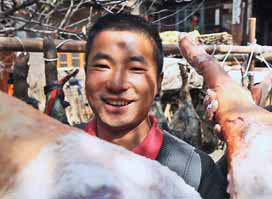 (A proud worker shows off a Yunnan Nuodeng Ham that has been aged for 3 years – China Daily photo)
CCTV’s smash hit documentary ‘A Bite of China’ has reawakened taste buds around the country for regional snacks and traditional foods. On May 14th, when the series debuted on late-night TV, viewer ratings surged by 30%, knocking out big-name TV dramas with young people normally bored of central television actively tuning in.
A year in the making involving a team of 30 top film-makers, for the first time in its long documentary-making history, CCTV employed high-resolution cameras and avant-garde filming techniques to create stunning visual and audio effect.
In the episode on traditional food preservation, director Zhang Minghuan took his entourage through nine cities in greater China from Heilongjiang province in the northeast where he filmed kimchi making to Tao O, Hong Kong, where he met one of the last salted prawn sauce craftswomen. The series also provided poignant glimpses into the hard yet rich lives of workers, farmers and fishermen who harvested winter bamboo shoots, dug up lotus roots, raised mitten crabs, and dove for sea urchins, sea cucumbers, and abalone.
The force of the series instantly rocked the webosphere where netizens looked high and low for any traditional foods mentioned on the program. Folk delicacies like furry bean curd, stinky fish, black truffles, matsutake mushrooms, aged Yunnan Nuodeng and Zhejiang Jinhua ham, Dali cheese, and other taste delights became hot items on China’s premier online shopping sites.
The first five episodes drove over 5.84 million people to search on Taobao, resulting in 20 million+ hits on its food pages and racking up nearly 7.3 million deals. Searches for Nuodeng ham, for instance, jumped 18 fold boosting sales by 80%. In addition, sales of kitchen utensils such as steam pots and traditional ceramic pots spiked after the airing of an episode on steaming and stewing.
Riding on the back of the documentary and the ensuing shopping frenzy, Taobao launched its own ‘A Bite of Taobao’ promotion that raked in nearly 22 million RMB (US$3.47 million) on the first day. Other sites like Sina and Baidu have also hopped on the bandwagon with copy-cat promotions.
But, more important than the windfalls generated for e-commerce, the documentary has lead to an existential reflection on the country’s modernization and how rapid industrialization and urbanization has impinged on traditional values, organic lifestyles, and more natural eating. Viewers lament the rapid pace of change that has left traditional farming and local cuisine behind.
In the second episode on staple grains, an elderly Ningbo couple of ‘empty nesters’ who made traditional rice cakes complained that their children have abandoned the craft for the city. The last episode ‘Our Country, Our Fields’, featured a Beijing rooftop gardener who reaps a bountiful crop of organic vegetables for himself and his neighbours amidst the concrete sprawl.
The documentary has caused a rare resonance among viewers. Nostalgia for simpler times when foods were pure and grown on small plots is compounded by loathing of heightened pollution of China’s lands and rivers, the heavy use of chemicals in industrialized agriculture, and the rash of tainted food scandals over the past few years. Intentionally or not, ‘A Bite of China’ has engendered a renewed consciousness about environmental degradation and food safety that sends a loud message to the authorities.
Because the series has struck such a deep chord with viewers, making it one of the most popular documentaries ever produced by CCTV, Chen Xiaoqing, the series’ leading director, said his crew will keep on filming for both home viewers and audiences abroad. Another series with similar themes is already in the works.
A trailer of the film was shown at the Cannes Festival in April and broadcast rights have been negotiated with 20 countries and regions including the US, Germany, Japan, and Korea. In June, CCTV9, the foreign language channel, will start dubbing the series into English, Russian, and Arabic, depending on where the orders come from.
More Chinese Millionaires
This is not necessarily a good development given the already wide disparities between the rich and poor in China. As China gradually shifts to a mainly domestic consumption-driven economy, the government must add focus to helping the poor and resolve to eliminate poverty within this generation. And, needless to say, Chinese millionaires should learn to be more philanthropic.
Millionaire households in China rose 16 percent to 1.43 million while those in Singapore climbed 14 percent to 188,000 and India saw a 21 percent increase to 162,000, the Boston-based firm said in a report released today. Millionaire households in the U.S. fell by 129,000 to 5.13 million.
Europe’s debt crisis and declining equity markets slowed the increase in global wealth last year with a 1.9 percent gain to $122.8 trillion compared with a 6.8 percent growth rate in 2010, Boston Consulting said. Singapore had the highest proportion of millionaire households while Hong Kong led the rankings for the percentage of billionaires.
“It’s the first significant interruption of growth since the financial crisis,” said Peter Damisch, a partner with Boston Consulting in Zurich. “Emerging markets will play a bigger role in private wealth going forward.”
The Stoxx Europe 600 slid 11 percent last year with industrial and financial-services companies among the biggest decliners. Germany’s Dax Index tumbled 15 percent while the Standard & Poor’s 500 Index was little changed.
Wealth in North America declined 0.9 percent to $38 trillion, while western Europe posted a 0.4 percent drop to $33.5 trillion, the report said.
Global wealth surged at a compound annual rate of almost 11 percent from 2002 to 2007 before the financial crisis and the indebtedness of developed-market economies slowed growth, according to Boston Consulting data. The firm predicts a growth rate of 4 percent to 5 percent over the next five years, driven by wealth creation in emerging markets.
Asia-Pacific, excluding Japan, saw an 11 percent increase to $23.7 trillion and will maintain that growth rate to surpass private wealth in Europe over the next five years, Boston Consulting predicted. The region may reach $40 trillion by 2016, it said.
Boston Consulting expects private wealth in China and India will increase by 15 percent and 19 percent a year respectively through 2016, with affluent Chinese more than $10 trillion better off by the end of the period.
How ‘A Bite of China’ was shot
For foodies, this links to a slideshow on how the super-popular CCTV documentary ‘A Bite of China’ was shot.
http://usa.chinadaily.com.cn/photo/2012-05/31/content_15439928.htm
China Competitiveness Down: IMD
China dropped 4 spots to 23rd in the latest competitiveness ranking for 59 countries by Switzerland’s Institute of Management Development (IMD). Hong Kong remains on top while the US slipped to 2nd and Canada upped a notch to 6th.
From its press release:
May 31, 2012
IMD today announced the findings of its annual World Competitiveness Yearbook (WCY). The WCY rankings measure how well countries manage their economic and human resources to increase their prosperity.
The most competitive of the 59 ranked economies in 2012 are Hong Kong, the US and Switzerland (see overall rankings table below). Despite all its setbacks, the US remains at the center of world competitiveness because of its unique economic power, the dynamism of its enterprises and its capacity for innovation.
The most competitive nations in Europe are Switzerland (3), Sweden (5) and Germany (9), which have export-oriented manufacturing and fiscal discipline. Meanwhile, Ireland (20), Iceland (26) and Italy (40) look better equipped to bounce back than Spain (39), Portugal (41) and Greece (58), which continue to scare investors.
Emerging economies are not yet immune to turmoil elsewhere. China (23), India (35) and Brazil (46) have all slipped in the rankings, while Russia (48) climbed only one place. All Asian economies have declined apart from Hong Kong (1), Malaysia (14) and Korea (22). Latin America also had a tough year, with every nation falling except Mexico (37).
One-third of the 329 ranking criteria come from an exclusive IMD survey of more than 4,200 international executives.

‘A Bite of China’
‘A Bite of China’ just came out in DVD with Chinese across the country clamouring to get a set. The exquisitely filmed 7-part CCTV documentary broadcast from mid-May set records for CCTV1 late-night viewership and tweets on Weibo. It’s caused a sensation in China and among Chinese expats abroad, stirring up pride and renewed interest in China’s varied and tasty regional cuisines. Here is a preview courtesy of China Daily. I’ll have a follow-up post.

1. Gifts from Nature
Climate and geographical differences lead to distinct eating habits and lifestyles. This episode focuses on the lives of families from the warm and humid seaside to the cold and dry grasslands, to demonstrate the different ways Chinese people attain food from nature.
 2. Story of Staples 2. Story of Staples
Staple foods are the main source of energy. From the natural grains of ancient times to the diverse offerings of today, staple foods have experienced significant evolution. This episode depicts how people from different areas process and prepare staple foods with admirable wisdom. |
 3. Conversion of Inspiration 3. Conversion of Inspiration
Chinese cuisine offers a variety of fermented delicacies, such as fermented bean curd, yellow wine and pickled vegetables. To convert simple materials into beautiful food and drink requires the right timing and conditions. This is how “eating” inspires great wisdom. |
 4. Taste of Time 4. Taste of Time
Salting, air-drying, pickling and freezing are the major ways Chinese people preserve foods. These are also the methods that have produced a lot of time-honored delicacies, such as Jinhua ham and salted fish. This episode aims to explore how the wisdom of our ancestors influences food preservation technologies. |
 5. Secrets in the Kitchen 5. Secrets in the Kitchen
Chinese cuisine believes in the perfect blend of color, aroma, taste, shape and appropriate cooking methods. To reach perfection, every Chinese chef is like a magician, skillfully handling the basic boiling, steaming and stir-frying techniques. This episode goes into the kitchens of both ordinary people and master chefs to show how they handle the skills. |
 6. Blend of Tastes 6. Blend of Tastes
Based on the five basic tastes of sour, sweet, bitter, spicy and salty, Chinese people always enjoy experimenting with different combinations. Going to about 10 different places that cover China’s four major cooking styles, this episode aims to show how people are playing with the palate by using different seasoning techniques. |
 7. Our Country, our Fields 7. Our Country, our Fields
The last episode leads audiences from dining tables into the fields, shifting their attention to the sources of food. This episode shows how different foods are grown, with a focus on the eco-friendly agricultural productions that guarantee both quality and safety. |
(China Daily 05/30/2012 page18)