
China to Speed Up Internet
This item caught my eye as workers just installed fiber optic cables that will enable Internet speed in our compound to reach 20M and higher. This is long over due. Speeds in China are too slow.
China Sets out to Improve Household Internet Speeds With New Targets
By Michael Kan, IDG News
China plans to increase Internet speeds for urban households in the country to 20M bps (bits per second) by 2015, according to a new government plan released on Monday.
Outside of urban cities, rural households in China will see Internet speeds reach 4Mbps by 2015. Fiber optic Internet connections will cover 200 million households, the plan added.
Although China is one of the world’s largest Internet markets with 513 million users, connection speeds in the country are still slow in comparison with other nations.
Average Internet speeds in China are about 1.4Mbps, ranking the country 90th globally, according to Internet content delivery network vendor Akamai Technologies. South Korea has the highest average Internet speed at 16.7Mbps, while the U.S. has an average speed at 6.1Mbps.
Monday’s targets were announced after China started an anti-monopoly investigation last November against state-controlled telecommunication firms China Telecom and China Unicom for keeping prices high for mobile broadband access. Due to the investigation, both China Telecom and China Unicom pledged to improve the Internet speeds for their subscribers, while also lowering the price.
As part of the action plan, China also wants to increase Internet penetration in the country to more than 45 percent by 2015. Currently, that figure is at 38.3 percent, according to the China Internet Network Information Center
China Leads in Clean Tech and Renewable Energy中国在清洁技术和可再生能源领域领先
Two studies on clean tech and renewable energy investment and market trends came out almost simultaneously last week drawing similar conclusions about China’s place and role going forward.
Commissioned by the United National Environment Programme (UNEP), Global Trends in Renewable Energy Investment 2012 cited China as maintaining the lead in world renewable energy investment last year, slightly ahead of the US. Global investment in renewable power and fuels reached a record US$257 billion, almost double the total for 2007.
China’s investments rose 17% to US$52 billion, moderating from the hectic pace of 2009 and 2010. Investment in the US witnessed a resurgence to US$51 billion piggybacking on a 57% surge. To a large extent, the spike was due to the expiration and imminent expiration of three major government incentive programmes causing developers to rush in before the deadlines.
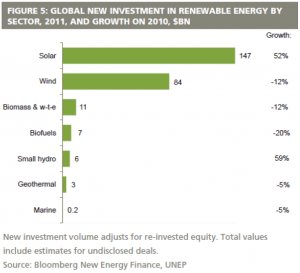
A salient aspect of renewables investment in 2011 was that solar out-paced wind as the biggest recipient sector, jumping 52% to US$147 billion. Photovoltaic (PV) module prices fell almost 50% because of manufacturing economies of scale, the rise of low-cost production in China, and over-capacity around the world. Prices plummeted to US$1-$1.20 per watt, some 76% below 2008, spurred further by increased rooftop installations in Germany and Italy and the mushrooming of small-scale PV use in China, the UK, and several other countries.
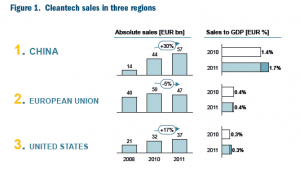
 The third edition of Clean Economy, Living Planet, commissioned by the World Wildlife Fund (WWF), named China the clear winner among the three pillar markets (EU, US, and China) for clean tech with sales growing EUR 13 billion (US$16.3 billion) to EUR 57 billion (US$71.4 billion) last year. The total value of world clean tech manufacturing reached EUR 198 billion (US$248 billion), doubling since 2008. Sales in the US also grew, but, as a share of its economy, they were significantly lower than in China and the EU.
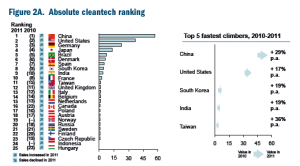
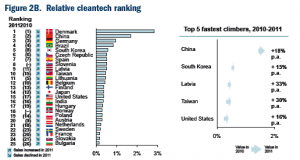
 In absolute terms, China remains the largest clean tech country as a result of consistent government policies, strong applied R & D, and a well-developed supply chain, concluded the report. Focused on biofuels and despite the spike in investment mentioned in the UNEP report, the US still lacks government incentives for other clean tech sectors compared to the EU and China. Meanwhile in Europe, with the exception of Denmark and Germany, clean tech sales declined in the Netherlands, France, and Spain, no doubt impacted by the financial crisis. In relative terms, Denmark holds the top spot with China closing in.
The report notes the race in clean tech manufacturing is just beginning and summarized the best practices and conditions in Denmark, China, Germany, the US, and South Korea for long-term growth: 1) government, research, and financial institutions the lay the foundations for solid industry growth; 2) markedly increasing market demand; and 3) the industry must improve efficiency and innovation and augment supply chains to optimize gains. Chinese companies enjoy good access to capital, economies of scale, and the benefits of vertical integration.
Based on company responses and analysis of regional developments, the report makes a number of recommendations for each pillar market. For China, it suggested the Chinese government allocate even more resources to basic research and to attract the best and brightest into the sector. The government should build more awareness that would help grow the sector and Chinese companies should adjust their practices to incorporate more clean tech technologies and products.
The report estimates the clean tech market will grow between EUR 40 and 90 billion (US$50.1 to $112.74 billion) by 2015 and drew base case and best case scenarios (if certain recommendations and measures are adopted) for each region. The EU could grow by EUR 19 to 31 billion (US$23.8 to $38.8 billion), the US by EUR 23 to 28 billion (US$28.8 to $35.1 billion), but China would stand to gain the most from EUR 30 to 80 billion (US$37.6 to 100.2 billion).
New Terracotta Warriors
See BBC’s picture gallery: http://www.bbc.co.uk/news/world-asia-china-18391197
China to Build Nearly 6 Dozen New Airports by 2015
From Dow Jones Newswires: http://www.nasdaq.com/article/china-sets-plans-to-buy-aircraft-build-airports-20120611-00006
Dambisa Moyo Interview on China
MacLean’s interview of Ms Moyo is quite interesting for its counterpoint to mainstream Western (mainly negative) portrayals of China’s resource deals in Africa. She also offers some sound advice for Canada’s relationship with China.
MacLean’s intro: Zambian-born, Oxford- and Harvard-trained economist Dambisa Moyo, 43, first rose to prominence with her bestselling 2009 polemic Dead Aid. In it she argued that development aid from rich countries to poor African nations has left the continent mired in dependency, corruption, market distortion and deeper poverty. In her new book, Winner Take All: China’s Race for Resources and What It Means for the World, Moyo rings a new alarm. Only China, she believes, has realized the pressure that rising world prosperity is placing on increasingly scarce commodities, and has begun to act accordingly.
Concordia Fund in Honour of Lin Jun
This is a good gesture that should help mollify Chinese netizen rage.
‘Gaokao’ University Entrance Exams Are On!
The world’s biggest and toughest national college entrance exams are afoot in China. More than than 9 million aspirants will vie for some 6.85 million university spots. Those who fail can take it again, opt for vocational training, go abroad for college, toil in factories or on the farms, or try their hand at small business. While meritocratic, critics say the exams limit the channels through which students can further their studies. Universities are experimenting with their own (non-national) exams combined with alternative recruitment criteria.
Here is a photo essay: http://www.chinadaily.com.cn/photo/2012-06/07/content_15482668.htm
Great Wall Twice as Long
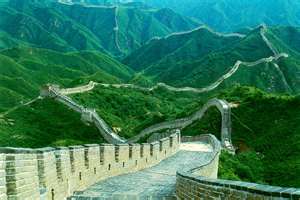
Experts have made estimates before taking into consideration the numerous overlapping and duplicate walls built throughout China’s dynastic history but this is the first formal remeasurement.
See a CBC report: http://www.cbc.ca/news/world/story/2012/06/06/china-great-wall-longer.html
The Spat Over PM2.5 Monitoring
The war of words between the Chinese Foreign Ministry and the US Embassy is heating up over the latter’s monitoring of pollution levels in the Chinese capital and Shanghai. The US Embassy has set up Twitter feeds (@BeijingAir and twitter.com/cgshanghaiair) for hourly updates. The embassy and consulate use MetOne BAM 1020 and Echotech EC 9810 monitors on rooftops to check ozone and PM2.5 particulates. The Twitter feeds are followed by more than 20,000 people presumably mostly outside China since the service is not available in the country.
Foreign Ministry spokesman Liu Weimin claimed the monitoring contravened the Vienna Convention on Diplomatic relations and urged foreign legations (without mentioning the US Embassy by name) to respect China’s laws and regulations and desist from issuing readings “especially over the Internet”. “If foreign embassies want to collect this kind of information for their own staff and diplomats, I think it’s up to them (but) they can’t release this information to the outside world”, blasted Mr Liu earlier this week.
The US State Department responded that its monitoring violated neither Chinese laws nor the Vienna Convention and therefore would not cease. In fact, Spokesman Mark Toner considered it a model for other missions around the world to follow. “This is an initiative by the embassy in Beijing, by the mission in China, to convey what we believe is useful information to our citizens abroad. It’s primarily directed to American citizens, but in terms of Chinese accessing this information, we don’t have a problem with it”, Mr Toner told the press
The US Environmental Protection Agency (EPA) converts PM2.5 readings (particulates smaller than 2.5 micrometers) into an air quality index (AQI) ranging from 0 to 300+ to help determine the health effects of polluted air. A value of 50, for instance, represents good air quality but any value around 300 or over can be hazardous to your health.
Aside from the US Embassy’s Twitter feeds, this author found a hourly-updated bilingual AQI monitoring service for many major cities in China – www.aqicn.info. At the time of writing (latest reading was at 1900 hours, June 7, 2012), the readings for Beijing, Shanghai, and Tianjin were 170, 148 and 107 respectively, all considered unhealthy. Guangzhou scored 92, Dalian 71, and Chengdu 55, meaning moderate pollution. The sole surprising bright spot was Shenzhen which scored 43 for good air, considering that it is major hub for manufacturing in the Pearl River Delta.
Following precedents in Beijing and Shanghai, Chongqing, China’s biggest municipality, will set up 17 PM2.5 monitoring stations across its main urban districts in July. By the end of October, test runs of PM2.5 monitoring stations will be extended to another 74 cities throughout the Beijing-Tianjin-Hebei Area, the Pearl River Delta, and the Yangtze River Delta. Monitoring results will be released by the end of the year.
Air quality remains extremely bad in Chinese cities with Beijing fairing much worse than its southern counterparts, owing to the mixture of dust and sand from Inner Mongolia, aerosols, car exhaust, and smokestack fumes. In an unreleased report based on government data last December, the World Bank said average PM2.5 concentrations in northern Chinese cities exceeded US limits by 5 to 6 times and were 2 to 4 times worse than southern Chinese cities. 9 of 13 major cities failed more than half the time to meet even the initial annual mean target for developing countries set by the World Health Organization (WHO) which environmentalists and experts expect will be adopted by China as its PM2.5 standard.
Wang Yuesi, chief air-pollution scientist at China’s Institute of Atmospheric Physics, forecast that it will take China at least 20 years to reach that target, if stronger measures are not adopted to rein in emissions. Since 1998, Mr Wang told Outlook Weekly, an influential Chinese periodical owned by the Xinhua News Agency, Beijing’s PM2.5 concentrations have been rising by 3-4% annually. He explained the thick haze that frequently envelops the capital is caused by finer MP2.5 particulates that absorb more sunlight.
The following is a ranking for the air quality of Chinese municipalities and provincial capitals for 2011 (based on particulates greater than PM2.5 (?)):
(notice that Beijing is near rock bottom, just a couple notches above Lanzhou)
1 Haikou
2 Kunming
3 Lhasa
4 Guangzhou
5 Fuzhou
6 Nanning
7 Guiyang
8 Hohhot
9 Nanchang
10 Changchun
11 Changsha
12 Shanghai
13 Yinchuan
14 Hangzhou
15 Shenyang
16 Chongqing
17 Tianjin
18 Shijiazhuang
19 Chengdu
20 Nanjing
21 Jinan
22 Xining
23 Harbin
24 Zhengzhou
25 Taiyuan
26 Wuhan
27 Xi’an
28 Hefei
29 Beijing
30 Urumqi
31 Lanzhou
(Rankings measured the days with first-grade and second-grade air quality in a year. Data are from air quality daily reports issued by the Ministry of Environmental Protection.)
(source: China Daily)