American Expert on China’s Corruption
Over the weekend, Jonathan Manthorpe of the Vancouver Sun launched a familiar tirade against China, this time on corruption. At the beginning of the article, he mentions a new book, Double Paradox: Rapid Growth and Rising Corruption in China, by Andrew Wedeman, Chair of Asian Studies at the University of Nebraska and a foremost expert on corruption in China but then immediately dismisses the author’s conclusions.
Instead, he focuses on a recent interview with Bao Tong, policy secretary of former disgraced CPC General Secretary Zhao Ziyang who died in 2005. Of course Mr Bao is going to denigrate the entire Chinese leadership since he was incarcerated for a number of years after the tragedy in Tiananmen.
Instead of sensationalizing the issue, it’s worthwhile to take a look at what Mr Wedeman specifically had to say. Following the publication of his book, he was interviewed by Tom Orlik, the Wall Street Journal’s finance and economic reporter, on its online China Real Time segment. In the interview, while declaring that corruption remains extensive in China, Mr Wedeman is nonetheless confident that the authorities can keep it in check, albeit unable to make significant inroads in mitigating it.
Here are some excerpts edited by the WSJ (I’ve done further editing due to the lack of space):
You talk about the difference between ‘developmental’ corruption’ in South Korea, Taiwan and Japan, and ‘predatory’ corruption in China?
One of the dirty secrets of high speed growth in the East Asian Tigers is that the developmental states rested on a foundation of corruption. Money flowed from business to the ruling party, which redistributed it to political stalwarts and voters to forge stable ruling coalitions.
China is different because the Communist Party does not depend on injections of cash from the private sector. As a result, whereas dirty money was an integral part of the developmental success in South Korea, Taiwan, and Japan, in China corruption fits the classic definition ─ the misuse of public authority for private gain.
Economic reform in China has created new opportunities for corruption on a grander scale?
Stripped to its barest essentials, economic reform in China involves the transfer of property rights from the state to the market. The nominal value of these assets is often well below their market value. The existence of large windfall profits creates strong incentives for officials to demand bribes from recipients and for buyers to kickback a share of the expected windfall profit.
Has corruption stimulated China’s growth?
Far from stimulating rapid growth, corruption in China feeds off rapid growth. In essence, corrupt officials are stripping off a share of the profits created by reform.
But in the long term, most experts think graft will weaken China’s economy what’s the doomsday scenario?
In the long term, graft will harm the Chinese economy. But I am not sure there is a “doomsday scenario.” Amidst all the hype about corruption gone wild in China, it is often forgotten that even though it is worse than the global average, it is not a level on par with what we might call crisis corruption.
(See Transparency International’s Corruption Perceptions Index for 2011, a world ranking of 183 countries that can be found in my post of May 1, 2012. In the ranking, China places 75th, closely behind Brazil (73), not far behind Italy (69), and 20 spots above India (95).)
My sense is that if corruption were not controlled then it would begin to become more of a drag on growth rates, particularly as the extent of asset transfers decrease and overall growth rates slow. But corruption alone would not push the economy into collapse.
You are more optimistic what’s your theory?
I have more confidence in China’s war on corruption than others, not because it will significantly reduce corruption, but in the much more modest sense that they have managed to prevent the problem getting significantly worse.
If you look at either the number of individuals charged with corruption or the estimates of the severity of corruption in China by outside experts, corruption has been at about the same level for nearly a decade.
Mainland Credit for Taiwanese Companies
This is a very significant move for cross-strait business ties.
Excerpted from AFP:
China pledged Sunday to offer up to 600 billion yuan ($95 billion) in credit to Taiwanese companies on the mainland as it furthered its campaign for reunification. The Industrial and Commercial Bank of China, Bank of China, China Construction Bank and China Development Bank will be authorised to make the loans.
“In order to help Taiwanese enterprises develop, mainland banks… will offer a 600 billion yuan credit ceiling over the next three to four years,” Wang Yi, head of the cabinet-level Taiwan Affairs Office, said in a speech at the Straits Forum annual meeting in Xiamen aimed at bolstering ties between China and Taiwan.
Trade between China and Taiwan has boomed over the past two decades, increasing by 10 percent last year to $160 billion, according to China’s trade ministry. Taiwan has been a major investor in China in recent years, providing more than $100 billion in finance, according to some estimates, as well as offering crucial technological know-how.
Datamonitor: Wealth Shifting to China and Other Emerging Economies
UK’s Datamonitor draws similar conclusions to an earlier report by the Boston Consulting Group.
Excerpted from IBNlive.com:
Datamonitor’s 2012 global wealth market report said the world order of wealth markets is witnessing a tilt towards emerging economies which are expected to overtake their Western European counterparts going forward. The top 10 wealth markets, in terms of dollar millionaire holdings at the end of 2011, in descending order, were the US, Japan, China, the UK, Germany, Italy, Canada, France, Brazil, and India. Moreover, the cumulative value of the liquid assets held by millionaires in the emerging economies of Brazil, China, and India are likely to triple to USD 4.6 trillion from USD 1.5 trillion between 2006 and 2015.
Top 10 wealth markets in 2015 will be the US at number one, with China in second place, followed by Japan, the UK, Germany, India, Brazil, Italy, Canada, and France, it added. Some of the mature markets have, however, proven more resilient, with the UK and the US, in particular, expected to perform strongly. The US will remain the largest high net worth market in the world till 2015, the report said. Spain’s fall from the top 10 wealth market in 2011 was largely due to the combination of its poor performance and the explosive growth seen in India and Brazil.
UK’s Datamonitor draws similar conclusions to an earlier report by the Boston Consulting Group.
Excerpted from IBNlive.com:
Datamonitor’s 2012 global wealth market report said the world order of wealth markets is witnessing a tilt towards emerging economies which are expected to overtake their Western European counterparts going forward. The top 10 wealth markets, in terms of dollar millionaire holdings at the end of 2011, in descending order, were the US, Japan, China, the UK, Germany, Italy, Canada, France, Brazil, and India. Moreover, the cumulative value of the liquid assets held by millionaires in the emerging economies of Brazil, China, and India are likely to triple to USD 4.6 trillion from USD 1.5 trillion between 2006 and 2015.
Top 10 wealth markets in 2015 will be the US at number one, with China in second place, followed by Japan, the UK, Germany, India, Brazil, Italy, Canada, and France, it added. Some of the mature markets have, however, proven more resilient, with the UK and the US, in particular, expected to perform strongly. The US will remain the largest high net worth market in the world till 2015, the report said. Spain’s fall from the top 10 wealth market in 2011 was largely due to the combination of its poor performance and the explosive growth seen in India and Brazil.
Tianjin Eco-City
Tianjin becoming an eco role model in China was mentioned at the end of my last post; here is a AFP video report: http://news.yahoo.com/video/world-15749633/giant-chinese-eco-city-rises-from-marshes-29691924.html
Are China’s Emissions Figures Skewed?
A study published this week in the journal Nature Climate Change may stir up further debate about China’s CO2 emissions, especially since she is already the world’s top greenhouse gas polluter, surpassing the US. Analyzing Chinese government statistics, Guan Dabo of Leeds University, who headed the study involving a team of scientists from China, Britain, and the US, suggested China’s 2010 emissions could be significantly higher than previously estimated.
Comparing national data to aggregates of provincial data, the team found a discrepancy equivalent to about 5% of the global total (in 2008), more than the emissions of Japan, the world’s fourth largest polluter. According to the National Bureau of Statistics (NBS), China’s CO2 emissions had grown at 7.5% annually from 3.1 billion tonnes in 1997 to 7.693 billion tonnes in 2010. However, aggregates of provincial statistics pointed to a growth rate that may be closer to 8.5%, rising from 3.131 billion tonnes to 9.084 billion tonnes.
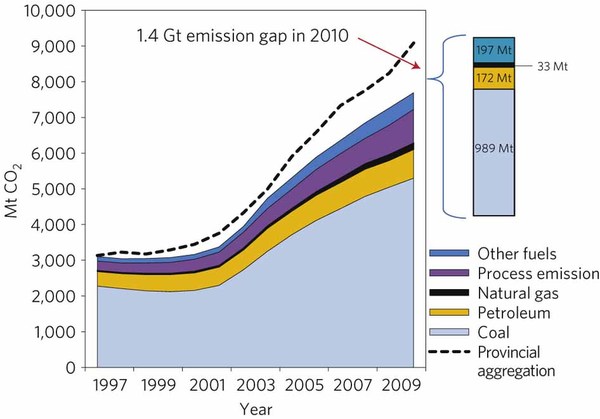
The study points out that the gap is mainly due to inconsistencies in national versus provincial statistics on coal consumption. The NBS blames different conversion factors for standard units of energy consumption but Guan and his team see the problem lying with small enterprises, most of who fail to keep accurate records of energy production and consumption. This problem is exacerbated by the many small mining and washing companies in poor areas, some operating illegally, that feed regional power companies due to the surging demand for electricity.
Another problem contributing to the inflation of provincial data is that local governments frequently report higher energy consumption to match their GDP figures, a key indicator of administrative performance. Data for natural gas, crude oil and coal consumption is often much higher than national figures whereas statistical differences for other energy-intensive products such as cement, pig iron and steel fall within a narrow error range.
The discrepancies can significantly skew global totals, “resulting in an incorrect understanding and modeling of the global carbon cycle…(adding) extra uncertainty in modeling simulations of predicting future climactic changes”, Guan et al. concluded.
The uncertainty complicates the assignment of responsibilities and setting of emission targets for post-Kyoto negotiations to reduce global emissions. The study urges reform of data collection systems for small coal mining and washing and manufacturing enterprises and the use of remote-sensing data to better monitor and verify emissions.
Just as the report came out, a leading Chinese climate change scientist argued China’s emissions could be much lower than that estimated by the UN’s Intergovernmental Panel on Climate Change (IPCC). Mr Wang Yi, director of the Climate Change Research Center at the Chinese Academy of Sciences in Beijing disputed the methodology used by IPCC that does not take sufficient account of the differences in calorific content of China’s many grades of coal.
Interviewed by Reuters, Mr Wang said, “we have some preliminary calculations and current emissions may be 10-20% less than the result based on IPCC methodology”. At the same time, Mr Wang admitted that even if the findings are confirmed, it would not make much dent on the debate.
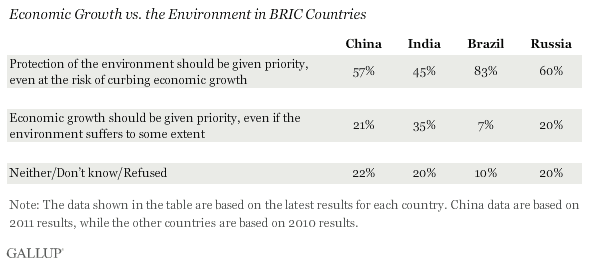
Meanwhile, a recent Gallop poll found that 57% of Chinese adults surveyed in 2011 wanted more government action to protect the environment, even at the risk of slowing economic growth. The World Health Organization (WHO) declared air quality in Beijing and Shanghai to be 2-3 times worse than in London or Los Angeles. While air pollution remains severe in the largest cities, Gallop cites regional cities like Qingdao, Tianjin, and Shenyang as emerging role models for urban environmental and economic development.
Tianjin Mall Looks Like a Italian Village
Florentia Village is new shopping mall on the outskirts of Tianjin. It cost an estimated US$220 million and copies old Italian-style architecture with Florentine arcades, a grand canal, bridges, and a building that resembles a Roman Coliseum.
This penchant for copying foreign (especially Western traditional) architecture and scenic villages (see an earlier post on the replica of an Austrian village) is getting to be a little too much.
From India’s Rediff: http://www.rediff.com/business/slide-show/slide-show-1-italian-village-meets-china/20120615.htm
Chinese Women Rising
Here’s a piece by CNN Bureau Chief Jaime FlorCruz, on the rising status of Chinese women, pegged on China’s first woman taikonaut, Liu Yang’s, participation in the historic docking of the Shenzhou 9 spacecraft with China’s space module.
http://edition.cnn.com/2012/06/15/world/asia/china-women-space/index.html
China’s Green Road Forward
The United Nations Conference on Sustainable Development (Rio+20) will convene next week in Rio de Janeiro. New Scientist magazine has an opinion piece and a report on China’s efforts in promoting a ‘green economy’. China is very polluted but it is surprising what she has accomplished over the past few years in terms of reducing carbon intensity, reforestation, and water resource management. New Scientist thinks in these areas and others, other countries could learn a thing or two from China.
Here is the link: http://www.newscientist.com/article/mg21428693.700-all-eyes-on-chinas-green-leap-forward.html?full=true&print=true The editorial provides a link to the article “China Leads the March for the Green Economy”.
Latest PEW Poll: China is No.1 Economic Power
The Pew Research Center, a Washington-based international polling oganization, released its latest poll on Obama’s international approval rating today. A section dealt with perceptions of US economic power versus the PRC. For the first time, perceptions are now in favour of China. At the same time, China’s overall image slipped in key Western countries and Japan.
It must said, however, that there is a big gulf between perception and reality. China remains a poor developing country compared to developed Western countries. China’s economic prowess aside, per capita GDP puts her in the middle rung of developing countries, even when measured on a purchasing power parity (PPP) basis.
Here are the excerpts:
China’s Growing Economic Might

The Obama era has coincided with major changes in international perceptions of American power – especially U.S. economic power. The global financial crisis and the steady rise of China have led many to declare China the world’s economic leader, and this trend is especially strong among some of America’s major European allies. Today, solid majorities in Germany (62%), Britain (58%), France (57%) and Spain (57%) name China as the world’s top economic power.
The belief that China is the world’s top economy has become more common in the last year in other parts of the world as well, including Brazil, Japan, Turkey and Lebanon…Views about the economic balance of power have shifted dramatically over time among the 14 countries surveyed each year from 2008 to 2012. In 2008, before the onset of the global financial crisis, a median of 45% named the U.S. as the world’s leading economic power, while just 22% said China. Today, only 36% say the U.S., while 42% believe China is in the top position.
(However), China’s image has slipped in several countries over the last year. The percentage of Japanese with a favorable opinion of China plummeted from 34% to 15%. In France, China’s favorability ratings dropped from 51% to 40%, and in Britain from 59% to 49%. And since last year, Americans have become less disposed to rate China positively (51% in 2011, 40% now).
Canada Best for Women, China Not so Good
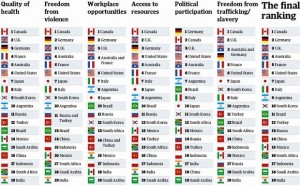
The Globe and Mail featured a chart on women’s status and rights in G20 countries based on a worldwide poll of gender experts for the 3rd Canadian-inspired G(irls)20 shadow summit leading up to next week’s formal G20 summit in Mexico. Canada comes out on top for all but one category and that was only bested by Germany. China’s rankings are far lower coming in 14th overall but befitting of its developing country status. India’s was worst or second/third worst in all categories.