
Are China’s Emissions Figures Skewed?
A study published this week in the journal Nature Climate Change may stir up further debate about China’s CO2 emissions, especially since she is already the world’s top greenhouse gas polluter, surpassing the US. Analyzing Chinese government statistics, Guan Dabo of Leeds University, who headed the study involving a team of scientists from China, Britain, and the US, suggested China’s 2010 emissions could be significantly higher than previously estimated.
Comparing national data to aggregates of provincial data, the team found a discrepancy equivalent to about 5% of the global total (in 2008), more than the emissions of Japan, the world’s fourth largest polluter. According to the National Bureau of Statistics (NBS), China’s CO2 emissions had grown at 7.5% annually from 3.1 billion tonnes in 1997 to 7.693 billion tonnes in 2010. However, aggregates of provincial statistics pointed to a growth rate that may be closer to 8.5%, rising from 3.131 billion tonnes to 9.084 billion tonnes.
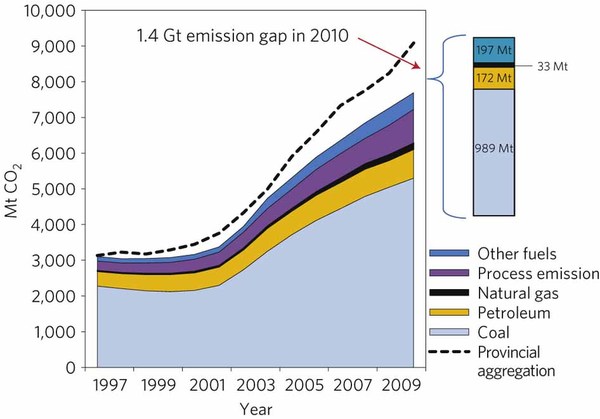
The study points out that the gap is mainly due to inconsistencies in national versus provincial statistics on coal consumption. The NBS blames different conversion factors for standard units of energy consumption but Guan and his team see the problem lying with small enterprises, most of who fail to keep accurate records of energy production and consumption. This problem is exacerbated by the many small mining and washing companies in poor areas, some operating illegally, that feed regional power companies due to the surging demand for electricity.
Another problem contributing to the inflation of provincial data is that local governments frequently report higher energy consumption to match their GDP figures, a key indicator of administrative performance. Data for natural gas, crude oil and coal consumption is often much higher than national figures whereas statistical differences for other energy-intensive products such as cement, pig iron and steel fall within a narrow error range.
The discrepancies can significantly skew global totals, “resulting in an incorrect understanding and modeling of the global carbon cycle…(adding) extra uncertainty in modeling simulations of predicting future climactic changes”, Guan et al. concluded.
The uncertainty complicates the assignment of responsibilities and setting of emission targets for post-Kyoto negotiations to reduce global emissions. The study urges reform of data collection systems for small coal mining and washing and manufacturing enterprises and the use of remote-sensing data to better monitor and verify emissions.
Just as the report came out, a leading Chinese climate change scientist argued China’s emissions could be much lower than that estimated by the UN’s Intergovernmental Panel on Climate Change (IPCC). Mr Wang Yi, director of the Climate Change Research Center at the Chinese Academy of Sciences in Beijing disputed the methodology used by IPCC that does not take sufficient account of the differences in calorific content of China’s many grades of coal.
Interviewed by Reuters, Mr Wang said, “we have some preliminary calculations and current emissions may be 10-20% less than the result based on IPCC methodology”. At the same time, Mr Wang admitted that even if the findings are confirmed, it would not make much dent on the debate.
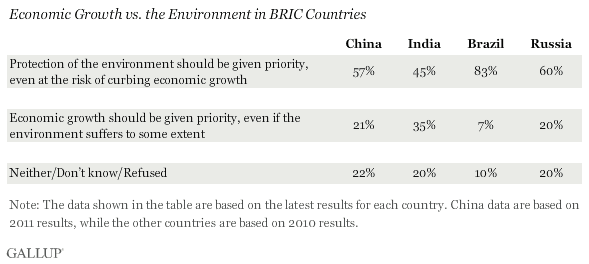
Meanwhile, a recent Gallop poll found that 57% of Chinese adults surveyed in 2011 wanted more government action to protect the environment, even at the risk of slowing economic growth. The World Health Organization (WHO) declared air quality in Beijing and Shanghai to be 2-3 times worse than in London or Los Angeles. While air pollution remains severe in the largest cities, Gallop cites regional cities like Qingdao, Tianjin, and Shenyang as emerging role models for urban environmental and economic development.