
The Rise of China Daily
This Globe and Mail reporter is simply loathe to admit the growing influence of Chinese media, including the China Daily, on the world stage. But, the trend is certain and will keep on growing.
Nuances of Chinese Censorship
Official censorship is certainly a controversial issue in China but how extensive is it, what sort of issues are monitored, and what actions taken have rarely been discussed in the foreign press. But the title of a recent report from researchers at Harvard’s Institute for Quantitative Social Science – How Censorship in China Allows Government Criticism but Silences Collection Action – speaks much about the Chinese authorities’ approach to Internet censorship.
Although Chinese censors are able to delete content with ‘military precision’, they do so in nuanced ways that often run counter to blanket condemnations. The authors argue that contrary to conventional research and analysis, “the purpose of (China’s) censorship is not to suppress criticism of the state or the Party…we find that when the Chinese people write scathing criticism of their government and its leaders, the probability that their post will be censored does not increase. Instead, we find that the purpose of the censorship program is to reduce the probability of collective action by clipping social ties…”
In contrast to common perceptions in the West, the authorities have allowed (and even encouraged) the expansion of social media, permitting sufficient room for negative commentary about the government, its policies, and its leaders. Negative criticism may make Chinese politicians look bad but that in itself doesn’t alarm them. Chinese individuals are essentially free to express their grievances so long as their potential capacity for collective action is eliminated.
In fact, rather than stifling comment on China’s many social media, officials saw them as excellent avenues to gauge citizen sentiment on any number of public issues, their interaction with government departments, and their perceptions of public officials’ performance. Social media can be turned around and used by the government to find ways to “satisfy and ultimately mollify” citizens. The ‘surprising’ patterns the authors discovered points to a “theoretically optimal strategy” adopted by the government.
The study also sheds light on relations between the central, provincial, and local governments, and on China’s relations with the outside world. Often times, local governments can act autonomously of the national government on specific issues that reveal the priorities of the localities as opposed to the center. Here the oft-quoted Chinese adage is apt: “the mountains are high and the emperor is far away”.
During the first half of 2011, 85 topic areas were sampled fitting into three levels of hypothesized political sensitivity. Posts were monitored from 1,382 Chinese websites, with the biggest being Sina Weibo, (59% of all samples), hi-baidu, voc, bbs.m4, and Tianya.
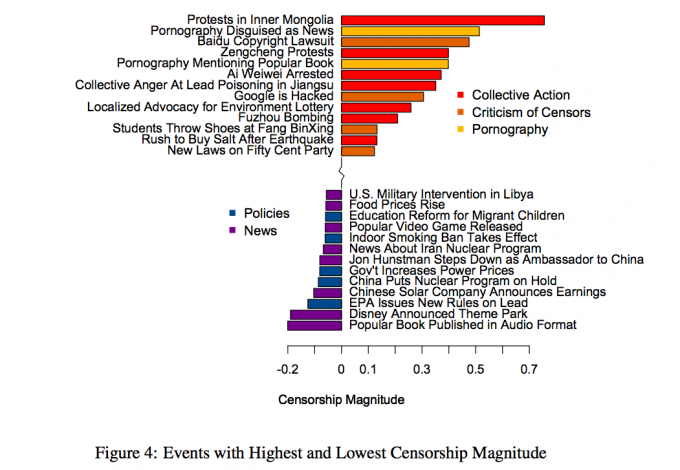
In the HIGH level category were issues and personalities such as embattled artist-critic Ai Weiwei, the blind activist who recently took refuge in the US Chen Guangcheng, dissident Liu Xiaobo, pornographic websites, the ‘princelings’ (children of former and present high officials and leaders), militant Uighur protests, protests over a herder’s death in Inner Mongolia, Taiwan weapons, and others.
In the MEDIUM category, there were some surprises: AIDS, angry youths, food prices (along with food safety and inflation in general), environment and pollution, official corruption, one-child policy, Vietnam and South China Sea, and significantly, Tibet. In the LOW category were issues such as Chinese investment in Africa, health care reform, Chinese tennis star Li Na, traffic in Beijing, and the World Cup.
Chinese Immigration and Community in Greater Vancouver
Here are some numbers on Chinese immigration and the rapidly expanding Chinese community in Greater Vancouver, especially from mainland over recent years (most figures for Richmond are only available to 2006):
In 1991, Metro Vancouver already had a substantial Chinese community. But immigration from Hong Kong in advance of the colony’s 1997 return to Chinese control was picking up, peaking in 1994 when 15,384 immigrants arrived. In the decade leading up to the handover, more than 96,000 people left Hong Kong and came to Vancouver.
While immigration from Hong Kong has slowed, immigration from Mainland China and Taiwan remains strong. Since 1997, more than 121,300 Mainland Chinese have arrived and nearly 35,700 people have come from Taiwan. They mainly speak Mandarin, which is why Fairchild TV also has news and current affairs programs in that language. They compete for viewers with eight Chinese-government television stations broadcast on cable, three Taiwanese cable stations as well as Global TV’s national news in Mandarin, available on Shaw cable.
. In 2006, 65.1 per cent of Richmond residents identified themselves as members of an ethnic minority – the highest percentage in Canada after Markham, Ont.
. Nearly four of every 10 Richmond residents speaks a Chinese language as their mother tongue, the highest percentage in Metro Vancouver.
. In Metro Vancouver, Richmond also has the lowest percentage (38.6 per cent) of residents who speak English as a first language.
. Ten per cent of Richmond’s workforce spoke a Chinese language most often at work, according to the 2006 census.
. In 2006, 28,545 Richmond residents identified Cantonese as their mother tongue and 26,235 said it was the language spoken most often at home.
. Richmond residents who spoke Mandarin as a first language rose by 41.6 per cent between 2001 and 2006 to 13,400.
. In 1971, Richmond’s workforce was comprised of slightly more than 24,188 people. By 2006, it reached 108,095, a jump of more than 400 per cent.
. Richmond’s population is 190,473, according to the 2011 census.
Sources: Fairchild TV; Metro Vancouver; Statistics Canada
For the entire article see: http://www.vancouversun.com/entertainment/face+community/6830424/story.html#ixzz1yh9noF25
Shenzhou 9, Tiangong 1, and Jiaolong
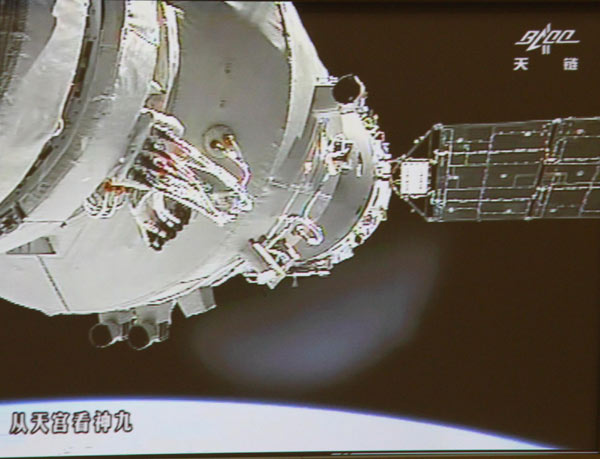
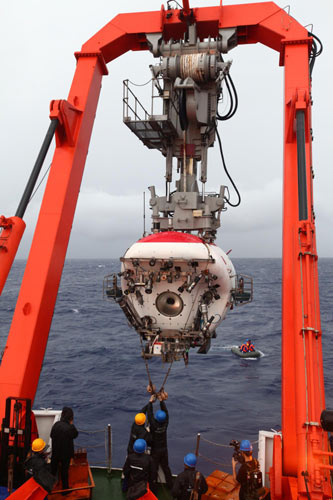
On the same day, China’s Shenzhou 9 spacecraft manually docks with the Tiangong 1 orbiting module as the Jiaolong submersible dives to 7015 M, setting a national record.
http://www.chinadaily.com.cn/china/2012-06/24/content_15519481.htm
Premier Wen on Poverty in China
Wen: 100m Chinese live in poverty
Premier Wen Jiabao on Wednesday reiterated that China, though boasting a fairly large economy, is still a developing nation and has more than 100 million people living below the poverty line.
Wen made the remarks while addressing the High-level Roundtable of the UN Conference on Sustainable Development (Rio+20 summit), which opened Wednesday in Brazil’s coastal city of Rio de Janeiro.
He said as a developing country, China may boast a fairly large economy, but its per capita income ranks around 90th in the world. Calculated according to a new standard, China still has more than 100 million people living below the poverty line.
He said China faces an uphill journey in promoting sustainable development. “Moreover, pressure from resources and the environment continues to mount, and problems of unbalanced, uncoordinated and unsustainable development remain challenging.”
China Daily
Wen: 100m Chinese live in poverty
Updated: 2012-06-21 09:23 By Qin Jize ( chinadaily.com.cn)
Premier Wen Jiabao on Wednesday reiterated that China, though boasting a fairly large economy, is still a developing nation and has more than 100 million people living below the poverty line.
Wen made the remarks while addressing the High-level Roundtable of the UN Conference on Sustainable Development (Rio+20 summit), which opened Wednesday in Brazil’s coastal city of Rio de Janeiro.
He said as a developing country, China may boast a fairly large economy, but its per capita income ranks around 90th in the world. Calculated according to a new standard, China still has more than 100 million people living below the poverty line.
He said China faces an uphill journey in promoting sustainable development. “Moreover, pressure from resources and the environment continues to mount, and problems of unbalanced, uncoordinated and unsustainable development remain challenging.”
China to Provide Largest Pool of Educated Workers
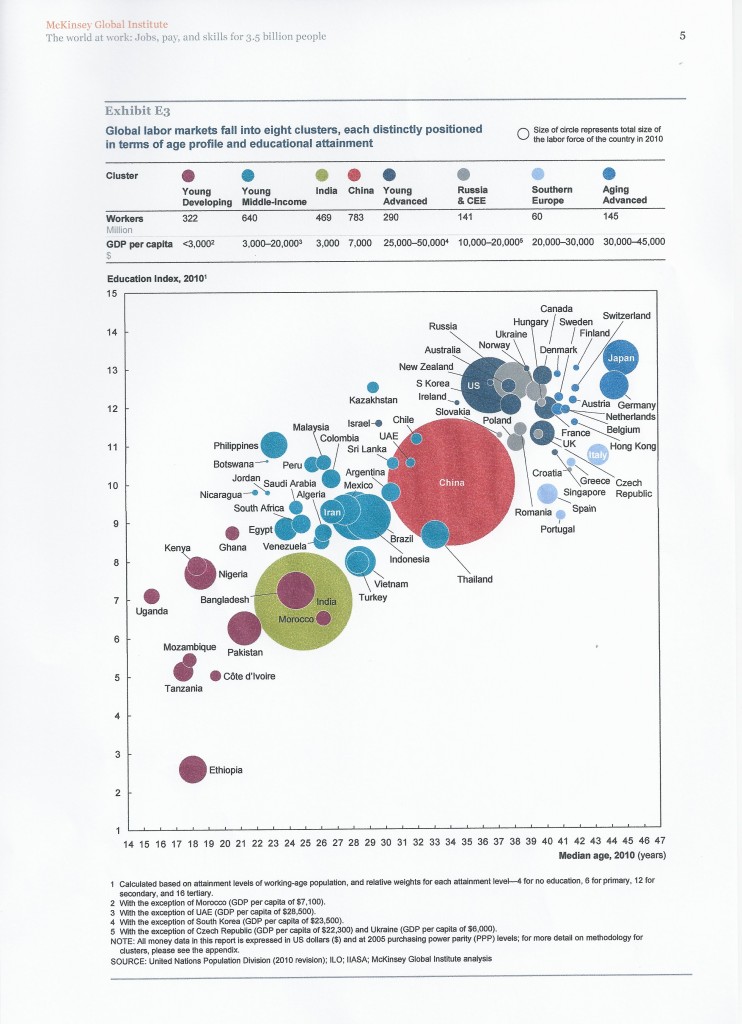
Figuring out trends over a five year span is hard enough but the McKinsey Global Institute’s (MGI) report on global demand for educated and skilled workers delves far into the future as it expects the global labour force to approach 3.5 billion by 2030.
By that time, employers could need 40 million workers with college education more than in supply to fill technical and managerial positions, amounting to 13% of overall demand. In the developing world, 45 million more high school graduates will be needed than available while a glut of up to 95 million low skilled workers could appear worldwide.
China plays a major role under such a scenario. Within two decades, China’s labour force growth will likely drop by almost half from 2010 levels to just 0.5% annually, placing greater burdens on the young in the face of a rapidly aging society. China will no longer be the main supplier of young low-wage workers, to be displaced by India and the so-called ‘young developing’ economies of South Asia and Africa.
At the same time, China is expected to become the largest supplier of college-educated workers to the global labour force, accounting for about 30% of the total (China and India combined will contribute 57%). Last year, China ramped up college enrollment to 6.85 million and far more Chinese students major in the sciences, technology, engineering and mathematics (STEM) than in the US and Europe. This gives China a big leg up in filling vacancies in some of the world’s fastest growing and technology-intensive sectors.
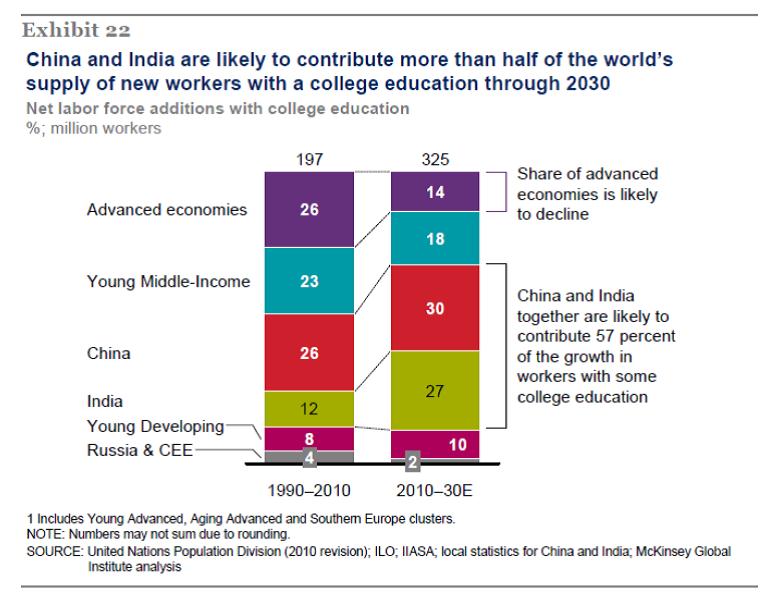
Despite its ‘skill-dividend’, however, by the end of this decade, China itself could face skilled labour shortages due to rapidly growing service industries and knowledge-intensive manufacturing as China slowly morphs from a low-tech export platform to a maturing economy driven mainly by domestic consumption. Mr Anu Madgavkar, who headed the MGI study, estimates that China could have a deficit of 23 million college graduate workers by 2020, or 16% of demand.
Developed economies, on the other hand, are facing the opposite problem – rising surpluses of less-educated workers with increasingly limited employment prospects. At current rates of educational attainment and labour force growth, projects MGI, there could be 32-35 million more high school graduates than needed by 2020. Developed countries will need to churn out 2.5 times more college majors in STEM fields and provide more and better job-relevant training to meet demand. In 2008, for example, only 14% of US graduates earned STEM degrees whereas 42% of Chinese graduates did.
But, in so far as population aging (which is more advanced in the US and Europe and worst in Japan) is concerned, China and developed countries are more or less in the same boat. By 2030, the total population of people over 55 who are not actively in the labour force could reach 360 million, with 40% of expected retirees living in China and the developed world. A little over 10% of them are college educated who will not be able to take advantage of their skills and experience. So raising the participation of older workers and finding ways to keep them fully employed should be a strategy for many countries to adopt.
 Sun Life Financial’s annual Unretirement Index poll, released last February, found only about 30% of Canadians surveyed planned full retirement by 66. About 48% of them said they plan to work part-time or freelance as they ease into retirement. Perhaps a sign of the times, 61% of Canadians who said they expect to work past retirement age said they had to do so out of necessity. ‘Freedom 55’ is thus a thing of the past.
World’s Tallest Skyscraper to go up in 3 Months!
Heard about this project in Changsha, Hunan Province, and the company Broad Sustainable Building (BSB) which has built tall buildings within a couple weeks. They claim it will be able to withstand a scale 9 earthquake. All the power to them if they do it but would you want to work in it?
Most of World’s Financing for SMEs Came from China
This is interesting:
A new Ernst & Young study produced for the G20 Young Entrepreneur Summit in Mexico City found that while small to medium-sized enterprises (SMEs) accounted for 50% of employment in most G20 countries, total investment in small businesses in 2010 came in at about US$714-billion, 6% of the US$11.5-trillion in total investments made in the G20.
Of that total, 56%, or US$400-billion, came from China, largely through bank lending. (Also the case in much of the rest of the G20).
Canada is near the bottom of the pile with about US$2.2-billion in total SMB investment, but more than 60% of that actually came from venture capital and IPOs.
The main reason financing has evaporated in Canada these past few years is a lack of an exit strategy for investors, “When funds invest, they want to eventually exit those investments and make a lot of money. There are really two vehicles for this: IPOs and M&A transactions,” said Mr. Richard Remillard, executive director with Canada’s Venture Capital and Private Equity Association.
The past four years have been largely devoid of IPO activity. And when it comes to M&A , many larger firms, particularly in the technology sector, have been sitting on their capital. “When the exit environment improves, investment volumes will pick up,” he said.
Colleen McMorrow, entrepreneurial services leader with Ernst & Young in Canada, said China has benefited from a booming venture capital and IPO industry that has helped spur entrepreneurial investment, but there are concerns a hard landing in China will affect inflation and interest rates and therefore bank lending.
“But the fundamentals of entrepreneurship are strong and that’s what we’re seeing reflected in the numbers from this report,” she said.
From the Financial Post
China to Give US$43 billion to IMF War Chest
China on Monday offered $43 billion to the IMF’s crisis-fighting reserves (1/10 of the pledged total) , joining other major emerging markets in pledging new funds to shore up the global financial system while demanding reforms to give the developing world more clout at the IMF. (Excerpted from Reuters)
Taiwan to Completely Clear Mines Near the Mainland
This is good news. Long overdue but a big step on the long road toward a formal peace pact.
Excerpted from AFP: In yet another sign of warming ties with former rival China, Taiwan said Monday that all landmines laid on the frontline islands off the mainland during the 1950s will be removed within six months.
The shores of Kinmen and Matsu, two Taiwan-controlled island groups sitting just a few kilometres away from the southeastern Chinese province of Xiamen, were carpeted with tens of thousands of mines after the two sides split in 1949, at the end of the Chinese Civil War.
The mines had been used as critical weapons by the the Kuomintang troops to fend off several major onslaughts launched by the Chinese communist forces during the 1950s, but have now emerged as a barrier against the ever closer ties between the former cross-strait foes.
“All the mines on Kinmen and Matsu are expected to be removed before the year’s end,” said President Ma Ying-jeou, the initiator of the ongoing detente with Beijing, according to a statement released by the presidential office.
Taiwan’s defence ministry spokesman David Lo told AFP that the de-mining project, launched six years ago, will be completed around six months ahead of the schedule.
This is good news. Long overdue but a big step in the long road toward a formal peace pact.
Excerpted from AFP: In yet another sign of warming ties with former rival China, Taiwan said Monday that all landmines laid on the frontline islands off the mainland during the 1950s will be removed within six months.
The shores of Kinmen and Matsu, two Taiwan-controlled island groups sitting just a few kilometres away from the southeastern Chinese province of Xiamen, were carpeted with tens of thousands of mines after the two sides split in 1949, at the end of the Chinese Civil War.
The mines had been used as critical weapons by the the Kuomintang troops to fend off several major onslaughts launched by the Chinese communist forces during the 1950s, but have now emerged as a barrier against the ever closer ties between the former cross-strait foes.
“All the mines on Kinmen and Matsu are expected to be removed before the year’s end,” said President Ma Ying-jeou, the initiator of the ongoing detente with Beijing, according to a statement released by the presidential office.
Taiwan’s defence ministry spokesman David Lo told AFP that the de-mining project, launched six years ago, will be completed around six months ahead of the schedule.