
China to Provide Largest Pool of Educated Workers
Figuring out trends over a five year span is hard enough but the McKinsey Global Institute’s (MGI) report on global demand for educated and skilled workers delves far into the future as it expects the global labour force to approach 3.5 billion by 2030.
By that time, employers could need 40 million workers with college education more than in supply to fill technical and managerial positions, amounting to 13% of overall demand. In the developing world, 45 million more high school graduates will be needed than available while a glut of up to 95 million low skilled workers could appear worldwide.
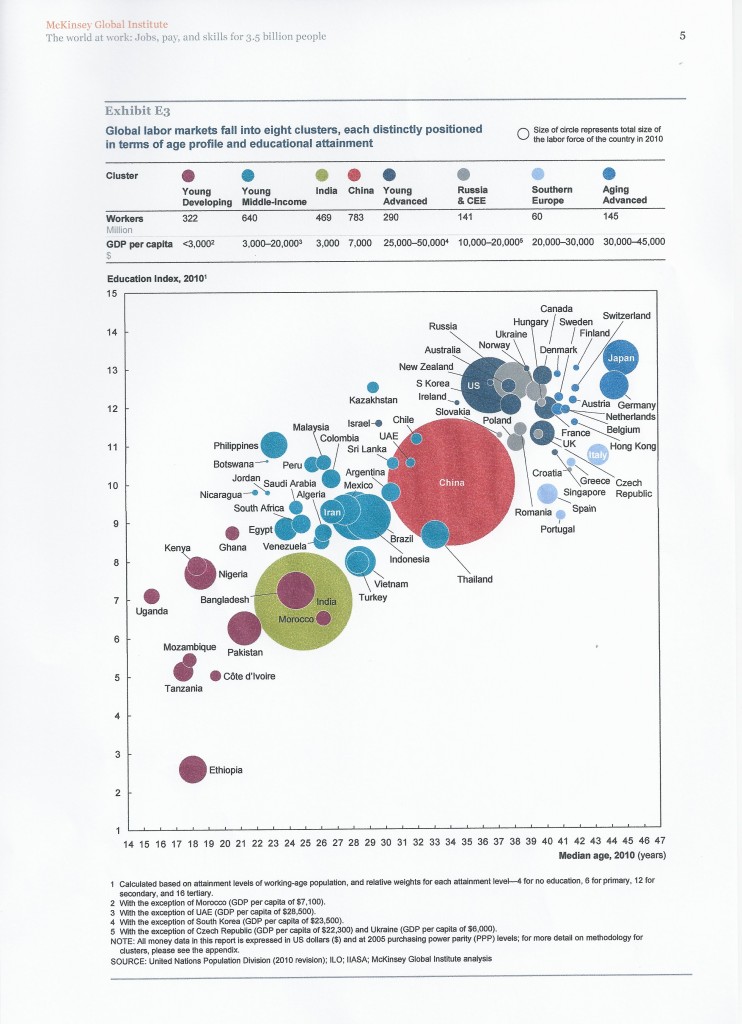
China plays a major role under such a scenario. Within two decades, China’s labour force growth will likely drop by almost half from 2010 levels to just 0.5% annually, placing greater burdens on the young in the face of a rapidly aging society. China will no longer be the main supplier of young low-wage workers, to be displaced by India and the so-called ‘young developing’ economies of South Asia and Africa.
At the same time, China is expected to become the largest supplier of college-educated workers to the global labour force, accounting for about 30% of the total (China and India combined will contribute 57%). Last year, China ramped up college enrollment to 6.85 million and far more Chinese students major in the sciences, technology, engineering and mathematics (STEM) than in the US and Europe. This gives China a big leg up in filling vacancies in some of the world’s fastest growing and technology-intensive sectors.
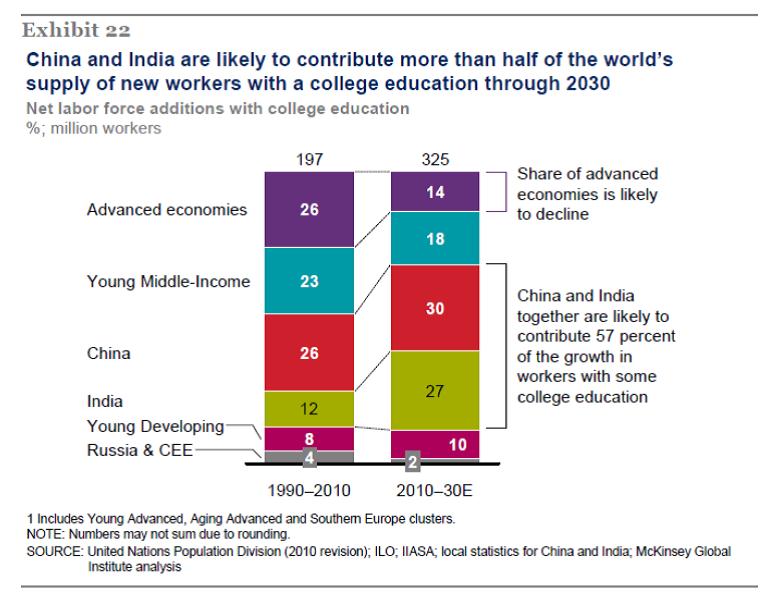
Despite its ‘skill-dividend’, however, by the end of this decade, China itself could face skilled labour shortages due to rapidly growing service industries and knowledge-intensive manufacturing as China slowly morphs from a low-tech export platform to a maturing economy driven mainly by domestic consumption. Mr Anu Madgavkar, who headed the MGI study, estimates that China could have a deficit of 23 million college graduate workers by 2020, or 16% of demand.
Developed economies, on the other hand, are facing the opposite problem – rising surpluses of less-educated workers with increasingly limited employment prospects. At current rates of educational attainment and labour force growth, projects MGI, there could be 32-35 million more high school graduates than needed by 2020. Developed countries will need to churn out 2.5 times more college majors in STEM fields and provide more and better job-relevant training to meet demand. In 2008, for example, only 14% of US graduates earned STEM degrees whereas 42% of Chinese graduates did.
But, in so far as population aging (which is more advanced in the US and Europe and worst in Japan) is concerned, China and developed countries are more or less in the same boat. By 2030, the total population of people over 55 who are not actively in the labour force could reach 360 million, with 40% of expected retirees living in China and the developed world. A little over 10% of them are college educated who will not be able to take advantage of their skills and experience. So raising the participation of older workers and finding ways to keep them fully employed should be a strategy for many countries to adopt.
 Sun Life Financial’s annual Unretirement Index poll, released last February, found only about 30% of Canadians surveyed planned full retirement by 66. About 48% of them said they plan to work part-time or freelance as they ease into retirement. Perhaps a sign of the times, 61% of Canadians who said they expect to work past retirement age said they had to do so out of necessity. ‘Freedom 55’ is thus a thing of the past.