
Chinalco Builds New Town in Peru
When the town of Nueva Morococha is completed by Chinese miner Chinalco and the residents move in next year, it could serve as a viable model for corporate responsibility of Chinese companies operating across the globe, including Canada. http://www.ottawacitizen.com/business/high+altitude+experiment+Peru/6879200/story.html
More Balance on China in US Presidential Race
See the video of this Canadian living in the States who urges less bashing and more balance in portrayals of China in the US Presidential campaign.
China to Ban Shark Fin From Official Banquets
This is a reflection of rising environmentalism in China and sends a strong message at home and abroad. However, it will take much more activism and consciousness raising before the general populace begins to shed its passion for cartilage that’s just a status symbol and not very nutritious in the first place.
Stiglitz’s Strong Endorsement of China’s Influence in the Global Economy
China has both the incentive and the resources to continue pushing growth [and its] economy’s share in global GDP and trade will increase in the coming years, said US economist Joseph Stiglitz. [He said] even though China’s economy may not grow at a high 9-10%, the fundamental change in the global economy will work to increase Chinese influence. He also feels the influence of the developed nations is decreasing. (From the Economic Times of India)
China and US Doing Their Bit on Emissions
Some fair words on China’s efforts at curbing emissions from an Australian expert.
Qianhai Bay and RMB Internationalization
Shenzhen is expected to experience another burst of hyper growth with the establishment of its Qianhai Bay economic zone, a ‘mini-Hong Kong’ hub for deepening financial reform. Starting next year and gradually over eight years, Qianhai’s barren reclaimed lands will be transformed at a cost of 285 billion RMB (US$44.8 billion) into an ultra-modern zone specializing in financial, logistics, and IT services.
Hong Kong based banks will be able to lend money to companies based there who enjoy low taxes, a more rigorous legal structure, and more stringent anti-corruption measures modeled after Hong Kong. Zhang Jianmin, vice-chairman of the National Development and Reform Commission (NDRC), China’s top economic planning agency, described the future zone as a pioneer for close collaboration between Hong Kong and the mainland for the gradual opening up of China’s capital account and full convertibility of the RMB.
Prior to the announcement, FinanceAsia magazine conducted a poll of 276 investment and commercial bankers, along with corporate executives and investors, mostly based in Hong Kong, on prospects for the internationalization of the RMB. About 30% of respondents believed the RMB will be freely convertible by 2020, coinciding with the completion of the Qianhai zone.
Speaking to the magazine, Yongmei Cai, a partner at Simmons & Simmons in Beijing, commented: “The acceleration of RMB liberalization in the past several years is remarkable…If this pace continues, and the erosion of obstacles to capital flows back to China…we may well see China’s economy fully integrated with the global and regional economy in a decade”.
Tim Cordon, chief Asia economist for ING bank added: “Were internationalization to lead to capital account convertibility, it would be the most significant pro-market economic reform since China acceded to the WTO in 2001. From what we have seen, I expect the RMB to become fully convertible in 5 to 10 years from 20 years as previously expected.”
While most (42%) said it could take at least until 2025 with 24% arguing it would take even longer, FinanceAsia wrote that the speed of RMB liberalization reform to date has been ‘lightening fast’. Below are the results of the survey on how much trade will be settled in RMB and when:
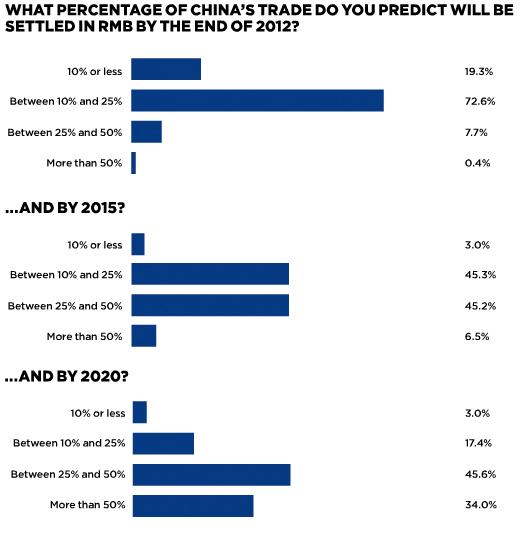
80% of those polled pointed to restrictions on the capital account as the single biggest obstacle against free convertibility. They urged the authorities to speed up capital account reforms and reforms to the country’s political system. For investors, full liberalization of the RMB means diversification of portfolios, more direct exposure to China, and closer integration of Chinese capital with global capital markets.
FinanceAsia notes that reforms have been gathering pace since the early 2000s, particularly over the past 4 years. In 2009, the authorities launched the RMB trade settlement scheme in Hong Kong which has been expanded. Bilateral RMB swap agreements have been signed with 14 trade partners and pilot schemes for inward and outward foreign direct investment (FDI) were introduced. In addition, the qualified foreign institutional investor program (QFII) has been expanded from US$30 billion to $80 billion.
In 2011, capital markets grew by “leaps and bounds” with dim sum (RMB denominated) bonds near tripling 2010 levels to $14 billion. 2/3 of the respondents expected to see steady increases this year to $15 to $20 billion with 18% even more bullish, predicting the bonds could expand two fold. Total issuance for the offshore RMB market (including certificates of deposit and dim sum bonds) was $26 billion last year. Most respondents expect amounts to remain in the $25 to $50 billion range over the next three years but may exceed $50 billion by 2020.
As for key international trading centers for offshore RMB outside of Hong Kong, a majority of respondents (52%) felt that less than 5% of global offshore RMB market will be handled in London, Singapore, and New York this year but 48% thought that by the end of the decade, 20% to 50% will be covered by these them. Meanwhile in Hong Kong, at the end of last year, RMB deposits reached 588 billion, 10% of all, displacing deposits in US dollars and euros.
NYT Partners with Sina Weibo for Chinese Edition
Expect more whining from the G & M

The New York Times, the august newspaper turned digital media company, is venturing onto thin ice brave new territory tomorrow with the launch of the Chinese version of its website. It’ll be online at cn.nytimes.com, which is currently blank and inaccessible behind a login. To mark the event, the New York Times has just joined Sina Weibo, China’s hottest Twitter-esque site, with the official account pictured above.
So far, the NYT’s Weibo – the page is here – has posted three things, all in Chinese, and one of which is the official announcement of what’s coming:
The New York Times Chinese Edition begins operation today, and tomorrow will begin releasing news. We welcome our new friends and followers and look forward to engaging with you.
So far it has just over 3,300 fans after only a few hours in action. It’s not clear what cn.nytimes.com will hold – translations of selected articles from the main edition, or original material written in Chinese? And what of its legal status as a media company in China?
Other major news portals have Chinese editions…both cn.WSJ.com and the Financial Times in Chinese are accessible – and it seems to be a digital market that the NYT wants a part of.
From Tech in Asia via Yahoo
Chinese Disposable Incomes
Here are some excerpts from a CNNMoney piece on China’s burgeoning middle class and their deeper pockets.
China’s middle-class boom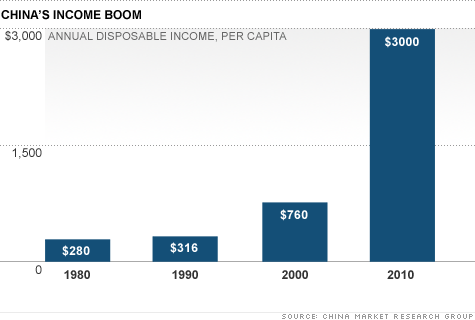
Since 1980, yearly earnings for an average Chinese household multiplied ten times over.
The average disposable income of urban Chinese households rose to around $3,000 per capita in 2010, according to an analysis of official government statistics by China Market Research Group. That means a typical family of three earns around $9,000 a year.
While that might not sound like a lot by U.S. standards, it’s a boon for Chinese residents, who have seen their yearly earnings multiply tenfold since 1980.
Over the past 10 years alone, incomes have quadrupled. In 2000, the average income was just $760 per person.
Of course, incomes vary greatly from region to region, with most of the wealthier residents residing in the cities. In rural areas, the average disposable income drops to $1,000, but in China’s largest cities like Shanghai, Beijing and Shenzhen, it’s around $12,000 a year, per person.
While there’s no official “middle-class” in China, (Chinese people don’t use the concept), a household considered to be middle-class in China would earn somewhere between $10,000 and $60,000 a year, according to Helen Wang, author of The Chinese Dream: The Rise of the World’s Largest Middle Class and What It Means to You.
“A rule of thumb is a household with a third of its income for discretionary spending is considered middle class,” Wang said.
Being middle-class in China often means earning at or below what’s considered the poverty line in America. But considering the much lower cost of Chinese life, living standards there aren’t bad at all.
The average city resident can afford to rent a 700-square-foot apartment, spend 35% of their income on food, and still put 20% aside in savings, as is customary in China, estimates James Roy, senior analyst at China Market Research.
Meanwhile, few use credit cards, and most are unlikely to own a car, opting for public transportation instead. The typical cell phone bill is around only $10 a month (or about $20 for an iPhone).
China’s ‘Exploding’ e-Commerce Market
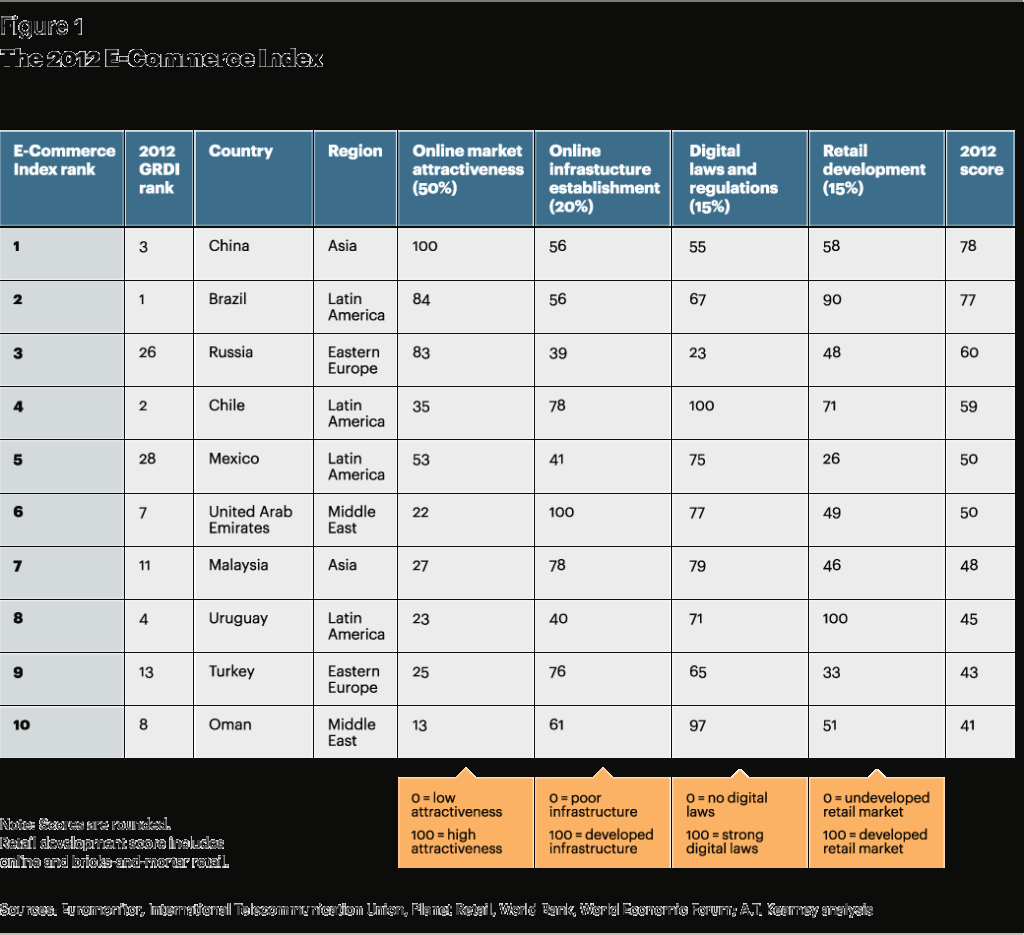
China’s e-commerce has grown by leaps and bounds over the past few years and A.T. Kearney’s inaugural 2012 E-Commerce Index predicts continued ‘explosive’ growth going forward. Taking account of 18 variables such as online market attractiveness and online infrastructure, China comes out on top on the list of 30 countries examined.
Second only to the US, China’s online retail market is now US$23 billion, expanding an amazing 78% a year since 2006. A.T. Kearny expects the market to reach $81 billion over the next five years as the country improves its infrastructure and as online purchasing behaviour evolves and matures. Among 513 million Internet users, some 164 million Chinese netizens shop online for the lowest prices, sales promotions, and free delivery mostly for consumer electronics, books, apparel, food and household supplies, beauty products, and ‘tuangou’ (group purchase) promotions.
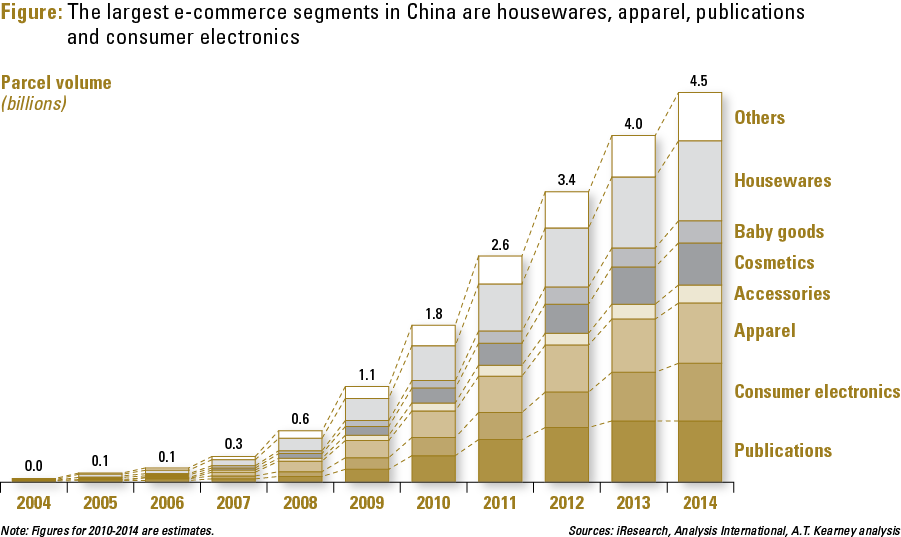
Chinese online retailers like Taobao, Paipai, 360Buy and others dominate the market but Amazon.cn which teamed up with a local retailer maintains certain market share. In addition, dozens of ‘tuangou’ companies offer a myriad of special dining, merchandize, and travel and hotel deals that are extremely popular. It’s been so lucrative that international supermarket chains, namely, Carrefour, Tesco, and Wal-Mart have jumped in as have European and US apparel and luxury specialists like Zara, Net-A-Porter and even Neiman Marcus.
An earlier A.T. Kearney report spelt out China’s e-commerce trends in more detail. Consumer-to-consumer (C2C) currently dominates China’s e-commerce market with 85% share in 2009. It is driven largely by hugely successful Taobao (China’s leading eBay-like site) which accounts for more than 3 million transactions each day. However, business-to-consumer (B2C) retailing is making a surge and is expected to grab 40% of the market by 2015. This is partly because C2C consumers are switching to B2C sites for higher-quality goods and services and C2C sellers are themselves setting B2C stores.
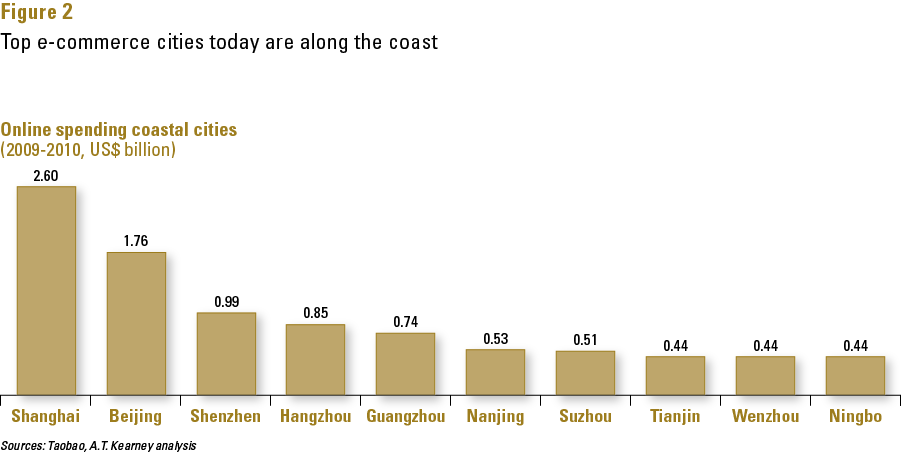
Taobao transactions data show that e-commerce spending is currently concentrated in China’s largest cities along the coast where Shanghai leads with $2.6 billion (2009-2010), 8.7% of the national total. But, as purchasing power rises in inland cities, Taobao transactions are rapidly increasing in tier-2 and tier-3 cities. Nationwide, in a couple years, per capita disposable incomes may nearly double that of 2008 and households earning more than $10,000 is forecast to reach 8% of all households by 2014.
This graph shows online spending in ten top cities.
But, limited rural spending power and poor roads remain major impediments against much higher growth potential. In comparison to the US’s 77% (or higher) Internet penetration rate, China’s is still only 34%. In terms of e-commerce, large segments of the rural population, with far less purchasing power, is less inclined to go on the Internet to make purchases. Often, buying from small local brick and mortar retailers can be cheaper than through the Internet, albeit product quality is less assured.
Moreover, although China is busily building roads and laying track throughout its vast countryside, timely and quality delivery remains a problem for rural consumers. In China’s largest and provincial cities, online purchases are almost invariably delivered by the literally hundreds of local courier companies that offer services at much cheaper rates than international companies. Typically, a small parcel can be delivered within Greater Beijing for 10 to 15 RMB as fast as the next day.
“China’s infrastructure challenges hinder the realization of the country’s full e-commerce potential. Delivery infrastructure varies outside of [urban areas] and inhibits the efficiency and effectiveness of the ‘last mile’ of online retail product delivery”, commented Mr Mike Moriarty, A.T. Kearney partner and report co-leader.
Among emerging e-commerce nations, Brazil is challenging China for top spot and Russia is an ‘awakening online giant’. Chile is Latin America’s online ‘gem’ and Mexico is the region’s next ‘breakout star’. The United Arab Emirates remains the ‘gateway to the Middle East’ while Malaysia may become Asia’s next e-commerce champion. The top ten is rounded out by Uruguay, Turkey and Oman.
Farmer Walks His 5000 Ducks
The ducks have to walk otherwise they forget how to, the farmer said. Must have been quite a sight for the locals.