
Chinese Companies Top Japanese For First Time in Fortune 500
China has overtaken Japan on the Fortune Global 500 for the first time on the list of the world’s biggest companies by revenue.
While US companies held the plurality of slots on the list, with 132 US firms featured, Chinese companies came in second, with 73, followed by 68 Japanese companies. China’s ascent marked the addition of 12 companies to the prestigious list, while the number of European firms fell to 161 from 172 in 2011. Eight energy businesses dominated the top 10, three of them Chinese companies; Sinopec Group, China National Petroleum and State Grid.
After Shell, the remaining companies in the top 10 are, in descending order: ExxonMobil; Wal-Mart Stores; Britain’s BP; Chinese companies Sinopec Group, China National Petroleum and State Grid; Chevron, ConocoPhillips and Toyota Motor.
The annual ranking reflected the shifting global landscape as the United States faces mounting competition from foreign rivals.
“Although the US still hosts the lion’s share of Global 500 corporations, no country has lost more companies during the last decade. There are 132 US-headquartered businesses on this year’s list, down from 197 a decade ago,” the magazine said.
-AFP
China and Hong Kong SAR Tops in FDI in East Asia
Excerpted from a press release for UNCTAD’s World Investment Report 2012 (references to China and related in bold):
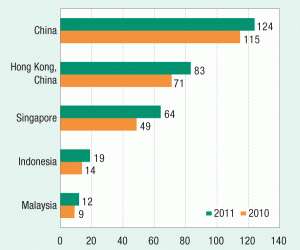
In East Asia, FDI flows to China reached a historic high of $124 billion in 2011. The second largest recipient in the sub-region, Hong Kong (China), saw its inflows increase to $83 billion, also a record. In China, FDI flows to services surpassed those to manufacturing for the first time as the result of a rise in flows to non-financial services and a slowdown in flows to manufacturing. FDI in finance is also expected to grow as the country continues to open its financial markets and as foreign banks expand their presence through mergers and acquisitions (M&As) and through organic growth.
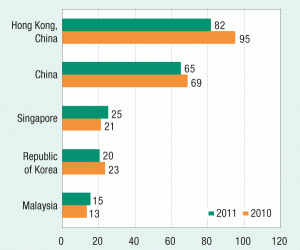
FDI outflows, after a significant increase in 2010, dropped 9 per cent from East Asia but recorded a 36 per cent rise from South-East Asia, the report says. Outgoing FDI from China declined by 5 per cent to $65 billion. FDI from Hong Kong (China), the region’s financial centre and largest source of FDI, declined in 2011 by 14 per cent to $82 billion.
M&A purchases worldwide amounted to $68 billion in 2011, slightly higher than the previous record set in 2010. The region’s cross-border M&A activities demonstrated diverging trends – total purchases in developed countries increased by 31 per cent to $46 billion, while those channeled to developing countries declined by 33 per cent to $22 billion. The rise in M&As from the region in developed countries as a whole was driven mainly by surges in Australia, Canada and the United States, while the value of total purchases in Europe decreased slightly.
The full UNCTAD report can be downloaded from: http://unctad.org/en/Pages/DIAE/World%20Investment%20Report/WIR2012_WebFlyer.aspx
Replica of Admiral Zheng He’s Ship Being Built
See the photo gallery of a replica of Zheng He’s famed ‘baochuan’ (treasure ship) being assembled in Nanjing using traditional techniques. According to historical accounts, sailed by the commander and his deputies, the nine-masted ships were about 127 metres (416 ft) long and 52 metres (170 ft) wide), more or less the size and shape of a football field. The replica, which doesn’t seem to be that size, is due to set sail in 2014.
http://en.ce.cn/main/photo-news/201207/07/t20120707_23470341_7.shtml
10 Ways China is Changing the World
This slide show and narrative originally appeared in Business Insider.
See the Financial Post: http://business.financialpost.com/2012/07/07/10-ways-china-is-transforming-the-world/
The piece is right that China indeed will wield immense clout in shale gas, rare earth, agricultural and industrial commodities and consumption generally going forward, along with burgeoning car production and sales and numerous other sectors. For Canada, in terms of shale gas, the author writes, once exploited China’s massive reserves will render the proposed gas pipeline to the BC coast much less attractive.
That China will be the world’s largest economy at the earliest by the end of the this decade (or more conservatively by mid next decade) and the RMB will be fully convertible by that time to challenge the supremacy of the dollar is also on the right track. (see an earlier post on the planned Shenzhen Qianhai experiment in RMB internationalization)
China’s fast emerging naval fleet is in step with its pace of development and need to protect economic and territorial interests. Instead of harping on China’s military, one must fundamentally question America’s pivot to Asia where it will deploy 60% of its naval forces.
The author questions China’s ‘state capitalism’ but the Chinese model is swiftly evolving in which the weight of state-owned enterprises (SOEs) is shrinking year by year. China’s authorities and press openly criticize the high prices for goods and services charged by the largest SOE providers. The ‘developmental state’ has been part and parcel of the early development of East Asian economies, namely, in Japan, Korea, Taiwan, and Singapore. Given the size of China, the gradual transformation to an overwhelmingly private economy will takes decades. A recent book by a renowned Arab writer argues that many developing countries are closely monitoring the transformation of the Chinese economy in search of ideas and methods for their own growth.
The author links the explosive growth in China’s IT software and hardware industry to heightening cyber attacks against Western interests but advancements in technology are always a double-edged sword and exploited for political and strategic goals. In this connection, he should, for instance, examine the West and Israel’s attacks against Iran and other ‘enemy’ states.
The author is dead wrong about China’s so-called ‘ghost cities’ and their ‘export’ to parts of Africa. As urbanization continues and speeds up over the next two decades and longer, those currently empty buildings will be filled up in quick fashion. As for Africa, China’s builds them for clients who have the responsibility to market them or otherwise allocate them to needy local residents.
But, aside from failing to mention China’s many strides in S & T such as in aerospace, the author missed the potentially biggest impact of all – China’s growing capacity for high-tech innovation. As featured in an earlier post, KPMG’s latest survey of high-tech CEOs and venture capitalists predicts the hub of global high-tech innovation will shift from the US to China over the next four years. In the post, I point to Cloud computing as a prime example where China is racing past the rest of the world.
Tariffs on Raw Log Exports a Bad Idea
This guy is spot on on the NDP leader’s idea of imposing tariffs on raw timber exports. The Chinese, major buyers of Canadian product, are already paying much higher prices for BC lumber than what Canadian mills will pay. You simply cannot force a big trading partner to pay unreasonable tariffs on top of high prices just because you want to generate jobs in Canada. It’s protectionist and the Chinese can always import more from other sources like the Russians. http://www.vancouversun.com/business/exports+have+Canadians+loggerheads/6892476/story.html
RMB Experiment Risks
Further to a previous post on China’s soon-to-be experiment in financial reform and RMB convertibility in Shenzhen’s Qianhai economic zone, here is a Reuters analysis of the risks involved. The key issue is that once you open a small valve, how do you prevent companies and individuals from exploiting it for speculative gain. Full convertibility of the RMB remains a long and arduous process and while some analysts believe full convertibility may occur in 5 years, I stand with those who feel that it probably won’t happen until the end of the decade or even later and with certain contols.
Bombardier to Share Technology with Chinese Rail Builder
Conference Board of Canada: Clearer Rules for Chinese Investment in Canada Needed
Glen Hodgson, Chief Economist for the Conference Board of Canada, argues that Canada is not capturing its fair share of foreign direct investment (FDI), particularly from China, and urges a fundamental revamping of Canada’s FDI screening system. He suggests our country can learn a few things from Australia which garners three times as much Chinese FDI as we do (despite being half the size) without harming its national interests.
Mr Hodgson said the 1980s Investment Canada Act is outdated and opaque, and a modernized structure is required to reduce arbitrary political intervention. He desires reform of the current national interest test for all FDI, with special reference to Chinese investment, proceeding from the presumption of innocence. He also wants to bring in a national security test, especially for state-owned enterprises and sovereign wealth funds (such as the China Investment Corporation (CIC)), to better address national security concerns. Currently, the net benefit rule is unclear and politically sensitive, he added.
Taking a page out of Australia’s book, he recommends that, as China does, Canada introduce technology transfer requirements (a major turning of the tables in the global economy) along with criteria for transparency in governance and job creation. In sum, he believes increased Chinese investment would boost jobs and productivity and a win-win for both countries.
Watch the interview: http://www.theglobeandmail.com/report-on-business/video/article4392745.ece
Financial Post report: http://business.financialpost.com/2012/07/05/canadas-takeover-rules-scaring-away-chinese-investments-in-oil-patch-report-warns/
Appetite for Business Education Grows in China
A Canadian teaching management at Beijing’s famed Renmin U. says the vast majority of his MBA students want to start up businesses.
KPMG Survey: China to Become Global High-Tech Innovation Hub
The capacity to make ‘disruptive technological breakthroughs’ with global impact over the next 2-4 years will likely shift from the US to China, concludes a recent survey of business executives by KPMG US’s Technology, Media and Telecommunications practice. Between March and May, the Global Technology Innovation Survey elicited responses from 668 CEOs of start-ups, medium and large enterprises, venture capital firms, and angel investors around the world.
44% of the executives suggest the global high-tech innovation hub would shift from Silicon Valley to China over the next 4 years. Interestingly, more than half of Asia Pacific CEOs thought so as did 40% in Europe, the Middle East and Africa while only 28% of Americans agreed. On the other hand, only 39% of US respondents stood with America as the most promising land for innovation as opposed to 71% in China saying their country would be.
Interviewed by cellular-news.com, KPMG partner Gary Matuszak, who headed the study, remarked, “China’s anticipated parity with the US tech sector shows the significant challenge facing the US to retain its position as an innovation leader, as other key countries will continue to take steps to boost technology innovation and attract tech entrepreneurs as well.”
Egidio Zarrella, a partner at KPMG China, points out that under the central government’s 12th Five-Year Plan (2011-2015), massive investment is being fostered in shared services and outsourcing, mobile payments, and Cloud computing. Of these three areas, 30% of respondents viewed Cloud Software as a Service (SaaS) as representing the next stage in consumer technology by 2015. 22% mentioned Cloud Infrastructure as a Service (IaaS) followed closely by SaaS as exerting the greatest impact on the transformation of businesses going forward. Almost 30% added that Cloud would also transform smartphones, tablets, and other mobile gadgets.
Late last month, at a forum organized by storage giant EMC2, keynote speakers lauded China for taking the lead in cutting edge Cloud computing deployments. Noting that his mainland customers are more willing than their Hong Kong counterparts to adopt Cloud due to their less reliance on complex legacy systems, Denis Yip, EMC2 president for Greater China said, “China is leading the way, which is strange because this is normally what happens with the US and then China follows…They are leading because there is no burden (of extant systems)…”
Partnering with regional Chinese governments, EMC2 is involved in 5 major projects in Qingdao, Zhenjiang, and three other undisclosed cities. Some projects focus on energy and the environment and others on healthcare. EMC2’s customers demand the latest technologies based around the VMAX and VPLEX family of visualization and private Cloud products and VNX unified storage line-up technologies. The projects are being led by local governments in a top-down fashion with the intention of bringing together siloed departments.
“The old school idea was to get R & D done in China because it was cheaper, but now you actually get better R & D done there,” global marketing CTO Chuck Hollis told a UK based IT journal.
“The pace of technology innovations today is happening at unparalleled speed and China’s projected rapid rise to prominence as a technology leader would be another example of this”, added Mr Matuszak of KPMG.
According to the Battelle Memorial Institute and R & D Magazine, as a percentage of global R & D spending, the US takes up 34% and China 12.9% witnessing a dramatic rise in investments. India, by contrast, spends a paltry 3%. Total global R & D spending is projected to increase 3.6% to US$1.2 trillion.