
Chinese Disposable Incomes
Here are some excerpts from a CNNMoney piece on China’s burgeoning middle class and their deeper pockets.
China’s middle-class boom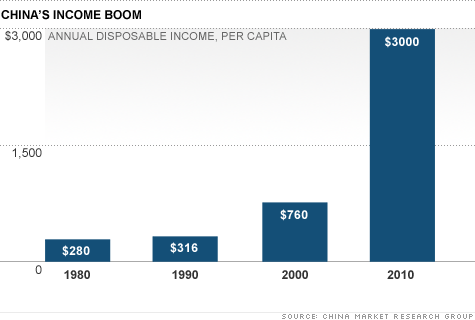
Since 1980, yearly earnings for an average Chinese household multiplied ten times over.
The average disposable income of urban Chinese households rose to around $3,000 per capita in 2010, according to an analysis of official government statistics by China Market Research Group. That means a typical family of three earns around $9,000 a year.
While that might not sound like a lot by U.S. standards, it’s a boon for Chinese residents, who have seen their yearly earnings multiply tenfold since 1980.
Over the past 10 years alone, incomes have quadrupled. In 2000, the average income was just $760 per person.
Of course, incomes vary greatly from region to region, with most of the wealthier residents residing in the cities. In rural areas, the average disposable income drops to $1,000, but in China’s largest cities like Shanghai, Beijing and Shenzhen, it’s around $12,000 a year, per person.
While there’s no official “middle-class” in China, (Chinese people don’t use the concept), a household considered to be middle-class in China would earn somewhere between $10,000 and $60,000 a year, according to Helen Wang, author of The Chinese Dream: The Rise of the World’s Largest Middle Class and What It Means to You.
“A rule of thumb is a household with a third of its income for discretionary spending is considered middle class,” Wang said.
Being middle-class in China often means earning at or below what’s considered the poverty line in America. But considering the much lower cost of Chinese life, living standards there aren’t bad at all.
The average city resident can afford to rent a 700-square-foot apartment, spend 35% of their income on food, and still put 20% aside in savings, as is customary in China, estimates James Roy, senior analyst at China Market Research.
Meanwhile, few use credit cards, and most are unlikely to own a car, opting for public transportation instead. The typical cell phone bill is around only $10 a month (or about $20 for an iPhone).