
World Bank to Do Joint Study on China’s urbanization
This study should have been done a decade ago. It is the biggest single factor driving China’s transition to a domestic consumption-led economy. And China’s urbanization will continue for another 2+ decades.
————————–
The World Bank is to launch a joint study with Beijing on urbanisation in China, one of the great human migrations of modern times, it said Friday.
Chinese cities have expanded rapidly in number and scale over the last 30 years, with more than half of its population of 1.35 billion people now considered urban dwellers — and the number still rising by 14 million a year.
The study aims to help “… not only China but all developing countries deal with the continuing massive influx of people into cities,” bank president Jim Yong Kim told reporters in Beijing.
Urbanisation drove growth and raised living standards, he said, but also brought “tremendous challenges to the environment, food security as well as the delivery of health care and education services”.
– AFP
UVic Ties Up With Chinese Academy of Sciences in Cleantech
http://thetyee.ca/News/2012/11/30/Beijing-BC-Clean-Tech-Connection/
Chinese Gov’t Think-Tank: China to Equal US 2012 GDP in 2020
Par for a government think-tank, this is a rather conservative forecast based on nominal GDP. Based on purchasing power parity (PPP), China will have more than equaled US 2020 GDP before then. And there is the issue of the RMB’s appreciation. The Conference Board of Canada recently predicted that the RMB will stabilize around 5 RMB:C$1 toward the end of the decade. Going just by exchanges rates, China’s GDP will have increased by 25%.
_____________________________
The size of China’s economy in 2020 will be close to that of the United States in 2012, an economic official forecast on Wednesday. China’s gross domestic product is expected to reach 100 trillion yuan in 2020, equivalent to 16 to $20 trillion, Yang Weimin, vice head of the Office of the Central Leading Group on Finance and Economic Affairs, said at a press conference.
In 2020, China’s per-capita GDP will likely exceed $10,000, almost double the amount in 2011, according to Yang. By 2020, the country will double its 2010 GDP and per-capita income for both urban and rural residents, President Hu Jintao said at the opening of the 18th National Congress of the Communist Party of China earlier this month.
Yang said the target of doubling per-capita income by 2020 will be met only when the per-capita disposable income of urban residents rises 7 percent every year and if the per-capita net income of rural residents increases 6.7 percent annually over the next nine years.
As the country’s central and western regions have huge potential for economic development, residents there will see their incomes rise faster than those in eastern parts over the next few years, the official added.
– China Daily
Study: China to be Largest Movie Market by 2020
The “Spotlight on China” study, prepared by Ernst & Young, estimates that China’s media and entertainment industry will grow at a 17% annual rate between 2010 and 2015, significantly faster than the country’s economy overall. 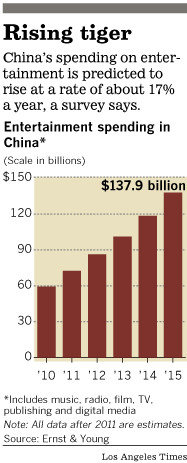 Part of that surge is driven by theatrical box office revenues. China recently surpassed Japan as the world’s No. 2 movie market and Ernst & Young says China will move past the United States to claim the top spot by 2020.
With all of the growth, though, come any number of obstacles. Chinese consumers have “constantly shifting” tastes and “have traditionally paid little or nothing for traditional content and have easy access to pirated digital content,” the report says.
Even with Chinese authorities trying to rein in piracy, media and entertainment companies will “struggle to get fair value for their products and services,” the report says. And, as has been the case with Chinese quotas on imports of American movies, government restrictions “limit or close certain sectors from either domestic or foreign private participation.”
“The challenges for media and entertainment companies to penetrate China are still considerable, however the vast potential of the market makes it impossible to ignore,” Ernst & Young’s John Nendick said in a statement accompanying the report. “Companies will need to understand that investing in China is a long-term proposition, and those who can make that commitment will be in a much better position to succeed.”
The report was particularly bullish on China’s middle class and overall spending on media and entertainment. In 2010, the report said, Chinese spending on entertainment and recreation was $350 billion, which jumped to $547 billion last year.
That spending was largely driven by the middle class, which numbered 247 million people in 2011, or 18% of the population. The study said experts predict the Chinese middle class will grow to more than 600 million by 2020.
– LATimes
Also, Canadians making small inroads in Chinese movie production:
“I don’t think a space film has ever been made yet in China,” Chang said from Taipei on Monday. “And it would require some really good partners.”
China Wants FTA With India
Canadians should wake up and smell the roses. Before you know it, China will have signed with many countries and once again, canada is slow off the blocks.
____________________________
China is very keen to have free trade agreement with India to strengthen further the economic cooperation and trade. This was revealed by a key member of the Chinese delegation which is in Delhi to brief about the changes effected during the recent 18th Communist Party Congress in Beijing.
Speaking at an interaction on “Implications of the Change in Leadership in PRC: Internal and External Dimensions” at Observer Research Foundation on Wednesday, Mr. Zhang Yansheng, Secretary General, Academic Committee, National Development and Reform Commission, said both the countries “should consider a Free Trade Agreement at the right time” to strengthen further the economic cooperation between the two most populous and fastest developing countries of the world.
Noting that already the two-way trade between China and India is around 73.9 billion US dollars, he said this would also help to achieve a model for South-South cooperation and greater role for both the countries in the global economy. He said China is for “a new type of global partnership” and India and China can work together.
– ANI
APF Survey: Canadian Companies Profitable in China
The Asia Pacific Foundation (APF) came out with this year’s follow-up to its 2010 Canadian Businesses in China Survey. For most Canadian companies, China remains a profitable place to do business but at the same time they face considerable challenges in a very demanding market. The survey was conducted last September/October garnering only 211 responses out of over 2,700 invites. The low response rate puts a question mark on the accuracy of the survey but the results are interesting just the same.
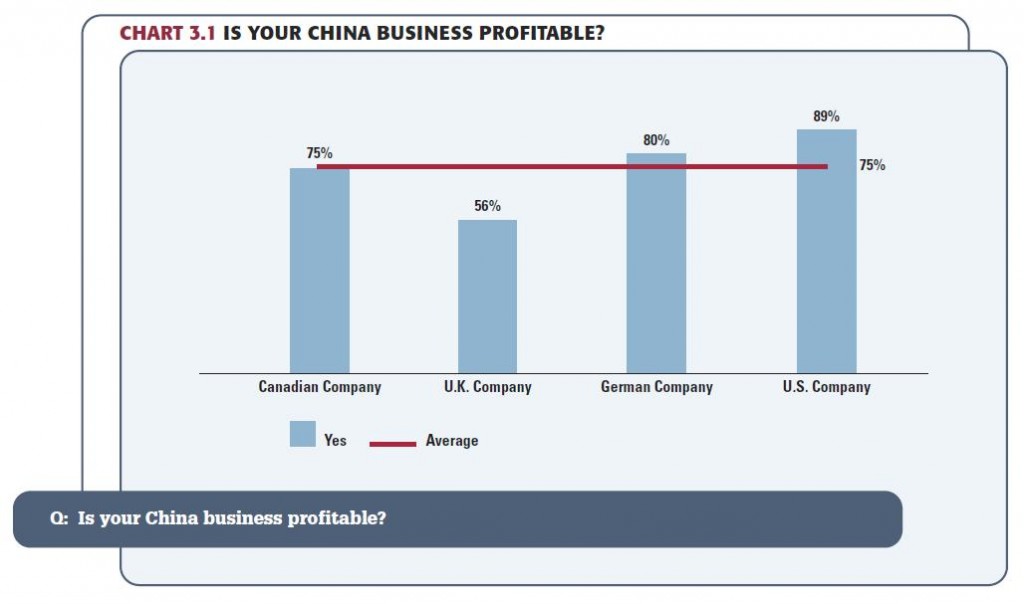
75% of company respondents said that their operations in China were profitable, roughly on par with the last survey (76%). Exporters to China had the highest profitability (84%) followed by importers (75%) and companies with operations in China (68%). German and American companies beat Canadians who in turn outperformed UK companies. In terms of share of global revenue, however, nearly 2/3 of companies indicated their China revenues were below 25%.
Nonetheless, China seems to be important for their long term growth with nearly 2/3 reporting that their business activities in China had grown over the last five years and the more established they are, the more likely their businesses will grow. 69% of respondents have been in China for at least 5 years with close to 1/5 more than 20 years.
Only 28% of companies suggested that they were interested in seeking Chinese investment and 30% said they wanted to do so to build or expand their businesses in China. Another quarter indicated they desired Chinese investors to build or expand businesses in Canada with significantly less saying it would help them expand globally.
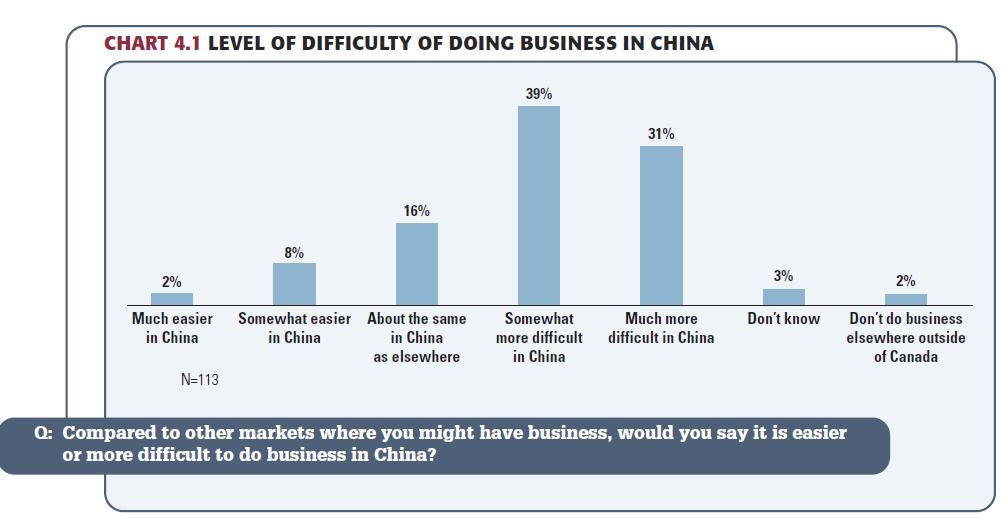
China proves to be a difficult market for Canadian companies. About 70% of the companies polled stated it is either much more difficult or somewhat more difficult to conduct business in China than in other countries. The toughest challenges they named are intellectual property protection, inconsistent interpretation of laws and regulations, weak dispute settlement, lengthy and complicated certification, and tariff and other border barriers.
The challenges were somewhat different from those cited in 2010 and by contrast, American and German companies were more concerned about human resources bottlenecks. APF suggests the challenges had to do with the rule of law and trade policy that are not easily resolved or improved at the company level. It remains the work of the two governments to hammer out/update agreements and enhance enforcement.
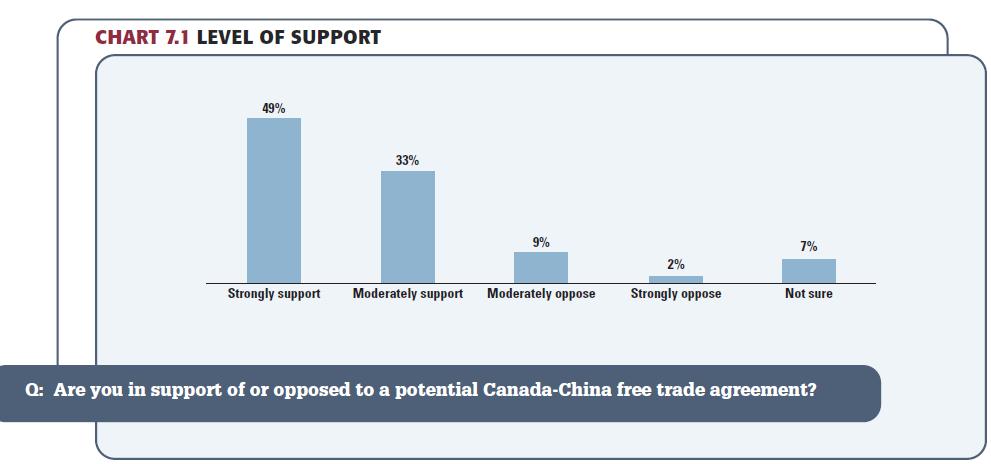
In line with an earlier poll on support for a Canada-China free trade agreement (FTA), the vast majority said they either strongly (49%) or moderately (33%) supported negotiations toward a Canada-China FTA. For APF, two reasons stand out: First, 39% agreed that a FTA would give them significant opportunities to build or expand their businesses in China; and second, 28% believe Canada needs greater trade and investment with China since the country only represents less than 7% of total Canadian trade.
As for potential benefits of a FTA with China, they named three: First, help protect Canadian businesses with commitments from Chinese authorities to treat Canadian companies on equal terms; second, help ensure that Canadian goods are not discriminated against on the Chinese market; and third, help improve a rule-based system for doing long-term business in China, giving Canadian businesses recourse to resolve disputes. Nearly 83% of respondents said their businesses or activities in China would be significantly or moderately increased under a FTA.
Canadian companies are also frustrated with the lack of access to China’s government procurement market. 85% of those polled have never bid on Chinese government contracts for the lack of interest, ignorance of where to find projects, never receiving offers to bid, and/or perceptions of discrimination against foreign companies. To win Chinese government contracts, many respondents said it is imperative to work with a Chinese partner, either being approached by one or actively soliciting a partner.
Perhaps counterintuitively, the poll showed that Canadian SMEs with global revenues of less than $10 million are the mainstay in the China market (58%) while large Canadian corporations with $100 million or more in global revenues formed another 20%. For one in five businesses, their activities are concentrated in Beijing or Shanghai and 10% in Guangdong Province. The rest are spread across China with the strongest presence in Hong Kong. 38% of them export products and services to China while 10% imported from China and nearly a quarter have set up a factory or office in China with another 20% wanting to do so.
Commenting on the results, Yuen Pau Woo, President and CEO of APF said, “Amid continued global economic uncertainty, this survey indicates that…Canadian businesses have no illusion about the difficulties of doing business in China but they have found the Chinese market to be profitable and have expanded their operations in that market over the last five years.”
Commentary: China the Subtle Superpower
While I do not necessarily agree that China is a superpower because of the myriad of domestic problems and development issues that she faces, especially given that the urbanization process has decades to go, I fully concur that China will exercise forms of soft power and Sun Zi-esque strategy in its diplomacy and foreign policy. It involves a melding Chinese culture, tradition, philosophy and strategy with modern realpolitics. So, in terms of how she acts on the world stage, China’s behaviour will be vastly different from the US’s.
—————————————
If Xi Jinping wants to tackle China’s “severe challenges”, he needs to understand the nature of the new power China has accumulated over the past decade. So the question remains: Is China a superpower today? A pundit recently said “no” because, among other factors, China has only one aircraft carrier in comparison to America’s 11. The analysis is mistaken; it’s not about the ship count, but the reality of power.
China possesses a power that is deeply rooted in tradition, ideas and cultural habits that are far more ancient than the policies connected with Western communism. What defines a superpower? It is a matter of spirit, confidence, influence, patience, determination and sophistication − all in pursuit of well-understood, long-term national interests.
A superpower stands on its own, without the need of allies (although those may be helpful at times). It influences other states, sometimes at a cost to these states’ national interests. It possesses enormous reserves of strength, sufficient enough to carry it through the most severe trials of real combat or devastating diplomatic reversals. It steers events to serve its interests, by subtle, sometimes invisible means, even in distant places. It prevents others from harming its national interests, or altering its existing spheres of influence. Its culture is dominant, and it modifies other cultures. Finally, it constrains the behaviour of enemies. If talking fails, diplomacy is backed up by the threat to use overwhelming force.
China currently meets all of these traditional characteristics of a superpower. But its mix and balance is special: China is and will continue to be a very different superpower from the US.
Traditional Chinese wisdom says: “Four taels yield a thousand catties.” A subtle player earns a big pay-off for a small effort. A clever wrestler redirects the opponent’s clumsy strength to win the bout. This wisdom is evident in China’s foreign policies. While America’s profligate expenditure of blood and treasure in the Middle East may end in profitless withdrawal, China, by subtle and nuanced deals with Iran and Syria, has gained access to needed oil supplies. While the US contemplates new military intervention, Syria’s sales to China provide financial lifeblood, giving China significant leverage.
By modulating the de facto aid it supplies to Syria and Iran, China can counteract or reinforce American aims in the Middle East, not by expenditure, but with less aggressive trading profits.
America and China use their superpower status vis-à-vis other nations in contrasting ways. When nuclear-armed North Korea threatens to fire a rocket, Japan shudders and the US issues a diplomatic document: yet the rocket flies. In contrast, China controls the dictator by providing marginally more or less aid. China gains influence over North Korea by its power to either offset Western force, or reinforce it. Moreover, against the US, China employs the wrestler’s trick: the opponent’s undisciplined power is the wrestler’s friend.
In other ways, too, China wields its influence differently from the US: China’s superpower style has parallels with that of the church.
China has its missionary Jesuit intellectuals: they are the overseas Chinese, found in Western universities, research institutions, banks, government bureaucracies, professional societies and military services. They are agents of change, exemplars of competence and professional excellence, who enrich the core traditions of the East with the help of the riches and liberty available in the West. Like the Jesuit missionaries of old, they plant ideas in foreign soil and undertake their intellectual obligation with zeal. With the help of these “missionaries”, China needs few spies or paid secret warriors: they have more dependable spokespeople, representatives and ambassadors.
This overseas diplomatic service is well-suited to China’s national interest. Like the church, it was never China’s intention to occupy distant lands. The primary objective is internal stability. It is content to be understood, respected and, to some degree, feared. It believes its ideas, cultural habits and Confucian morality will survive any challenge.
This new form of superpower is old. Long-lived empires from classical Rome to the Catholic Church “gain ascendancy” with language, culture, religion, values and vast patience. China does so today, with an interesting reversal. Its elites learn the language, culture, religion and aesthetic values of the West, take them “home” and absorb them, without abandoning their own. Asia’s ruling classes will be, more and more, agents of change in both societies.
China’s superpower status springs from similar fertile ground: antiquity, tradition, dignity, elegance, learning and pride. The Western superpower will do well to understand that the mystical and spiritual traditions of the East demand respect and even admiration.
So: is China a superpower? Russia’s UN vote doesn’t count without China’s support. American sanctions against Iran and threats against Syria are neutralised when China, and its faithful companion Russia, decides to veto. The US$1.3 trillion American debt held by China could threaten the US financial system even more than would a fleet of submarines and carriers.
Back when the Soviet Union still existed, Joseph Stalin, when told the Vatican was preaching against his tyranny, replied with a sneer: “So, how many divisions does the Pope have?” He made the mistake of focusing on the military side of a superpower, and failing to understand the subtle, spiritual side of power.
The time is now to build common ground and common understandings to link East and West. And, in a spirit of dignity and mutual understanding, accept the superpower status of today’s Asia. The alternative is profoundly dangerous.
– SCMP
Tom Velk is a professor of economics and director of the North American Studies programme at McGill University. Olivia Gong is a finance student and research assistant at McGill
Canada’s Carney to Head Up Bank of England
This is a very significant appointment for Britain which is mired in debt and financial mismanagement. Carney has been very gung ho on Canada-China trade and investment. His views on China may influence England’s strategy of closer financial and currency ties to China.
——————————————-
Britain named Canadian central bank chief Mark Carney on Monday to head the Bank of England, springing the surprise choice of a foreigner to push reform of its troubled financial system.
A former Goldman Sachs investment banker who at the Bank of Canada guided the Canadian economy through the global economic crisis, Carney will succeed Mervyn King who retires in July.
Carney, who already plays a leading role in setting global banking rules, defended his departure from Canada and signalled that bigger problems awaited him in London.
“I’m going to where the challenges are greatest,” he told an Ottawa news conference, stressing the need to “rebalance” the economy which has relied heavily on a financial services sector hit by huge losses and scandals.
“It’s very important for the global economy that the UK does well, that it succeeds in this rebalancing of their economy, that the reform of the British financial system is completed,” he said.
Carney will become the first non-British head of the central bank in its 300-year history, beating hot favourite BoE deputy governor Paul Tucker to the post.
During the crisis, Carney helped to make Canada’s recession one of the shallowest of the world’s richest nations. No Canadian bank needed government help, and the country recovered all the jobs it lost in the downturn relatively rapidly. By contrast, Britain had to bail out Royal Bank of Scotland and Lloyds Banking Group, and the world’s sixth-largest economy is still struggling to achieve growth four years after the crisis broke.
– Reuters
Canadian Cleantech Companies Navigate a Complex Course in China
Interesting article on the complexities of the Chinese market for Canadian cleantech companies. The potential for profits are immense but the long road is full of potholes.
http://thetyee.ca/News/2012/11/26/China-Cleantech-Series-One/
World’s Tallest Building Up in 90 Days?
I’ve posted on the feats of Broad Sustainable Building Corp. before that put up a building at the 2010 Shanghai World Expo is one day and a multi-storey hotel in a week. But, this time it’s aiming for the ultimate high – a 220 storey skyscraper called Sky City One that would be higher than the Dubai Tower and completed in 90 days! The CEO is super-confident about the time schedule along with the building’s sturdiness and sustainability. Simple formula: prefab modular construction like snapping together Lego blocks.

Here’s their PDF presentation: http://www.broad.com:8089/english/down/en_sky_city.pdf
Atlantic Wire: http://news.yahoo.com/build-worlds-tallest-skyscraper-90-days-213548067.html