
IEA: China Could Account for 40% of World Renewable Energy Growth
With oil and gas demand shifting to eastern economies, the IEA said China could account for as much as 40 percent of the global renewable energy growth.
China has a five-year development plan to limit coal production and use by 10 percent of 2011 levels by 2015. The International Energy Agency said China aims to double the amount of natural gas it uses by 2015.
The official Xinhua news agency this week reported that China’s development plan through 2015 calls for the addition of 123 trillion cubic feet of proven conventional natural gas reserves.
IEA Executive Director Maria van der Hoeven said much of Asia has an important role to play in a low-carbon future.
“China alone accounts for almost 40 percent of global renewable generation growth,” she said in a statement.
The IEA said renewable energy projects like geothermal energy could help with the carbon reductions needed to keep climate issues in check across the region.
– UPI
Harper Government Approves CNOOC Takeover of Nexen
The Nexen takeover is finally a done deal but the government will be raising the threshold for future foreign takeovers, especially by SOEs.
TI: Canada Among least Corrupt Countries; China Down From 75th to 80th
In Transparency International’s 2012 Corruption Perceptions Index, Denmark, Finland and New Zealand tied for first place out of 176 countries – meaning they were perceived to have the lowest levels of state sector corruption. Sweden was fourth with Singapore ranked as fifth.
Germany came in at 13th, one notch better than 2011 and Japan remained at 17. The United States ranked 19th in 2012, up from 24th out of 183 countries in 2011. China ranked 80th after 75th in 2011.
The 2012 index ranks 176 countries by their perceived levels of public sector corruption. The index assigns scores of between one and 100, 1 being highly corrupt and 100 clean.
Here is a list of the 10 most corrupt nations and the 10 cleanest in reverse order:
MOST CORRUPT: RANK COUNTRY SCORE 174 Somalia 8 174 North Korea 8 174 Afghanistan 8 173 Sudan 13 172 Myanmar 15 170 Uzbekistan 17 170 Turkmenistan 17 169 Iraq 18 165 Venezuela 19 Burundi, Chad and Haiti are all ranked at 165
LEAST CORRUPT: RANK COUNTRY SCORE 9 Netherlands 84 9 Canada 84 7 Norway 85 7 Australia 85 6 Switzerland 86 5 Singapore 87 4 Sweden 88 1 New Zealand 90 1 Finland 90 1 Denmark 90
Commentary on China’s performance this year:
China saw its ranking slip to 80 from 75 last year, but Swardt said the Beijing leadership showed a greater understanding of the dangers of ignoring corruption, including among Chinese companies operating both at home and abroad.
Last month, state media quoted Communist Party chief Xi Jinping as saying that if corruption was allowed to run wild, the Communist Party risked major unrest and the collapse of its rule.
TI Managing Director Cobus de Swardt drew comparisons with standards in the Organisation for Economic Cooperation and Development, which groups wealthy nations. “We have seen a criminalization of bribery to the standards of the OECD,” he said.
“The Chinese used to say their companies could not be held to rich country standards because they needed to catch up, but now they realize tackling this is in their own interests.”
But tackling corruption in a lasting way required allowing ordinary citizens the power to scrutinize public services and institutions, he added.
– TI and Reuters
Researcher: Canada May Not be the US’s All-Weather Partner in East Asia
Both the US and Canada are making an Asian ‘pivot’ but for vastly different reasons that impinge on the degree to which Canada is willing to coordinate security policies with the US, especially vis a vis China. In a newly released paper from the Center for International Governance Innovation (CIGI), Research Fellow James Manicom writes: “Despite the simultaneous realignment of foreign policies toward Asia, there may, in fact, be little common ground between the US and Canada as the ‘Asia-Pacific Century’ unfolds’”.
In the past, Canada has played an honest broker role in South China Sea disputes such as was the case in the 1990s; and since its inception, Canada has been an active participant in the Rim of the Pacific Exercise (RIMPAC) led by the US Pacific Command. Yet, increasingly, a number of ‘incompatibilities’ have emerged between the US and Canada. The US ‘pivot’ is designed to maintain US hegemony in the Pacific with the US transferring 60% of its military forces to the region. In his address to the Australian Parliament a year ago, President Obama stated unequivocally “reductions in US defense spending will not – I repeat, will not – come at the expense of the Asia Pacific”.
Canadians, on the other hand, are less concerned about US-defined security issues in Asia-Pacific and much more about the continuing decline in exports south of the border. Indeed, since 2009, China has displaced Canada as America’s largest trading partner. Hence, trade ‘diversification’ with bustling Asia and particularly China has become the buzz word in Ottawa since the Harper government’s amazing about-face in China policy.
Minister of Natural Resources Joe Oliver’s open letter to the public this year was telling: “Canada is on the edge of an historic choice: to diversify our energy markets away from our traditional trading partner in the US or to continue with the status quo…For our government, the choice is clear: we need to diversify our markets in order to create jobs and economic growth.”
With the shelving of the Keystone pipeline project by the Obama Administration and loud American criticism of Albertan oil sands as well as headways made in the US shale gas sector, it is not surprising that Canada is looking westward for stable and growing demand. As trade with and investment from Asia (China) grow, Canada may find itself constrained on a number of diplomatic fronts. In the backdrop of China’s disputes with Japan and its ASEAN neighbours over territorial claims in the East China and South China seas, one salient issue central to US foreign policy that has come to the fore is ‘freedom of navigation’ .
In contrast to sharp criticisms of North Korea and Myanmar, Canada’s silence on the issue, Mr Manicom argues, stems from her desire to foster better trade and investment relations with the Asian giant. For, despite the national furor over CNOOC’s takeover bid of Nexen and Chinese SOE investment in general, Canada needs plenty of Chinese investment to develop the oil sands. Second, though seemingly unconnected, it may also have to do with Canada’s own desire not to draw international scrutiny of its exceptional claims over the Northwest Passage (NWP). As is well known, Canada claims the NWP as internal waters whereas the US and the EU view it as an international strait through which they can freely navigate.
Third, instead of openly standing with the US and its allies, notably Japan and the Philippines, Canada may be more inclined to play a bridge-building role in the region. To do so, it would require Canada to maintain the appearance of impartiality which would be best served by an equidistant posture from both the US and China.
Given these inter-connected factors, Mr Manicom suggests Canada may not be a reliable Pacific partner for the US going forward in spite of having been a strong ally since the end of WWII. Moreover, there remains a ‘strong ‘Atlanticist impulse’ in Canada that perceives the Pacific as far-away and where Canada should not be sticking its nose into. While there is advocacy for stronger Canadian coordination with the US in Asia-Pacific, Asian security remains largely off the radar for Canadian foreign policy.
Mr Manicom thus concludes: “As Asian investment in Canada’s resource sector deepens and as Canadian exports to the region grow, Ottawa may become less willing to take sides in East Asia’s various flashpoints. This does not prevent Canada from actively supporting non-traditional security challenges in the region, nor does it prevent Canada-US cooperation in fields beyond East Asia; however, Canada may not be as willing an ally as Washington expects.”
AP: China Eclipses US as Top Global Trader
AP’s first installment in its “China’s Reach” series of special reports is being picked up around the world:
In just five years, China has surpassed the United States as a trading partner for much of the world, including US allies such as South Korea and Australia, according to an Associated Press analysis of trade data. As recently as 2006, the US was the larger trading partner for 127 countries, versus just 70 for China. By last year the two had clearly traded places: 124 countries for China, 76 for the U.S.
In the most abrupt global shift of its kind since World War II, the trend is changing the way people live and do business from Africa to Arizona, as farmers plant more soybeans to sell to China and students sign up to learn Mandarin.
The findings show how fast China has ascended to challenge America’s century-old status as the globe’s dominant trader, a change that is gradually translating into political influence.
See AP interactive graphics on how quickly China has usurped the US as the dominant trader here:
http://www.nzherald.co.nz/business/news/article.cfm?c_id=3&objectid=10851800&ref=rss
Forbidden City Theme Park for Australia
This is interesting indeed. Sure to draw ever more Chinese tourists to Oz. Wonder if any Canadian entrepreneurs are contemplating similar projects to milk the Chinese tourism cash cow?
_______________________
A China theme park in Australia featuring a full-size replica of gates to the Forbidden City and a nine-storey temple could rival the Sydney Opera House as a tourist drawcard, officials say.
The planned Aus$500 million (US$520 million) attraction moved a step closer after Wyong Shire Council in New South Wales signed a deal on Sunday to sell 15.7 hectares of land to the company behind the proposal.
Construction of the seven-sectioned theme park 80 kilometres (50 miles) north of Sydney is set to begin in 2015 and be finished by 2020.
On completion it is expected to employ more than 1,000 people.
“What this proposal will do is turn the Wyong Shire into a tourist mecca and bring millions of dollars worth of tourism into the area — which will have a flow on effect to the entire region’s economy,” Mayor Doug Eaton said.
“Outside the Opera House and Harbour Bridge, this has the potential to be among the biggest tourist attractions in the state.”
The first stage of the theme park to be built is likely to be the replica of an entrance to the Forbidden City, Beijing’s Imperial Palace, complete with red walls and golden roof.
There will also be a section constructed in the architectural style of the Tang and Song dynasties, with small courtyards typical of a Chinese neighbourhood, and another in the style of the Ming and Qing dynasties.
Other areas will include the temple, a theatre, a royal villa, and a children’s section devoted to pandas, though not including any live animals.
“It is going to be a unique $500 million tourist attraction, employing more than a thousand people and bringing economic prosperity to Wyong Shire,” said Bruce Zhong, chairman of Australian Chinese Theme Park, the private company behind the project.
The park will tap in to the growing number of tourists from China visiting Australia.
China is Australia’s fastest growing and most valuable international tourism market, worth more than Aus$3.8 billion in 2011, with more than 400,000 Chinese visitors coming to New South Wales state each year.
– AFP
Two Charts on China’s Dwindling Low-Cost Labour and Rising Wages
In the last post, I mentioned the growing shortage of labour due in part to the one-child policy that is bringing China’s labour-intensive export-led growth strategy to an end. Here are two charts that show the problem of labour shortages and wage hikes in China.
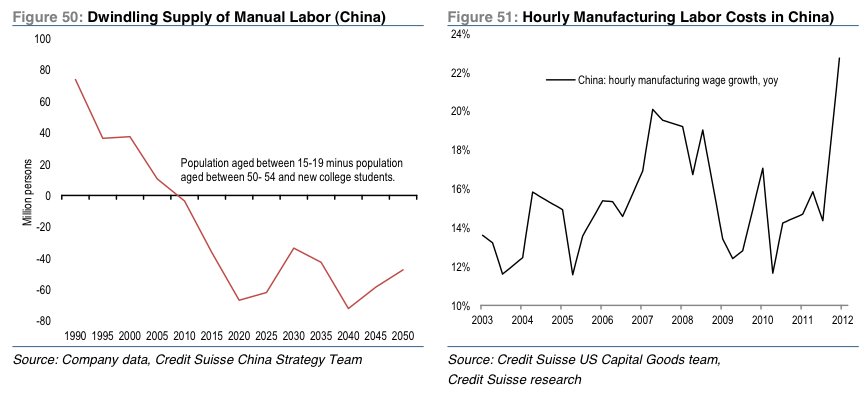 – Business Insider
Changes to China’s One-Child Policy
Recently, the Chinese press and the blogosphere have been abuzz about expected changes to the one-child policy. The issue has become all the more pressing since China’s fertility rate has dropped to a deeply worrying 1.7, well below the population replacement level of 2.1. However, experts suggest that changes are likely to be incremental and introduced regionally in selected pilot projects.
Putting aside draconian measures resorted to in some regions to enforce existing laws, the one-child policy has led to some wacky rules, especially in the major cities. In Beijing, for example, although couples who are both single-children are allowed to bear a second child, they can be fined if a second child is given birth when the mother is less than 28 years-old or the second child is born within four years after the first. Wealthy couples can afford to pay the “social maintenance fee” fines but their ‘extra’ children cannot obtain ‘hukou’ or household registration and lose educational and health benefits.
Mr Zhang Weiqing, former head of the National Population and Family Planning Commission (NPFPC), said proposed changes would allow urban women to have a second child, even if one of the parents is not an only child. A more relaxed policy also would mean that rural parents will be able to have two or more children.
A major report released by government think-tank the China Development Research Foundation (CDRF) last October recommended that policies be introduced in two stages. First, relaxing curbs in cities and rural areas that have followed existing policies to the letter; and second, by 2015, putting in place a ‘one and a half child’ policy under which if the first child is a girl, a second child would be allowed.
In an interview with Economic Reference News, Lu Mai, Secretary General of the CDRF, said his foundation discussed and modeled four scenarios for policy change: 1) selectively relaxing policies, 2) relaxing policies across the country, 3) selectively relaxing policies for families with one single-child parent, and 4) relaxing policies for one single-child parent families across the board.
The exercise found that the second scenario would result in an explosion of births over the short-term and the third and fourth scenarios would take too long to achieve desired results. Thus, selective relaxation of existing policy was deemed the best option considering the urgency of China’s demographic problems while seeking to prevent an acute Chinese-style ‘baby boom’.
Lu Jiehua, a demographer at Peking University and a member of the NPFPC, told the China Daily, “I think the government will take action next year and the chances are inevitable given the increasingly complicated population problems ranging from ageing to a massive migrant population, and the huge gender gap.” He also expected a universal two-child policy to be introduced eventually but over the next two decades, family planning will remain the domain of the government rather than individual families.
Low birth rates across the country have become severe. In Shanghai, most single-child parents refuse to procreate beyond a single child. Despite campaigns by the city’s family planning bureau to encourage second-child births, in 2010, Shanghai’s fertility rate had fallen to a dismal 0.77. A 2007 survey by the Population Institute of the Chinese Academy of Sciences revealed that in nearby Jiangsu Province, of the families that were eligible to have a second child, only 4.4% wanted one. Pilot projects in the countryside of inland provinces Shanxi, Gansu, Hebei and Hubei to allow two or more children indicated an overall fertility rate of only 1.6.
Hence, some experts are advocating the abandonment of the one-child policy altogether. Discounting the adverse effect of a sudden burst in babies, they say the trashing of the entire policy would not even augment fertility levels to above the replacement level. China’s population dividend is essentially over, they argue, leading to sharply rising labour costs and the end of China’s labour-intensive export- oriented development strategy. Zhang Erli, a former leading statistician at the NPFPC put it bluntly: “Relaxing population controls is no longer optional, it has become imperative and imminent”.
Moreover, China’s elderly population is heading on a steeply upward trajectory. Today, there are some 100 million elderly collecting old-age pensions as half of provincial social security accounts face deficits. By the mid 2030s, that number is expected to increase to 300+ million, placing inordinate pressures on China’s social security system. Thus, if appropriate reforms are not adopted fast enough, China may land in the same boat that Japan is in.
Harbin-Dalian High-Speed Rail Begins Operations
Wouldn’t it be great if we had high-speed rail in Canada. This could be a model.
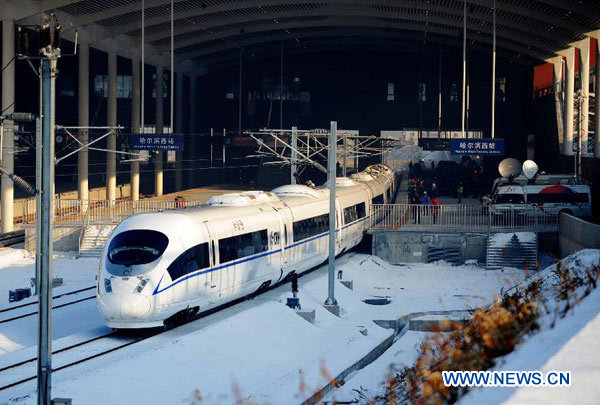
| A high-speed train leaves the Harbin West Railway Station in Harbin, capital of northeast China’s Heilongjiang Province, Dec. 1, 2012. The world’s first high-speed railway in areas with extremely low temperatures, namely the Hada High-speed Railway which runs through the three provinces in northeast China, started operation on Saturday. The railway links Harbin, capital of Heilongjiang Province, and Dalian, a port city in Liaoning Province. (Xinhua/Wang Jianwei) |
SHENYANG, Dec.1 (Xinhua) — The world’s fastest railway in areas with extremely low temperatures, which runs through three provinces in northeastern China, started operation on Saturday as part of the country’s efforts to revitalize this old industrial base.
Four trains departed from stations in Harbin, capital of Heilongjiang; Changchun, capital of Jilin; Shenyang, capital of Liaoning; and Dalian, the port city in Liaoning, simultaneously at 9 a.m. on Saturday to mark the opening of the 921-km line.
The high-speed railway with designed speeds of up to 350 km per hour went into service after passing a two-month test during which the region saw blizzards and temperatures as low as minus 40 degrees Celsius.
“The operation of the Harbin-Dalian high-speed railway signals great progress in the building of a high-speed rail network with four lines running vertically up the country and four lines running horizontally across the country,” said Lu Chunfang, vice minister of railways.
So far, China has 8,600 km of operating high-speed railway, more than any other nation.
Brookings’ Global MetroMonitor 2012
Here is an interesting interactive graphic depicting the best and worst economic performances of major cities across the globe. Blue indicates best, red the worst. Note where the best and worst are.
http://www.brookings.edu/research/interactives/global-metro-monitor-3