
First Subway to Cross Yangtse River
Here is a Xinhua photo gallery of the first subway line in Wuhan to traverse the mighty Yangtse.
http://news.xinhuanet.com/english/photo/2012-12/15/c_132043266.htm
Chang’e-2’s Pictures of Asteroid Toutatis
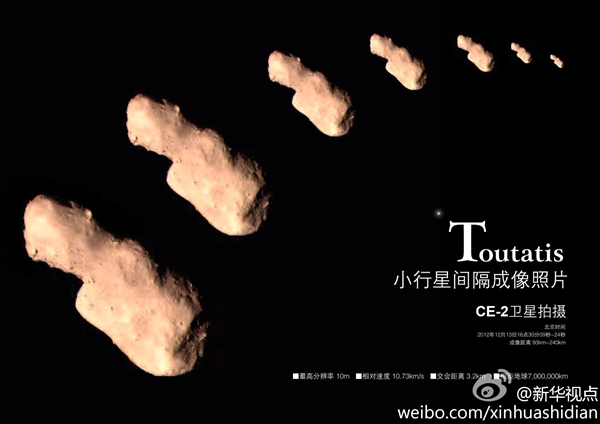
China’s space probe Chang’e-2 has successfully conducted a maneuver in which it flew by the asteroid Toutatis, about seven million km away from the Earth.
Travelling in deep space, Chang’e-2 made the flyby on Dec. 13 at 16:30:09 Beijing Time (08:30″09 GMT), the State Administration of Science, Technology and Industry for National Defense (SASTIND) announced on Saturday.
The flyby was the first time an unmanned spacecraft launched from Earth has taken such a close viewing of the asteroid, named after a Celtic god.
It also made China the fourth country after the United States, the European Union and Japan to be able to examine an asteroid by spacecraft.
– Xinhua
The Brave New World of 2030: NIC Report
This week, the US National Intelligence Council (NIC), a consortium of 17 US government intelligence agencies, came out with its landmark quadrennial report “Global Trends 2030: Alternative Worlds” (GT2030). On China, the report largely follows conventional, if not conservative, projections of its economic trajectory to surpass the US before that time but also sees America remaining tallest among midgets in international affairs.
The fifth in a series, the report does not profess to predict the future but rather provide food for thought to decision makers. It cites 4 megatrends, 6 game-changers, and 4 scenarios of a bold new world in 2030. This post focuses on the most relevant parts about China.
GT2030 states that “no country – whether the US, China, or any other large country – will be a hegemonic power”. Within two decades, Asia will have reversed the nearly three centuries of Western dominance with China re-establishing itself as the world’s premier economy. The megatrends of diffusion of power, empowerment of individuals, demographic aging in key countries, including China, and growing basic resource demands that may lead to conflict are underpinned by tectonic shifts, namely, economic power flowing to the East and South, growth of the global middle class, urbanization, and others that characterize China’s growth.
Elaborating on one game-changer – the shift to a crisis prone global economy – GT2030 seems ironically to lament the loss of America’s hegemony, the Hobbesian Leviathan that realist scholars argue is central to world stability. The prospect of declining US power and unwillingness to serve as the global security provider would be a key factor contributing to instability, the report underscored. Fear of China’s growing power and questions about the US’s sway would exacerbate insecurities among America’s allies in East Asia.
More and more, the world’s economic prospects will increasingly pivot on the performance of large emerging countries, foremost of which is China. According to the World Bank’s baseline modeling, China will contribute about 1/3 of global growth by 2025. But, the report also suggests, I believe wrongly, that China’s growth will slow to 5% per annum by 2020 and faces immense challenges in overcoming the so-called ‘middle-income trap’. While unlikely, says GT2030, an economically collapsed China would trigger domestic political unrest and shock the global economy.
China will continue to suffer from a ‘democratic deficit’. Within 5 years, China is slated to pass the threshold of US$15,000 (PPP) per capita that often triggers democratization. Here, the report delves in some wishful-thinking suggesting that a ‘black swan’ event such as Chinese democratization could trigger an immense ‘wave’ of democratization around the world. But, other experts contend that a democratic China could become more nationalistic with the electorate hijacked by jingoism and demagoguery.
Possibly the biggest game-changer is the crucial albeit waning role of the US. In spite of economic decline, the US is likely to remain the ‘first among equals’ in great power relations in 2030. At the same time, the “unipolar moment” in the immediate years following the collapse of the Soviet Union is over and Pax Americana that has defined international relations since the end of WWII is quickly coming to a close.
The report is right when it says in the next 15-20 years, power will become more multifaceted and more contextual and America’s role will be increasingly determined by how successful it is at helping to manage international crises. The report may also be on the right track when it suggests China will not be able eclipse the US as the preeminent superpower nor will a new international order be erected by the emerging world.
The report ends by positing four alternative worlds under which the West, particularly the US, declines to varying degrees: The worst scenario has economic engines in America and Europe stalling forcing turns inward and an unraveling of the euro zone resulting in a vacuum in international leadership. This in turn could cause inter-state conflicts in Asia, the center of economic activity, to rise owing to a new “great game”.
The next worst scenario is a “Gini out-of-the-bottle” world of clear-cut winners and losers where the EU barely functions as a single market and the US selectively disengages from policing world affairs. Meanwhile, the massive and growing gulf between the rich and poor, corruption, and other social issues in China causes social discontent possibly leading to unrest and even a split in the Party.
A third scenario involves the emergence of non-state actors and sub-national units such as megacities that share power with the nation-state. Authoritarian states would be fair worst but democratic countries too would face more difficulties in successful governance. This is a “patchwork” and uneven world but economically it is preferable to a stark divide between the haves and have-nots.
Finally, “fusion” would be nirvana in which China, the US and Europe coordinate closely to put out fires around the world. Over time, China’s credibility is bolstered through domestic political reform and a proactive role in the international arena. By 2030, the world economy could be as big as US$132 trillion (in today’s dollars) with the American Dream reinvigorated, a vibrant EU marketplace, and China successfully leaping over the ‘middle-income trap’.
Critical of reports like GT2030, a commentary in the Atlantic Monthly magazine nonetheless praised it for some usefulness: “The GT2030 report is important for how it’s changing the process and trying to encourage adaptive thinking about the future. It helps leaders understand not just the current trends but also how to be flexible enough to adapt to rapid change. Leaders should look at reports like GT 2030 and think how they can evolve current institutions to be more adaptable and flexible in the future”.
Canada Ups Environmental Cooperation With China
Canada’s Environment Minister, the Honourable Peter Kent, serving as the International Executive Vice Chair for the China Council, concluded three days of co-chairing the Annual General Meeting of the China Council for International Cooperation on Environment and Development with China’s Minister of Environmental Protection, Minister Zhou Shengxian.
“Canada is proud of the leadership role it has played in the China Council for over two decades, tackling critical environment and development issues,” said Minister Kent. “The research undertaken by the China Council has influenced important changes in Chinese policies, including the development of China’s environmental impact assessment legislation and adoption of measures to reduce soil, water and air pollution.”
The Council’s 2012 Annual General Meeting resulted in key recommendations to strengthen marine environmental protection, address regional air pollution challenges, and establish a balanced and green regional development strategy across the various regions of China.
The China Council is a high-level international advisory body that provides China’s State Council with research-based policy recommendations on a wide range of environment and development issues. It consists of 32 Chinese and 25 international members from various countries and organisations who have significant expertise in the fields of environment and development.
Canada helped to establish the China Council in 1992, and is the lead international partner of the Council serving as the vice chair at the China Council’s annual general meeting. Since the founding of the China Council, China has experienced continued and rapid economic growth which has brought about increasing pressure on its environment and natural resources. Combined with a number of global environmental challenges such as climate change and loss of biodiversity, the work of the China Council plays an ever important role in facilitating high quality research and providing advice on specific policy measures to Chinese decision-makers.
SOURCE: Environment Canada
Chinese Urbanization to Drive Canadian Lumber Exports to China
This is a no-brainer.
_____________
China’s import of softwood lumber from British Colombia is down this year but demand should begin to accelerate by the end of 2013 as the world’s most populated country continues to build millions of homes to accommodate massive urbanization, an industry analyst said Wednesday.
B.C. exported 5.4 million cubic metres of softwood lumber during the first nine months of 2012, a drop of 1.5 per cent from a year earlier, but less than the five per cent decline in overall Chinese lumber imports.
Mark Kennedy of CIBC World Markets says the performance is positive in light of the recent slowing of the Chinese real estate market and reflects the pullback in U.S. exports and recognition of the quality of Canadian wood.
Canadian lumber is used primarily in China for concrete forms in apartment building construction, furring strips used to attach drywall and flooring, and for trim, door and window frames.
China imported 1.86 million cubic metres of lumber in November, up nearly 15 per cent from the prior month and slightly below volumes shipped a year ago.
Kennedy says the growth of Chinese imports will depend on stimulus programs adopted by the new government and its support for social housing.
Imports could increase up to 20 per cent between 2013 and 2015, supporting strong demand from Canada which supplies more than 80 per cent of North American lumber exports. Increased Chinese demand, coupled with a slow recovery in U.S. home construction should boost lumber prices and eliminate softwood lumber duties as of January.
The leading beneficiaries include West Fraser Timber (TSX:WFT) and Canfor (TSX:CFP), Western-based producers which together paid nearly $100 million in duties last year.
The long-term demand for lumber is huge as an estimated 10.75 million homes are expected to be built annually in the next 15 years, including 40 per cent in the form of social housing targeted at low income earners, Kennedy wrote in a report.
China’s urban population is expected to hit one billion around 2027, prompting five million housing starts annually. Replacements of demolished homes represent another two million homes, plus 3.75 million units to reduce housing shortages.
In addition to lumber, Chinese demand is growing for pulp as the country expands its production of tissue and cardboard packaging.
China imported 1.4 million tonnes of pulp in November, up 2.2 per cent from October, but 7.6 per cent higher than November 2011. In the first 11 months of the year, imports grew 15 per cent to 15.1 million tonnes.
– The Canadian Press
Nexen Approval and New Requirements for Foreign SOE Investment
As expected, the Harper government’s decision to approve CNOOC’s takeover of Nexen garnered mixed reviews from pundits across the spectrum. One National Post columnist hailed the Prime Minister for his able handling of the delicate politics involved while a Sinologist critic warned of sinister Chinese Sunzi-style strategy that could threaten Canada’s sovereignty if “China accumulated a critical mass of economic power”.
On this issue, the Prime Minister was able to carefully balance the need to uphold the greater good of Canada-China trade and investment while appeasing those concerned about Canadian resource security.
The Harper government declared that purchases of Canadian assets by foreign governments though SOEs are different from strictly private transactions and so will be judged on their own merits and approved on an “exceptional basis”. Henceforth, applications by foreign interests, especially SOEs, will be closely scrutinized for the degree of control or influence they could exert on the Canadian company, the industry in which it operates, as well as the extent to which a foreign state could exercise control or influence over the SOE making the acquisition.
Daniel Schwanen, author of a C. D. Howe Institute study on foreign, notably Chinese, SOE investment in Canada released just prior to the announcement, wrote in the Globe and Mail that the Harper government’s statement made some needed clarifications for foreign investors but may also lead to questions about overall Canadian trade and economic policy.
The revised guidelines now require an evaluation of the market orientation, corporate governance and transparency of the Canadian acquisition. There are also provisions for free market principles and industrial efficiency, indicating a clear preference for private companies. Equally important, the reference to approval on ‘exceptional basis’ is a “de facto declaration of a national strategic interest in the oil sands. This opens the door to state-to-state negotiations whereby Canada leverages access to state owned investors in exchange, for example, for broad market access concessions for Canadian firms”, Mr Schwanen pointed out.
In the wake of the Nexen deal, Canadian eyes are trained on Scotiabank’s $719 million offer to buy a 20% share of the Bank of Guangzhou whose approval by Chinese banking authorities has languished for the past year. But a Scotiabank spokeswoman said the bank does not see the Nexen deal as having an impact on its purchase and its president remained confident the deal will go through.
Meanwhile, the Alberta government has reacted cautiously to the new guidelines, concerned that it could slow the pace of foreign investment into the oil sands. Natural Resources Minister Joe Oliver had himself estimated that Alberta will need some $650 billion over the next decade to develop the sector. Thus, Mr Oliver recognizes that his government has much work to do to reassure SOEs not only from China but also India, Brazil, South Korea, Kuwait, and Abu Dhabi, all of which are considering investment in Canadian oil and gas.
Interviewed by the Globe and Mail, Peter Harder, a former deputy minister of foreign affairs and now president of the Canada-China Business Council, said the Nexen deal is a major advance for Canada-China business relations but both sides will be treading delicately in the offing.
“I think we need a period to politically digest this and we need leaderships across the political spectrum to point out to Canadians why opening ourselves to Asia generally and China in particular is in our economic interest. And I don’t know how we get the capital we need in the oil sands over the long haul without the involvement of SOEs, not just the Chinese but others”.
Writing in the Ottawa Citizen, Wenran Jiang, China scholar at the University of Alberta, suggests Chinese SOEs can react in a number of ways. They may acquiesce to the requirements but take only minority shares of Canadian assets. They could challenge the guidelines as unfair, discriminatory and even hostile causing them to stay away from the oil sands. They could also pack up and leave for better pastures entirely as Chinese SOEs don’t lack suitors for investment.
Mr Jiang concludes: “Which scenario(s) will unfold depends on how Canada will engage with China. We now need a coordinated strategy between the federal government, the provinces, and the private sector in dealing with exactly what Harper has said, that Canada needs to take advantage of the Chinese market while avoiding the risks associated with it”.
China Backed Tech Incubator Launched in Ottawa
This is an interesting development; bodes well for Canadian-Chinese tech co-development.
____________________
Partnership between Invest Ottawa and state-owned ZDG aims to help local tech startups enter Chinese market
Ottawa tech startups interested in entering the Chinese market have $10-million and Canada’s first China-backed tech incubation centre to help their efforts.
Invest Ottawa, the city’s economic development agency, and the state-owned Zhongguancun Development Group (ZDG) have partnered to open the ZDG Ottawa International Incubation Centre, the second such centre to open in North America, following a similar one in Silicon Valley last year. ZDG, created by Beijing’s municipal government and with $11-billion in assets, has committed an initial $10-million in funding.
The centre will be housed in a 1,600-square-foot space at Invest Ottawa’s headquarters and will help startups with funding of China-based research and development, marketing and office expansion, a release said.
– G & M
Comment: US Also Stole Intellectual Property
Intellectual property theft is a bad thing but it is often hypocritical of especially American commentators when they harp on alleged theft of US IP by Chinese companies in a knee-jerk fashion. As China climbs up the technological ladder, its companies are already having to contend with theft of their IP by their counterparts in other emerging countries namely, India and Russia, not to mention Southeast Asian, Latin American, and African countries. Therefore, it is increasingly in Chinese corporate interest to desist from illegal activities and protect IP all around.
Here is a refreshing look back at American behaviour in the 19th Century to acquire British technology that served to revolutionize mass production in the US:
——————————————-
Why America was the China of the 19th Century
The ship carrying Francis Cabot Lowell and his family home from England in the summer of 1812 was intercepted by a British war squadron, which held the passengers and crew for some days at the British base at Halifax, Canada. Lowell’s baggage was subject to several intensive searches, for his captors had been warned that he may have stolen designs for power textile weaving machinery, a serious crime in England. Lowell, indeed, had done just that – but, aware of the risk, had committed the designs to memory.
The British rarely accorded outsiders the privilege of touring their cotton plants. But Lowell was a leading Boston merchant who imported a great deal of British cloth and had solid relations with his British counterparts. One can imagine him on one of his tours, feigning languid disinterest even as he diligently filed away details on gearing and loom speeds. By the gentlemanly codes of the day, it seems dishonorable.
Today, it’s China that is the rising power, and the United States that is the hegemon wary of the young upstart. To China, the United States appears much as Great Britain did to Americans two centuries ago. The US Navy is an intrusive presence on its coasts, while US support for Taiwan parallels British sympathies for southern separatists.
Most threatening for Beijing is the appeal of America’s raucous democracy for China’s rising masses. The Chinese today are as determined as 19th-century Americans were to achieve economic parity with their rival, and like early Americans, will steal all the technology they can. The important difference is that modern documentation standards make theft much more rewarding. Any drawings Lowell purloined would have been mostly dimensionless and only approximately accurate. (He was fortunate that Paul Moody, the genius mechanic who designed and built his plants, was also a skilled weaver.) In the mid 19th century, Americans were also desperate to replicate Britain’s famed Sheffield steel, by common consent the world’s finest. But the best Sheffield craftsmen the United States could buy failed to replicate it. (The key, which even the British had not guessed, was the local clay used in the heating vessels.) Today, Chinese espionage is widely assumed to have targeted virtually all big American technology companies. A long list of firms, including Apple, Boeing, Dow Chemical, Dupont, Ford, Motorola, Northrup Grumman, and General Motors, have pursued successful criminal actions against Chinese moles and other agents.
Back in 1812, finished cotton textiles dominated British exports, accounting for about half of all trade revenues, the fruit of a half century of progress in mechanised mass production. Proportionate to GDP, the industry was about three times the size of the entire US automobile sector today. High-speed textile manufacture was a highly advanced technology for its era, and Great Britain was as sensitive about sharing it as the United States is with advanced software and microprocessor breakthroughs. The British parliament legislated severe sanctions for transferring trade secrets, even prohibiting the emigration of skilled textile workers or machinists.
But the Americans had no respect for British intellectual property protections. They had fought for independence to escape the mother country’s suffocating economic restrictions. In their eyes, British technology barriers were a pseudo-colonial ploy to force the United States to serve as a ready source of raw materials and as a captive market for low-end manufactures. While the first US patent act, in 1790, specified that “any person or persons” could file a patent, it was changed in 1793 to make clear that only UScitizens could claim U.S. patent protection.
China’s modern trade and patent regimes are similarly tilted against outsiders. “Use” patents are freely awarded for Chinese versions of Western inventions. High-value chips are denied import licences unless companies allow the “inspection” of their source code. Western partners willingly make Faustian bargains to contribute crown jewel technologies for the sake of immediate contracts. German companies that once supplied mag lev technology to their Chinese high-speed rail partners now find themselves shut out by newly born Chinese competitors. Last summer, GE made a similar deal involving its highly valuable, and militarily sensitive, avionics technology.
If anything, the early Americans were even more brazen about their ambitions. Entrepreneurs advertised openly for skilled British operatives who were willing to risk arrest and imprisonment for sneaking machine designs out of the country. Tench Coxe, Alexander Hamilton’s deputy at Treasury, created a system of bounties to entice sellers of trade secrets, and sent an agent to steal machine drawings, but he was arrested. While skilled operatives were happy to take US bounties, few of them actually knew how to build the machines or how to run a cotton plant.The breakthrough came in the person of Samuel Slater. As a young farm boy, he served as an indentured apprentice to Jedidiah Strutt, one of the early developers of industrial-scale powered cotton spinning. As Strutt came to appreciate Slater’s great talents, he employed him as an assistant in constructing and starting up new plants. (In his signed indenture, Slater promised to “faithfully … serve [Strutt’s] Secrets.”)
Worried about his future in England, Slater made the jump to the United States when he was 21, bringing an unusually deep background in mechanised spinning. Emigrating under an assumed name, he answered an ad from Moses Brown, a leading Providence merchant, who had been badly stung by ersatz British spinning machinery. Brown was sufficiently impressed by Slater to finance a factory partnership, and over the next 15 years, Slater, Brown, their partners, and the many people they trained created a powered thread-making empire that stretched throughout New England and down into the Middle Atlantic states. Former president Andrew Jackson called Slater “The Father of the American Industrial Revolution,” the Brits called him “Slater the Traitor.”
The development implications were profound, for Slater and Lowell together jump-started American mass-production manufacturing, the essential ingredient in its startling 19th-century growth. The United States’ present-day high technology could have much the same implications for China. There is no point appealing to Chinese ethics – in the great game of nations, ethics don’t enter into the conversation.
– Charles R. Morris in Foreign Affairs.
Xi Jinping’s ‘Chinese dream’
Xi Jinping’s recent public remarks on ‘national rejuvenation’, ‘revival of the Chinese nation’ and the ‘Chinese dream’ have caused a minor stir among certain Western press. They lambast that such references are emblematic of China’s ‘victimization complex’ and used by Chinese leaders to stoke the fires of nationalism. For them, his remarks are inappropriate in the backdrop of China’s disputes with her neighbours over territorial claims in the South China Sea.
This is a fundamental misreading of Xi’s words which are aimed at a domestic audience, designed to appeal to patriotic sentiments, especially among the single-children young who have only known rising prosperity in the reform era. For older Chinese, however, they have known mostly war, hunger, and social and political chaos. The exhibit and Xi’s remarks are about remembering the nearly two centuries of subjugation and war at the hands of foreign colonial powers (along with the civil war waged by Chiang Kai-shek) so that the country does not devolve into another cycle of decline and weakness. Mr Xi’s message is clear: China’s modernization remains a ‘work in progress’ and the Chinese people must keep their eyes firmly on the prize.
Two phrases stand out in his talks: “without revival, China will continue to be beaten” and “empty talk condemns the nation; only through hard work will the nation prosper”. During the Opium Wars, Britain, the first narco-state and its allies, defeated the corrupt, inept, and backwardly equipped Qing Dynasty with little effort and extorted indemnities that nearly crippled the country. Later, the weakness of central state power under the Kuomintang ushered in decades of warlordism that allowed the Japanese to annex Manchuria and eventually invade the rest of China, causing death and destruction to millions.
But also implicit in Mr Xi’s remarks is a rejection of the folly of Maoist utopianism during the disastrous Great Leap Forward that contributed to the ensuing famine. Just as calamitous was his radical political program since the Anti-Rightist Movement of 1957 and 1959 culminating in the debilitating persecution and social upheaval of the Cultural Revolution. Mr Xi stressed that after the first 30 years of gross mistrials, the Chinese people had finally found a winning formula, a viable path toward modernization, and for the first time in two centuries, have hope of realizing that dream.
For Mr Xi, the ‘China Dream’ is not simply an ‘American Dream’ writ Chinese. It means not only the pursuit of individual happiness through hard work (a universal value) but the development ethos that has defined Chinese aspirations for a strong and prosperous country since before Sun Yat-sen’s 1911 Republican Revolution. On a visit to the ‘Road Toward Renewal’ exhibit at the National Museum of China, Mr Xi said, “In my view, to realize the great renewal of the Chinese nation is the greatest dream of the Chinese people in modern history”.
A commentator for Hong Kong’s Ta Kung Pao daily said Mr Xi’s remarks were most relevant for China’s youths. Today, despite increasing prosperity, utilitarianism and cynicism pervade young people’s thinking. In this respect, they need a spiritual revival encapsulated in his speeches.
“A country where most people do not hold ideals cannot rise as a great nation in the world. To become a successor to and promoter of modern civilization, China must provide vitality and hope to the young with ideals lighting their way…I hope that during Mr Xi’s time in office, an environment is created for the average Chinese to realize his/her dream through hard work and in so doing reflect the attractiveness and temperament of a rising China”, she wrote.
Mr Xi has set a timetable to realize that dream: “I believe that by the time when the CCP marks its 100 founding anniversary (2021), the goal to complete the building of a moderately prosperous society in all respects will be inevitably achieved…and the great renewal of the Chinese nation accomplished”.
Yet, even by then, China’s full modernization will be incomplete as China continues to urbanize through the 2030s. Currently, China still has over 100 million people living under two US dollars a day. Only when China’s per capita incomes approach that of rich countries can the Chinese truly say their dream has been fulfilled.
UVic Historian Discovers a Canadian Medical Missionary Heroine in China
Much hard digging by UVic Historian John Price and his associate uncovered the remarkable story of Victoria Chung who is revered as a hero in Jiangmen, Guangdong Province.
______________________
As a medical missionary in China, she touched the lives of thousands.
Victoria Chung – named for her hometown – was honoured in that country as a national hero of culture.
And yet her accomplishments overseas may not have been recounted on this side of the Pacific, had a single news clipping from 1929 not caught the attention of historian John Price.
“It announced the upcoming visit of Victoria Chung to Peterborough, where she was going to be talking about China,” said Price, an associate professor of history at the University of Victoria.
In the Toronto Star article, Chung dismissed questions from the reporter about her experiences. But it was enough to spark Price’s interest.
For the past four years, he and fellow researcher Ningping Yu have scoured records and recollections of Chung, both in Canada and China, trying to reconstruct her life.
“I began from scratch – where she had gone, where she had worked. We made contact with the hospital in Jiangmen in the process of recovering her memory,” Price said.
To date, he’s established a solid account of her education and career. His bigger challenge is painting a picture of her personality and personal life.
“Were trying to piece it together,” Price said. “We don’t have access to her personal papers, so we really don’t know.”
– Victoria News