
Study: China to be Largest Movie Market by 2020
The “Spotlight on China” study, prepared by Ernst & Young, estimates that China’s media and entertainment industry will grow at a 17% annual rate between 2010 and 2015, significantly faster than the country’s economy overall. 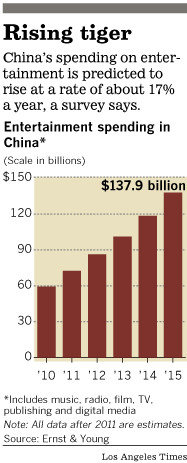 Part of that surge is driven by theatrical box office revenues. China recently surpassed Japan as the world’s No. 2 movie market and Ernst & Young says China will move past the United States to claim the top spot by 2020.
With all of the growth, though, come any number of obstacles. Chinese consumers have “constantly shifting” tastes and “have traditionally paid little or nothing for traditional content and have easy access to pirated digital content,” the report says.
Even with Chinese authorities trying to rein in piracy, media and entertainment companies will “struggle to get fair value for their products and services,” the report says. And, as has been the case with Chinese quotas on imports of American movies, government restrictions “limit or close certain sectors from either domestic or foreign private participation.”
“The challenges for media and entertainment companies to penetrate China are still considerable, however the vast potential of the market makes it impossible to ignore,” Ernst & Young’s John Nendick said in a statement accompanying the report. “Companies will need to understand that investing in China is a long-term proposition, and those who can make that commitment will be in a much better position to succeed.”
The report was particularly bullish on China’s middle class and overall spending on media and entertainment. In 2010, the report said, Chinese spending on entertainment and recreation was $350 billion, which jumped to $547 billion last year.
That spending was largely driven by the middle class, which numbered 247 million people in 2011, or 18% of the population. The study said experts predict the Chinese middle class will grow to more than 600 million by 2020.
– LATimes
Also, Canadians making small inroads in Chinese movie production:
“I don’t think a space film has ever been made yet in China,” Chang said from Taipei on Monday. “And it would require some really good partners.”