
APF Survey: Canadian Companies Profitable in China
The Asia Pacific Foundation (APF) came out with this year’s follow-up to its 2010 Canadian Businesses in China Survey. For most Canadian companies, China remains a profitable place to do business but at the same time they face considerable challenges in a very demanding market. The survey was conducted last September/October garnering only 211 responses out of over 2,700 invites. The low response rate puts a question mark on the accuracy of the survey but the results are interesting just the same.
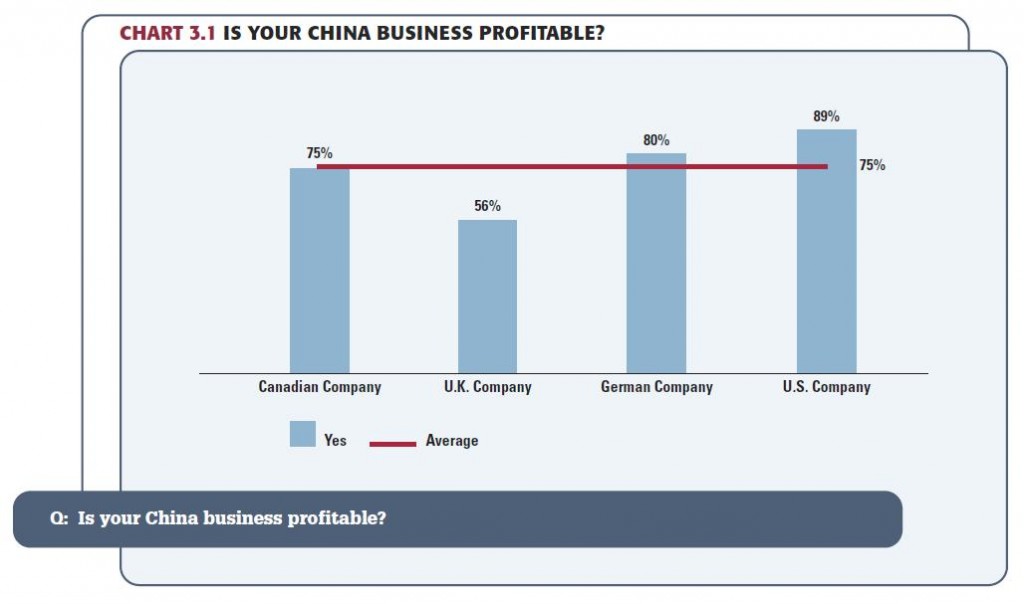
75% of company respondents said that their operations in China were profitable, roughly on par with the last survey (76%). Exporters to China had the highest profitability (84%) followed by importers (75%) and companies with operations in China (68%). German and American companies beat Canadians who in turn outperformed UK companies. In terms of share of global revenue, however, nearly 2/3 of companies indicated their China revenues were below 25%.
Nonetheless, China seems to be important for their long term growth with nearly 2/3 reporting that their business activities in China had grown over the last five years and the more established they are, the more likely their businesses will grow. 69% of respondents have been in China for at least 5 years with close to 1/5 more than 20 years.
Only 28% of companies suggested that they were interested in seeking Chinese investment and 30% said they wanted to do so to build or expand their businesses in China. Another quarter indicated they desired Chinese investors to build or expand businesses in Canada with significantly less saying it would help them expand globally.
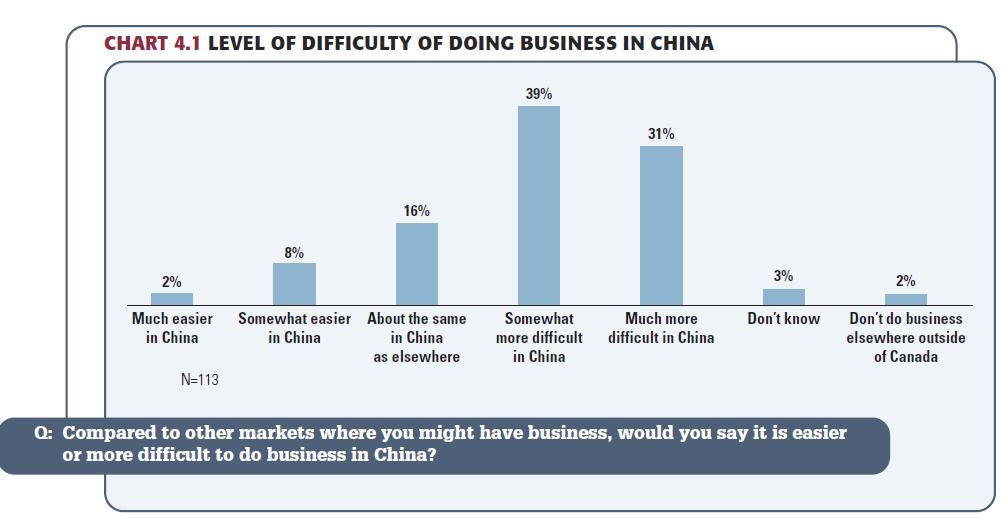
China proves to be a difficult market for Canadian companies. About 70% of the companies polled stated it is either much more difficult or somewhat more difficult to conduct business in China than in other countries. The toughest challenges they named are intellectual property protection, inconsistent interpretation of laws and regulations, weak dispute settlement, lengthy and complicated certification, and tariff and other border barriers.
The challenges were somewhat different from those cited in 2010 and by contrast, American and German companies were more concerned about human resources bottlenecks. APF suggests the challenges had to do with the rule of law and trade policy that are not easily resolved or improved at the company level. It remains the work of the two governments to hammer out/update agreements and enhance enforcement.
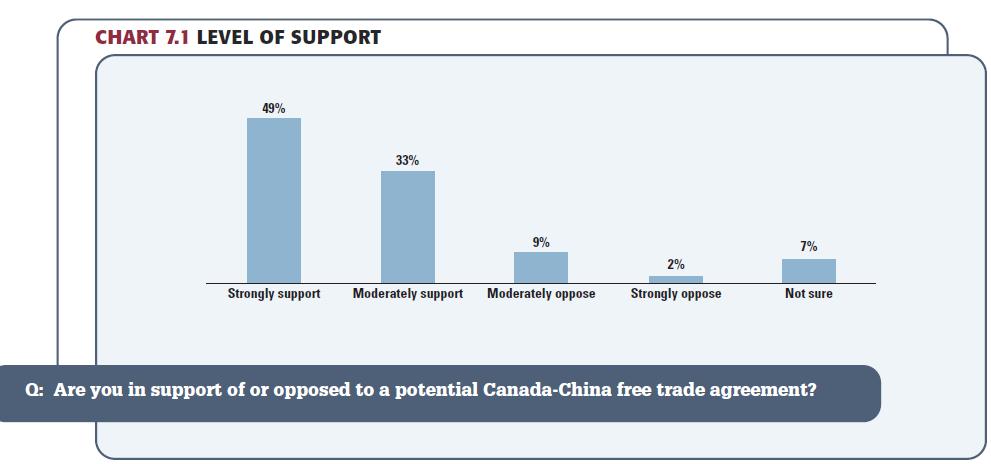
In line with an earlier poll on support for a Canada-China free trade agreement (FTA), the vast majority said they either strongly (49%) or moderately (33%) supported negotiations toward a Canada-China FTA. For APF, two reasons stand out: First, 39% agreed that a FTA would give them significant opportunities to build or expand their businesses in China; and second, 28% believe Canada needs greater trade and investment with China since the country only represents less than 7% of total Canadian trade.
As for potential benefits of a FTA with China, they named three: First, help protect Canadian businesses with commitments from Chinese authorities to treat Canadian companies on equal terms; second, help ensure that Canadian goods are not discriminated against on the Chinese market; and third, help improve a rule-based system for doing long-term business in China, giving Canadian businesses recourse to resolve disputes. Nearly 83% of respondents said their businesses or activities in China would be significantly or moderately increased under a FTA.
Canadian companies are also frustrated with the lack of access to China’s government procurement market. 85% of those polled have never bid on Chinese government contracts for the lack of interest, ignorance of where to find projects, never receiving offers to bid, and/or perceptions of discrimination against foreign companies. To win Chinese government contracts, many respondents said it is imperative to work with a Chinese partner, either being approached by one or actively soliciting a partner.
Perhaps counterintuitively, the poll showed that Canadian SMEs with global revenues of less than $10 million are the mainstay in the China market (58%) while large Canadian corporations with $100 million or more in global revenues formed another 20%. For one in five businesses, their activities are concentrated in Beijing or Shanghai and 10% in Guangdong Province. The rest are spread across China with the strongest presence in Hong Kong. 38% of them export products and services to China while 10% imported from China and nearly a quarter have set up a factory or office in China with another 20% wanting to do so.
Commenting on the results, Yuen Pau Woo, President and CEO of APF said, “Amid continued global economic uncertainty, this survey indicates that…Canadian businesses have no illusion about the difficulties of doing business in China but they have found the Chinese market to be profitable and have expanded their operations in that market over the last five years.”