
Fast Growing Mongolia Hitching a Ride With China
Here is an intro to fast paced Mongolia from the Atlantic.
Mongolia is part of a new class of countries that, like the Middle Eastern states that got rich selling oil to the West, have hitched their economies to resource-hungry China.
Predictions for Canada’s Medal Count and the Big Three at the London Games
Well, it’s a week to go for the London Olympics. Here are some predictions about Canada’s performance and that of the top three total medal contenders. Predictions are all over the map but it seems to be toss-up between China and the US for the top spot with Russia coming in third and perhaps UK fourth with its home field advantage.
Canada:
Daniel Johnson, a Canadian-born professor of economics at Colorado College, predicts that Canada will take 17 medals in London and rank 15th overall. Based on a set of economic factors such as per capita income and population, his model has proven accurate over six consecutive Olympics, averaging a correlation of 93% with actual medal counts, and 85% for gold medals.
His forecast is more pessimistic than the Canadian Olympic Committee’s goal of finishing in the top 12, which would be one better than 13th at Beijing. Back then, the prediction was Canada would get 17 medals and four golds. Canada ended up with 18 and three golds.
Jeremy Freeborn, a sports journalist for the Examiner, agrees: “After several months of research and statistical analysis, I am ready to project that Canada will win 17 medals at London…I am predicting twelve medals will come in four sports– diving, rowing, wrestling and cycling”.
Top Medals Countries:
In an interview ahead of the 100-day countdown to the Games, organizing committee chief Sebastian Coe predicted China would top the table, irritating the head of the USOC. He said China has expanded its sporting prowess beyond its traditional strengths. “I think it will be China, U.S., and then Russia…I just think if you look at it, in its entirety, (it will be) China”, Coe said.
Luciano Barra , a former senior member of the Italian Olympic Committee who projects Games results, has China topping the overall and gold medal count with 103 medals — 43 gold, 31 silver and 29 bronze. The U.S. will finish second with 82 medals — 35 gold, 19 silver and 28 bronze and Russia third with 76 — 30, 22 and 24.
Tuck School of Business at Dartmouth predictions: Overall, the US will win 103 medals followed by China with 94, Russia with 67, and the UK with 62 but China will likely snatch 48 golds and the US 35. Tuck managed a 95% accuracy rate for the total medal count at the Beijing Games. Its formula similarly takes into account each nation’s economic development, measuring per capita income, population, prior Olympic success, and other factors.
Professor Johnson (above) also predicts the US will be on top, followed by China and Russia, with Great Britain placing fourth. This year, Professor Johnson re-calibrated the model, matching 60 years of historical data with a correlation of 96% for all medals and 95% for gold medals.
USA Today projects China will take top spot overall with 94 medals, followed by the United States at 88 and Russia at 81 but the US will edge China in golds by a 41-24 margin.
The U.S. Olympic Committee wants to win the medal count but won’t name a specific goal to avoid creating unrealistic expectations.
The China Olympic Committee likewise did not set an overall target although specific teams may have.
The top 10 medals table forecast by Robin Scott-Elliot, a sports journalist for UK’s Independent newspaper. Don’t think Great Britain will beat Russia, however.
1. United States 2. China 3. Great Britain 4. Russia 5. Germany 6. South Korea 7. Australia 8. France 9. Japan 10. Italy
A ‘Milestone’ for Saskatchewan Uranium Exports to China
SASKATOON – An agreement signed Thursday in Beijing will help Canadian companies export more uranium to China, said Foreign Affairs Minister John Baird. The “supplementary protocol,” signed by Baird and Liu Tienan, head of China’s National Energy Administration, will expand a nuclear co-operation agreement that’s been in place since 1994.
“Canada is committed to building stronger trade and investment ties with China, our second-largest trading partner,” Baird said in a release. “Increased collaboration with China’s civil nuclear-energy market will give Canadian companies greater access to one of the world’s largest and fastest-expanding economies, creating new jobs, growth and long-term prosperity.”
The negotiations for the deal were completed during Prime Minister Stephen Harper’s trip to China in February.
Saskatchewan-based Cameco Corp. (TSX:CCO), one of the world’s biggest uranium miners, welcomed what it called a “key milestone.”
– Canadian Press
ADB: RMB on Way to Become Asian ‘Anchor’ Currency
Further to previous posts on RMB internationalization, this is an important endorsement from the Asian Development Bank (ADB).
 |
SINGAPORE – China’s yuan is increasingly being used to settle trade transactions in Asia, gradually cementing its way to becoming a regional ‘anchor’ currency, the Asian Development Bank (ADB) said Thursday.
The rise of the currency’s use in trade and in the financial markets is likely to nudge China to further open up its financial sector if it wants the yuan to play a bigger global role, the Manila-based lender said. The yuan, or renminbi, “is being increasingly used to settle trade transactions”, the ADB said in a statement issued in Singapore at the launch of its latest report, the Asian Economic Integration Monitor. “Over time it could become an anchor currency, helping the region to integrate their economies, cooperate on monetary and finance issues as well as gradually open up the (Chinese) financial market,” the statement said. Iwan Azis, head of ADB’s Office of Regional Economic Integration, told reporters at the launch that some countries engaging in bilateral trade with China settle in renminbi, and their number has been increasing. “I know that policymakers in Beijing are actively persuading ASEAN countries to use yuan for their bilateral trade settlement with China,” he said, referring to the 10-member Association of Southeast Asian Nations. Hong Kong, Singapore and London settle some international trade in yuan, and this month the Singapore Exchange said it is ready to quote, trade, clear and settle securities denominated in yuan, the ADB report said. “All in all, it makes sense that some of the players – exporters and importers – start to accept the use of alternative currency, and since China is the biggest player in the field, they accept the use of the yuan for trade settlement,” Azis said. He said it is “only a matter of time” before the yuan becomes an anchor currency, given that China is now the world’s second biggest economy. Since late 2008 China has established 20 bilateral local currency swap arrangements with countries within and outside Asia, totalling 1.6 trillion yuan (S$314 billion), ADB said. In the first quarter of this year, current account transactions settled in yuan were 8.6 per cent of China’s total current account deals, well above the 5.7 per cent in the same quarter last year, it added. – AsiaOne |
BBC World Editor Equates China’s Development With the Industrial Revolution
Presumably in Beijing to report on the changing of the guard at the highest echelons of the Party and central government, John Simpson, BBC’s World Affairs Editor, returns to Tiananmen Square and comments that China’s transformation over the past ten years under President Hu Jintao can only be compared to England’s Industrial Revolution two centuries ago.
Watch the video: http://www.bbc.co.uk/news/world-asia-18903058
Chinese Tourists to Canada Now Fourth Largest Group
Canada should be doing MUCH MUCH more to attract Chinese tourists. China is set to become both the biggest tourist destination and source of tourists going abroad within 5 years, according to international tourism analysts.
From the G & M: China has now overtaken Australia as the fourth-largest overseas market for visitors to Canada behind the U.K., France and Germany. In the first five months of 2012, residents from China made 115,200 trips to Canada, a 22.9 per cent increase from the same period in 2011.
With its relatively strong economic growth that has created a new class of wealthy travellers among its 1.3 billion citizens, China is now one of the world’s most influential markets for international tourists. More than 77 million Chinese travellers are expected to take a trip overseas this year and Western countries are aggressively courting their business.
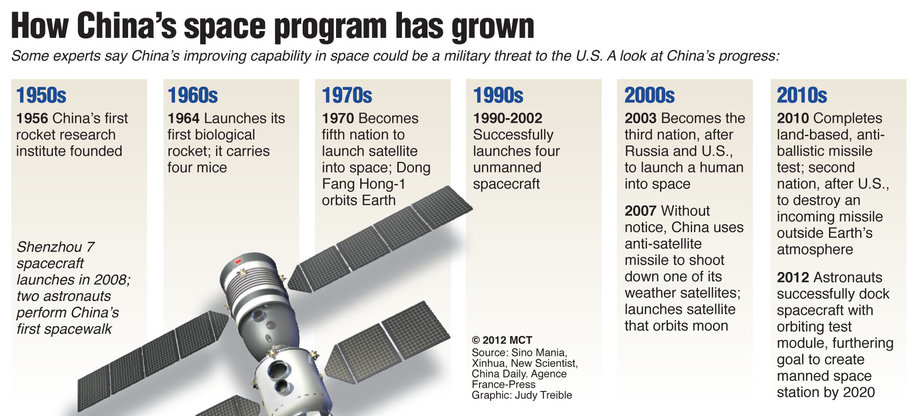
Evolution of China’s Space Program
 – McClatchy Newspapers
Comics Legend Stan Lee to Create Chinese Superhero
 Stan Lieber a.k.a. Stan Lee, the legendary Marvel Comics co-creator of Spiderman, the Hulk, the X-Men, Iron Man, Thor, the Fantastic Four and many other childhood superheros is set to create a Chinese superhero, the Annihilator, for world audiences. It’s a collaboration between his company Pow Entertainment and a Chinese production company. He said the script has been approved and production will start soon. After that, he’s planning an Indian superhero.
As for shows, he’ll open a live action arena show called “Yin/Yang: The Power of Tao” in Macau next year in which the audience actively participates.
Watch the interview: http://movies.yahoo.com/video/ymovies-6393699/comic-con-2012-stan-lee-on-his-projects-29977989.html
Robots to Replace Migrant Workers
A favorite topic of Westen analysts is China’s ‘draconian’ one-child policy that has dramatically narrowed the corridor to take advantage of the so-called ‘demographic dividend’. China’s growing shortage of young workers, they say, will bring demise to Chinese manufacturing, put much heavier burdens on a shrinking workforce in supporting a rapidly aging society, and possibly even bring about social upheaval and political chaos. Moreover, they predict, China will be old before she becomes rich. Such dire prognostications are simply over the top.
I have commented on China’s one-child policy in earlier posts but here is my take on the issue as it impacts on employment. For one thing, China will continue to enjoy its ‘dividend’ for many years to come. Second, labour-intensive production is steadily moving to central and western China as wages along the coast have ballooned some 100% in the Pearl River Delta over the past few years.
Third, as urbanization gathers speed and spreads to urban-rural nexus areas, the authorities will have to loosen up the ‘hukou’ system that impedes permanent farmer migration to bigger urban centers. The idea is to create agglomerations of townships and county seats to absorb growing populations that rely increasingly on non-farm employment. Large cities such as Hangzhou are providing permanent residence to migrants with secure jobs and long-term addresses.
In the coming years, following Western precedents, China will embark on immigration reforms to attract not only the best and brightest scientists and technologists from around the world but also ‘guest workers’ for farm work and labour-intensive production. There is already a steady stream of illegal workers seeping in from neighbouring Indochinese countries and beyond. Of course, eventually, the authorities will have to take a poke at the one-child policy, particularly as urban birth rates decline like they have in Hong Kong, Taiwan, Japan, and the West.
But, there is one aspect that isn’t talked much about in the Western press. To address possible shortages of labour for repetitive assembly line work, the most advanced companies are moving to massively use robots in automated factories, much like in Japan and Korea. A report from www.technologyreview.com below examines Foxconn’s plans for automated assembly employing up to one million industrial robots within three years. A recent New York Times article also reported on the extensive use of robots in state-of-the-art factories in Baoding, Hebei Province. 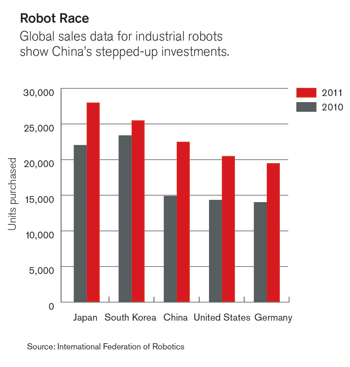 This is a wave of the future as China climbs up the ladder of technological sophistication. Instead of mind-numbing production line assembly work for less educated migrants, China is gradually shifting its increasingly educated workforce to highly-skilled jobs in high-tech and services. (See earlier posts on OECD and McKinsey Global Institute studies indicating that by 2020, 30% of the world’s pool of university educated workers between the ages of 25 and 34 will be provided by China.) A significant portion of labour-intensive jobs will undoubtedly drift to other countries in Indochina, South Asia, and Africa that will/are enjoying their versions of the ‘demographic dividend’.
Excerpts from: Migrant Workers in China Face Competition from Robots
One of the defining narratives of modern China has been the migration of young workers—often girls in their late teenage years—from the countryside into sprawling cities for jobs in factories. Many found work at Foxconn, which employs nearly one million low-wage workers to hand-assemble electronic gadgets for Apple, Nintendo, Intel, Dell, Nokia, Microsoft, Samsung, and Sony.
So it was a surprise when Terry Guo, the hard-charging, 61-year-old billionaire CEO of Foxconn, said last July that the Taiwan-based manufacturing giant would add up to one million industrial robots to its assembly lines inside of three years. The aim: to automate assembly of electronic devices just as companies in Japan, South Korea, and the United States previously automated much of the production of automobiles.
“Automation is the beginning of the end of the factory girl, and that’s a good thing,” says David Wolf, a Beijing-based strategic communications and IT analyst. Wolf, who has visited many Chinese factory floors, predicts an eventual labor shift similar to “the decline of seamstresses or the secretarial pool in America.”
Highly structured and predictable tasks are well suited to automation, says Jamie Wang, a Taipei-based analyst for the research firm Gartner. Industrial robots, typically equipped with a movable arm, use lasers or pressure sensors to know when to start and finish a job. A robot can be operated 160 hours a week. Even assuming competition from nimble-fingered humans putting in 12-hour shifts, a single robot might replace two workers, and possibly as many as four. Wang stresses that Foxconn can’t replace human workers right away because automating assembly lines would require rejiggering its entire manufacturing process.
Foxconn isn’t the only Chinese manufacturer betting on robots. The International Federation of Robotics, based in Frankfurt, tracked a 50 percent jump in purchases of advanced industrial robots by Chinese manufacturers in 2011, to 22,600 units, and now predicts that China will surpass Japan as the world’s largest market in two years. It’s obvious, Wolf says, that industrial robotics “is about to get very hot in China.”
http://www.technologyreview.com/news/428433/migrant-workers-in-china-face-competition-from/?ref=rss#
Canada’s Environmental Assessment Speeds Up
The leader of Canada’s Green Party, Elizabeth May, never ceases to amaze with her vitriol demonizing China in everything from human rights to past Canadian government supported business dealings with the country. In her latest tirade on the party’s website, she links the environment assessment portions of the Harper government’s omnibus budget implementation Bill C-38 that just passed parliament to nefarious Chinese intents in Canadian oil and gas.
In the post, she blasted: “Chinese money is already invested in the Enbridge pipeline and tanker scheme, PetroChina wants to build the pipeline, and Suncor is talking about using lower waged Chinese temporary workers – just in time to drive down wages and environmental standards…And now Sinopec’s 9% share in Syncrude has given it veto power over any future decision to refine Syncrude bitumen in Canada.”
She accuses the Harper government of selling out Canadian values and interests to the Chinese who trample on human rights, workers’ rights, and environmental protection. What has Bill C-38 got to do with China’s human rights situation? And how does Sinopec’s 9% share in Syncrude give it veto power? Her remarks pander to China-haters among her constituency and points to the embarrassing fact that her party is the perpetual oppositionist that will never wield power to practice actual government. But, enough said about her adolescent outbursts.
The importance of Bill C-38 is the message about closure in environment assessment it sends to investors, domestic and foreign, and how the overhaul of Canada’s environmental review process impinges on major projects such as the Northern Gateway Pipeline. The May and July Blakes bulletins published by the Blake, Cassels & Graydon LLP law firm provides a detailed look at key changes to the Canadian Environmental Assessment Act (new Act) that came into being earlier this month.
The Canadian Environmental Assessment Agency’s (CEAA) new regulations (to be entered into the Canada Gazette this week) determine new thresholds for federal environmental assessment to focus on the largest and most impactful projects and activities. Only categories of projects that would have required comprehensive studies will be assessed.
A major reform involves screenings and time limits. Screenings under the old Act will be continued only by special order from the Minister of the Environment with all other federal screenings suspended. Decisions on standard assessments are generally required to be made within a year of issuance. In cases involving a public review panel, decisions must be issued within two years. Under special circumstances, extensions may be allowed for up to three months.
But, it remains to be seen how the transitional provisions under the new Act will work for Northern Gateway. The joint review committee for the project was established in December 2009 with final hearings to begin in the fall but a decision unlikely until well into 2013. Since the new 2 year time limit for panel reviews has already expired, it remains unclear how the new regulations will affect Northern Gateway.
The new Act has resulted in the number of projects subject to federal assessment to plummet precipitously. Prior to the new Act, there were over 2900 screenings, 26 comprehensive studies, and 9 panel reviews (as of April 2010). Following the new Act, including screenings transitioned under ministerial order, there are only 70 projects subject to federal assessment.
Although Enbridge is a long way from selecting contractors for Northern Gateway, PetroChina is interested in building the $5.5 billion pipeline and considering taking an equity stake. PetroChina is very experienced in building and operating pipelines, able to provide a big skilled workforce at much cheaper costs, so they are expected to submit a very competitive bid. At the same time, however, Chinese companies are frustrated with Canada’s convoluted environmental assessment process. In their eyes, the old process had reduced Canada’s attractiveness as an investment destination.
China is the world’s second-biggest oil consumer that will eventually surpass the US. Following Obama’s delayed decision on the Keystone XL Pipeline, the Harper government and the oil industry is increasingly looking to China and other Asian countries as supplemental alternative markets. Thus, despite intense and often misguided criticism from the green lobby, speeding up environmental review under the new Act is a positive sign that Canada is getting serious about foreign involvement in the oil and gas industry.