
Robots to Replace Migrant Workers
A favorite topic of Westen analysts is China’s ‘draconian’ one-child policy that has dramatically narrowed the corridor to take advantage of the so-called ‘demographic dividend’. China’s growing shortage of young workers, they say, will bring demise to Chinese manufacturing, put much heavier burdens on a shrinking workforce in supporting a rapidly aging society, and possibly even bring about social upheaval and political chaos. Moreover, they predict, China will be old before she becomes rich. Such dire prognostications are simply over the top.
I have commented on China’s one-child policy in earlier posts but here is my take on the issue as it impacts on employment. For one thing, China will continue to enjoy its ‘dividend’ for many years to come. Second, labour-intensive production is steadily moving to central and western China as wages along the coast have ballooned some 100% in the Pearl River Delta over the past few years.
Third, as urbanization gathers speed and spreads to urban-rural nexus areas, the authorities will have to loosen up the ‘hukou’ system that impedes permanent farmer migration to bigger urban centers. The idea is to create agglomerations of townships and county seats to absorb growing populations that rely increasingly on non-farm employment. Large cities such as Hangzhou are providing permanent residence to migrants with secure jobs and long-term addresses.
In the coming years, following Western precedents, China will embark on immigration reforms to attract not only the best and brightest scientists and technologists from around the world but also ‘guest workers’ for farm work and labour-intensive production. There is already a steady stream of illegal workers seeping in from neighbouring Indochinese countries and beyond. Of course, eventually, the authorities will have to take a poke at the one-child policy, particularly as urban birth rates decline like they have in Hong Kong, Taiwan, Japan, and the West.
But, there is one aspect that isn’t talked much about in the Western press. To address possible shortages of labour for repetitive assembly line work, the most advanced companies are moving to massively use robots in automated factories, much like in Japan and Korea. A report from www.technologyreview.com below examines Foxconn’s plans for automated assembly employing up to one million industrial robots within three years. A recent New York Times article also reported on the extensive use of robots in state-of-the-art factories in Baoding, Hebei Province. 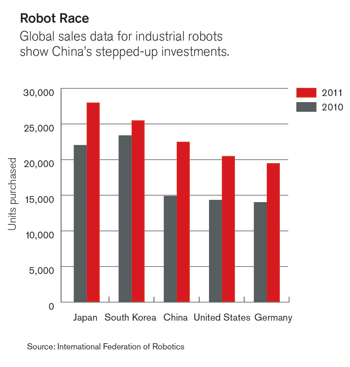 This is a wave of the future as China climbs up the ladder of technological sophistication. Instead of mind-numbing production line assembly work for less educated migrants, China is gradually shifting its increasingly educated workforce to highly-skilled jobs in high-tech and services. (See earlier posts on OECD and McKinsey Global Institute studies indicating that by 2020, 30% of the world’s pool of university educated workers between the ages of 25 and 34 will be provided by China.) A significant portion of labour-intensive jobs will undoubtedly drift to other countries in Indochina, South Asia, and Africa that will/are enjoying their versions of the ‘demographic dividend’.
Excerpts from: Migrant Workers in China Face Competition from Robots
One of the defining narratives of modern China has been the migration of young workers—often girls in their late teenage years—from the countryside into sprawling cities for jobs in factories. Many found work at Foxconn, which employs nearly one million low-wage workers to hand-assemble electronic gadgets for Apple, Nintendo, Intel, Dell, Nokia, Microsoft, Samsung, and Sony.
So it was a surprise when Terry Guo, the hard-charging, 61-year-old billionaire CEO of Foxconn, said last July that the Taiwan-based manufacturing giant would add up to one million industrial robots to its assembly lines inside of three years. The aim: to automate assembly of electronic devices just as companies in Japan, South Korea, and the United States previously automated much of the production of automobiles.
“Automation is the beginning of the end of the factory girl, and that’s a good thing,” says David Wolf, a Beijing-based strategic communications and IT analyst. Wolf, who has visited many Chinese factory floors, predicts an eventual labor shift similar to “the decline of seamstresses or the secretarial pool in America.”
Highly structured and predictable tasks are well suited to automation, says Jamie Wang, a Taipei-based analyst for the research firm Gartner. Industrial robots, typically equipped with a movable arm, use lasers or pressure sensors to know when to start and finish a job. A robot can be operated 160 hours a week. Even assuming competition from nimble-fingered humans putting in 12-hour shifts, a single robot might replace two workers, and possibly as many as four. Wang stresses that Foxconn can’t replace human workers right away because automating assembly lines would require rejiggering its entire manufacturing process.
Foxconn isn’t the only Chinese manufacturer betting on robots. The International Federation of Robotics, based in Frankfurt, tracked a 50 percent jump in purchases of advanced industrial robots by Chinese manufacturers in 2011, to 22,600 units, and now predicts that China will surpass Japan as the world’s largest market in two years. It’s obvious, Wolf says, that industrial robotics “is about to get very hot in China.”
http://www.technologyreview.com/news/428433/migrant-workers-in-china-face-competition-from/?ref=rss#