
Sports Scholar: Beijing Games Changed the Olympics and the West
London and Beijing Olympic Games opening ceremonies
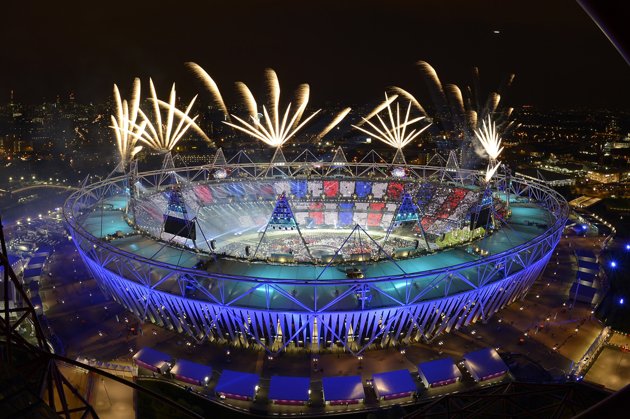

Atlantic Monthly online featured an enlightening Asia Society interview with sports anthropologist Susan Brownell who has written extensively on sports in China and China and the Olympics. She disparaged Western ‘self-centeredness’ that pervaded in the lead-up to, during, and after the 2008 Beijing Olympics on whether and how much China would be changed by the Olympics. Instead, she suggests, the question should be stood on its head – how much has China changed the Olympics along with Western perceptions and biases?
“Westerners seemed so concerned about the question of whether hosting the Olympics would push China toward Western-style political reforms, and no one seemed concerned about the question of whether, instead of us changing China, China might actually change us. I felt that many of my Western listeners needed to be awakened out of their self-centeredness”, she said pointedly.
So, did China change the Olympics and Western views and behaviour? She gives a resounding ‘yes’. First, the importance afforded Beijing’s hosting of the Games by China’s leaders forced their Western counterparts to take notice and attend the opening ceremonies. (Despite notable snubs like Stephen Harper’s, George Bush was among the dignitaries in the Bird’s Nest.) This time round, both Mitt Romney and Michelle Obama are present, precisely because of the political and economic importance attached to Olympics since Beijing. Moreover, Beijing’s opening ceremonies and Games management are a hard act to follow that set a new standard for others.
Thus, depending how the London Olympics turns out in all its facets – pre-Games lead-up, opening ceremonies, day-to-day management and operations, athlete performances, transport and traffic, ticket sales, security, etc. – Professor Brownell anticipates discussions on the merits and weaknesses of games held in liberal democracies in contrast to the virtually ‘unlimited’ human and financial resources that the Chinese threw at Beijing.
[London’s opening ceremonies will cost some US$42 million compared to more than $100 million for Beijing. Overall costs: Total Beijing investment in buildings and infrastructure, including Capital Airport’s Terminal 3, is around $40 billion. London’s costs are disputed: The British House of Commons Public Accounts Committee puts the figure around 11 billion Pounds ($17.31 billion); Games Monitor calculates costs at 13 billion Pounds ($20.45 billion); but a Sky Sports investigative report estimates that, including public transport upgrades, the price tag will be closer to 24 billion Pounds ($37.76 billion)]
Professor Brownell also had some trenchant words about media coverage ahead of Beijing versus London. On the positive side, counter to expectations, coverage in the lead-up to London is actually up from Beijing, partly because of the ‘Anglo-Saxon clique’ within the IOC but mainly because of the energy that Beijing engendered into the Games. On the negative side, media coverage of Beijing 2008 was a “product of a mutual production cycle” in which the Western media largely reported on reports and statements issued by human rights groups that were timed for release at regular intervals.
So, ‘news’ covered mainly those groups as opposed to concrete events. Ahead of the London Games, surveying the Anglophone media (via Lexis/Nexis), she found that in the week following the resignation of London Organizing Committee of the Olympic and Paralympic Games (LOCOG) sustainability chairman, there were only 21 reports about the scandal but at the same time, there were 17 reports about artist turned self-professed dissident Ai Weiwei.
“Apparently, criticizing the Chinese government is more popular than criticizing multinational corporations”, she pointed out.
On the US-China rivalry over gold and total medals, Professor Brownell thinks China will not be able to repeat its gold medal performance in Beijing, perhaps ending up with 35-39. (Her prediction dovetails with that of a Chinese official who projected that China would harvest 1/3 less golds than 2008 (51) and finish second overall.) More important, the debate should/could lead to a bigger dialogue on market-based versus state-supported sport, the support for women athletes and minor sports in the US versus China, and other bigger issues.
Finally, she had some critical advice for Western (American) journalists reporting on China generally and more specifically on China and the Olympics: “I wish that more journalists would approach their stories on China asking, ‘What does China do admirably, which we can learn from?’ One of the points I try to hammer home is that government-supported sport is more supportive of women than market-based sport, and that’s one reason China topped the US in the gold medals count in 2008. Americans don’t really want to hear that”, Ms Brownell contended.
For the entire interview, visit: http://www.theatlantic.com/international/archive/2012/07/a-new-kind-of-spectacle-how-china-changed-the-olympics/260407/
Japan Health Ministry: Hong Kong Women Now Most Long-Lived
Japanese women had had the world’s longest life expectancy every year since 1985, but the latest figures from Japan’s Ministry of Health put them second behind Hong Kong, where women can anticipate living to 86.7. The ministry said deaths from the country’s double disaster were a key factor in lowering its calculation of newborn girls’ expected lifespan from 86.3 years in 2010 to 85.9.
“We can’t say Japanese women’s life expectancy is on course to decline (longer term) because the East Japan Great Earthquake is seen as a one-time factor,” the ministry said.
Spanish women were third at 84.9 years, followed by French at 84.8.
Japanese men’s life expectancy also declined to 79.4 years, putting them in eighth place globally.
-AFP
Schumer Gripes About CNOOC-Nexen
I thought something like this might happen. The China bashers in US Congress are so pitiful. As if the US can block the deal.
The U.S. government should block a bid by China’s state oil company CNOOC for Canadian oil company Nexen until China’s government provides fair access for U.S. companies that want to invest in China, a top Democratic senator plans to tell Treasury Secretary Timothy Geithner on Friday.
In a draft letter obtained by Reuters, Charles Schumer, the Senate’s No. 3 Democrat and a frequent critic of China’s trade and currency policy, said the powerful Committee on Foreign Investment in the United States should not approve the deal until China makes “tangible, enforceable commitments” on market access for U.S.
-Reuters
China’s High Speed Rail Network Formed by 2015
After the sub-high speed rail accident a year ago, it looks like full speed ahead for China’s high speed rail network.

Xinhua – China will have established a high-speed railway network covering almost all its cities with a population of more than 500,000 by 2015, according to a latest official program.
The State Council, or China’s cabinet, late Tuesday issued a plan for building a comprehensive transportation network during the 2011-2015 period. According to the plan, China should basically complete the construction of a high-speed railway network with a total operating length of more than 40,000 kilometers by the end of 2015.
China will initially establish a comprehensive transportation network with a total length of 4.9 million kilometers, mainly including railways, roads and inland waterways, according to the plan.
IMF Upbeat About Chinese Growth
Markus Rodlauer, Deputy Director, Asia & Pacific Department, IMF, answers questions from ordinary Chinese about growth, the housing market, RMB appreciation, and sustainability of growth going forward.
China’s economy is soft landing with growth at 8%, raising consumption is key medium-term priority, the IMF said in its latest assessment of the country’s economy.
Watch the video: http://www.imf.org/external/mmedia/view.aspx?vid=1751997458001
Dutch/EU Study: China CO2 Emissions Up Significantly
A report released earlier this month by the PBL Netherlands Environmental Assessment Agency and the European Union has China leading the world in CO2 emissions by a wide margin, emitting 9.7 billion tonnes last year. This figure is much higher than the International Energy Agency’s (IEA) data for 2009 putting China’s emissions at 7.7 billion tonnes that year. (see post of May 29) The Dutch report’s findings for China are even higher than that would be the case if IEA’s 2009 data were extrapolated by 10% rises over the last two years.

The top six emitters, according to Trends in Global CO2Emissions 2012, are China (29%), the US (16%), the EU (EU27) (11%), followed by India (6%), the Russian Federation (5%), and Japan (4%). These countries accounted for 71% of global emissions. Interestingly, OECD countries now emit only 1/3 of global totals, roughly the same as China and India combined.
China’s hike of 9% in 2011 was driven by fuel consumption associated with industrial production, building construction, and expansion of infrastructure, the report stated. Since 2002, China’s emissions have expanded by a staggering 150% while industrial emissions in the EU continued to decline. China’s emissions upsurge is consistent with increases in coal-fired thermal power generation, steel production which uses large amounts of coal, and the making of cement.
According to the World Steel Association, the 9% increase in Chinese crude steel production last year represents almost 1/3 of global expansion with China making 44% of all steel. China’s cement production also jumped 11%, accounting for 57% of global emissions from the sector.
But the report also points to discussions about discrepancies (uncertainty margin) in Chinese fuel consumption data as reported from provincial versus national sources could be as high as 10% (see post of June 16).
In terms of per capita emissions, China’s figures have likewise spiked. Last year, they increased 9% to 7.2 tonnes. Taking into account an uncertainty margin of 10%, Chinese emissions are now on par with the EU which emitted 7.5 tonnes per person. Well within the 6 to 19 tonnes/person range for the largest industrialized countries, China’s emissions are bound to complicate the debate over her responsibilities and that of other large rapidly developing countries at future climate change talks. 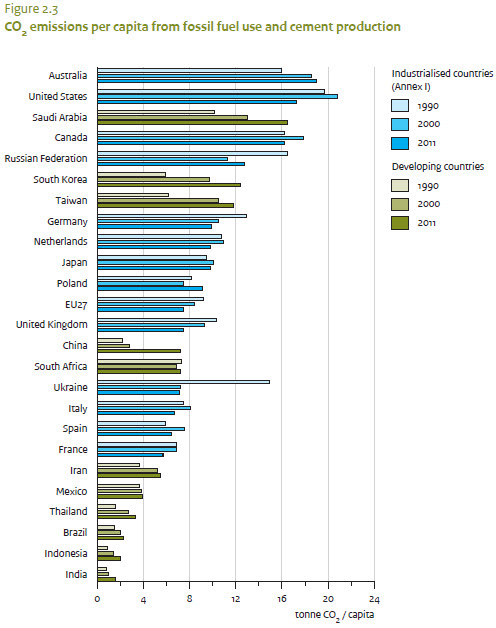 By way of a comparison, in the 22 year span between 1990 and today, China’s per capita emissions have more than tripled from 2.2 to 7.2 tonnes per capita whereas in EU27 countries, they have declined from 9.2 to 7.5 tonnes. The US has also seen a decline from 19.7 to 17.2 tonnes.
In terms of fossil fuel consumption, China’s thirst for oil rose by 5.5%, less than the 10-year average, with oil imports increasing 13%. Coal consumption leaped 9.7% to account for 49% of global coal use. Imports rose 10%, making China the world’s largest importer, overtaking Japan.
One bright spot is renewable energy in which China is a front-runner. (also see post of June 12) China is the world’s largest wind power market, installing 16.6 gigawatts (GW) of new capacity in 2011 to total 62.4 GW albeit wind still represents a small fraction (1.5%) of total power generated. One of the problems holding back wind power in China is that local grid infrastructure cannot keep pace with installations, resulting in connection delays.
China doubled its installed capacity of solar photovoltaic (PV) panels, adding 2.2 GW (1.8 GW for wind farms and 0.4 GW for rooftop installations). Although hydropower increased modestly last year, China’s output over the past two decades represents nearly 1/2 of global increases of 62%. Without renewable energy, world emissions would be 5% higher in which China accounts for about 1/3 of potentially avoided emissions.
CNOOC to Acquire Canadian Oil-Producer Nexen
This is a big deal and sets a precedent for Chinese investment in Canadian oil and gas, if only for its size. Guess Harper’s get close to China policy for trade and investment is paying off. But, how many Chinese investments of such magnitude will Canada allow? And, you can expect a backlash from China bashers and radical environmentalists.
http://news.yahoo.com/chinas-cnooc-says-buy-canadas-nexen-15-1-103111969–finance.html?_esi=1
Some key facts about Nexen.
– Nexen is Canada’s sixth-largest independent oil explorer and producer, and the 10th biggest energy company by market capitalization in the energy sector of the Toronto stock exchange, based on Friday’s closing price.
– As of 2011, Nexen had about 2.3 billion barrels of oil equivalent of proved and probable reserves.
– The company started in Western Canada as a unit of Occidental Petroleum Corp, but is now fully independent. It operates in the Gulf of Mexico, Colombia, the North Sea, Yemen, and offshore West Africa. Its assets include conventional oil and gas, oil sands and shale gas.
– Nexen produced 207,000 barrels of oil equivalent per day (boe/d) in 2011, including about 45,000 boe/d in the Athabasca oil sands region in the Canadian province of Alberta, where it has stakes in the Long Lake and Syncrude Canada projects.
– Nexen is the second largest oil producer in the North Sea, where it operates the Buzzard platform. In 2011, its share of Buzzard production was 62,400 boe/d. In the Gulf of Mexico, Nexen’s 2011 share was 22,600 boe/d.
– Headquartered in Calgary, Alberta, and traded on the Toronto Stock Exchange and the New York Stock Exchange, Nexen has about 3,000 employees, including about 2,000 in Canada, 500 in the United Kingdom and 330 in the United States.
– Nexen’s market capitalization was C$9.15 billion as of Friday’s close.
– Interim Chief Executive Kevin Reinhart took over in January, and shares rose on hopes he could fix costly operational problems that have plagued the company’s Long Lake oil sands project and its North Sea operations.
– Some analysts are impressed with Reinhart’s progress, but shares have been held back by the weak outlook for oil prices.
Source: Company filings, company website, Thomson Reuters data.
Some Beijing Olympic Venues Deserted
This Yahoo! Sports/Reuters photo essay headlined “Beijing’s ’08 Olympic Venues in Shambles” is somewhat misleading. It claims that MOST of the venues built for the 2008 Olympics are either abandoned or demolished which is not true. The biggest venues such as the Bird’s Nest, Water Cube, tennis center, basketball stadium, etc. are well-maintained and in use.
The deserted venue photos are of the baseball, kayaking, BMX racing, rowing, beach volleyball venues along with the velodrome. But, the velodrome is not abandoned at all as international cycling races are held there not infrequently. The dilapidated facilities are for sports that are not popular in China such as baseball, kayaking and BMX racing. They had to be built for the Olympics. So, let’s put things in a little perspective.
The photo essay can be seen here: http://sports.yahoo.com/photos/olympics-before-and-after-beijing-s-2008-olympic-venues-four-years-later-slideshow/bird-s-nest-2008-photo-1340387759.html
Sex Offender Peeping Chinese Olympic Swimmers in Locker Room
This is simply bizarre:
Female Chinese Olympics swimmers are “tapering” – dialing down the rigor of their workouts – at their Leeds training camp before the Games officially begin on Friday.
What the women didn’t expect was Declan Crosbie.
Three of China’s elite female swimmers were in a locker room at a university pool last week when they noticed a man inside a locked toilet stall, peering over the top of the stall at them. The swimmers alerted a pool manager and a security guard who asked the occupant to come out.
“When they challenged him, he answered in a lady’s voice,” said Karen Williams, a local prosecutor.
When he emerged, the man was “dressed smartly” – unless you count his fly being open. He fled the scene but was later arrested.
Mr. Crosbie, 25, from Leeds, pleaded guilty to trespassing with intent to commit a sexual offense and will be sentenced next month. British media reports say he has been on the Registered Sex Offenders list due to previous convictions for climbing onto a roof to film a woman taking a shower and “peering at women under leisure center cubicles,” according to The Telegraph newspaper. He was also jailed after “he was found inside a house standing over a sleeping woman” with his trousers down.
The story was the most searched item last Friday on Baidu, China’s largest search engine.
– IHT Rendezvous
Solar Farms Proliferating in Xinjiang
China is the world’s largest investor in renewable energy – wind, solar, and hydro – and Xinjiang, along with Gansu, Qinghai, and Inner Mongolia, is emerging as a key node in China’s renewable energy strategy, particularly for solar. Abundant in sunlight, Xinjiang is renowned for its delicious grapes and raisins and hami melons. But in recent years, the vast province covering almost 1/6th of the country has witnessed exponential growth in solar farms.
Owing to dramatic drops in solar panel prices and lackluster sales in the US and EU, China is increasingly looking to the domestic market for expansion. Solar farms are popping up everywhere in Xinjiang, including isolated off the grid Kazakh villages along the Mongolian border. Installed capacity is expected to double this year and by the end of 2013, China will surpass Germany and the US to become the world’s biggest installer of solar panels.
Watch this interesting Financial Times video report: http://www.ft.com/intl/whats-next-asia