
National Rejuvenation Index
China has a legion of social scientific think tanks pounding out literally thousands of reports every year. While many produce thoughtful and interesting research that shed light on a rapidly changing socio-economic landscape, some are downright wacky. Take the latest “The Great Rejuvenation of the Chinese Nation Monitoring and Evaluation Index” that was just released by Yang Yiyong, Director of the Microeconomics Institute at the National Development and Reform Commission (NDRC). (In the past, I have interviewed Mr Yang on labour and employment issues.)
According to his quantitative index, China is almost 2/3 (62.7%) of the way to restoring its former glory as the greatest economic and political power on earth. Apparently, back in 2005, China was only 46% of the way there but within a short five years, national rejuvenation had pressed ahead by over 16%. At that rate, China should achieve full rejuvenation within a decade, roughly the same timetable set by the central government to achieve mid-developed status by 2020.
Reported on China News Online, Mr yang said his index looks at five criteria for China’s national rejuvenation, including China’s overall economic strength; all-round development of society, science and technology, education, and health; development of socialist democracy and the rule of law; environmentally-friendly and sustainable growth; and China’s re-unification with Taiwan along with contributions to world peace. Needless to say, some of his criteria are hardly amenable to quantification.
Yet, Mr Yang insists he is able to quantify them using three levels of indicators: an overall indicator for ‘national rejuvenation’; another set of indicators measuring economic and social development, the ‘sophistication’ of the people, R & D and innovation, resources and environmental protection, and international influence; and a set of 29 indicators such as one that matches appropriate GDP to population, the Engel coefficient, the Gini coefficient, per capita education levels, rates of patent registration, forest cover, and international competitiveness, among others.
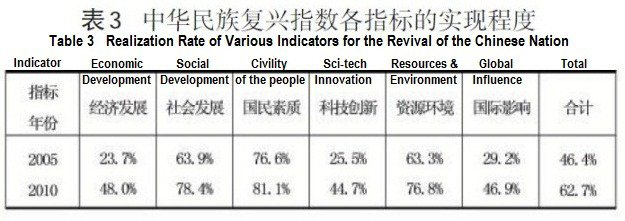
But, his index immediately drew a torrent of criticism from the Chinese media, not to mention snide remarks from Chinese netizens. A commentator on Global Times questioned, “how was the calculation conducted in terms of more subjective subjects like democracy or the rule of law? Were they calculated simply by comparing the contextual difference between China’s policies and law and those of developed Western countries?…When rating the revival of a nation, parameters of economic development are indeed important. But what’s more significant is whether people are becoming more confident in their nation and their culture”.
A writer on Hongwang added: “the feelings of the nation and international recognition and acceptance are standards by which to measure a nation’s development…The feelings of the people are more direct and convincing. A country in which ordinary people cannot afford to seek medical attention, attend school, or buy a house is country that is still a long way from ‘rejuvenation’”. Instead of wasting time and public expense on such frivolous efforts, the writer admonished, Mr Yang should be devoting himself to more down-to-earth research that actually benefits socio-economic understanding.
But, Mr Yang shrugs of the criticism and remains undaunted. Acknowledging the need for more time-specific and relevant indicators, he promises to come up with a better set of measurements in his next report planned for 2017. Best of luck to him in his impossible task.
China Top Export Market for Most of US
Wonder what US China bashers are thinking now.
All but 15 of the 435 districts represented in the United States Congress recorded larger numbers of goods sold to China than to other export markets in 2011, according to a leading business group. The US-China Business Council, which represents US companies that do business with China, also found that in 418 of those 420 congressional districts, the growth in exports to the country hit triple digits between 2002 and 2011.
“Exports to China contribute to America’s economic recovery and support good jobs for American workers. China is the third-largest US export market and continues to provide growing opportunities for US businesses, large and small,” said the council’s vice-president, Erin Ennis.
Canada and Mexico are the top two US export markets, largely due to their proximity to the United States and participation in the North American Free Trade Agreement. From 2000 through 2011, US exports to Canada increased by US$102 billion, followed by China ($88 billion), Mexico ($86 billion) and Brazil ($28 billion), the business council’s report said.
The top three districts that export to China in 2011 were Washington state’s 4th Congressional District ($3.3 billion), Louisiana’s 5th ($3.1 billion) and Oregon’s 1st ($1.5 billion). Their chief exports include agricultural products, computers and electronics, chemicals, waste and scrap. Broken down by state, Washington had five of the top 10 exporting districts, followed by Louisiana with three.
“Congressional districts in states as diverse as Colorado, Nevada, Ohio, Michigan, Pennsylvania, Virginia and Wisconsin also benefited from rapidly increasing exports to China – including exports of manufactured goods such as electrical equipment, machinery, computers and electronics, transportation equipment, and other high-end products,” Ennis said.
Despite the rapid improvement, China was the destination of only 7 per cent of US exports last year. For China, the United States is only the fifth-biggest source of imports, according to the US Trade Representative’s Office.
To maximise exports, the US-China Business Council suggests in its report that Washington policymakers increase the capacity and resources of trade-promotion agencies such as the US Commercial Service, the US Export-Import Bank and the Trade Representative’s Office while providing more support to local-level exchanges between the two countries.
The Chinese government has said that US controls on the export of technology products are the main constraint on trade with China. Former US Treasury secretary Henry Paulson wrote in his recent report A New Framework for US-China Economic Relations that the US should be more open to Chinese investment, grant China market-economy status on a sector-by-sector basis and reform its outdated export-control system.
– China Daily
Journal Nature Apologizes for its Irresponsible Article on Ye Shiwen
The journal Nature apologized to Chinese swimmer Ye Shiwen on Monday for carrying a controversial article on its website that “gave the impression that we were supporting accusations against her” with implication for doping. The article titled “Why great Olympic feats raise suspicions” was published on Nature’s website on August 1, which says that Ye’s gold-winning performance is “anomalous” and implies that her clean drug test during competition can’t rule out the possibility of doping.
The 16-year-old Ye broke a world record to win the women’s 400m individual medley gold and followed up with a 200m medley gold in the London Olympics.
Nature apologized in an “Editor’s Note” on Monday, saying: “The news story was triggered by a debate that was already active, concerning the scale of Ye Shiwen’s victory. Such debates have arisen over many outstanding feats in the past, by athletes from many countries, and it is wrong to suggest, as many of the critics do, that we singled her out because of her nationality.
“The story’s intention as an explainer was to examine how science can help resolve debates over extraordinary performances, not to examine those performance statistics in detail. Several analyses done by others convinced us that it was fair to characterize Ye’s performance as ‘anomalous’ – in the sense that it was statistically unusual.
“But we acknowledge that the combination of errors discussed above and the absence of a more detailed discussion of the statistics (which with hindsight we regret) gave the impression that we were supporting accusations against her, even though this was emphatically not our intention.
“For that we apologize to our readers and to Ye Shiwen.”
The note was co-authored by Tim Appenzeller, Chief Magazine Editor of Nature, and Philip Campbell, Editor-in-Chief of Nature.
– Xinhua

China Approached Canada First on Free Trade
This is interesting:
“China asked Canada to consider the feasibility of an FTA (Free Trade Agreement) as part of a study into the ways in which the Canadian and Chinese economies are complimentary…Canada accepted China’s proposal for an economic study and to consider an FTA thereafter”, the note reads.
Trade consultant Lawrence Herman said the fact China approached Canada is significant because it is selective in which countries it chooses to pursue free trade talks with. China may want to use Canada as a testing ground before launching negotiations with larger and potentially more complicated trading partners such as the United States or European Union, Herman said.
Hungry for Canadian energy and natural resources, it may also want to establish a framework around which to expand its involvement in the oilsands and mining sectors. China has emerged as Canada’s second-largest trading partner after the United States and a major source of foreign investment – including $10 billion into Alberta’s oilsands and B.C.’s shale gas deposits.
A joint study launched during Prime Minister Stephen Harper’s trip to China in February is aimed at determining ways to enhance trade and economic activity between the two countries. The study was to be completed by the end of May, but it still hasn’t been released.
A recent Asia-Pacific Foundation of Canada survey of 465 individuals engaged in Asia through their professional, research or personal interests found nearly half felt the government should prioritize trade talks with China over other partners such as Japan, India and the European Union.
– Postmedia News
Study: Canada Needs More STEM Graduates to Compete
A recent report commissioned by the Canadian Council of chief Executives (CCCE) draws a grim picture of Canadian higher education that it is failing to graduate a new generation of scientists and engineers. If downward trends persist, Canada’s ability to compete in the rapidly evolving global economy could be threatened.
Competing in the 21st Century Skills Race (Competing) compares Canadian and Chinese achievements in general literacy, student enrollment in science, technology, engineering, and mathematics (STEM), and cultivation of skills for innovation. It is co-authored by Graham Orpwood, York University professor emeritus of mathematics, Bonnie Schmidt, president and founder of Let’s Talk Science, a non-profit NGO, and Hu Jun, associate professor at the China National Institute for Educational Sciences in Beijing.
Canadian education has traditionally set high standards for literacy and the OECD Program for International Student Assessment (PISA) consistently places Canadian teenagers among the top in reading, mathematics, and science. In 2010, the Conference Board of Canada gave Canadian primary and secondary education highest marks, surpassed only by Finland among 17 peer countries. Canada also scored high in high school and college completion rates.
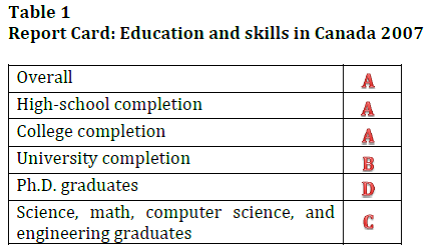 source: Conference Board of Canada
Canada falters, however, in post-secondary STEM education. A benchmark study on Canadian science learning sponsored by Let’s Talk Science and Amgen, a leading Canadian biotech company, found that from 2004 to 2007 only 10-13% of university degrees granted were in the sciences. What’s worse, engineering degrees constituted a mere 8-9% of all degrees granted. By contrast, the proportion of engineering graduates in China had increased from 30% to 37% in the same period.
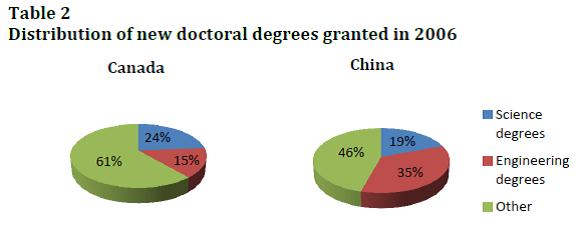 source: OECD Science, Technology and Industry Scoreboard
The situation doesn’t improve at the doctoral level. In a 2006 ranking, science and engineering doctorates accounted for only 22% and 17% respectively of all doctorates. Again, China trained far more engineering and science doctorates – 37% in engineering and 20% in the sciences.
In terms of student preferences, a 2010 Angus Reid survey of teenage Canadian attitudes found only 37% interested in taking a science course at university. Competing similarly found a majority of Canadian students not attracted to STEM programs and careers. The Amgen/Let’s Talk Sciences study points to a serious disconnect between positive perceptions of the importance of science in society and young people’s desire to pursue as a science or engineering career.
Looking at labour market trends, Competing concludes that Canada faces a growing shortage of skilled workers with STEM university or post-graduate degrees. It cites a 2010 study by Dr Rick Miner, President Emeritus of Seneca College, projecting that in Ontario alone, there will be a million skilled vacancies by 2021 and close to two million by 2031. (already 1/2 million vacancies in 2011) Human Resources and Skills Development Canada says most vacancies are in mining, IT, transportation equipment, oil and gas, science services, and health care, all sectors requiring solid STEM educations.
The challenge for Canadian post-secondary education, then, is fostering interest in STEM programs and encouraging young people to take up STEM careers. Posing a few ‘awkward questions’, Competing strongly suggests the creation of a National Roundtable on Skills with the participation of various levels of government, the private sector, NGOs, and educators.
A rethinking of subject boundaries and development of multi-disciplinary education is needed to recruit and retain young people in STEM programs. With the help of the private sector, better linkages must be made between educational programs and career paths.
For these reasons among others, the report recommends robust and long-term academic exchanges and collaboration between Canada and China to enable deeper understanding and exploration of innovative trends in education. It would also help Canadians better understand China as a world-class developer of skilled workers. This is all the more important given that China is expected to provide 30% of the world’s high-skilled workforce by 2030. (see post of June 11, 2012)
Shanghai Winning War on Chinglish
Glad they’re winning the fight in Shanghai but second and third tier cities are full of egregious violations.
China’s most international city says it is winning a war on “Chinglish,” the garbled and often quirky translations that adorn street signs, shop fronts and menus across the country. Officials from Shanghai’s “quality watchdog” announced that the accuracy of English language signs in public spaces had improved 85 per cent since it took action three years ago.
The campaign to eradicate “Chinglish” was launched in the run-up to Shanghai’s 2010 World Expo and aimed to spare the city’s blushes from thou-sands of giggling foreign guests. Shanghai’s “Commission for the Management of Language Use” deployed hundreds of volunteer students on to the streets.
Signs removed include those telling commuters to “keep valuables snugly” or to “inform police immediately – if you are stolen.” Visitors venturing out-side China’s big cities can still dine out on “gross noodles,” withdraw money from “cash recycling machines” or relax in “personnel crush-rooms.”
Shen Weimin, vice-director of Shanghai’s municipal bureau of quality and technical supervision, boasted that English gaffes were increasingly rare and that other provincial governments were following Shanghai’s lead. “We created standards in the use of English for 12 industries from public transportation to tourism,” he said, according to the Global Times newspaper.
– Daily Telegraph
Kim Says Economy is Priority
I’ll see it to believe it.
Kim Jong-un, North Korea’s new young leader, has told chief backer China that his priority is to develop the decaying economy and improve living standards in one of the world’s poorest states, the latest sign that he may be planning economic reforms.
“Developing the economy and improving livelihoods, so that the Korean people lead happy and civilized lives, is the goal the Korean Workers’ Party is struggling towards,” he was quoted by China’s Xinhua news agency on Friday as telling Wang Jiarui, visiting head of the Chinese Communist Party’s International Department and Beijing’s key interlocutor with the North.
– Reuters
Maclean’s Chart: US-China Economic and Olympics Rivalry
CHART – Team China vs. Team USA: The great overtaking
By Erica Alini – Monday, July 30, 2012 – 0 Comments
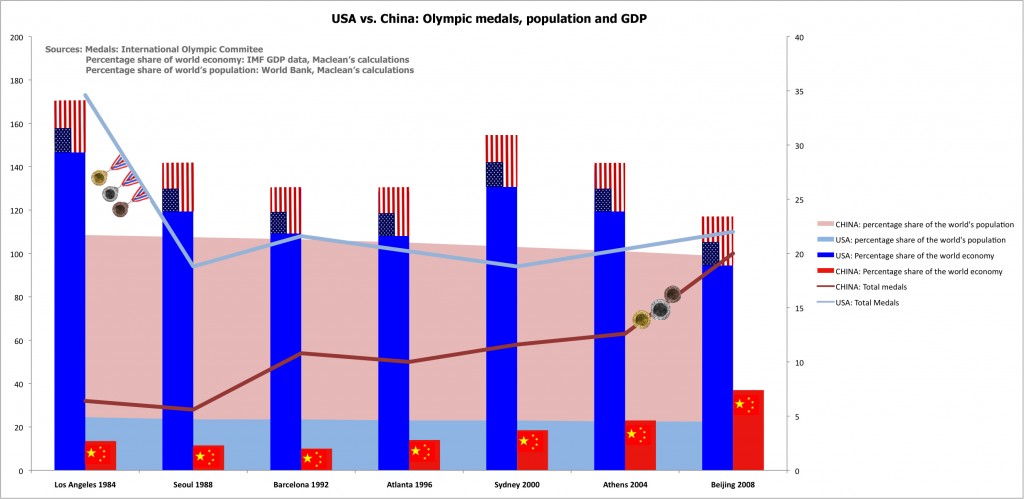
In the 2008 Beijing Olympics, China came in a close second after the U.S. in the medals count — placing first, second or third in 100 events vs. the Americans’ 110.
London 2012, though, might well be the games where China overtakes Uncle Sam. Medal, after medal, after medal, the People’s Republic has been dominating the charts since day one — and unsurprisingly so.
As our graphic shows, population and GDP are propelling China to the top of the podium. It’s been a slow climb for the past 14 years. Below, we’ve charted the U.S. and China’s shares of the world economy (the blue and red columns), their share of the world’s population (the blue and red shaded areas) and the total number of medals won in each of the past seven Olympics (the blue and red lines).
Report: Canada Must Prioritize Trade with Emerging Economies
A recent report by Gowlings law firm in collaboration with Carleton University’s Norman Paterson School of International Affairs is a laundry list of recommendations to reform government policy and business thinking and behaviour for a major transformation of Canada’s international trade.
Winning in a Changing World: Canada and Emerging Markets, sounded the alarm bell for Canada to strengthen its relationship with rapidly developing markets, especially East Asia, or risk falling behind in an increasingly competitive export environment.
Presented to Prime Minister Harper, opposition leaders and premiers, the report leveraged Mark Carney’s, Governor of the bank of Canada, recent remarks on Canada’s faltering trade since 2000. Canada performed second worst among G-20 countries, almost 5% slower than average global export growth with Canada’s share of world totals plummeting from 4.5% to 2.5%. 85% of Canadian trade continued to be with the US and other slow moving developed country trading partners. 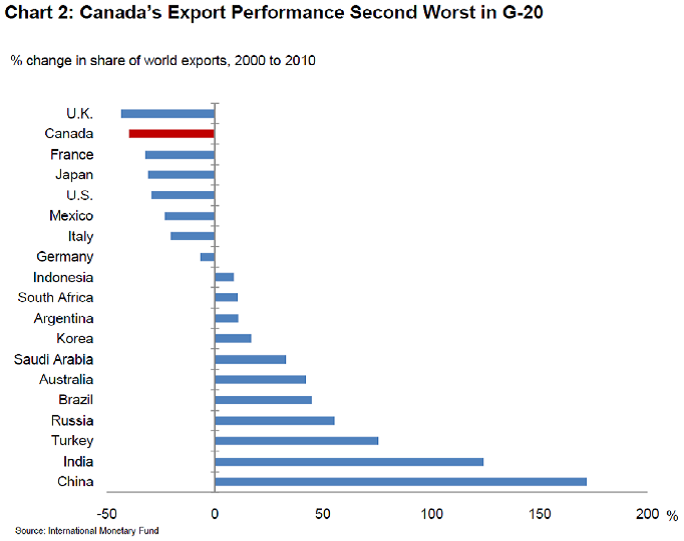
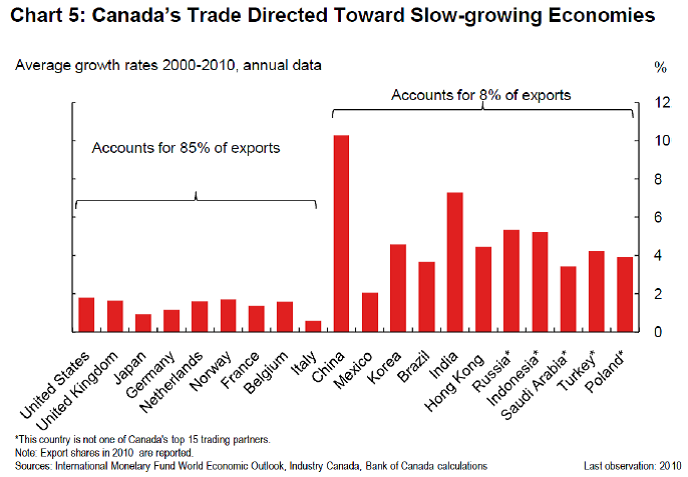 Emerging economies, including China, India, Korea, Indonesia, Brazil, Russia, along with Saudi Arabia and Turkey, by contrast, accounted for about 2/3 of global economic growth and 1/2 of import growth. Citing various studies, the report noted that China will surpass the US in size by the end of the decade and global trade will nearly quadruple in a further ten years. By mid century, emerging markets will account for 70% of global wealth and 60% of world trade with Asian countries taking up 50% of world production. North America’s share of global trade will shrink by nearly 1/2 to a mere 8%.
Governor Carney spelled out three factors contributing to Canadian export malaise: declining competitiveness due to a strong dollar, rising wages, and productivity declines; failure of Canadian businesses to adapt to a rapidly changing world; and lack of focus on the best markets while being fixated on the US.
All this points to an ‘inescapable conclusion’: “It’s time for major efforts that strengthen Canada’s relationships with emerging markets, especially in Asia…the relationships will prove much more rewarding than those with our traditional trade and investment partners”.
The report singled out Australia for its successful diversification of trade to southeast and northeast Asia since the 1980s. The Auzzies became more export-oriented and aggressively pursued Asian markets. In the food sector alone, Australia phased out supply management, allowing it to become the biggest supplier of dairy products and meat to the region. Australia also launched aggressive and comprehensive programs to attract Asian students to its universities. Nowadays, 50% of Australia’s global trade is engaged with Asia and half of that is with China. 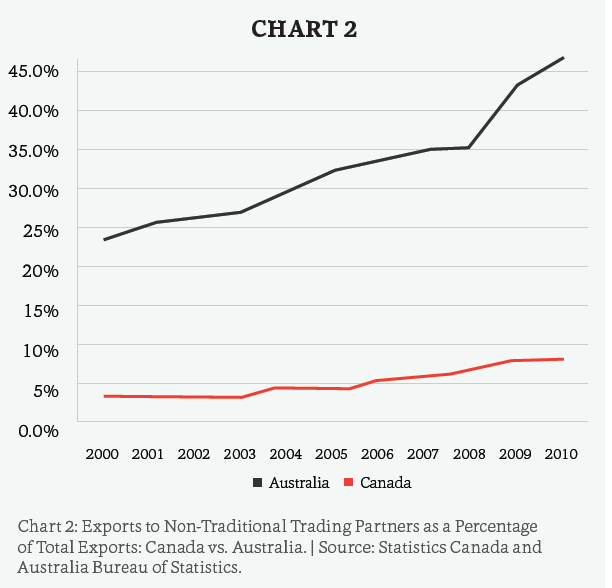 Among the report’s 14 major recommendations, a few stood out: Most important, Canadian political and business leaders must promote greater awareness of the growing importance of emerging markets, especially East Asia, and Canada must reorient its political and commercial resources to target key countries. Just as important, Canadian businesses must reject their “culture of comfort” that is severely risk-averse, causing them to eschew innovation in favour of easy profits, particularly from south of the border.
While Canada’s largest firms are already well-entrenched in Asian markets, establishing strong ties with local partners for the long haul, small and medium-sized Canadian firms (SMEs) remain preoccupied with short-term returns in North America.
“For many SMEs, the US market has provided as much of a challenge as they are willing to take on (but) investors should be prepared to let SMEs become large enough to play significant roles in the global economy”, the report advised.
The report also called upon Canadian universities and colleges to augment foreign language training (particularly East Asian languages) and promote international exchange programs to attract students from the Asia-Pacific region and beyond. Interestingly, the report urges introducing key foreign language instruction, notably Mandarin, at the secondary level to help open doors for young Canadians in East Asia.
To enhance engagement in the broader global economy, major changes must happen in public policy and business leadership: First, Canada must reform its tax system to promote innovation and productivity gains and which is competitive internationally, especially with emerging markets. Second, policies and practices of a bygone era must be streamlined.
On the one hand, the regulatory process for FDI must be simplified and consolidated for major projects in energy, mining and infrastructure. On the other hand, more efforts must be made to promote leading Canadian sectors such as aerospace, financial services, IT, and agriculture in emerging economies. Canadian companies must improve their productivity and Canada’s national infrastructure – transmission grids, ports, pipelines, terminals, roads, etc. – must be renewed and extended.
“The need for strategy, focus, and leadership is critical. Canada cannot afford to continue to fall behind…Canada has the potential to meet the demands of a rapidly changing global economy. What is missing is a determined effort to leverage our strengths and to reshape Canadian policies and priorities”, the report concluded.