
National Rejuvenation Index
China has a legion of social scientific think tanks pounding out literally thousands of reports every year. While many produce thoughtful and interesting research that shed light on a rapidly changing socio-economic landscape, some are downright wacky. Take the latest “The Great Rejuvenation of the Chinese Nation Monitoring and Evaluation Index” that was just released by Yang Yiyong, Director of the Microeconomics Institute at the National Development and Reform Commission (NDRC). (In the past, I have interviewed Mr Yang on labour and employment issues.)
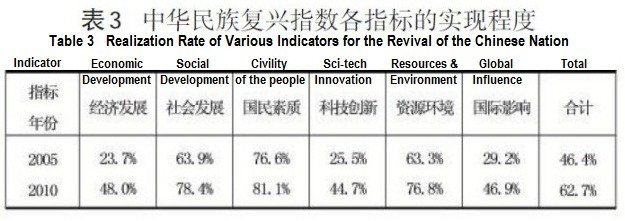
According to his quantitative index, China is almost 2/3 (62.7%) of the way to restoring its former glory as the greatest economic and political power on earth. Apparently, back in 2005, China was only 46% of the way there but within a short five years, national rejuvenation had pressed ahead by over 16%. At that rate, China should achieve full rejuvenation within a decade, roughly the same timetable set by the central government to achieve mid-developed status by 2020.
Reported on China News Online, Mr yang said his index looks at five criteria for China’s national rejuvenation, including China’s overall economic strength; all-round development of society, science and technology, education, and health; development of socialist democracy and the rule of law; environmentally-friendly and sustainable growth; and China’s re-unification with Taiwan along with contributions to world peace. Needless to say, some of his criteria are hardly amenable to quantification.
Yet, Mr Yang insists he is able to quantify them using three levels of indicators: an overall indicator for ‘national rejuvenation’; another set of indicators measuring economic and social development, the ‘sophistication’ of the people, R & D and innovation, resources and environmental protection, and international influence; and a set of 29 indicators such as one that matches appropriate GDP to population, the Engel coefficient, the Gini coefficient, per capita education levels, rates of patent registration, forest cover, and international competitiveness, among others.
But, his index immediately drew a torrent of criticism from the Chinese media, not to mention snide remarks from Chinese netizens. A commentator on Global Times questioned, “how was the calculation conducted in terms of more subjective subjects like democracy or the rule of law? Were they calculated simply by comparing the contextual difference between China’s policies and law and those of developed Western countries?…When rating the revival of a nation, parameters of economic development are indeed important. But what’s more significant is whether people are becoming more confident in their nation and their culture”.
A writer on Hongwang added: “the feelings of the nation and international recognition and acceptance are standards by which to measure a nation’s development…The feelings of the people are more direct and convincing. A country in which ordinary people cannot afford to seek medical attention, attend school, or buy a house is country that is still a long way from ‘rejuvenation’”. Instead of wasting time and public expense on such frivolous efforts, the writer admonished, Mr Yang should be devoting himself to more down-to-earth research that actually benefits socio-economic understanding.
But, Mr Yang shrugs of the criticism and remains undaunted. Acknowledging the need for more time-specific and relevant indicators, he promises to come up with a better set of measurements in his next report planned for 2017. Best of luck to him in his impossible task.