
APF Survey: Canadian Businesses ‘Overwhelmingly Support’ Canada-China FTA Negotiations
At the G20 Summit in Mexico last June, Prime Minister Harper was expected to make a key announcement on progress toward free trade talks with China following the completion of a joint study by the two countries during Harper’s February China mission. Although industry participants remarked the high-level assessment proved more fruitful than expected and was to be finalized by the end of May, the Harper Administration seems not in a hurry to present the results. Instead of an announcement, Canada was formally welcomed into the Trans-Pacific Partnership (TPP), a gathering to which China has not been invited.
Ever since, everyone’s wondering what will happen next? Trade experts say the next step will involve a more in-depth and comprehensive study to assess whether free trade with China is indeed the best option. In six years, the Harper government has concluded free trade agreements with nine Latin American, Middle Eastern and European countries. It is also engaged in talks with the EU and India, along with a handful of smaller countries, not to mention intentions to proceed with Japan and Thailand. Free trade with China, however, is seen as exceedingly complex given the size of the economy, its rapidly expanding domestic market, its hybrid economic system, and its foreign trade prowess.
It is under this backdrop that the Asia Pacific Foundation (APF) published its most recent survey of Canadian business attitudes on a free trade agreement (FTA) between the two countries. The opinions of Canadians engaged in Asian business were quite interesting, giving strong support for negotiations the sooner the better.
55% of respondents believed Canada is moving too slowly in consolidating economic and political relations with China with 47% seeing China as the priority for negotiations toward a FTA. FTA talks with other countries garnered much less support – Japan (16%), India (15%), the EU (11%), South Korea (10%, and Thailand (2%). In addition, more than 60% of Canadian Asia businessmen felt a FTA with China would have a positive effect on their businesses in China and on Canada’s relations with other Asian countries.
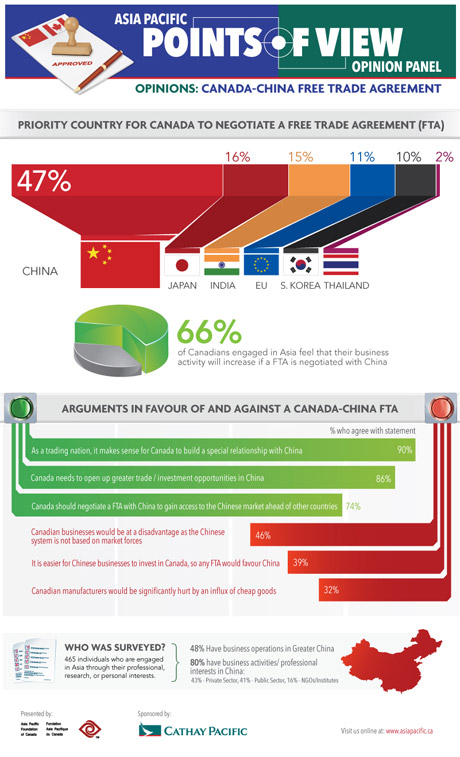
90% agreed China is the biggest market in Asia so Canada should take full advantage of trade and investment opportunities there. Nearly 3/4 of Canadians engaged in Asia saw a FTA as the best way to secure early access to the Chinese market ahead of American and European competitors and almost as many said Canadian manufacturers would benefit. Moreover, most of them felt that a FTA with China would strengthen Canadian political and diplomatic influence in Asia as a whole.
A key benefit of a FTA would be cementing a rule-based system that better protects Canadian business interests and provide a more level playing field. The vast majority (more than 70%) felt a FTA would ensure access to the Chinese market; provide recourse in fighting exclusion; and secure equal treatment. Conversely, clear majorities (65%) saw a FTA as clarifying rules for Chinese investment in Canada in general and for Chinese state-owned enterprises (SOEs) in particular. Interestingly, a solid majority also supported Canada relaxing visa requirements for skilled and professional workers moving freely between the two countries.
At the same time, respondents outlined three areas of concern about trade and investment in China: intellectual property rights protection, dispute resolution mechanisms, and government regulations that discriminate against foreign companies. They were also concerned about restrictions on Canadian direct investment in China and lack of access to Chinese government procurement contracts. As for Chinese investment in Canada, respondents remained reticent about opening bidding access to Canadian government contracts; more flexibility of rules governing Chinese SOE investment; and relaxing anti-dumping penalties on Chinese products coming into Canada.
APF drew some general observations from the survey: “First, the overall reaction of Asian practitioners to closer economic relations with China is overwhelmingly positive (with on average 73% in favour versus 27% against a Canada-China FTA)…Second, it is quite clear that Asia practitioners perceive the idea of a Canada-China FTA as a practical and concrete way for Canada to take advantage of China’s increasing global economic importance, and to so early enough to position Canada favourably in Asia for the foreseeable future…”.
Economist: Vancouver, Toronto, and Calgary Among Best Cities to Live In
Canadian and Australian cities dominate the top ten with Melbourne coming out on top in the Economist Intelligence Unit’s latest liveability ranking.
For the second year in a row, Melbourne has been adjudged the world’s most liveable city, ahead of Vienna and Vancouver, whose slip from the top of the list last year, after almost a decade, riled many western Canadians. Three other Australian cities make it into the top ten, with Adelaide rising from ninth to equal fifth in 12 months.
The ranking scores 140 cities from 0-100 on 30 factors spread across five areas: stability, health care, culture and environment, education, and infrastructure. These numbers are then weighted and combined to produce an overall figure. The cities at the top of the table are separated by tiny differences, with just 0.3 percentage points between first and fourth.
As has been clear for several years now, the cities that do best in this ranking are mid-sized conurbations in countries with low population densities. Such conditions are likely to result in low crime levels, functioning infrastructure and easily available recreational activities. Murder rates in Melbourne, Vienna and Vancouver, for example, were respectively 2.7, 1.1 and 2.5 per 100,000 people in 2010-11, compared with the American average of 4.8. Indeed American cities tend not to do as well as their Australian and Canadian counterparts because poor scores for crime and congestion negate their decent marks for culture. Honolulu, which is 26th on the list, is the best placed, though it should be noted that all American entries come in the top tier of 63 cities, for which HR managers are advised not to bother paying a hardship allowance.
Most liveable cities: 1. Melbourne 97.5 2. Vienna 97.4 3. Vancouver 97.3 4. Toronto 97.2 5=. Calgary 96.6 5=. Adelaide 96.6 7. Sydney 96.1 8. Helsinki 96.0 9. Perth 95.9 10. Auckland 95.7 … 138. Lagos 39.0 139. Port Moresby 38.9 140. Dhaka 38.7
NRC Document: Canada Must Boost Renewable Energy
Two planetary megatrends – rapid growth of emerging economies, in particular China and India, along with the gradual transition to low-carbon energy – will dramatically affect Canada’s economy and global demands for resources and energy, stated newly declassified internal briefing notes from Natural Resources Canada to Minister Joe Oliver. While richly endowed with fossil fuel resources, Canada nonetheless needs to diversify its energy sources to meet growing domestic demand in an environmentally sustainable way, the briefing notes advised.
The notes point out that Canada ranks 13th in the world and last among G8 countries in clean energy investments while the US, China, Germany, and other countries are making major headway to become low-carbon leaders.
The Harper government claims to have invested more than $10 billion in programs to reduce greenhouse gases, build clean energy infrastructure, promotes energy efficiency, and support new technologies and fuels. But, in actuality, its record has seen fits and starts, reports Postmedia News. After its election in 2006, the Harper government cancelled $billions in climate change and clean energy programs but announced new initiatives under different guises a year later following public criticism.
Forming a majority government last year, it again terminated a number of funding programs for wind, solar, and other renewables. This is in spite of setting a goal of generating 90% of Canada’s electricity from zero-emitting sources by 2020. Currently, renewable energy sources generate 17% of Canada’s total primary energy with hydropower accounting for over 60% of electricity production. (Invest in Canada and Centre Flow)
The Pew Environmental Group’s annual report on clean energy investment around the world has Canada growing by 4% to total $5.5 billion, putting it 11th among G20 countries last year. 56% of Canadian investment went into wind with the remainder into residential and commercial solar (19%), geothermal, biomass and small hydro (13%), biofuels (8%), and energy efficiency and low carbon technologies (4%). Canada has 9.6 gigawatt (GW) of installed renewable energy capacity – 5.4 GW of wind, 2 GW of small hydro, 1.8 of biomass, and 0.47 GW of solar.
The United Nations Environment Program (UNEP) in its June report has China leading the world in renewables investment with $52 billion (20% of the world total) followed closely by the US with $51 billion (developers rushed in to take advantage of a series of government incentive programs before they expired in 2011-2012). China led in wind turbine installations with generation increasing more than 48%. It was also tops in hydropower and the leading manufacturer of photovoltaic modules. Germany, Italy and India rounded out the top five with India’s investment surging 62% to $12 billion spurred by its National Solar Mission. Also impressive was Brazilian investment at $7 billion.
Chinese national and provincial governments have big plans for solar (see July 22 post on solar farms spreading in Xinjiang), targeting a 40% increase in installed capacity to 21 GW by 2015. Northwest Gansu province, for instance, plans to install 5000 megawatts (MW). As for Chinese solar panel makers, in addition to foreign markets, Yingli Green Energy, a leading manufacturer, hopes to sell 900 MW (35% of production) in panels on the domestic market this year going forward. This is big spike from 2010 when it sold a paltry 6% at home.
“Growing demand for natural resources and the long-term transition towards a low-carbon economy will affect the whole of Canada’s economy…How Canada develops and uses its assets, from its resource base through to its skilled labour force and emerging clean tech sector, will be a deciding factor in strengthening its overall competitiveness in today’s uncertain world”, concluded the Natural Resources Canada document.
Quebec Companies Could Veto Foreign Takeovers
This is an ominous sign.
Quebec could become the first province to arm companies with a veto power over foreign takeovers, under a proposal with potential domino-effect implications for other parts of the country.
Two political parties have now promised that if they win the Sept. 4 election they would allow a company’s board of directors to repel a foreign acquisition if it’s deemed to be against the interest of workers or the greater community.
The latest such pledge from the Charest Liberals, whose promise Monday resembles an earlier one from the Parti Quebecois, prompted one analyst to predict copycat moves elsewhere in Canada.
The PQ, which leads in the polls, last week promised to amend the Quebec Corporation Act to also give corporate boards broader powers.
– Canadian Press
U of T’s Green Path Program Prepares Chinese Students for Life in Canada
The Green Path program is an initiative that recruits top students from high schools in mainland China to participate in an academic and ESL program preparing them for undergraduate studies at the University of Toronto. In addition to building academic skills in the areas of reading, writing, grammar, as well as listening to and speaking English, they also get to adapt to life in Canada.
The students live in residence and the program includes social activities and field trips to popular tourist sites in Toronto and the GTA. Once the students successfully complete the Green Path program, they go directly into first-year undergraduate studies at U of T. This year, 197 students from 19 different provinces in China participated in the program.
Green Path, which translates from Chinese as ‘the way to success,’ is taught by faculty members from the University of Toronto’s School of Continuing Studies’ English Language program. Last year, the 172 program graduates went on to extraordinary academic success in the recent school year. More than half of the courses taken by Green Path graduates resulted in scores in the B+ range.
Graduates of the Green Path will receive their certificates at a special graduation ceremony and lunch on Thursday, August 16 that will be attended by Consul General Li Fang from the Consulate General of the People’s Republic of China in Toronto, UTSC principal and U of T vice-president Franco Vaccarino and Rick Halpern, dean and vice-principal academics.
– U of T website Media Room
Xinhua Details Bogu Kailai Murder Case
Xinhua released a statement in Chinese on Friday (English version on Saturday) detailing the murder trial of Bogu Kailai, wife of former Chongqing Party Chief Bo Xilai. Here are the most relevant parts:
KEY POINTS OF THE CASE
As the court investigation proceeded and the debate thoroughly unfolded, key details of the murder allegedly committed by the two defendants began to surface, based on the testimonies of Bogu Kailai and Zhang Xiaojun during the investigation and throughout the trial as well as evidence presented in court.
— MURDER MOTIVE
Bogu Kailai said in her testimony that “it was in about 2005 when my son was studying in Britain that Neil Heywood wrote us a letter of self-introduction, showing his intent to get to know us.”
Bogu Kailai testified that after she and her son, surnamed Bo, became acquainted with Heywood, she introduced him to serve as a proxy to a company and participate in the planning of a land project, which never got started. Heywood later got into a dispute with Bogu Kailai and her son over payment and other issues, and he threatened her son’s personal safety.
In court, prosecutors presented emails exchanged between Heywood and Bo, showing how the dispute between the two had escalated.
According to the evidence prosecutors brought to court, after Bogu Kailai learned of the escalation of their dispute, she believed Heywood had threatened the personal safety of her son and decided to kill Heywood.
“To me, that was more than a threat. It was real action that was taking place. I must fight to my death to stop the craziness of Neil Heywood,” according to Bogu Kailai’s testimony that prosecutors presented in court.
The defense counsels for Bogu Kailai presented their opinions on the criminal motive, while prosecutors presented a series of evidence to prove Bogu Kailai’s criminal motive.
— CRIMINAL PROCESS
Prosecutors presented Zhang Xiaojun’s testimony as follows: On Nov. 12, 2011, Bogu Kailai asked me to contact Neil Heywood, saying that she wants to meet him and I shall pick him up and bring him to Chongqing. She instructed me repeatedly that I should accompany Heywood to Chongqing. I called Heywood and told him that Bogu Kailai wanted to meet him in Chongqing. Heywood replied that he also wished to see her, but had to check his schedule. Within half an hour, Heywood called me back, telling me he would be available the next day and asking me to book a flight for him.
As shown by documentary evidence that includes the flight tickets and hotel registration form, on Nov. 13, 2011, Zhang escorted Neil Heywood from Beijing to Chongqing. Heywood checked in to Room No. 1605 of the 16th building of the Lucky Holiday Hotel in Nan’an District of Chongqing Municipality, as arranged by Zhang.
According to the testimonies of Bogu Kailai and Zhang, which were presented to the court by prosecutors, that evening, Bogu Kailai had prepared two bottles — a glass bottle of poison that contained cyanide compound and another medicine bottle of capsulated drugs. Bogu Kailai gave the glass bottle to Zhang.
At around 9 p.m. on Nov. 13, 2011, Bogu Kailai and Zhang visited Heywood’s hotel, bringing along the two bottles, as well as wine and tea. After entering Heywood’s hotel room, Bogu Kailai drank wine and tea with him while Zhang waited outside. Later, Heywood became drunk and fell in the hotel bathroom, and then Bogu Kailai called Zhang into the hotel room and took the glass bottle of cyanide compound that Zhang was carrying.
Zhang said in his testimony that he put Heywood on the hotel bed. After Heywood vomited and asked for water, Bogu Kailai put the bottle of cyanide compound she had prepared into Heywood’s mouth. Then she scattered the capsulated drugs on the hotel floor, making it seem as though Heywood had taken the drugs.
According to what Zhang recalled in his testimony, Bogu Kailai poured cyanide compound into a small soy sauce container that she had prepared beforehand, mixed it with water and walked to the left side of the bed. She dripped the toxic mixture into Heywood’s mouth as she was talking to him.
Bogu Kailai and Zhang visited Heywood’s room on the night of the crime, as video footage presented to the court by the prosecutors showed. According to the physical evidence inspection report submitted by China’s Ministry of Public Security, DNA samples from Bogu Kailai and Zhang were found on bottle caps and cup lids at the crime scene.
Bogu Kailai told hotel waiters to leave the guest alone in Room No. 1605, after hanging the “Do Not Disturb” sign on the door when she left, according to the testimony of a hotel waiter.
— CAUSE OF DEATH
Witness testimony provided by prosecutors showed that Bogu Kailai illegally obtained the poison that contained cyanide compound through other people.
During the trial, the Ministry of Public Security’s reports and position papers on the examination of material evidence, as offered by prosecutors, showed that blood extracted from Heywood’s heart and samples of his vomit collected at the crime scene contained cyanide ions, and Heywood’s death was caused by cyanide poisoning. The conclusion was based on renewed examination and identification of trace evidence taken at the crime scene as well as the blood from Heywood’s heart, which was collected and preserved by the Public Security Bureau of Chongqing after his death.
During the trial, defense counsels of Bogu Kailai and Zhang Xiaojun raised questions concerning the transfer and preservation of the blood from Heywood’s heart and other material evidence. Prosecutors pointed out that the blood and other key pieces of evidence were preserved in normal conditions, proving the validity of the material evidence.
Experts with the material evidence identification center under the Ministry of Public Security appeared in court to testify and answered questions raised by the prosecutors and defense counsels.
— EXPERT TESTIMONY
During the examination and prosecution phases of the case, defense counsels entrusted by Bogu Kailai filed an application to the prosecuting body to evaluate Bogu Kailai’s mental state at the time of Heywood’s death through forensic psychiatric expertise.
After examination, the prosecuting body entrusted the forensic examination institute under the Shanghai Mental Health Center to conduct an evaluation of Bogu Kailai’s mental state in accordance with the law.
After studying her medical records and interrogation transcripts, hearing the testimony of witnesses, talking with Bogu Kailai alone and conducting discussion and analysis, the expert group concluded that Bogu Kailai had been treated for chronic insomnia, anxiety and depression, and paranoia in the past.
She used to take anxiolytics, antidepressants and sedative hypnotic drugs, and she also received combined treatment by taking antipsychotic drugs, but the curative effect was not enduring. She developed a certain degree of physical and psychological dependence on sedative hypnotic drugs, which resulted in mental disorders.
However, Bogu Kailai had a clear goal and a practical motive in committing the alleged crime. Preparations were made prior to the alleged criminal act, including, for example, asking for poison from others and storing the poison, planning to take the victim to Chongqing and arranging the location for committing the alleged crime, among others.
She was also able to determine the environment for committing the alleged crime, and she had a relatively strong awareness of protecting herself.
Taking all of the above factors into consideration, Bogu Kailai has an intact ability to identify the nature and consequences of this alleged criminal behavior and a weakened ability to control herself. Therefore, she should be identified as having the capacity to accept full criminal responsibility.
BEFORE AND AFTER TRIAL
Investigatory, procuratorial and judicial authorities have taken the facts as the basis and the law as the criterion, and handled the case strictly in accordance with the law in the process of the investigation, approval of the arrest, prosecution and the court hearing.
During the investigation, the public security department formulated a meticulous investigation plan, conducted 394 interrogations of the witnesses and people involved in the case and put together 212 evidence documents totaling 1,468 pages in 16 volumes. Investigators visited Chongqing, Beijing and other places many times in the course of the investigation, questioning people involved in the case and people who know about the case.
Investigators studied the full process of collecting, examining, storing and transferring important material evidence such as the blood extracted from Neil Heywood’s heart, the poison and the vomit samples. A substantial amount of evidence had been further obtained and confirmed after three months’ of scrupulous investigation efforts.
During the procuratorial process, to ensure the facts of the case are clear, the evidence sufficient and the procedure lawful, judicial staff thoroughly and meticulously examined the evidence collected and put together by investigators. They also provided more than 200 items of suggestion for further investigation.
Judicial staff sent the defendants a letter to inform them of their rights and responsibilities. The defendants were informed that they were entitled to entrust defense counsels to represent them. The victim’s close relatives were informed that they were entitled to obtain legal representatives. The defendants were legally interrogated, and the opinions of the defense counsels were heard.
After the defendants were indicted, the Hefei City Intermediate People’s Court formed a collegial panel, sent duplicates of the indictment to the defendants, informed the defendants and the victim’s family of their litigation rights and gave lawyers access to the case file.
After Bogu Kailai was held by investigators, she once refused to engage a lawyer. In a bid to protect the legitimate rights of a criminal suspect, judicial staff informed her of her right to a lawyer several times.
Bogu Kailai eventually decided on her own to entrust two lawyers to represent her, and Zhang Xiaojun decided to entrust one lawyer to represent him.
After the trial, Jiang Min, a lawyer with Anhui Tianhe Law Firm who serves as one of Bogu Kailai’s defense counsels, said that since he got involved in the case, judicial authorities have protected the lawyer’s rights to meet with the defendant and to have access to the case file. Jiang said more than 10 meetings with the defendant had been arranged, and he fully expressed the opinions of the defense in court as he had planned to do beforehand.
Victoria-based Viking Air Lands First Deal in China

Vancouver Island-based Viking Air Ltd. has pulled off what so many B.C. companies aspire to do: landing a large deal in China.
The floatplane maker recently announced its first Chinese sale: a $30 million deal to sell five Twin Otter Series 400 floatplanes to Meiya Air Co., Ltd. of Hainan province, and the possibility of additional sales beyond.
“It’s our first contract with China and we see it as a significant step,” said David Curtis, Viking Air’s president and CEO.
Landing the deal, Curtis said, has involved significant work. But the company started with a leg up: China came calling.
“[Meiya Air] started researching around the world about what are the best float planes and at the end of the day the Twin Otter pops up pretty much every time,” Curtis said. “So it was a matter of them finding us, frankly, and approaching us and wanting to learn about the airplane.”
Curtis said, as talks progressed, Viking Air sought outside expertise. “We’ve relied heavily on the federal government trade commission in Beijing and here locally to help us connect with other Canadian firms doing business in China and just understanding what the lay of the land is,” he said.
“When we talk about a general aviation airplane like a Twin Otter, there’s only about 500 of those airplanes in China today,” he said. “And if you compare that with the U.S., there’s a quarter of a million general aviation airplanes in the U.S.”
How does Viking Air plan to progress further in China?
Curtis said the company is still working out its strategy, and noted that there are still trade barriers such as a fairly significant import duty on aircraft.
“We’re going to be looking at ways of maximizing our market opportunities – likely through some kind of a joint venture,” he said. “That’s really the way that business works in China – you need a strong partner there.”
Doug Taylor, an international trade consultant with Small Business BC, said B.C. businesses still face significant barriers to doing deals with China.
“The biggest difficulties are the absolute need to have the right connections, [and] the ability and resources to take the time to develop those connections and understand that you are working with a government, not private companies – even though they look like private companies.”
He agrees partnerships are key to breaking into the highly competitive marketplace. But he said that, given the massive size of many Chinese companies, a B.C. company may find a more balanced partnership by joining forces with a similiar-sized Singaporean or other Asian firm with connections to China.
– Business Vancouver
China’s Life Expectancy Rises to Nearly 75
China’s life expectancy is 5 years above the world average but still 5 years less than in developed countries.
China’s average life expectancy rose to 74.83 years as of the end of 2010, 3.43 years greater than that of 2000, according to the National Bureau of Statistics (NBS) using data from the sixth national census t.
Analyzed by gender, the average life expectancy among Chinese men was 72.38 years, 2.75 years longer than that of 2000. Meanwhile, the average life expectancy for Chinese women rose 4.04 years to 77.37 years.
The female-male gap widened to 4.99 years in 2010 from 3.7 years in 2000, according to the NBS.
Data provided by the NBS showed that while the average global life expectancy was 69.6 years in 2010, those living in high-income countries or regions enjoyed an average lifespan of 79.8 years.
A human rights action plan released by the Chinese government in June predicted that the number of Chinese people aged above 65 will rise sharply to 323 million, or more than 23 percent of the nation’s population, by 2050.
– China Daily
A 2010 Statistics Canada report on births and deaths showed life expectancy at birth reached 80.7 years for the three-year-period between 2005 and 2007, up 0.2 years from an average of 80.5 between 2004 and 2006. In 1995 to 1997, life expectancy at birth was 78.4.
– CBC
Incidentally, life expectancy in India was 64.78 in 2009, according to a 2010 World Bank report.
UBC President: Canadian Education Must Tilt to Asia
Canadian think-tanks have been working overtime these days churning out reports about the necessity for Canada to mesh much closer with emerging economies, especially China and other East and South Asian countries. The latest contribution comes from Stephen Toope, President of UBC, in his advocacy to turn education into a major pillar of Canadian foreign policy and economic growth strategy.
Strengthening Education and Research Connectivity Between Canada and Asia, written for the Canadian Council of Chief Executives (CCCE) (see last post on a similar CCCE education related report), bashed Canadian governments for their ‘episodic and sporadic’ initiatives; their ‘diffuse’ efforts at working together; and inability to scale up programs to achieve the scale necessary to yield ‘truly transformative results’.
Mr Toope called for strong branding of Canadian educational excellence in targeting key Asian markets such as China and India that represent half of the top ten source countries for international students to Canada. China has been a primary source for many years running, having sent close to 1/4 of the nearly 100,000 foreign undergraduate and graduate students in 2009. Another 12% come collectively from India, South Korea, Japan, and Hong Kong.
In 2010, the number of long-term Chinese students at all levels ballooned to nearly 57,000, cited an earlier report prepared by Roslyn Kunin & Associates (RKA) for Trade Minister Ed Fast. That year, foreign students contributed more than CAN$6.9 billion to the Canadian economy with Chinese and South Korean students taking up some 37% of that. In terms of percentage of imports of Canadian goods and services to their country, Chinese consumption of Canadian educational services accounted for nearly 14%. Rates were even higher for South Korea, India, and Saudi Arabia.
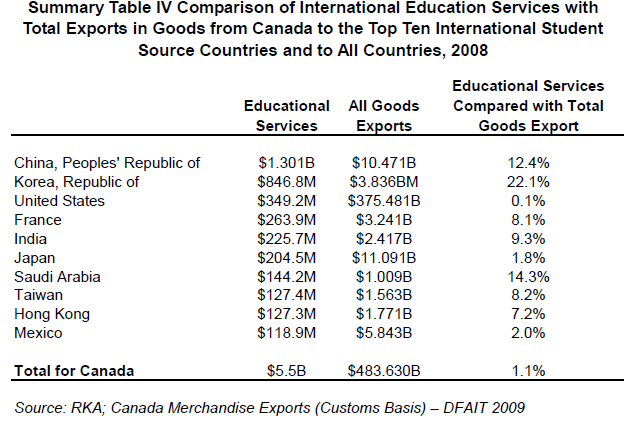
Citing Australian and New Zealand moves to eliminate differential tuition fees for foreign graduate and post-doctoral students in a bid to attract more talent to their universities, the RKA report encourages Canadian educational authorities to do likewise. Foreign students in Canada pay two to six times more than local students to attend college or university.
“Given the competition in the global international education market, educational policy makers may need to re-examine the practice of differential tuitions and fees”, the report declared.
In his paper, President Toope added that the Canadian government should ramp up its high-profile Vanier Canada Graduate Scholarships and Banting Postdoctoral Fellowships to attract and retain world-class international talent. On top of that, vigorous scholarship programs for undergraduates should be created, working with the private sector and higher education institutions.
In this connection, last May, BC Premier Christy Clark announced a $5 million scholarship and internship program under a broader plan to boost the number of foreign students attending BC schools by 50% – 47,000 more students – within four years. Almost half of that target is expected to attend private language schools with the remainder going to public and private high schools and K-12 schools.
Mr Toope complained about the lack of interest among Canadian students to study overseas for credit as a reflection of persistent provincialist attitudes and lack of government commitment. Germany, he pointed out, has actively promoted international study for undergraduates, devoting millions to fund study-abroad scholarships, resulting in almost 1/3 of all German students going abroad for part of their education. Further, he urges the integration of international elements, especially Asian content, into domestic programs from kindergarden through university. In particular, there should be a strong emphasis on promoting Asian language study in Canadian schools.
The UBC President also wants to see more effort on the part of Canadian universities to work with host institutions to develop full offshore programs including distance learning, export of Canadian curricula, franchising courses and programs, and provision of various education services abroad. UBC’s Sauder School of Business, for instance, already offers more than 30 programs in China and Canada for senior government officials and business executives. To date, UBC has trained more than 500 senior leaders from across China.
Cognizant of the epochal shift in the center of science and technology R&D toward Asia, President Toope suggested that closer collaboration with Asian research institutions would help stimulate Canadian research and economic competitiveness. Over the years, China’s R&D budget has risen dramatically. In February, China’s National Bureau of Statistics in its annual statistics report disclosed that R&D spending in 2011 had surged 21.9% to US$139.7 billion, representing 1.83% of GDP, on course to reach the target of 2%.
Canadian government policy of late has been heartening nonetheless, wrote Mr Toope. In addition to key MOUs signed with India and important missions to Vietnam, Singapore, and Malaysia in 2010-11, this year, Prime Minister Harper and Chinese President Hu Jintao announced that Canada and China aim at increasing the two-way exchange of students to 100,000 within five years.
“Canada’s universities are often at the forefront of engagement with developing economies. As such, they are an asset that both government and the private sector can work to advance our place in the world. By working together, we can ensure that Canada’s economy and society will thrive and prosper”, he concluded.