
APF Survey: Canadian Businesses ‘Overwhelmingly Support’ Canada-China FTA Negotiations
At the G20 Summit in Mexico last June, Prime Minister Harper was expected to make a key announcement on progress toward free trade talks with China following the completion of a joint study by the two countries during Harper’s February China mission. Although industry participants remarked the high-level assessment proved more fruitful than expected and was to be finalized by the end of May, the Harper Administration seems not in a hurry to present the results. Instead of an announcement, Canada was formally welcomed into the Trans-Pacific Partnership (TPP), a gathering to which China has not been invited.
Ever since, everyone’s wondering what will happen next? Trade experts say the next step will involve a more in-depth and comprehensive study to assess whether free trade with China is indeed the best option. In six years, the Harper government has concluded free trade agreements with nine Latin American, Middle Eastern and European countries. It is also engaged in talks with the EU and India, along with a handful of smaller countries, not to mention intentions to proceed with Japan and Thailand. Free trade with China, however, is seen as exceedingly complex given the size of the economy, its rapidly expanding domestic market, its hybrid economic system, and its foreign trade prowess.
It is under this backdrop that the Asia Pacific Foundation (APF) published its most recent survey of Canadian business attitudes on a free trade agreement (FTA) between the two countries. The opinions of Canadians engaged in Asian business were quite interesting, giving strong support for negotiations the sooner the better.
55% of respondents believed Canada is moving too slowly in consolidating economic and political relations with China with 47% seeing China as the priority for negotiations toward a FTA. FTA talks with other countries garnered much less support – Japan (16%), India (15%), the EU (11%), South Korea (10%, and Thailand (2%). In addition, more than 60% of Canadian Asia businessmen felt a FTA with China would have a positive effect on their businesses in China and on Canada’s relations with other Asian countries.
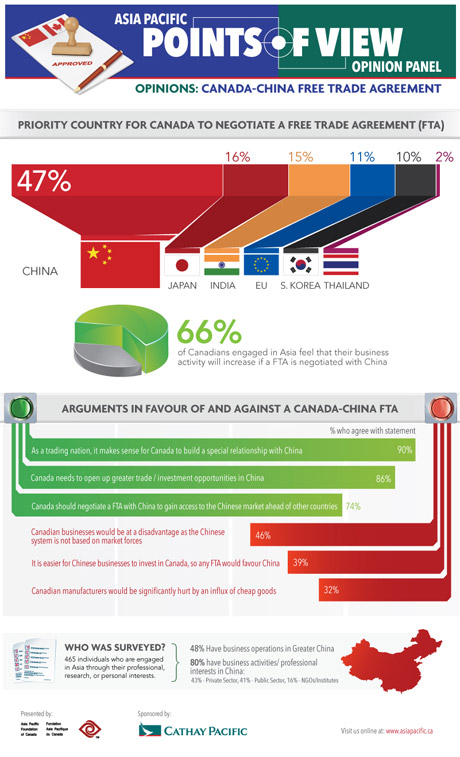
90% agreed China is the biggest market in Asia so Canada should take full advantage of trade and investment opportunities there. Nearly 3/4 of Canadians engaged in Asia saw a FTA as the best way to secure early access to the Chinese market ahead of American and European competitors and almost as many said Canadian manufacturers would benefit. Moreover, most of them felt that a FTA with China would strengthen Canadian political and diplomatic influence in Asia as a whole.
A key benefit of a FTA would be cementing a rule-based system that better protects Canadian business interests and provide a more level playing field. The vast majority (more than 70%) felt a FTA would ensure access to the Chinese market; provide recourse in fighting exclusion; and secure equal treatment. Conversely, clear majorities (65%) saw a FTA as clarifying rules for Chinese investment in Canada in general and for Chinese state-owned enterprises (SOEs) in particular. Interestingly, a solid majority also supported Canada relaxing visa requirements for skilled and professional workers moving freely between the two countries.
At the same time, respondents outlined three areas of concern about trade and investment in China: intellectual property rights protection, dispute resolution mechanisms, and government regulations that discriminate against foreign companies. They were also concerned about restrictions on Canadian direct investment in China and lack of access to Chinese government procurement contracts. As for Chinese investment in Canada, respondents remained reticent about opening bidding access to Canadian government contracts; more flexibility of rules governing Chinese SOE investment; and relaxing anti-dumping penalties on Chinese products coming into Canada.
APF drew some general observations from the survey: “First, the overall reaction of Asian practitioners to closer economic relations with China is overwhelmingly positive (with on average 73% in favour versus 27% against a Canada-China FTA)…Second, it is quite clear that Asia practitioners perceive the idea of a Canada-China FTA as a practical and concrete way for Canada to take advantage of China’s increasing global economic importance, and to so early enough to position Canada favourably in Asia for the foreseeable future…”.