
Dutch/EU Study: China CO2 Emissions Up Significantly
A report released earlier this month by the PBL Netherlands Environmental Assessment Agency and the European Union has China leading the world in CO2 emissions by a wide margin, emitting 9.7 billion tonnes last year. This figure is much higher than the International Energy Agency’s (IEA) data for 2009 putting China’s emissions at 7.7 billion tonnes that year. (see post of May 29) The Dutch report’s findings for China are even higher than that would be the case if IEA’s 2009 data were extrapolated by 10% rises over the last two years.

The top six emitters, according to Trends in Global CO2Emissions 2012, are China (29%), the US (16%), the EU (EU27) (11%), followed by India (6%), the Russian Federation (5%), and Japan (4%). These countries accounted for 71% of global emissions. Interestingly, OECD countries now emit only 1/3 of global totals, roughly the same as China and India combined.
China’s hike of 9% in 2011 was driven by fuel consumption associated with industrial production, building construction, and expansion of infrastructure, the report stated. Since 2002, China’s emissions have expanded by a staggering 150% while industrial emissions in the EU continued to decline. China’s emissions upsurge is consistent with increases in coal-fired thermal power generation, steel production which uses large amounts of coal, and the making of cement.
According to the World Steel Association, the 9% increase in Chinese crude steel production last year represents almost 1/3 of global expansion with China making 44% of all steel. China’s cement production also jumped 11%, accounting for 57% of global emissions from the sector.
But the report also points to discussions about discrepancies (uncertainty margin) in Chinese fuel consumption data as reported from provincial versus national sources could be as high as 10% (see post of June 16).
In terms of per capita emissions, China’s figures have likewise spiked. Last year, they increased 9% to 7.2 tonnes. Taking into account an uncertainty margin of 10%, Chinese emissions are now on par with the EU which emitted 7.5 tonnes per person. Well within the 6 to 19 tonnes/person range for the largest industrialized countries, China’s emissions are bound to complicate the debate over her responsibilities and that of other large rapidly developing countries at future climate change talks. 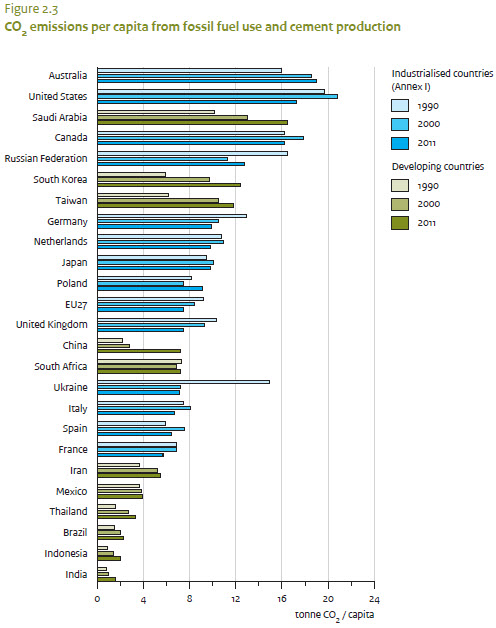 By way of a comparison, in the 22 year span between 1990 and today, China’s per capita emissions have more than tripled from 2.2 to 7.2 tonnes per capita whereas in EU27 countries, they have declined from 9.2 to 7.5 tonnes. The US has also seen a decline from 19.7 to 17.2 tonnes.
In terms of fossil fuel consumption, China’s thirst for oil rose by 5.5%, less than the 10-year average, with oil imports increasing 13%. Coal consumption leaped 9.7% to account for 49% of global coal use. Imports rose 10%, making China the world’s largest importer, overtaking Japan.
One bright spot is renewable energy in which China is a front-runner. (also see post of June 12) China is the world’s largest wind power market, installing 16.6 gigawatts (GW) of new capacity in 2011 to total 62.4 GW albeit wind still represents a small fraction (1.5%) of total power generated. One of the problems holding back wind power in China is that local grid infrastructure cannot keep pace with installations, resulting in connection delays.
China doubled its installed capacity of solar photovoltaic (PV) panels, adding 2.2 GW (1.8 GW for wind farms and 0.4 GW for rooftop installations). Although hydropower increased modestly last year, China’s output over the past two decades represents nearly 1/2 of global increases of 62%. Without renewable energy, world emissions would be 5% higher in which China accounts for about 1/3 of potentially avoided emissions.