
Publishing Flourishing in China
This is interesting, from the NYT:
The Bookworms of China
By CLARISSA SEBAG-MONTEFIOREBEIJING — The traditional publishing industry’s prospects may be bleak overall, but there is a promising story to be found in an unexpected place, in a country plagued by censorship and bureaucracy: China.
Driving sales is a literate population that emphasizes education and self-improvement.
Last week at the Beijing International Book Fair, the largest gathering in the event’s 19-year history, the mood in the cavernous exhibition center was buoyant, despite the barren decor and a lack of good coffee. The Chinese publishing industry is in an “expansive mode” explained Seth Russo, the director of international sales at Simon & Schuster. It is now the world’s largest in terms of volume, with 7.7 billion books published in 2011, up by 7.5 percent from 2010.
Driving sales is a literate population that emphasizes education and self-improvement. Censorship has become less draconian since Mao’s time and publishing has become more commercial. As a result, readers of Chinese books today have more choice of genre, voice and subject matter than they have had at any time in the last 60 years.
During the Cultural Revolution, schools and universities were shut down and books were banned. Writers under Mao could be executed, imprisoned or ostracized for political incorrectness. (Sometimes they still are.) But such suffering became part of China’s creative legacy in the 70’s, thanks to “scar literature,” a popular genre that describes the horrors of the era.
In other words, if hardline Communism stalled Chinese literature, it did not stamp it out. “Unlike many developing countries, China has a long tradition of education and reading, culture and literature,” Jo Lusby, head of Penguin China, told me in Beijing this week. The Chinese consumer’s interest in books needed only to be revived, not created.
Mirroring a society more concerned with personal pleasure and personal woes than political movements, contemporary Chinese writing focuses on individual feelings. The racecar driver and bad-boy blogger Han Han is making millions off his novels, including his debut “Triple Door,” a scathing satire on school life, which sold over two million copies.
Genre fiction is exploding. In bookstores, crime stories and romantic fiction rub alongside wuxia, adventure stories of chivalrous martial heroes, and so-called “officialdom” fiction, tales of political intrigue that double as how-to guides for aspiring officials. (Mind you, the latter genre tends to tread carefully, often focusing on local stories of corruption rather than daring to incriminate party higher-ups.)
Popular nonfiction books include self-help tracts on how to get rich or find love. Publishers at the fair last week also described a growing children’s book market propelled by the one-child policy: Chinese parents are eager to pour their resources into their single offspring. And English-language books — from novels to learning aids — are in demand among those who want to improve their language skills.
 Michael Reynolds/European Pressphoto Agency
International publishers looking to enter China have reason to be enthusiastic. Last year 48 titles sold over one million copies each. Among bestsellers for 2011 were a collection of speeches by former Prime Minister Zhu Rongji — it topped the list — and a modern sequel by Lin Xinwu to the 18th century “Dream of the Red Chamber,” one of China’s so-called four great classical novels.
But the success stories aren’t limited to Chinese books. “Steve Jobs,” Walter Isaacson’s biography of Apple’s founder, sold more than 50,000 hardcopies here — in English. Last year’s bestsellers also included Gabriel García Márquez’s “One Hundred Years of Solitude.”
This evolution in China’s publishing industry reflects the general liberalization of the country’s economy. When the raison d’être of Chinese books was moral worthiness (and propaganda), state publishers had little impetus to produce books that responded to market demand. Today, though these turgid giants still monopolize distribution, innovative private publishers are forcing them to up their game or miss out.
There are challenges, of course. As in the West, online retailers are squeezing independent bookstores and digitization is hurting sales of printed books; more distinctively local is the problem of piracy. And while international publishing houses are eager to enter this market, local writers and publishers complain that because of red tape the number of books published in China is still well below par for a country this size.
Clarissa Sebag-Montefiore is an editor at Time Out Beijing.
Winning the World Economic Decathlon
Shortly after the London Olympics, the McKinsey Quarterly came out with an enlightening report on strategies for multinational corporations (MNCs) to tackle expanding opportunities in emerging markets. “Winning the $30 Billion Decathlon: Going for Gold in Emerging Markets” (Winning) uses the Olympics analogy to describe epochal changes in the developing world, particularly in China and India.
Winning posits that China and India doubled their per capita GDP in just 12 and 16 years respectively compared to the 150 years for Britain during Industrial Revolution 1.0 and more than 50 years for America in Industrial Revolution 2.0. With a combined population of roughly 1 billion at the outset of their economic takeoffs compared to about 10 million for Britain and the US at the beginning of their rise, China and India’s Industrial Revolution 3.0 is “roughly 10 times the economic acceleration of the Industrial Revolution, on 100 times the scale – resulting in an economic force that is over 1000 times as big”.
Owing to two decades of rapid urbanization in emerging economies, the number of people in the ‘consuming class’ around the world, defined as earning more than US$10 a day on purchasing power parity (PPP) basis, the level at which households start to make purchases of major appliances and electronic devices, has surged from 1 billion in 1990 to 2.4 billion today.
With large scale urbanization continuing into the next decade and beyond, the McKinsey Global Institute (MGI) suggests that within 14 years (2025) the consuming class will nearly double to 4.2 billion out of a global population of 7.9 billion. By that time, roughly 1 billion households with annual incomes of $20,000+ will reside in developing countries and their annual consumption will jump to $30 trillion to account for nearly 50% of global spending. In 2010, only 17% of MNC revenues came from emerging economies even though those countries generated 36% of global GDP that could double by 2025.
A new generation of young consumers is rising in the developing world who are more confident about their career and income prospects in a digital era than their counterparts in developed countries. China is home to over 510 million netizens, more than twice that of the US. They are increasingly savvy in using e-commerce and mobile-payment systems while homegrown major service providers like Baidu and Tencent are leapfrogging the developed-market competition. Just a couple days ago, Baidu announced an investment of over $1.6 billion in new cloud computing facilities to focus on its next phase of growth centered on the mobile Internet.
Winning argues that emerging market consumers are increasingly driving global innovation in product design, manufacturing, distribution channels, supply chain management, and other areas so advanced country MNCs must radically re-think their strategies and operations there. Like decathletes, MNCs must run faster, jump higher and longer, and throw farther and more accurately.
MNCs must develop 10 key capabilities to meet the myriad of challenges in emerging markets including surgically targeting urban growth clusters; aggressively redeploying resources to take advantage of niche and nascent markets; crafting brands, innovating at all price segments, and building a go-to-market approach; while fundamentally rethinking their management structures and processes.
McKinsey’s analysis of urban growth clusters (conceptualized by Chinese scholars years ago) particularly stands out for approaches to the China market (which I will look at in a subsequent post). In terms of annual GDP values, the Shanghai cluster, for instance, is the size of Switzerland. The Jingjinji cluster (the Chinese acronym for the Beijing-Tianjin-Hebei province corridor which I have examined closely in a report commissioned for Global Bridge Consulting) is larger than Belgium; the Shandong cluster is greater than Norway and Austria; and Guangzhou exceeds Denmark.
Although it focuses on MNC strategies and mentions new domestic champions in China such as Internet giants Baidu and Tencent, Winning substantially underestimates the growing competition from Chinese companies across the industrial and high-tech spectrum. A post on July 4 discussed a recent KPMG survey of international high tech and venture capital firm CEOs forecasting the shift in high-tech innovation from Silicon Valley to China within a short 4-5 years. This is not to mention cutting edge R&D and state-of-the-art facilities being put to use in traditional industrial sectors.
Jakarta Post Op-Ed: No Cheap Shots at China Mrs Clinton
Excellent opinion piece in the Jakarta Post on Hillary Clinton’s Asian tour and upcoming China visit.
http://sg.news.yahoo.com/opinion-no-china-cheap-shots-please-mrs-clinton-100001659.html
Saint-Jacques Right Man for the Job
Knew him when he was in charge of trade at the Beijing Embassy in the late 1990s – eminently qualified for the job.
The appointment of Guy Saint-Jacques signals the high priority Ottawa is placing on commercial ties with Asia
Ottawa’s choice of Guy Saint-Jacques as Canada’s next ambassador to China [http://www.theglobeandmail.com/news/politics/ottawa-taps-veteran-diplomat-for-ambassadors-role-in-china/article4509122] does not herald a radical new direction in Canada’s relationship with Beijing. That a veteran diplomat, Mandarin speaker and China hand will assume the post from David Mulroney [http://www.theglobeandmail.com/news/politics/harpers-ambassador-to-china-set-to-leave-post/article4170270] won’t transform Canada’s standing in the Middle Kingdom overnight.
After years of distinctly frosty relations with China, the Conservative government has undergone a dramatic about-face. The Global Financial Crisis served as the wake-up call. It found the U.S. and European economies in tatters and China powering ahead as the global economic engine. Mr. Harper came to the logical conclusion that Canada needed to diversify. This from a Prime Minister who when speaking about relations with China once said Canada would not sell out its values for the almighty dollar. [http://www.cbc.ca/news/world/story/2012/01/11/pol-harper-china-trip.html]
It has become clear to the government that China and the fast-growing emerging markets in the rest of Asia are a logical target destination for Canada to concentrate its trade efforts. China recently overtook Great Britain to become Canada’s second-largest trading partner. Canadian exports to China rose by 27 per cent to $17-billion (U.S.) last year from 2010. China’s exports to Canada climbed 8 per cent to $48.6-billion.
Canada’s reliance on the U.S. has declined. America once accounted for more than 80 per cent of Canada’s trade but is now about 68 per cent.
China, India and much of the rest of Asia are returning to their historical position as the drivers of global GDP growth [http://www.economist.com/node/16834943] .
This means that growth in the developed economies of the U.S. and Europe will be much slower. While Ottawa must nurture its trade with these regions (and is currently negotiation a potential free-trade agreement with the EU) it must break new ground in Asia. This entails travel by high-ranking officials for face-to-face meetings. Long-distance diplomacy does not work well in China or much of the rest of Asia.
While trade between Canada and China has increased, Canada’s place among China’s trading partners has not. Canada does not make the list of China’s top ten trading partners and the percentage of China’s trade that Canada accounts for remains relatively small.
Canada still does not have a single free trade agreement with any country in Asia. Early-stage discussions with countries including India and Japan are underway, but a firm deal will take years to hammer out.
When Mr. Harper last visited Beijing, China’s Premier Wen Jiabao appeared to offer Canada the chance to begin talks on a potential free trade agreement. China has only one free trade deal with a western country – New Zealand – but is close to finalizing a pact with Australia.
Canada has yet to respond. It is still trying to finalize a Canada-China Foreign Investment Promotion and Protection Agreement that Mr. Harper announced in February. When asked about the delay, Foreign Affairs Minister John Baird recently suggested that translation and legal issues were to blame.
Ottawa clearly has a long way to go if China and the rest of Asia are to become more important trading partners and a destination for Canadian goods and services. Mr. Harper wants the Northern Gateway pipeline completed so China will be an alternative market to the U.S. as a customer for production from the Alberta oil sands. At the same time, the government faces pressure to closely scrutinize Chinese state-controlled energy company CNOOC Ltd.’s $15.1-billion takeover offer for Canada’s Nexen Inc.
– Globe and Mail
Chinese Lunar Lander to Carry Telescope to the Moon
This is interesting, a US-based non-profit organization cooperates with the Chinese space agency while the US Congress bans it with NASA. Time for the ban to be lifted. Even NASA’s head suggests cooperation would be in both countries’ interests.
The International Lunar Observatory Association, an ambitious Waimea nonprofit that has plans to plant a telescope on the moon, is taking a big step forward on Tuesday with the signing of an agreement with the Chinese space agency.
In recent years, the ILOA has been taking small, quiet steps toward its ultimate goal. This week, the group will invite a delegation of dignitaries and scientists from China’s National Astronomical Observatories to its headquarters in Waimea.
The meeting is being held in advance of next year’s moon landing — the first soft lunar landing since 1976 — of China’s Chang’e-3 moon lander and rover. The lander will have a 6-inch diameter telescope that will take images in the ultraviolet wavelengths.
The agreement will allow the ILOA-sponsored Galaxy Forum program to use images of the core of the Milky Way from the telescope in local classrooms. In exchange, the Chinese will be able to reserve time on two of ILOA’s own space-bound telescopes when they arrive on the moon, perhaps in 2014 or 2015, depending on the availability of funding.
– Hawaii Tribune-Herald
Chart: If China Catches a Cold, We All Suffer
China bears, beware of what you wish for.
If China catches a cold
A slowdown in China would have far-reaching effects
TRADE is not the only measure of China’s economic influence: many foreign companies have set up shop inside the country, profiting from its market without having to export to it. To obtain a measure of multinational exposure to the Middle Kingdom, The Economist has prepared a stockmarket index made up of 135 companies in America’s S&P 500, weighted by China’s reported share of their revenues. (For companies that report revenues only for the Asia-Pacific region as a whole, we have assumed China’s share of regional revenues reflects its share of the region’s GDP.) This “Sinodependency” index has outperformed the S&P 500 in recent years, climbing by almost 129% since the beginning of 2009, compared with the S&P 500’s gain of 57% (see left-hand chart). It has also performed far better than China’s own stockmarkets.
In the right-hand chart, we have calcaulted the effect of reduction in Chinese capital formation in the event of a soft landing; which we define as a two-percentage-point slowdown in China’s investment growth, and a harder landing; which we define as a 3.9-point slowdown—the same as it endured in 2008. A hard landing would hobble South Korea and bring Taiwan’s growth to a shuddering halt, but growth in Brazil and Australia would hold up surprisingly well. However, these estimates capture only the direct impact of a Chinese slowdown, as transmitted through its trade links. But stockmarkets around the world would also swoon and some countries would be hit by indirect effects: Germany, for example, would suffer both a loss of exports to China and to countries like America that sell a lot to China.

– Economist online
Advisory Panel: Double the Number of International Students in Canada
These days, everybody seems to be concerned about the state of Canadian education, especially higher education in science, technology, engineering, and mathematics (STEM) disciplines, the sweeping need to attract the best and brightest from around the world to attend Canadian programs, and retaining budding scientists and technologists with offers of life and work in Canada.
The recent task force report “International Education: A Key Driver of Canada’s Future Prosperity” compiled for DFAIT addresses these themes, putting forward no less than 14 recommendations. Most striking is its call for Canada to double the number of full-time international students from kindergarten through post-secondary and post-graduate programs from the nearly 240,000 at present to more than 450,000 by 2022.
To help achieve this ambitious goal, the task force proposes the formation of a Council on International Education and Research (CIER) headed by deputy ministers for international trade, citizenship and immigration, and industry to coordinate the activities of various stakeholders. Management of Canada’s International Education Strategy would reside with DFAIT working closely with Citizenship and Immigration Canada (CIC) and the Council of Ministers of Education, Canada (CMEC).
Canada should adopt a comprehensive strategy to market the Canadian brand abroad, particularly in target markets, including e-marketing in the form of a national portal for international applicants wishing to study in Canada. Interestingly, the report cites the example of the Canadian Embassy in Beijing making use of Weibo (the Chinese Twitter) in gradually replacing the “bricks and mortar” approach to communicating Canada’s educational advantages. Markets deemed to have the most growth potential are the biggest BRIC countries China and India, but also Brazil, the Middle East, Turkey, Vietnam and Mexico. A re-evaluation of priority markets is to be carried out every three years.
Canadian scholarships and grants should be regrouped under one label/brand such as “Canada Scholarships”, with a focus on R & D in key S & T sectors. A realignment of the objectives and operations of Canada’s granting councils would also help. There should be stable federal funding for 2000 graduate scholarships and grants and 1000 post-doctoral fellowships per year under one label. As well, the Canadian government should provide co-funding for 8000 new undergraduate scholarships.
To process the rising volume of applications, CIC would need to hire much more staff and develop a coherent and well-supported visa system to ensure processing times and client service. Taking a page out of Germany’s book, the report further supports the idea of a co-funded International Mobility Program for Canadians to study abroad and participate in cultural exchanges, reaching 50,000 students a year by 2022. At present, 90% of students stay in their home provinces for university, let alone go abroad.
The panel did not put a dollar figure on its proposals and DFAIT will review the recommendations for incorporation into its overall global commerce strategy slated to come out next year.
The Globe and Mail opined that the challenge is largely of marketing: “Those who work in university recruitment attest that in China, India, and other emerging economies most heavily targeted, Canada is barely on the radar…(The government) must do more to market Canada’s brand…There are roles the federal government is uniquely able to play, because it is seen elsewhere to have more credibility than provinces or post-secondary institutions.”
But the global battle for S & T talent is already fast afoot. In a bold bid to reverse the brain drain, last year, China launched a program to transform the country into a major destination for international students with similar numerical targets – increasing the international student population in China from the current 260,000 (including those attending short term programs) to 350,000 by 2015 and 500, 000 by 2020. Most international students come from Korea, US, and Japan but China is heavily targeting the EU, ASEAN, parts of Africa, Latin America, and the Arab World.
Credit transfer agreements and mutual recognition of academic credentials with other countries are an integral part of the plan, with China already signing agreements with 34 countries. More courses are to be taught in English and more scholarships available through the China Scholarship Program.
Canada, China and the Arctic
Prime Minister Harper is currently touring the North to highlight Canada’s “great national dream” of tapping the Arctic’s mineral and energy bounty. He’ll visit gold and copper mines in the Yukon, oil and gas projects in the Northwest Territories, and drop in on troops involved in Operation Nanook, the annual summer military exercises that seek to project Canadian sovereignty.
But just prior to Harper’s visit, China’s icebreaker Xuelong (Snow Dragon) arrived in Iceland sailing the northern passage along the Russian coast. While China’s eyes have been fixed on the Arctic for years, the successful journey, made more possible by record ice melts, represents a key step in realizing its scientific, economic, and geo-political aspirations in the region. This has become all the more important for Canada as it assumes the leadership of the 8 member Arctic Council next year. China and several other countries are applying to join as permanent observers.
In addition to the Xuelong voyages, China’s credentials include its Polar Institute, the Arctic research station at Alesund, Svalbard along with two others (in Antarctica), and a soon to be built Institute of Arctic Studies in Shanghai in collaboration with the Icelanders. It has also commissioned Finnish firm Aker to design and assemble a state-of-the-art icebreaker at a cost of US$200 million to be launched in 2014. The new ship would be able to break through 1.5 meters of ice and possess marine geology, magnetic and seismic survey, and marine biology and ecology research capabilities. All together, since 1984, China has conducted 31 expeditions to the Arctic, on which they have invited foreign experts.
Writing in the Meridian Newsletter of the Canadian Polar Commission, University of Calgary political scientist Rob Huebert outlined China’s interests in the Arctic. Aside from pure scientific research, China is interested in the potential impact of climate change on maritime navigation. Shipping costs could be cut considerably if new trade routes could be developed through relatively ice-free waters, especially during the summer. China is also keenly interested in Arctic oil and gas and mineral resources. The US Geological Survey estimates that 13% of the world’s undiscovered oil and 30% of natural gas reserves lie north of the Arctic Circle.
Of course, the Chinese have a strong interest in the geo-political implications of the Arctic. While they cannot vote, permanent observers can propose projects through member countries, and with permission, issue statements and express views at Council subsidiary bodies. Canada will lead the members to decide on observer applications next May and member states recognize it is better for China to be in the club rather than out. But, regardless of the outcome, China has indicated its intent on becoming a major player in the Arctic.
To that end, China has been actively wooing members with state visits and offers of investment and collaboration in sustainable development and renewable energy. Earlier this year, President Hu Jintao made the first Chinese head of state visit to Denmark and Premier Wen Jiabao flew to Iceland and Sweden. Both diplomatic events were covered prominently at home.
Icelandic officials are “generally in favour” of admitting China and other applicants and the Danish say they support those applicants who live up to the criteria set by council ministers at their meeting in Nuuk, Greenland last year. The main uncertainty lies in Norway’s fracas with China over the Norwegian Nobel Committee’s awarding of the 2010 Nobel Peace Prize to Chinese dissident Liu Xiaobo. Yet, a spokesman for the Norwegian Foreign Ministry said recently that it is the country’s long-standing position to support China’s inclusion although regrettably no high-level consultations have been conducted due to the freeze in relations.
Meanwhile, Canada may face a slight dilemma when takes over the chairmanship of the Council. Canada is reluctant to extend observer status to the EU because of its ban on seal products. Postponing any decision may be seen by China as a slight that could sour other aspects of the relationship. The Harper government has pinned hopes on the diversification of Canadian oil exports to Asian customers and China is the second largest energy importer. If Canada supports China and not the EU, it could be perceived as favouritism and anti-EU. The best outcome for Canada would be if the current Swedish chair delivers a surprise and resolves the issue before the transfer of power.
On the Canada-China Economic Complimentarities Study Part III The Trade Picture
This post centers on overall trade, leaving two-way portfolio and direct investment to future posts.
Over the last decade, Canada-China trade has surged ahead to consolidate China’s position as Canada’s second-largest trading partner and Canada as China’s 13th. The US remains by far the largest recipient of Canadian goods, taking some 74% last year (US$220.8 billion). Nonetheless, that represents a 13.4% drop from the peak of 87% attained in 2002. (Canada exported $330 billion of products to the US that year.)
China is slowly chipping away at US’s dominance and is now the third largest importer of Canadian products, taking in $21.6 billion worth of mainly wood products, pulp and paper, minerals, agricultural products, and machinery. Yet, China’s imports are still only a paltry 3.75% of all Canadian exports.
Going the other way, Canadian imports of Chinese goods reached a record $48.6 billion, nearly six times the level of a decade ago. China is now the second-largest exporter to Canada after the US whose exports have remained basically stagnant since 2002. Needless to say, the resulting trade balance is heavily skewed in China’s favour with the deficit tripling since 2002, having accelerated after the 2008 global financial meltdown.
|
Canada-China Merchandise Trade (US$ Billions) |
|||||||||||
|
2001 |
2002 |
2003 |
2004 |
2005 |
2006 |
2007 |
2008 |
2009 |
2010 |
2011 |
|
|
Canada Exports |
2.7 |
2.6 |
3.4 |
5.2 |
6.0 |
6.9 |
8.9 |
9.9 |
9.7 |
12.9 |
17.0 |
|
Canada Imports |
8.2 |
10.2 |
13.3 |
18.6 |
24.4 |
30.5 |
35.9 |
39.9 |
35.0 |
43.2 |
48.6 |
|
Total |
11.0 |
12.8 |
16.7 |
23.8 |
30.4 |
37.3 |
44.8 |
49.8 |
44.7 |
56.1 |
65.6 |
Source: Global Trade Atlas (Canadian statistics)
In services, there is ample room for growth between the two countries. Canadian statistics show bilateral trade in services reaching $2.2 billion in 2009 although Chinese statistics say there has been a doubling over five years to $5.4 billion in 2010.
Travel alone accounts for 33% of all Chinese imports of services and industry experts expect up to a 50% jump in Chinese tourist arrivals by 2015 resulting from the granting of Approved Destination Status (ADS) in 2010. Last year, nearly 250,000 Chinese traveled to Canada, injecting some C$390 million into local economies. In the first five months of this year, mainland Chinese made 115,200 trips to Canada, a 22.9% year-on-year increase.
This is not to mention the contribution of Chinese students to the Canadian economy. In 2010, international students spent a total of C$6.9 billion in Canada of which Chinese students took up nearly 14%. A subsequent post will look at a trade ministry commissioned study calling for a doubling of foreign students in Canada, echoing recent words of the president of UBC.
A couple years ago, IHS Global Insight modeled world GDP growth from 2009 to 2040. Within 20 years, projected the model, nearly 1/3 of global output will come from emerging Asia-Pacific countries, particularly large ones like China, India, and Indonesia. Under this scenario, Canadian trade officials figure the US will continue to garner the lion’s share of Canadian exports, rising slightly over current levels.
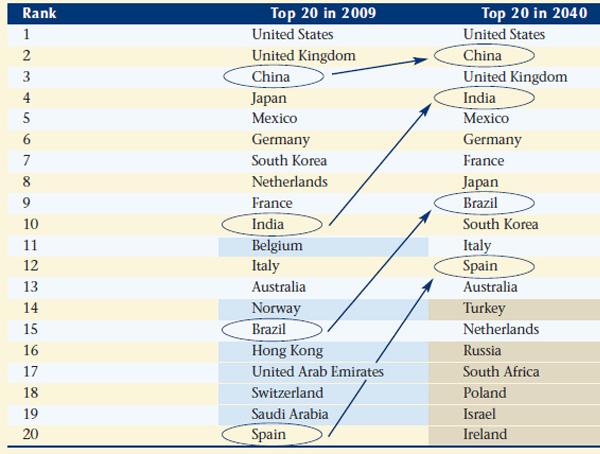
At the same time, however, China, India, Brazil, Russia, South Africa, Turkey and other emerging markets are expected to import much more from Canada. China will overtake the UK for second place and India leapfrog several countries to take fourth. But, in my estimation, this forecast vastly underestimates the potential for Chinese imports, given the country’s increasingly large energy/natural resources and high-tech needs going forward as up to 400 million more peasants join the ranks of urban dwellers over the next two decades.
The Complimentarities Study concludes: “(This study) speaks to the enormous growth in bilateral trade and investment in recent years, and to our countries’ increasing potential to maximize our economic development. The Canadian and Chinese governments should continue to deepen and strengthen our bilateral trade and investment ties through appropriate bilateral instruments to ensure that Chinese and Canadian citizens can continue to build a prosperous and sustainable future”.
My fingers are crossed for substantive talks soon toward the ultimate ‘bilateral instrument’ – a free trade agreement.
Tales of Young Canadians in China
Canadians see a land of opportunity—in China
Maybe a new life awaits you in Nanjing

Os Ishmael/Novus Select
When Noel Muller returned to Toronto from China in 2010, he was thrilled to be home. Within a few months, however, the then-28-year-old teacher, fed up with unemployment—and with bunking in his mom’s basement—was back on a plane bound for China. Muller had spent a year in Jilin, a small city in China’s northeast, teaching English to local children. He’d been homesick, especially toward the end, and keen to start a permanent teaching career in Ontario. But within weeks of returning, Muller realized that might not be an option for him.
With the economy in the tank, he says, “all the jobs dried up.” And in a year in which over two-thirds of education graduates were unemployed, Muller certainly wasn’t being picky. He was applying for everything from tutoring positions to teacher’s assistant spots to a job teaching English as a second language. Then he got a call from his old boss in Jilin. “He was pretty desperate to have me back,” he says, “and offered me a substantial pay raise.” For Muller, it was an easy choice. “Adventure may have brought me here the first time,” he says, “but monetary considerations certainly brought me back.”
Muller is one of a growing number of young Canadian professionals pursuing careers in the new land of opportunity. In Canada, recent graduates were hit particularly hard by the financial crisis—youth unemployment here sits at 14 per cent, double the national rate—and have not fully recovered. Many are settling for contract work outside their field, often below their skill level. But in China, companies are hungry for educated young workers. And they’re willing to pay a premium for foreigners who can act as linguistic and cultural bridges between China and the West.
Mitch Moxley, a Regina native, was in a similar position to Muller when he moved to China in 2007 to pursue a writing career. Moxley, a freelance reporter, was struggling to find paid work in Toronto. One day, while browsing online want ads, he noticed an open position at China Daily, the state-run newspaper, and applied. China itself wasn’t the allure—any position abroad would have suited him. He wanted to improve his resumé, experience a new culture, and head home after a year. But all that changed after the financial crisis in 2008. Five years later, he still lives in Beijing, one of many young Canadians pursuing the kind of careers they were struggling to launch at home. “People can come here and really land on their feet,” he says. “There is a tonne of opportunity, especially for young people.” The combination of good jobs and a low cost of living has kept even the most hesitant Canadians in China years longer than they expected.
While Muller isn’t entirely confident his teaching experience in China will be marketable back home, his current lifestyle is enough to make him want to stay. “I’m really comfortable here. I have the nicest apartment I’ve ever lived in. I go out and eat and drink. I spend as much money on entertainment as I want, I travel on every vacation, and at the end of the month I still save half of my paycheque. That’s just not going to happen in Toronto.”
While lifestyle alone is enough to keep Muller in the country, Tyler Ehler, a graduate student in economics at the University of Nanjing, went to China to begin a career in international business. The McGill grad was confident the country was going to be a huge part of Canada’s economic future. “We’ve got to expand beyond the United States,” he says, “and Europe is a mess.” Smart companies realize that if they’re not in China, “they’re not in the global market.” The 23-year-old Aurora, Ont., native is working for a Hong Kong venture capital firm.
Ehler thinks it’s critical that he’s in China when he’s starting out. Many of the struggles Westerners face when trying to break into the Chinese market are the result of a networking failure; in China, good business relies on good relationships, he says. “If I develop a network now, at the start of my career, it’s going to be a lot easier than just showing up here at 40 and expecting to do business,” he says.
Ehler has been able to dip into the Hong Kong business world’s most exclusive circles simply as a novelty. “There are a lot of Chinese-Canadians here but there are no non-Asians who speak Mandarin,” he says, adding that his boss has taken him to meetings to which he might not have been invited under different circumstances. “When he’s having lunch with government officials, my boss says he likes to surround himself with pretty girls and a white guy who speaks Mandarin,” he says. “That’s his way of distinguishing himself.”
Alongside work and school, Ehler is part of a $30,000-project, launched by Johns Hopkins University, to start a bilingual English-Mandarin social enterprise to help Chinese and Western companies interact. Ehler hopes the project will turn into a consulting firm in the future.
But despite all the opportunity China offers today, few young Canadians say they intend stay much beyond their twenties or early thirties. Living in a country undergoing rapid change can be unsettling, Ehler admits. “In Shanghai they have the living standards of an affluent European country, but in other parts of the country they have the living standards of a poor African country. There are so many challenges ahead.” Even after five years in Beijing, Moxley says he intends to return home. “Living in China, you can sometimes feel like you’re running away from reality,” he says. “Eventually you grow up and realize you don’t want to hide away.”