
PEW Survey: Indians Much More Pessimistic About Economy Than Chinese
China and India, the two largest developing countries and key members of the BRICS, have had a vexed relationship since the late 1950s. A short-lived border war gave India a big wallop that has instilled profound mistrust ever since. In the mainstream Indian media, one still hears of the 1962 humiliation and readiness to take on China should border tensions turn for the worse. But, the days of guns and mortar are long gone, replaced by a bustling economic and trading relationship, albeit lop-sided in China’s favour.
This week, Washington-based Pew Research Center released the results of its recent poll highlighting Indian economic pessimism contrasted to the upbeat responses of Chinese, Brazilians, and others. Conducted in 21 countries last spring, the survey polled over 26,000 respondents worldwide, including over 4,000 Indians of all classes living in urban and rural areas.
In a world where Americans and Europeans constantly fret about their economic prospects, Indians turn out to be the most gloomy. Gone are the buoyant views of imminent economic supremacy over China prevalent just a few years ago. Nowadays, almost 6 in 10 Indians are dissatisfied with the direction in which the country is headed. This compares to 18% of Chinese and 57% of Brazilians but fairs better than the Americans, 71% of who are disenchanted.
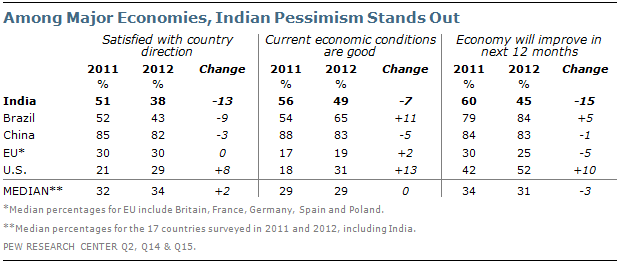
Just shy of half (49%) of Indians believe economic conditions are good, significantly down from a year ago, trailing Chinese respondents by 34% and Brazilians by 16%. Moreover, only 45% think the economy will improve over the next twelve months, down 15% from 2011, 39% behind Brazilians and 38% behind Chinese. In July, the IMF had downgraded its forecast of 2012 Indian GDP growth to 6.1% with a slight rise expected next year.
What’s worse, a full 2/3 (66%) of Indians expressed gloominess about how their children will fair in the future in terms of better jobs and becoming wealthier than themselves. The survey found such sentiments widespread across all income groups and among those with or without university education.
On a brighter note, many Indians felt they are financially better off than 5 years ago and doing better than their parents at their age. Here again, Chinese and Brazilians have a better opinion of their current economic well-being. Not surprisingly, wealthier Indians tended to be more upbeat but the divergence in views between richer and poorer Indians are more pronounced than in Brazil and China, even though income gaps have widened substantially in all three countries.
The survey was also quite revealing about Indian opinions of foreign countries. A clear majority of city-dwellers hold favourable views of the US and Americans with nearly 7 out of 10 (69%) admiring US scientific and technological prowess, 56% liking American approaches to business, but notably, only 48% liking American democratic ideals. In addition, many did not like the fact that American ideas and customs are spreading quickly and support for things American diminish in the countryside.
When it comes to China, it is a completely different story. Whether it’s China’s bustling economy or concern about media fanned hysteria over border tensions, China’s growing military might, and forays into the Indian Ocean, most Indian urbanites take a dim view of their large northern neighbor and burgeoning economic and trading partner. Only 1/3 (33%) hold favourable views with 44% expressing the opposite (23% had no opinion) and 40% deemed the bilateral relationship hostile while only 28% said it was cooperative.
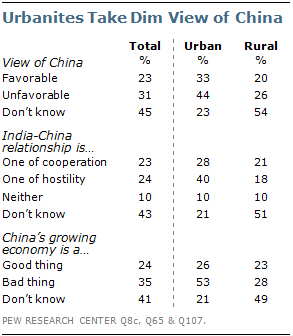
Perhaps reflecting economic anxieties and frustrations with the country’s growth, 53% of Indian urbanites felt China’s economic prosperity is a bad thing for India with only a quarter (26%) thinking it was good. There was a 58% correlation between those who thought Chinese commercial success as bad for India and the likelihood of characterizing the bilateral relationship as one of antagonism. Perhaps tasting sour grapes, only 20% of urban residents acknowledge China as a leading economic power compared to a median of 42% across 20 countries surveyed.
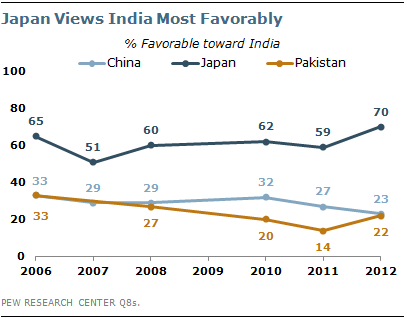
As for how other countries saw India, among Asian countries where the question was posed, an overwhelming majority in Japan (70%) saw India in a positive light, the highest rate since the question was first asked in 2006. Japanese positive feelings toward India stand in stark contrast to their negative views of China that have steadily plummeted over recent years. Japanese coldness toward China stems from deep unease over China’s growing economic, political, and military clout as their economy stagnates and international influence declines.
Just as Indians feel dimly about China, only 23% of Chinese see India favourably, down 10 percentage points from 6 years ago. Images of Indian ghettos, unsanitary conditions, pockets of intense poverty, dilapidated infrastructure, persistent economic under-performance, red-tape, and political and bureaucratic corruption pervade Chinese perceptions of India and Indians.
Sun Group of Newspapers Now Endorses CNOOC’s Bid for Nexen
Canada’s Sun newspaper group on Tuesday reversed its opposition to federal government approval of a $15.1 billion bid by Chinese state-owned oil company CNOOC Ltd for Canada’s Nexen Inc, saying a bilateral agreement signed last week was a “game changer.”
The Sun group, which has a conservative editorial bent, had been the loudest public opponent to the proposed deal, running a hostile editorial after it was announced, commissioning a poll that showed public opposition to it and pressing Prime Minister Stephen Harper on the issue in a news conference. The chain, whose papers include the Ottawa Sun and Calgary Sun, said in July the government should stop the deal, or insist on a quid pro quo if approved. The papers are owned by Quebecor Media Inc.
In an editorial on Tuesday, however, it hailed the signing on Saturday of a Foreign Investment Promotion and Protection Agreement between China and Canada, saying the pact cast the Nexen deal in a fresh light. Canadian Prime Minister and Chinese President Hu Jintao witnessed the signing of the agreement on Saturday on the margins of an Asia-Pacific meeting in Vladivostok, Russia.
It is intended to ensure that two-way investment can take place in a secure manner, with legally binding provisions ensuring greater protection against discriminatory and arbitrary practices, though it does not require each country to approve each proposed investment.
The “China-Canada investment agreement is a game changer toward serious consideration of approving the Nexen sale to the state-owned China National Offshore Oil Corp (CNOOC),” the editorial said.
-Reuters
Sasktel/Huawei Launch First TDD-LTE 2.5 GHz Fixed Wireless Trial in Canada
If this succeeds, and in all probabilities it will, it will be big for Huawei in Canada.
SaskTel and Huawei today announced the signing of an agreement to launch a TDD-LTE (Long Term Evolution) fixed wireless trial in Saskatchewan. The trial will help determine the feasibility of wireless broadband and voice services for customers in predominantly rural locations, using Huawei solutions and equipment. The agreement was signed in Huawei’s traditional courtyard facility in Beijing, by Ron Styles, SaskTel President and CEO, and Sean Yang, President of Huawei Canada. The signing was witnessed by Brad Wall, Premier of Saskatchewan.
“This is another great first in a long list of firsts for SaskTel, and I am pleased that SaskTel is continuing its commitment to investigating opportunities to provide rural customers with advanced communications solutions,” Premier Brad Wall said.
“We are very pleased to be working with SaskTel in launching Canada’s first 2.5 GHz TDD-LTE deployment,” said Sean Yang. “The ability to bring next generation high-speed wireless technology to residents and businesses across the Province is critical to ensuring Saskatchewan is able to compete and innovate with markets around the world.”
The trial will occur in a minimum of three rural locations and will provide the latest wireless broadband speeds available. LTE will reach download speeds of approximately 100 Mbps per second, compared to existing 4G wireless technology reaching speeds of 21 Mbps. In addition, the trial will encompass the provisioning of equipment to a local telephone service, in order to determine comparability with existing landline services using copper wire infrastructure.
“SaskTel’s copper infrastructure dates back to the 1960s and we are fast approaching the need to replace and upgrade this technology,” said Ron Styles, SaskTel President and CEO. “With the positive partnership that has evolved with Huawei with our 4G network and our mobile LTE wireless deployment efforts that are underway, we are very pleased to partner with them to complete this trial.”
The trial is scheduled to be launched in rural locations in Saskatchewan by the end of December, 2012 and will conclude in August, 2013. Following the completion of the trial, Huawei and SaskTel will work jointly to analyze results, and provide a report that includes an economic overview for the replacement of parts of its rural copper network.
BEIJING, Sept. 10, 2012 /CNW
Saskatchewan’s Exports to China Booming Despite Economic Slowdown
The competition for China’s imports is growing fiercer, as the country’s economy slows and demand – though still among the world’s strongest for many commodities – drops off accordingly. Nine of Canada’s 13 provincial and territorial leaders will be in China this week for the World Economic Forum in Tianjin, known informally as the summer Davos, once again promoting Canada’s exports ranging from natural resources to Anne of Green Gables.
Fortunately for Saskatchewan’s farmers, at the end of the day, everybody still needs to eat.
The province’s exports to China jumped 103 per cent year-on-year in the first half of 2012, driven by potash sales and food exports. Turns out Saskatchewan’s yellow peas, used in transparent vermicelli noodles, have caught on in China; the province is thought to provide 85 per cent of China’s total pea imports and 20 per cent of its potash imports, according their own data.
Chinese demand for potash was widely expected to fall this year on falling food prices. But Canpotex is now in the second of a three-year deal to sell more than three million tonnes of the fertilizer to China’s Sinofert, a state-connected firm listed on the Hong Kong stock exchange.
“We are marketing food and energy, and whether or not there is a recession, the world needs those,” Saskatchewan Premier Brad Wall told reporters after addressing a polite luncheon crowd at Beijing’s St. Regis Hotel, better known as President Barack Obama’s home when last in town.
“Even when they’re in recession, they grow at 7 or 8 per cent. That’s quite a recession, by our definition.”
– Globe and Mail
Op-Ed: China Trumps West in Africa
This guy’s views are spot on. A friend with a business in Nigeria tells me that Africans must first learn the workings of a market economy before development can be sustainable. It’s a matter of doing the simpler things first. Western governments have been doing the exact opposite leading to few results.
How China’s approach in Africa beats the West’s
With the ability to deliver projects on time and on budget, China’s leaders are offering their African counterparts a clean-cut deal: If you work with us, we will build it—period. Given that Africa’s economic growth has long been stunted by a lack of dependable transportation infrastructure, this is more than a tempting offer. It’s a historic opportunity.
Without making light of the drawbacks of China’s development methods in Africa—such as relying mostly on its own work force even for projects deep in the African interior—China’s vision is very distinct from the West’s. In post-colonial Africa, the West focused on democracy-building over market-building. The Chinese approach switches those priorities. And whatever the preferences of Westerners, it is Africans who must ultimately make the choice of whether to embrace democracy or markets first.
In the abstract, it is always preferable to focus on democratic structures. However, in countries where poverty remains rampant, an uncomfortable counterargument can be made, based on the West’s poor track record of the last 50 years. In much of Africa, political growth remains as stunted as the economy.
Focusing on market-building first can empower a budding middle class—which provides a counterbalance to the vestiges of clan-based feudalism. In this approach, economic development promotes political development. And, in fact, that is more or less what happened in Europe over the last few centuries. Economic empowerment led the merchant classes to demand increased political rights, which eventually put the continent on the road to full democracy.
As Communist China keeps building bridges, railroads and conference centers across Africa, it is, ironically, the Chinese people—not the Americans—who can make a compelling case that their focus in Africa hasn’t been on spreading ideology but on the practical business of securing natural resources and creating future customers.
Stephan Richter is publisher and editor in chief of The Globalist, and president of The Globalist Research Center
CNOOC’s Nexen Takeover Bid and Canadian Investment Policy
Prime Minister Harper met with his Chinese counterpart, President Hu Jintao, at the sidelines of the Asia-Pacific Economic Cooperation (APEC) summit in Vladivostok yesterday. The two heads of state also presided over the signing of the landmark Canada-China Foreign Investment Promotion and protection Agreement that has been in the works since the Prime Minister’s visit to China last February. Yet, hanging over the agreement is Industry Canada’s on-going review of the $15.1 billion friendly takeover bid of Calgary-based Nexen Inc. by the China National Offshore Oil Co. (CNOOC).
On his way to Russia, speaking to a gathering of businessmen in Vancouver, Mr Harper said approval of the CNOOC deal should not be taken as a ‘litmus test’ for Canadian investment policy as he promised more clarity on Canadian rules for foreign takeovers. A much-debated issue is the ‘net benefit test’ that on the one hand examines quantifiable factors such as job creation and increased investment over time, but on the other, subjective judgments such as whether foreign takeovers are consistent with government policy.
The real sticking point in the CNOOC case is whether China’s third largest petroleum state-owned enterprise (SOE) is able to operate purely along commercial lines and not as an extension of Chinese government policy. A recent Asia-Pacific Foundation of Canada (APF) survey found an overwhelming majority of Canadians skeptical of Chinese SOEs taking over Canadian companies and assets with only 16% in favour. Acknowledging the suspicions, Mr Harper remarked it was incumbent on the Chinese to show their willingness to play by Western rules and that deepening relations were a two-way street.
Late last month, CNOOC formally sought approval of the takeover from the Canadian government. The Nexen board overwhelming endorsed the acquisition, especially because CNOOC is offering to pay a 62% premium over the stock price. The government has 45 days, extendable for another 30, to come up with a decision. Further, since 10% of Nexen’s assets are in the US, CNOOC has scrupulously filed for approval from the US government to address any American national security concerns.
Prime Minister Harper has said that his government is assessing the deal’s long-term impact for Canada and will look beyond a narrow definition of ‘net benefit’. Industry Minister Christian Paradis indicated that reciprocity for Canadian businesses investing in foreign countries is a key concern. Most industry insiders, however, believe that while the deal will be used to prod China on broader trade and investment issues, reciprocity should not hold up ultimate approval.
These sentiments were echoed in a Canadian Business article examining the CNOOC bid. The author urged Ottawa to resist calls for rejecting approval on the basis of lack of reciprocity on the Chinese side. Moreover, proper observance and application of Canadian environmental protection, labour, and competition laws should ease Canadian fears about any rogue behaviour from CNOOC.
“(Approval) should be exploited as an invitation to China to forge a deeper relationship. We should continue pressing China selectively for improved access to targeted areas of the Chinese marketplace where Canadian companies are poised to excel…We can learn a great deal from the exercise – and those insights could be crucial”, the article concluded.
Approval of the CNOOC deal is all the more symbolic and important since Canada will require as much as $650 billion over the next decade to develop its energy and other resources, Natural Resources Minister Joe Oliver remarked in Toronto prior to the Prime Minister’s trip. “Those numbers are just the beginning. Countries in the Asia-Pacific region are hungry for energy and minerals and metals and foreign products they need to fuel growth and build a better quality of life for their citizens”, he said.
Minister Oliver revealed that based on new calculations, natural resources development is now responsible for 20% of Canadian economic activity (15% directly and another 5% from indirect services), much higher than previous estimates. Just as important, natural resources industries – energy, forestry, metals, and minerals – account for 10% of Canadian jobs. In 2010, his ministry had natural resources accounting for only 11.5% of GDP.
Canada and China High in Literacy
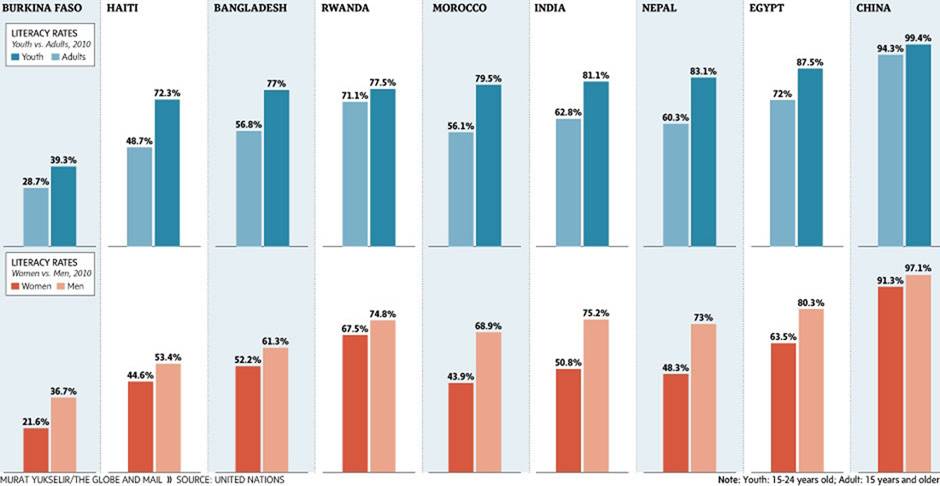
After across-the-board gains between 1990 and 2000, the world literacy rate climbed from 76 per cent to about 82 per cent. Progress has slowed in the decade since. Several countries have plateaued, and only three – China, Indonesia and Iran – are expected to reach the international goal of cutting illiteracy rates in half by 2015.
Literacy rates in Canada are high – around 97 per cent – but there is a debate about what that measure really means. Ideas about literacy have shifted, and while measures once focused on a person’s ability to decipher characters and read text, the bar has been raised to consider economic productivity. In 2008, ABC Life Literacy Canada authored a report that raised concerns about whether Canadians, including those who have graduated high school, can read well enough to be comfortable with new written information or doing computer work. The report relied on Statistics Canada data that showed 48 per cent of adults age 16 and older didn’t have the literacy skills needed for the working world. The report noted that while many were new immigrants, native-born Canadians with high-school diplomas also had difficulties.
– Globe and Mail
Scotiabank Partners with Bank of Xi’an
“We are in more than 55 countries around the world and have been proud to work in China for over 20 years,” said Winnie Leong, Vice-President of Multicultural Banking, Scotiabank. “Based on our international experience we have a strong understanding of what a complicated and important decision it is to move to a new country. When newcomers arrive in Canada, one of their top priorities is finding a financial institution. Through our new partnership with Bank of Xi’an, we are able to give immigrants, foreign workers and students peace of mind by helping them establish a Canadian banking relationship before they emigrate to Canada.”
Scotiabank currently owns a minority stake in the Bank of Xi’an. Under this co-operation agreement with the Bank of Xi’an, Chinese immigrants, international students and foreign workers planning to move to Canada are able to open an account with Scotiabank through 10 participating Bank of Xi’an locations in Xi’an, China. Once in Canada, customers can visit their local Scotiabank branch to activate their accounts, apply for a credit card and take advantage of additional benefits included in the Scotiabank StartRight Program, Scotiabank’s banking package designed for newcomers to Canada.
“This new partnership is a natural extension to our eight year relationship with Scotiabank,” said Zhishun Liu, Vice-President, Bank of Xi’an. “We look forward to offering our guidance and assistance to a wide range of customers here in China that are looking to begin the financial part of their lives in Canada.”
Scotiabank’s business in China also includes a partnership with China Everbright Bank (CEB), which began in 2009. Through this partnership, immigrants and international students moving to Canada can open an account with Scotiabank through any participating CEB branches in 33 cities across China.
About Bank of Xi’an
Bank of Xi’an Co., Ltd., a joint-equity commercial bank, was founded in May 1997, whose shareholders include Xi’an Municipal Finance Bureau, the Bank of Nova Scotia, China Cinda Asset Management Co., Ltd., domestic large and medium-sized enterprises, and individual investors. As a leading regional commercial bank, the Bank has one branch and 113 sub-branches and owns two rural banks, providing full financial services in Chinese western area. It has 2300 employees, CNY102.3bn total assets, CNY76.3bn deposits, and CNY44.6bn loans at the end of 2011. The featured services and products of the Bank include “Golden Silk Road”, “Profit Power”, ” Global Golden Line of Credit”, and “E-credit line.” In 2012, the Bank was ranked No. 632 by the Banker magazine on its “Top 1000 World Banks.”
SOURCE: Scotiabank
Economist: China Dependency Graphs
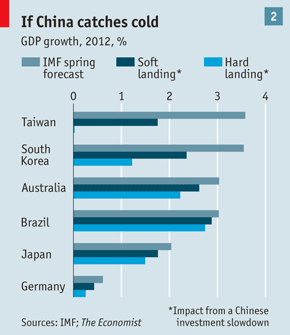
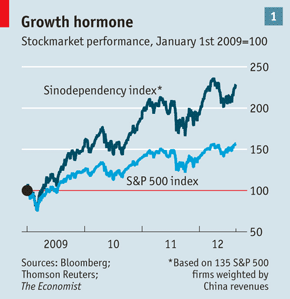
The Economist magazine first came out with its Sinodependency Index a couple years ago; here are some recent graphs on the world’s exposure to the Chinese economy which it says is on par with the Bic Mac Index for currency misalignments. While admittedly rough, the Index has performed rather well against the S & P 500.
http://www.economist.com/node/21560890
Also see its interactive chart on 135 international companies with varying degrees of dependency on China sales.
WEF Competitiveness Survey: Canada and China Down Slightly
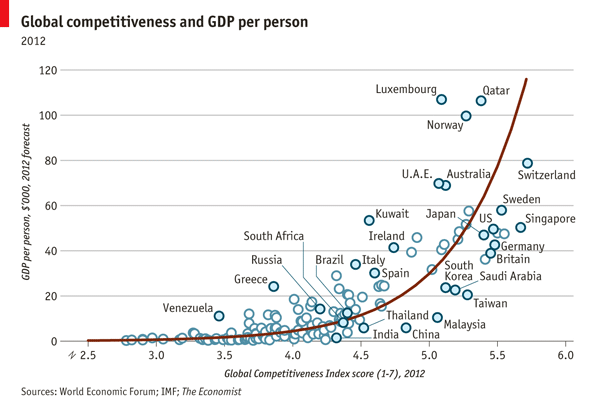
The Global Competitiveness Index (GCI), tabulated annually by the World Economic Forum (WEF), otherwise known for its famous yearly winter concave in Davos, Switzerland, is arguably one of the most comprehensive country competitiveness surveys that ranks 144 countries by examining 113 indicators pulled from official data and polling over 15,000 executives around the world.
In the latest GCI, Switzerland again topped the world for the fourth year in a row while the US continued a four-year slide to 7th place. Both Canada and China fell slightly from the previous year with Canada dropping a couple notches to 14th and China 3 spots to 29th.
Rather than a major shake-up, the 2012-13 survey found ‘deepening divides’, owing to dysfunctional parliaments/congress generating political deadlock in Europe and the US. Hong Kong SAR, Japan, and several Western European and Nordic countries rounded out the top 10. Not surprisingly, the lowest ranked European country was Greece at 96th with its macroeconomic situation placing dead last.
Canada has highly developed merchandise, labour and financial markets as well as well functioning and transparent institutions, good infrastructure, health-care, and primary and higher education and training. However, sliding university enrollments, a downward trend in on-the-job training, declining R & D and the quality of research institutions, and the role of government procurement in promoting innovation are serving to drag down Canada’s overall standing, the GCI highlighted in the report.
China’s descent returns the country to the level it achieved in 2009 but still clearly leading the BRICS pack by a wide margin. It is 19 spots ahead of Brazil (48th) and 30 places in front of India (59th) which has seen its ranking plummet 10 places from its peak in 2009. China’s macro-economy remains robust with a moderate budget deficit, a fairly low 26% government debt to GDP ratio, and a high domestic savings rate of up to 50%. Its sovereign debt is much better situated than most countries and significant advances have been made in health-care, basic education, and higher education.
At the same time, however, deteriorating financial markets, lack of technological readiness, market inefficiencies, and insufficient domestic and foreign competition due to barriers to entry are more prevalent than in previous years. In addition, despite hugely increased university enrollment, the quality of Chinese education, in particular management education, lags behind developed countries, not to mention the gap between course content and specific needs of business and industry.
A lesser known survey, the 2012 Country RepTrak survey conducted by UK’s Reputation Institute, named Canada as having the best reputation among 50 countries. Polling 36,000 people from G8 countries online, it judged countries on not easily quantifiable criteria: trust, admiration, respect, and affinity. These criteria in turn were broken down into 16 related attributes such as quality of life, business environment, products and services, and even the country’s physical beauty.
It was the second year running that Canada garnered the accolade for “exhibiting global leadership in terms of effective government, an advanced economy, and an appealing environment”, said an executive partner for the institute. Interestingly, the US faired poorly at 23rd, just above Peru and India.
And revealing its pro-Western political bias, the survey lumped China (43rd) with Ukraine (42), Russia (45th), and Saudi Arabia (46th). On the positive side, China’s reputation for producing high quality goods and services and being increasingly technologically sophisticated, has improved by some 5-8 points over the past few years.
According to the Country RepTrak model, improvements in reputation is directly translatable into revenue for that country. A 5-point improvement for the US, for example, could mean a US$14.6 billion boost in tourist income. But, just how it arrives at that figure is open to question. Its contention that reputation and people-friendliness drives exports is also problematic. In the survey, China’s reputation is very low and yet the country is an export juggernaut. Canada is lauded for its stability, solid democratic institutions, high GDP, and strong social infrastructure, and yet Canada’s exports lag behind other exporters, especially to countries other than the US.