
WEF Competitiveness Survey: Canada and China Down Slightly
The Global Competitiveness Index (GCI), tabulated annually by the World Economic Forum (WEF), otherwise known for its famous yearly winter concave in Davos, Switzerland, is arguably one of the most comprehensive country competitiveness surveys that ranks 144 countries by examining 113 indicators pulled from official data and polling over 15,000 executives around the world.
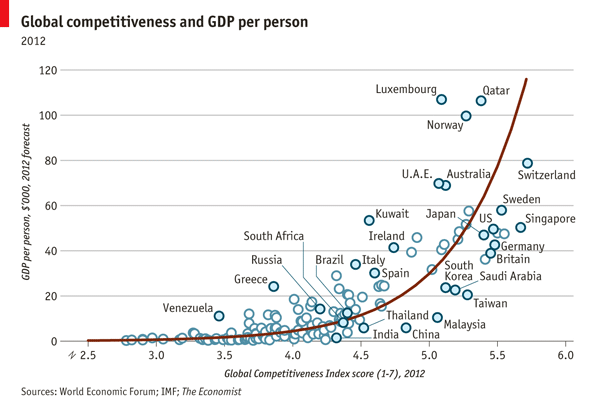
In the latest GCI, Switzerland again topped the world for the fourth year in a row while the US continued a four-year slide to 7th place. Both Canada and China fell slightly from the previous year with Canada dropping a couple notches to 14th and China 3 spots to 29th.
Rather than a major shake-up, the 2012-13 survey found ‘deepening divides’, owing to dysfunctional parliaments/congress generating political deadlock in Europe and the US. Hong Kong SAR, Japan, and several Western European and Nordic countries rounded out the top 10. Not surprisingly, the lowest ranked European country was Greece at 96th with its macroeconomic situation placing dead last.
Canada has highly developed merchandise, labour and financial markets as well as well functioning and transparent institutions, good infrastructure, health-care, and primary and higher education and training. However, sliding university enrollments, a downward trend in on-the-job training, declining R & D and the quality of research institutions, and the role of government procurement in promoting innovation are serving to drag down Canada’s overall standing, the GCI highlighted in the report.
China’s descent returns the country to the level it achieved in 2009 but still clearly leading the BRICS pack by a wide margin. It is 19 spots ahead of Brazil (48th) and 30 places in front of India (59th) which has seen its ranking plummet 10 places from its peak in 2009. China’s macro-economy remains robust with a moderate budget deficit, a fairly low 26% government debt to GDP ratio, and a high domestic savings rate of up to 50%. Its sovereign debt is much better situated than most countries and significant advances have been made in health-care, basic education, and higher education.
At the same time, however, deteriorating financial markets, lack of technological readiness, market inefficiencies, and insufficient domestic and foreign competition due to barriers to entry are more prevalent than in previous years. In addition, despite hugely increased university enrollment, the quality of Chinese education, in particular management education, lags behind developed countries, not to mention the gap between course content and specific needs of business and industry.
A lesser known survey, the 2012 Country RepTrak survey conducted by UK’s Reputation Institute, named Canada as having the best reputation among 50 countries. Polling 36,000 people from G8 countries online, it judged countries on not easily quantifiable criteria: trust, admiration, respect, and affinity. These criteria in turn were broken down into 16 related attributes such as quality of life, business environment, products and services, and even the country’s physical beauty.
It was the second year running that Canada garnered the accolade for “exhibiting global leadership in terms of effective government, an advanced economy, and an appealing environment”, said an executive partner for the institute. Interestingly, the US faired poorly at 23rd, just above Peru and India.
And revealing its pro-Western political bias, the survey lumped China (43rd) with Ukraine (42), Russia (45th), and Saudi Arabia (46th). On the positive side, China’s reputation for producing high quality goods and services and being increasingly technologically sophisticated, has improved by some 5-8 points over the past few years.
According to the Country RepTrak model, improvements in reputation is directly translatable into revenue for that country. A 5-point improvement for the US, for example, could mean a US$14.6 billion boost in tourist income. But, just how it arrives at that figure is open to question. Its contention that reputation and people-friendliness drives exports is also problematic. In the survey, China’s reputation is very low and yet the country is an export juggernaut. Canada is lauded for its stability, solid democratic institutions, high GDP, and strong social infrastructure, and yet Canada’s exports lag behind other exporters, especially to countries other than the US.