PEW Survey: Indians Much More Pessimistic About Economy Than Chinese
China and India, the two largest developing countries and key members of the BRICS, have had a vexed relationship since the late 1950s. A short-lived border war gave India a big wallop that has instilled profound mistrust ever since. In the mainstream Indian media, one still hears of the 1962 humiliation and readiness to take on China should border tensions turn for the worse. But, the days of guns and mortar are long gone, replaced by a bustling economic and trading relationship, albeit lop-sided in China’s favour.
This week, Washington-based Pew Research Center released the results of its recent poll highlighting Indian economic pessimism contrasted to the upbeat responses of Chinese, Brazilians, and others. Conducted in 21 countries last spring, the survey polled over 26,000 respondents worldwide, including over 4,000 Indians of all classes living in urban and rural areas.
In a world where Americans and Europeans constantly fret about their economic prospects, Indians turn out to be the most gloomy. Gone are the buoyant views of imminent economic supremacy over China prevalent just a few years ago. Nowadays, almost 6 in 10 Indians are dissatisfied with the direction in which the country is headed. This compares to 18% of Chinese and 57% of Brazilians but fairs better than the Americans, 71% of who are disenchanted.
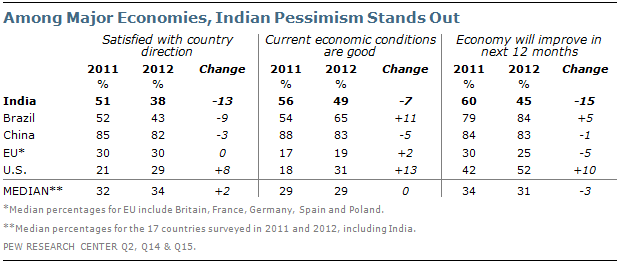
Just shy of half (49%) of Indians believe economic conditions are good, significantly down from a year ago, trailing Chinese respondents by 34% and Brazilians by 16%. Moreover, only 45% think the economy will improve over the next twelve months, down 15% from 2011, 39% behind Brazilians and 38% behind Chinese. In July, the IMF had downgraded its forecast of 2012 Indian GDP growth to 6.1% with a slight rise expected next year.
What’s worse, a full 2/3 (66%) of Indians expressed gloominess about how their children will fair in the future in terms of better jobs and becoming wealthier than themselves. The survey found such sentiments widespread across all income groups and among those with or without university education.
On a brighter note, many Indians felt they are financially better off than 5 years ago and doing better than their parents at their age. Here again, Chinese and Brazilians have a better opinion of their current economic well-being. Not surprisingly, wealthier Indians tended to be more upbeat but the divergence in views between richer and poorer Indians are more pronounced than in Brazil and China, even though income gaps have widened substantially in all three countries.
The survey was also quite revealing about Indian opinions of foreign countries. A clear majority of city-dwellers hold favourable views of the US and Americans with nearly 7 out of 10 (69%) admiring US scientific and technological prowess, 56% liking American approaches to business, but notably, only 48% liking American democratic ideals. In addition, many did not like the fact that American ideas and customs are spreading quickly and support for things American diminish in the countryside.
When it comes to China, it is a completely different story. Whether it’s China’s bustling economy or concern about media fanned hysteria over border tensions, China’s growing military might, and forays into the Indian Ocean, most Indian urbanites take a dim view of their large northern neighbor and burgeoning economic and trading partner. Only 1/3 (33%) hold favourable views with 44% expressing the opposite (23% had no opinion) and 40% deemed the bilateral relationship hostile while only 28% said it was cooperative.
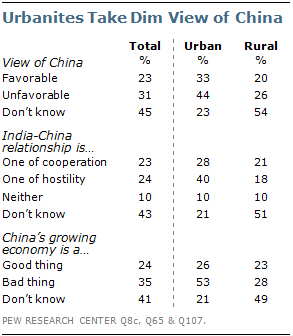
Perhaps reflecting economic anxieties and frustrations with the country’s growth, 53% of Indian urbanites felt China’s economic prosperity is a bad thing for India with only a quarter (26%) thinking it was good. There was a 58% correlation between those who thought Chinese commercial success as bad for India and the likelihood of characterizing the bilateral relationship as one of antagonism. Perhaps tasting sour grapes, only 20% of urban residents acknowledge China as a leading economic power compared to a median of 42% across 20 countries surveyed.
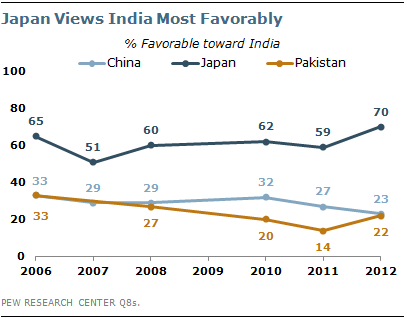
As for how other countries saw India, among Asian countries where the question was posed, an overwhelming majority in Japan (70%) saw India in a positive light, the highest rate since the question was first asked in 2006. Japanese positive feelings toward India stand in stark contrast to their negative views of China that have steadily plummeted over recent years. Japanese coldness toward China stems from deep unease over China’s growing economic, political, and military clout as their economy stagnates and international influence declines.
Just as Indians feel dimly about China, only 23% of Chinese see India favourably, down 10 percentage points from 6 years ago. Images of Indian ghettos, unsanitary conditions, pockets of intense poverty, dilapidated infrastructure, persistent economic under-performance, red-tape, and political and bureaucratic corruption pervade Chinese perceptions of India and Indians.