
Expert: Canadians Missing the Point in Canada-China Trade Debate
Canadians are missing the point in their debate over increased trade with China, according to one Canadian foreign policy expert.
“The debate that Canadians need to have, and the debate we’re really not having,” according to Kim Nossal, director of Queen’s University’s Centre for International and Defence Policy, is on where we will fit as relations between the U.S. and China change.
The proposed $15.1 billion US bid by state-owned China National Offshore Oil Corp. (CNOOC) for Calgary-based Nexen and Enbridge’s bid to build a pipeline to carry Alberta oilsands crude to the west coast has led to much discussion about the bilateral relationship.
But what we should be talking about, Nossal says, are “the implications for us, as a small country that has relations with both the United States and with the People’s Republic of China, as the relations between those two great powers begin to shift and change in the next decade or so.”
Nossal has a unique perspective, having being born in Australia and spent time in Beijing and Hong Kong beginning in the 1960s.
He continues to do research on Australia’s foreign and defence policy. And he’s watched the surge in China’s trade with Australia –an economy very similar to Canada’s in terms of its weighting in commodity exports — especially in the last decade.
The two-way merchandise trade between China and Australia has soared from $113 million Australian dollars in 1973, just after the two opened diplomatic relations, to $78.2 billion in 2009, making China Australia’s largest trading partner.
Add in services, and the total trade in 2009 was worth $85.1 billion, up 15.1 per cent over the year earlier.
In 2010, Canada’s bilateral merchandise trade with China totalled $57.7 billion.
– CBC.ca
Survey: Canadians and Americans See China Relations Very Differently
A Abacus Data survey of 1,068 Canadians and 1,012 Americans provides some insights into Canada’s relationship with its largest trading partner and how both countries feel about other countries.
When asked which country is most important to their economy, 71% of Canadian respondents picked the U.S., followed by China at 16% and India at 4%. Americans picked China (33%) followed by Canada (29%) and Britain (12%).
“Canadians and Americans share concerns about China,” Abacus CEO David Coletto said. “But both see China as being a key part of both countries’ economic future.”
When respondents from both countries were asked to rank countries they believe to be their closest ally, 68% of Canadians picked their southern neighbour while 27% chose Britain. Americans (50%) selected Britain while Canada was the second choice at 38%.
Survey participants were chosen at random from an online database of 150,000 volunteers. The Canadian-American Business Council commissioned the poll. Abacus weighted the survey sample by age, gender, region, and education level according to the most recent census data. Its method is widely used and, according to the industry association of which the pollster is a member, is believed to be capable of producing accurate results. The survey was conducted Nov. 9-12.
– Sunmedia.ca
China Set for ‘Revolution’ in Nuclear Power
CHINA is on track to become the world’s largest generator of nuclear power between now and some time in the 2020s, a senior Rio Tinto executive says. Rio Tinto Energy’s general manager of markets and industry analysis, Stephen Wilson, said China was now about the eighth or ninth largest nuclear energy producer.
By the end of the decade, China was expected to leap to the number two position, he said, before overtaking the US in the 2020s, producing 100 gigawatts of power. ”Their vision is to produce 400 gigawatts of nuclear power by 2050. That’s been publicly stated by Chinese officials,” Mr Wilson told the Australian Institute of Energy national conference in Sydney yesterday. ”That’s more than the whole world has got today.”
The growth in nuclear energy in China would come from new third generation power plants that produced electricity more cheaply than coal and gas plants in coastal China.
– AAP
Xi Jinping and Prospects for Economic Reform
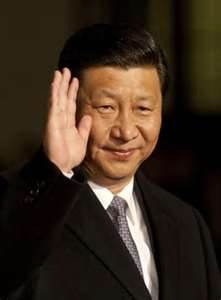
The West knows little about new CCP General Secretary Xi Jinping since tradition dictates that aspiring officials lay low and tow the Party line while nurturing economic growth and putting out the fires of social unrest. The ‘school of hard knocks’ coupled with his pedigree served Mr Xi well, helping to fuel his quiet and slow but sure rise up the ranks of the Party structure.
Xi Zhongxun, his legendary guerrilla leader father’s purge in the early 1960s leading to persecution and imprisonment during the Cultural Revolution, spelled disaster for the Xi junior. He spent much of his teens through early 20s toiling in the parched fields in a remote village, spending most of that time in a ‘yaodong’, cave-dwellings typical of desolate and hilly northwest China. His applications for Party membership were rejected nine times due to his father’s political predicaments. He finally acceded in 1974 and later earned a chemistry degree at prestigious Tsinghua University.
In a rare magazine interview in 2001, he mused, “Knives are sharpened on the stone. People are refined through hardship. Whenever I later encountered trouble, I’d just think of how hard it had been to get things done back then and then nothing would seem difficult.”
Following the death of Chairman Mao in 1976 and the rehabilitation of his father, Xi served as secretary to then Defense Minister Geng Biao, one of his father’s closest comrades. His ties to the PLA and his father’s influence after death may explain his simultaneous promotion to the chairmanship of the Central Military Commission without having to endure the two year or more delays by his predecessors.
Eschewing a cushy bureaucratic career in the Party’s higher echelons, Xi chose to work from the ground up starting in the rural town of Zhengding, Hebei. There, he took advantage of opportunities to create jobs and generate revenue and owing in part to his family background, Mr Xi was able to garner support for local projects from the higher-ups. A few years later, with several years of experience at the grassroots under his belt and given a boost from his father, Mr Xi was named a deputy mayor of Xiamen, which at the time was in its heydays as one of the original four Special Economic Zones.
Serving there and in other capacities throughout the province, Mr Xi steadily climbed the ladder to become provincial governor in 1999. In the lobby of the provincial headquarters, he hung a big banner blazed with the words “Get It Done”. During his 17 year career in Fujian, Xi built up a reputation for frugal government, strong support of private enterprise, and fighting corruption all the while attracting huge amounts of foreign and Taiwanese investment.
From 2002 to 2007, he assumed the highest offices in neighbouring Zhejiang Province, China’s biggest hotbed of private business and a lively civil society. In 2007, he was dispatched to clean-up Shanghai following the corruption scandal of Party boss Chen Liangyu involving the misuse of the city’s social security funds. A year later, he took charge of security at the Beijing Olympics and helped manage relations with Hong Kong.
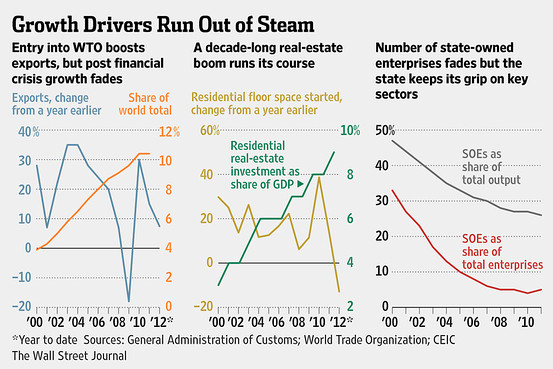
Enigmatic in his political and policy leanings, 22 years of reform in Fujian and Zhejiang speak well for Mr Xi’s continued support of private business even as SOEs continue to benefit from numerous advantages such as access to cheaper capital and land. In this respect, it is significant to note that under Hu Jintao’s watch, SOEs’ share of total industrial and services declined dramatically from 48% in 2000 to about 27% last year. But for Mr Xi to rejuvenate the private sector, he must boldly introduce measures to encourage competition and whittle away the entrenched interests of state monopolies, a tall order even for a man of his background and experience.
Speaking at a conference recently, Mr Li Jian’ge, Chairman of China International Capital Group and a vice-chairman of state-owned Central Huijin Investment Co., suggested that Xi Jinping will unveil new market-oriented reforms within a year focusing on reducing government intervention ranging from excessive regulation to rigid price controls and breaking up or at least curbing the power of state monopolies. Mr Li, who is also a member of the CPPCC that met recently with major private businessmen, said, “Expectations are high…We must give private businesses equal treatment”.
Mr Li was a fellow at the Development Research Center under the State Council. Last February, the Center had collaborated with the World Bank to produce the influential ‘China 2030’ report that points the way for sustained growth and avoiding the so-called ‘middle-income trap’. The report explicitly called for the overhauling of SOEs, SOE banks, land laws, labour and financial markets, while promoting competition and reducing government intervention. The lengthy report was said to have been endorsed by incoming Premier Li Keqiang.
Report: China’s Brain-Drain Reversed
Seems most mainland Chinese who’ve studied abroad over the past three decades have returned, according to a government education agency report. This is a formal accounting of trend reversals since the early 2000s.
————————
| More than 72 percent of overseas Chinese students have returned to China after finishing education abroad since the late 1970s, according to a report from a government-backed agency. From 1978 to 2011, about 818,400 Chinese students returned home after studying abroad, said a report issued on Sunday by the Chinese Service Center for Scholarly Exchange (CSCSE), which is administered by the Ministry of Education. In 2011 alone, nearly 186,200 chose to return, nearly 40 percent more than that in the previous year, said the report, adding that the center had offered services to 110,000 of them.
– Xinhua |
Film About American Adopted Chinese Girls to Debut
Listen to the PRI report about the new documentary “Somewhere Between” that tells the story of the 80,000 girls adopted from Chinese families over the past 25 years. What feelings do they have as they manage their quest to understand what their roots are, and how that culture meshes with the culture they grew up in, here in the United States.
WSJ Charts Accomplishments Under Hu Jintao
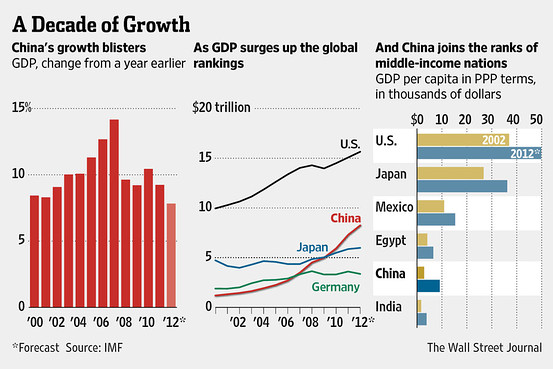
In line with a couple earlier posts, here is a set of charts from the Wall Street Journal’s China Real Time blog. The top three are well known but the bottom three tell another side of China’s transformation – exports leveling out, residential real estate taking a much bigger share of GDP, and the decline of SOEs. Decelerating exports and the steady slide of SOEs may be good for the long-term health of the nation but I am not sure about the growing importance of real estate.
New CCP Politburo and Standing Committee
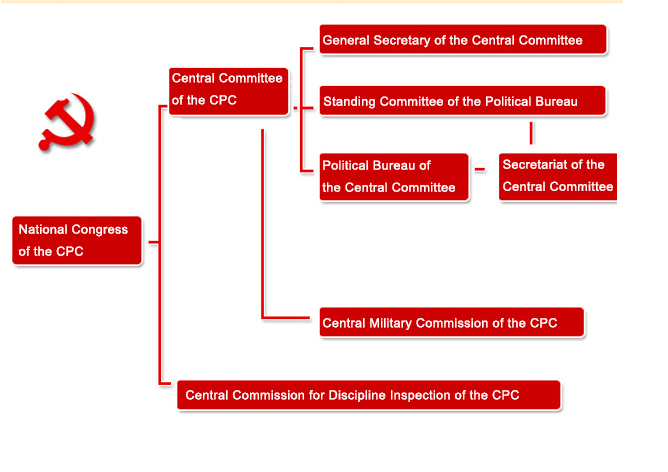
Newly elected General Secretary Xi Jinping stepped out with his 6 colleagues of the Politburo Standing Committee, the inner most sanctum of political power in China – Li Keqiang, Zhang Dejiang, Yu Zhengsheng, Liu Yunshan, Wang Qishan, and Zhang Gaoli – to meet the international press at the close of the CCP’s 18th National Congress yesterday.
This is an older cohort than the last group, averaging 63.4 years compared with 62.1 years five years ago. With the exception of Messrs Xi and Li, all the others are 64 or above who will have to make way for newcomers next time round. (Subsequent posts will look at the major players more closely.)
 source: Xinhua
In addition to Party Chief, Mr Xi was named Chairman of the Central Military Committee (CMC), in contrast to his predecessor Hu Jintao who was only able to take the helm there two years after he became General Secretary cum President of State. This indicates the transition of power went smoother than expected and bodes well for Mr Xi to consolidate power and set his political and economic development and reform agenda much earlier. Mr Xi will assume the Presidency next spring at the National People’s Congress (NPC) that elects the highest officials in government.
First to be introduced by Mr Xi, Mr Li, practiced in economics and law, is destined to become the next Premier next March. North Korea trained Zhang Dejiang is expected to head up the NPC, which despite its rubber-stamp reputation, is witnessing sharper debate and a rise in opposition votes. Shanghai Party Secretary Yu Zhengsheng, appearing fourth in line, is likely to become the Chairman of the Chinese People’s Political Consultative Conference CPPCC), China’s advisory body. Liu Yunshan, fifth to step out, most likely oversees culture and media affairs and it remains to be seen how he will deal with China’s burgeoning press, both traditional and Internet-based. Mr Zhang, the last to meet reporters, is slated to become Executive Vice-Premier.
Perhaps the biggest surprise was 6th entrant Mr Wang Qishan, an economics and finance specialist who takes up the unenviable task of fighting graft within the Party. He was appointed Secretary of the Central Commission for Disciplinary Inspection (CCDI) which set to work right away. A veteran state-owned bank governor and Mayor of Beijing at the height of the SARS crisis in 2003-2004, he is affectionately known as ‘chief of the fire brigade’ – putting out fires in the financial world, the economy, and in broader society. Given his deep financial credentials and the fallout of the Bo Xilai affair, he has been given a strong mandate to go after economic criminals.
In his farewell speech, Mr Hu singled out corruption as the biggest danger faced by the Party and government. Mr Xi, in his first speech as supreme leader, conveyed the same sentiments: “There are many pressing problems within the Party that need to be resolved, particularly corruption, taking bribes, being divorced from the people, going through formalities, and bureaucratism caused by some in the Party…(We must) solve major problems of the Party, improve out conduct and maintain close ties to the people.”
Several younger rising stars were elevated into the top 25. Guangdong Party Chief Wang Yang, seen by many as an economic liberal who advocates deeper economic and political reforms, joined 17 other non-Standing Committee colleagues. Li Yuanchao, the always smiling chief of the Party’s powerful Organization Department, also joined the ranks. Two prominent woman made the cut, Liu Yandong, tipped to become a Vice-Premier, and Sun Chunlan, who some speculate will become head honcho in Tianjin.
Among the youngest to ascend are Inner Mongolia Party boss and experienced Tibet expert Hu Chunhua who could take over from Wang Yang in Guangdong and Sun Zhengcai who could be dispatched to clean up Chongqing, the former bastion of Bo Xilai. Beijing Party chief Guo Jinlong was promoted along with Shanghai Mayor Han Zheng. Public Security Minister Meng Jianzhu will continue to oversee domestic security, a portfolio that was downgraded from the Standing Committee. Finally, Liu Qibao joins the select group who some claim will head up the Propaganda Ministry.
Prentice: ‘Patently Unwise’ to Reject CNOOC’s Bid
Canada should not reject Chinese investments in its oil industry out of hand because China offers an important outlet as Canada seeks to broaden the market for its crude oil supplies, a former government minister said on Wednesday.
Jim Prentice, vice chairman for Canadian Imperial Bank of Commerceand a former member of Prime Minister Stephen Harper’s cabinet, made his remarks as Ottawa reviewed the $15.1 billion takeover bid by China’s state-owned CNOOC Ltd <0883.HK> for Nexen Inc.
Prentice said Canada must remain open for business and realize that much foreign investment will be made by sovereign wealth funds and state-owned enterprises from both democratic and non-democratic countries.
The Harper government has intensified efforts to open up new markets for Canadian oil in China and throughout Asia to reduce reliance on the United States as its sole export market, in hopes of boosting returns for fast-growing oil sands production.
“In such an environment, saying ‘no thanks’ to the largest new market opportunity, namely China, would be patently unwise — particularly in circumstances where the transactions do not imperil Canadian values or environmental and labor laws,” Prentice said in notes for a speech to a major energy conference in London.
“One can fairly expect Prime Minister Harper to move with care and dexterity, balancing Canada’s internal political concerns about foreign investment with the imperative to develop out its ‘strategic partnership’ with China and demonstrate progress on the need for reciprocity,” he said.
Early this month, Ottawa extended its deadline for ruling on the takeover of Calgary-based Nexen by CNOOC to December 10. The government is scrutinizing the contentious deal under guidelines for state-owned enterprises that Prentice drafted as minister of industry five years ago.
– Reuters
BCG: 20% of Chinese Affluent by 2020
Twenty per cent of the Chinese population will be wealthy enough to be considered “affluent” by 2020, according to research by the management-consulting company Boston Consulting Group.
By then, 280 million people are expected to form the country’s affluent class, wielding US$3.1 trillion a year of purchasing power, an amount equal to 5 per cent of global consumption, the company said. Boston Consulting defined people who have an annual household disposable income of US$20,000 to US$1 million as being affluent.
By 2020, their consumption will be nearly equal to Japan’s total consumption for the same year, 128 per cent of Germany’s and three times South Korea’s, the report said.
Adjusted to take differences in purchasing power into account, the US$20,000 starting point for the affluent class is equivalent to an annual household disposable income of US$38,000 in the most-developed markets and is near to the medium household income of many developed countries, the company said in its report.
– China Daily