
Video: China’s Z-10 Attack Helicopter Debuts at the Zhuhai Air Show
Reuters video can be seen at: http://www.theglobeandmail.com/report-on-business/video/video-china-debuts-attack-helicopter/article5269498/
Economist Chart: Hu Performed the Best?
Following yesterday’s post on China’s growth during Hu Jintao’s tenure, the Economist provides an interesting comparison of the three leaders Deng Xiaoping, Jiang Zemin, and Hu Jintao.
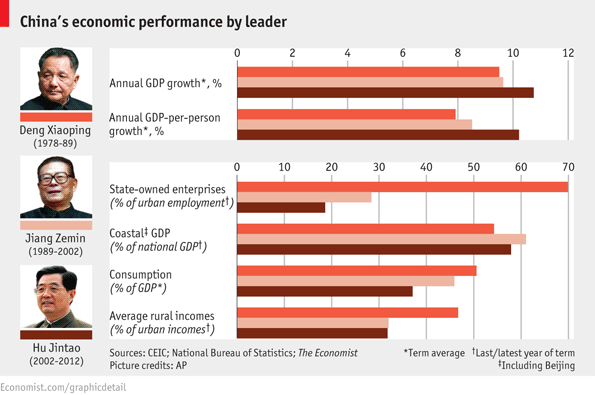
The accompanying article can be read at: http://www.economist.com/blogs/graphicdetail/2012/11/daily-chart-9?fsrc=nlw|newe|11-14-2012|4149113|36108690|
China’s Economy and Politics Over the Past 10 Years and Going Forward
The pivotal 18th Congress of the CCP is winding down and a group of new leaders will be anointed to steer the world’s second largest economy onto a more sustainable path of development and reform, both economically and politically. The Singapore research team at Capital Economics dubbed the Chinese leadership change as more significant to especially emerging economies than the re-election of Barack Obama. It may be worthwhile here to review China’s transformation over the last ten years since the last leadership change and gauge the way forward.
Surging economic growth has been the main hallmark of the past decade. China leapfrogged from 5th place in 2002 to the world’s second largest economy, averaging 10.6% annual GDP growth and hitting a high of 14.2% in 2007 before the global financial meltdown. Growth has since slowed considerably to 9.2% last year and most likely will end up with 7.5% to 8% this year. Government and private economists expect +7% growth to be maintained for the remainder of the decade.
In line with rapid GDP growth has been a more than quadrupling of per capita incomes from around $1000 dollars a decade ago to last year’s US$5400, according to World Bank and IMF figures. In the cities, the average minimum wage rose on average 12.5% from 2006 to 2010 and going by government forecasts, wages will keep rising by 13% a year into 2015. In his goodbye speech to the 18th Congress last week, General Secretary Hu Jintao reiterated the plan to double 2010 GDP and per capita incomes of both urban and rural residents by 2020. By 2030, the World Bank conservatively projects per capita incomes to triple to around $16,000.
Under the current five-year plan (2011-2015), the government has pledged to grow incomes by more than 7% a year which would result in a doubling by the end of the decade. At the same time, the yawning gap between the rich and poor has become a highly sensitive issue. Despite absolute income gains, average urban disposable incomes are only about $3500 a year and much lower in the countryside. According to the United Nations Development Program (UNDP), about 13% of Chinese people in poor and remote areas still live on less than $1.25 a day.
In a poll of 1200 adults across major Chinese cities just prior to the 18th Congress, the Global Times newspaper found the vast majority of respondents increasingly concerned about the their livelihood and social security. Over 70% want the government to up efforts vigorously in providing universal medical care, retirement pensions and social security in the years ahead.
Consumer spending has ballooned over the past decade driven by rising incomes amid fast-paced urbanization. Increasing spending power by the 150+ million strong middle class is set to propel the country to become the world’s largest consumer market by 2015 with retail sales hitting $5 trillion. So far this year, household and government consumption together accounted for about 55% of GDP, the first time that consumption surpassed investment as the main driver of GDP growth.
Residential consumption which has been growing like gangbusters over the past decade reached 16 trillion RMB ($2.56 trillion) last year and is expected to climb to 30 trillion in 2016 and as much as 50 trillion by 2022, forecast a researcher from Hainan-based China Institute for Reform and Development.
General Secretary Hu committed the government to spurring the transformation from an export-led economy to one based mainly by domestic demand. He told 18th Congress delegates: “we should firmly maintain the strategic focus of boosting domestic demand, speed up the establishment of a long-term mechanism for increasing consumer demand, unleash the potential of individual consumption, increase investment at a proper pace, and expand the domestic market.”
On the political front, Mr Hu underscored the importance of political reform, fighting corruption, and strengthening the rule of law, all of which the people seem to yearn for. The Global Times survey found more than 81% of respondents desired a faster pace in political reform, with vast majorities demanding public and media scrutiny and punishment of illicit official behavior coupled with increasing government transparency. In the fallout of the Bo Xilai, Bogu Kailai affair, they singled out corruption and official abuse as the biggest challenge for the CCP in maintaining social stability.
In a Q & A with Goldman Sachs, Cheng Li, a CCP expert at the Washington-based Brookings Institution, remarked, “(They must) address the crisis of legitimacy raised by the Bo Xilai episode. Political reform will likely be centered on the establishment of an independent judicial system and credible rule of law. This is a more effective way forward for political reform than the pursuit of democracy…In a country without the rule of law, no one is safe. In addition, I believe the new leaders will also aim to adopt more intra-party elections in order to build new sources of legitimacy.”
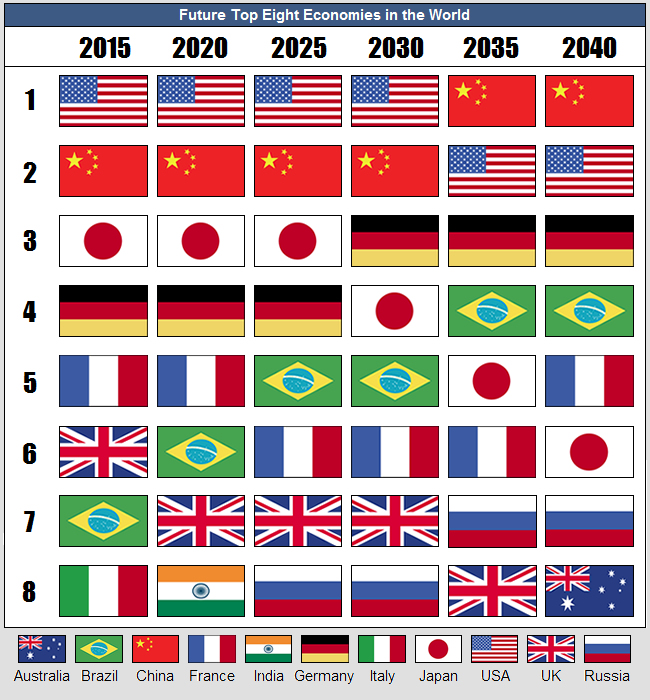
Graphic: Future Top Eight
Rather conservative graphic about the future top eight. Using purchasing power parity rates (PPP) China should surpass the US by the end of the decade (OECD and IMF saying earlier). Even using nominal exchange rates, China should top the US between 2025-2030.
But, one thing is striking in this graphic – the steady decline of Japan. And looking at the advance of Australia which is half the size of Canada, where are we? And where is India, touted by some as a rising power?
————————–
– streetauthority.com
Bombardier Strengthens Pact with COMAC
Further to an earlier post on COMAC’s increasing sales of its C919 mid-sized passenger jets, here is more news about the deepening Bombardier-COMAC tie-up.
______________________
Canada’s Bombardier Incand Commercial Aircraft Corp of China Ltd COMAC) have strengthened an existing cooperation agreement to include possible joint sales and marketing on their new C-Series and C919 planes, the companies said on Tuesday.
Announcing the second phase of a contract that could also include collaboration on future product lines, the companies said they hoped for cost benefits for both planes. Under an agreement first announced in March, the two companies say they have made efficiency and product development gains on cockpit-crew interfaces, electrical systems, development of aluminum-lithium standards and specifications, and technical publications.
– Reuters
Forbes Columnist: Give China’s New Leadership Time
Good commentary on the challenges facing incoming President Xi Jinping and Western and other critics needing to allow him time and space to introduce and implement reforms instead of political trite from the likes of the befuddled Dalai Lama.
China to be Biggest User of Robotics
I have posted on the growing use of robotics in industry as a way to alleviate labour shortages in the future. China’s one-child policy is in need of deep reform but Western prognosticators of imminent Chinese industrial and social collapse due to warped demographics may be just preaching to choir.
________________________________
Demand for industrial robots in China is expected to hit 32,000 units by 2014, making it the world’s largest robotics consumer nation.
According to the International Federation of Robotics, the sector has gained momentum amid higher labour costs.
At a major international fair in the country, which closed Saturday, China’s robot manufacturers showcased their models to the world.
The five-day exhibition attracted over 1,800 participants, Xinhua reported. Chinese robots are exported to overseas markets such as the US, Canada, Russia and India.
– IANS
China’s Pterodactyl Drone on Display at Zhuhai Air Show
http://www.businessinsider.com/chinas-mysterious-predator-clone-is-finally-out-in-the-open-2012-11

OECD Report: China By Far the Biggest Economy by 2030
Crystal ball gazing far into the future is folly at the best of times and the latest attempt by the Economics Department of the Organization for Economic Cooperation and Development (OECD) in forecasting world development over the next half century is outright bold, particularly about China and India. So eye-catching was its prediction that China’s Central Television (CCTV) made a rare mention on today’s noon news.
Using 2005 purchasing power parity (PPP) rates, “Looking into 2060: A Global Vision of Long-Term Growth” projects China’s GDP to surpass the Euro Zone within a year and the US within a few. In another 18 years, China will account for 28% of the total output of 42 major economies, compared to 18% for the US, 12% for the Euro Zone, and 4% for Japan. 30 more years on, the OECD sees China staying constant at 28% as India leapfrogs the US to 18% (US drops to 17%), and the Euro Zone and Japan continuing their steady slide to 9% and 3% respectively.

By around 2025, the combined gross domestic product of China and India will likely exceed that of all G7 rich countries and by 2060, more than 1 1/2 times bigger than the entire OECD area (from a mere 1/3 now). In 2010, China and India accounted for less than 1/2 of G7 GDP.
Improvements in productivity will serve as the biggest driver of growth in the emerging world. Collectively, those countries currently with relatively low productivity levels such as the BRICs and newly emerging countries/regions like Indonesia and Eastern Europe will grow faster than more developed countries, facilitated by greater trade openness, wider technological diffusion, and the strength of domestic competition.
Rising incomes in relatively high-saving China and India plus fiscal consolidation in the indebted West and Japan, will raise the global savings rate. This means capital accumulation will remain fairly stable until around 2030. Afterwards, that rate gradually falls as demographic developments, particularly rapid aging in China, exert their impact coupled with slower growth overall in emerging countries.
Rapid aging in Asia, Eastern Europe, and Southern Europe will put a drag on growth. China faces an increasingly severe problem so the OECD expects India and Indonesia to overtake China’s growth rate by the end of this decade. On the other hand, improvements in education leading to the further build-up of human capital will add significantly to GDP growth in China and India over the next 5 decades.
Although the rapid ‘catch-up’ of China and India will bring about a seven-fold increase in per capita incomes, China’s living standard will still just be 25% higher than current US levels or about 60% of the US in 2060. This would be slightly behind Spain and France but ahead of Italy. Meanwhile, India should reach 1/2 of current US levels. According to World Bank, IMF, and CIA charts, at the end of 2011, China’s PPP per capita GDP hovered around $8400 to $8500 while nominal GDP stood in the neighbourhood of $5400. By contrast, India’s PPP income is just above $3000 and nominal around $1500.
As for Canada, the OECD report envisages a bright future, projecting it to continue leading the G7, averaging a 2.2% growth rate over the next 50 years. Only the US and the UK will come close, averaging 2.1%. The OECD’s expectations on Canadian growth are based on a continuingly growing work force, albeit more slowly due to retiring baby boomers. Japan and Germany will experience contractions, reducing overall per capita income levels. Canada’s per capita income will be near the top, just behind Japan among the G7.