
China’s Vanke Real Estate Showing the Way for Small Homes
China is leading the way in research around minimal sized housing with one of that country’s largest development companies intensively studying the lifestyle practices and consumer preferences of 18-to 25 -year olds – mainly college students and recent graduates.
Vanke Real Estate is conducting research to try to meet the functional housing needs of this young group with a living space of just 194 square feet. They believe the basic needs of daily life can be provided in an intricately designed shared space that functions as a living room, bedroom, bathroom, kitchen and study den for those young people who tend to spend most of their social time connecting with friends in public places, like restaurants, coffee houses, bars and clubs and who turn to the digital world for both their communications and entertainment.
This prototype compact apartment is designed to make Internet access and notebook computer or smart phone use as easy as brushing your teeth. For example, much attention is paid to the design of the built-in bed to ensure that people can use their laptop, notebook or smart phone in bed, with power close at hand and proper lighting. Design of the essential features of the bathroom, such as the shower and basin, tend to be more important than the design of the extremely minimal kitchen, which is little more than a coffee-making and instant soup preparation station for a generation that tends to dine mostly in fast food outlets and restaurants.
Innovative design research like this is leading to homes smaller than most of us can imagine. We might never see homes this small in our part of the world, but demographic and economic forces are going to continue to drive a trend toward smaller housing.
For the entire article see: http://www.vancouversun.com/business/Small+becoming+when+comes+housing/7530253/story.html#ixzz2BsU7E84H
18th National Congress of the CCP
President Obama just won the US election with over 300 Electoral College votes and a 1.7% advantage in the popular vote. Now, it’s China’s turn. Over the next few days, more than 2200 delegates of Chinese Communist Party (CCP) is gathering at its potentially epoch-changing 18th Congress to elect a new General Secretary, Premier of State, and members of the Politburo and Standing Committee, not to mention hammering out the country’s crucial development agenda for the next 5-10 years.
This is the first of a series of posts on the CCP Congress. First off, a brief introduction to the congress.
The CCP is the world’s largest political party with an estimated 82 million members. All political participation goes through the CCP with party members choosing delegates to the national congress. The CCP’s structure is pyramid-shaped from village members at the grassroots to the highest echelons of the Party apparatus and government in Beijing.
Since the mid-1980s, the CCP has tried to maintain a smooth and orderly succession and avoiding, in particular, the cult of personality that pervaded under Chairman Mao. The CCP national congress convenes every 5 years and chooses leading officials every 10 years. Delegates elect about 200 to 300 members to the CCP’s Central Committee along with 150 alternates.
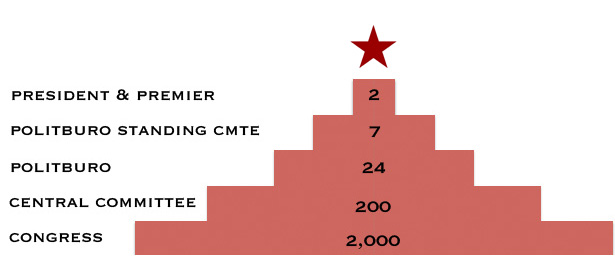
The Central Committee, in turn, picks the Party’s highest decision-making body, the 24-25 member Politburo and its all-powerful Standing Committee which has consisted of 9 members since the last congress. This time round, the Standing Committee is expected to be whittled down to 7 members. The Politburo often includes party secretaries from municipalities and the largest provinces. Provincial and central ministry chiefs must retire at 65.
At this congress, 14 Politburo members are expected to step aside due to age and tenure limits, including 7 members of the Standing Committee, most notably, General Secretary Hu Jintao and Premier Wen Jiabao. Barring a catastrophe, they will be replaced by Messrs Xi Jinping and Li Keqiang respectively. Since 1993, the general secretary has also served as the president of state. (A subsequent post will provide brief introductions to the two leaders.)
The Politburo Standing Committee also appoints 4 vice-premiers of the State Council and the Chairman of the National People’s Congress (NPC), China’s nominal parliament. Its chairman, Mr Wu Bangguo will step down at this congress. The State Council’s main role is running and managing the national economy, overseeing central bureaucracies under its wing along with 35 leading members heading up government ministries. Members of the Chinese People’s Political Consultative Conference (CPPCC), China’s advisory body, can be CCP and non-CCP members but its Chairman is usually a Politburo member. Mr Jia Qinglin, current chairman, will retire.
As previously posted, aside from leadership changes, the Congress also reviews and rewrites, whenever necessary, parts of the Party’s Constitution. The 15th Congress in 1997, following the death of paramount leader Deng Xiaoping and the repatriation of the Hong Kong SAR that year, saw the departure of Qiao Shi, former Chairman of the NPC and the enshrining of Deng Xiaoping Theory in the constitution.
At the 16th Congress in 2002, the ‘Fourth Generation’ of CCP leaders under Hu Jintao assumed control of the Party/state with former General Secretary Jiang Zemin retaining the Chair of the Central Military Commission for a number of years as his ‘Three Represents’ theory became part of Party doctrine. At the last Congress in 2007, Vice-President Zeng Qinghong, a leading Jiang Zemin protégé, left the limelight and Hu Jintao’s ‘Scientific Development Concept’ became a canon in the CCP’s guiding ideology.
Compared to the CCP congressional process which is steeped in secrecy, the HKSAR has limited democracy that allows Hong Kongers to directly elect half of its 60 legislators with the head of government chosen by a special body of 1200 members. Hong Kong will be allowed to directly elect its leader in 2017 and all of its lawmakers by 2020 at the earliest. The Macau SAR shares similar processes.
Since the death of strongman Chiang Kai-shek’s son Chiang Ching-kuo in 1988, Taiwan has transformed into a full-fledged yet rowdy and rambunctious democracy with fist fights in parliament and attempted assassinations of election candidates. Former President Chen Shui-bian of the Democratic Progressive party that openly espouses independence from China, is currently serving a lengthy prison sentence for corruption.
Kevin Rudd on China’s Foreign Policy Under Incoming President Xi Jinping
Pretty good synopsis: http://www.bbc.co.uk/news/world-asia-china-20217333
Book on China Megatrends: 13 Mega Cities, 4 Mega Regions, and 6 Mega corridors by 2025
China is set to become the largest economy in the world by 2025 with a nominal GDP value of US$38 trillion. Fuelled by a strong urbanisation rate, a favourable corporate environment, huge infrastructure investment and the largest working age population, the Chinese economy will finally transform itself from being the manufacturing site of the globe to one of the biggest and largest consumer markets in the entire world.
New analysis from Frost & Sullivan, Mega Trends in China: Macro to Micro Implications of Mega Trends to 2025, has identified over 10 key Mega Trends that will accelerate China’s nominal GDP growth rate to around 16 per cent by 2020.
Urbanisation will bring about spatial changes to the country, resulting in the emergence of 13 Mega-cities, 4 Mega-regions, and 6 Mega-corridors in 2025. The Mega Cities will grow to become the major hubs for commercial and business activity, contributing nearly US$6.24 trillion to China’s GDP in 2025.
“By 2025, an estimated 921 million people or 65.4 per cent of China’s population, will live in cities, which is about 2.6 times of the United States’ total population”, says Archana Amarnath, Programme Manager, Visionary Innovation Research Group, Frost & Sullivan.
She also added that the growth in Chinese mega cities will supplement Asia’s growing role as the world’s financial centre. In fact, by 2020, Hong Kong and Shanghai are expected to occupy two places in top five global financial centres. – PRNewswire
SCMP: Premier Wen Requests Probe Into Family Fortunes
China’s ruling Communist Party has launched an internal inquiry into allegations made by The New York Times that theChina’s ruling Communist Party has launched an internal inquiry into allegations made by The New York Times that the family of Premier Wen Jiabao accumulated at least $2.7 billion in “hidden riches”, the South China Morning Post said on Monday.
Wen himself asked for the inquiry in a letter to the Politburo Standing Committee – the party’s top decision-making body of which he is also a member – in an apparent move to clear his name, the Hong Kong daily said, citing unnamed sources. Lawyers for the Wen family have rejected The New York Times’ Oct. 26 report, which says corporate and regulatory records show Wen’s mother, siblings and children amassed most of their wealth since Wen became Vice Premier in 1998.
“The Standing Committee had agreed to his (Wen’s) request,” the South China Morning Post said, quoting the sources. It cited some analysts as saying that Wen’s request for a probe showed the premier was keen to use it as a chance to push forward a long-stalled “sunshine law”, which would require a public declaration of family assets by senior leaders.
– Reuters
Think Tank: China’s Middle Class to Grow to 600 Million by 2020
CHINA’S rapid urbanization will see its middle class grow to 600 million and support an economic growth between 7 percent and 8 percent annually by 2020, a government think tank chief predicted yesterday.
Speaking at a reform forum in Haikou, capital of China’s southern-most province of Hainan, Chi Fulin, executive president of the China Institute for Reform and Development, said: “As urbanization creates huge domestic demand potential, China still has ample room for transition and reform for the coming decade.”
According to the think tank, China’s urbanization rate reached 51.3 percent in 2011, meaning over half of Chinese were living in cities and towns last year.
The continued urbanization, together with the increase in middle-class consumers will spur investment demand by at least 40 trillion yuan (US$6.3t) over the next 10 years, Chi added.
– Shanghai Daily
Gallup: Chinese Women Vastly Outpace Indian in the Workforce
Chinese women are taking part in their country’s labor force in vastly greater numbers than Indian women are, according to Gallup surveys between 2009 and 2012. Overall, 70% of Chinese women are either employed in some capacity or seeking employment, vs. 25% of Indian women.
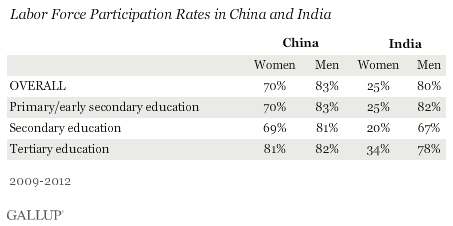
Gender gaps are also much narrower in China than in India, and all but disappearing among Chinese with the highest level of education. College-educated Indian women are significantly more likely than those who are less educated to be in the labor force; however, even among this group about one-third (34%) are in the labor force.
Not only do Indian women participate in the labor force at lower levels, those who do participate have a harder time finding jobs than women in China. Gallup’s data indicate that, among Indian women who are labor force participants, 15% are unemployed — meaning they are available for work and looking for jobs — compared with 5% among India’s male labor force participants. Among the much larger share of women in the Chinese workforce, 5% are unemployed.
Amendments to the CPC Constitution
In the run-up to the critical 18th Communist Party of China (CPC) Congress, Chinese and foreign media organizations are abuzz with speculation about the possible removal of references to Mao Zedong Thought and Leninism in the Party’s constitution. Should this happen, it could be an epochal break from the Party’s ideological strictures, ushering in the next phase of crucial economic and political reforms. To people unacquainted with the arcane workings of CPC ideological politics, such seemingly subtle alterations can be of paramount importance.
The ‘double –eighteen’ as it is being called (the 18th Party constitutional amendment at the 18th Party Congress) is expected to elevate ‘scientific development’, credited to General Secretary Hu Jintao, to become the guiding thinking of the CPC, deduces Hong Kong’s Ta Kung Pao. The concepts of ‘scientific development’ and ‘harmonious society’, both attributed to Hu, were written into the constitution at the 17th Congress 5 years ago. Previous amendments had enshrined ‘Deng Xiaoping Theory’ and former General Secretary Jiang Zemin’s ‘Three Represents’ in the constitution, not to mention the landmark provision allowing entrepreneurs to join the Party.
Relatedly, there are indications that instead of listing the ‘theoretical contributions’ of Deng, Jiang and Hu individually, they may all be encompassed in the phrase ‘theoretical system of socialism with Chinese characteristics’. A recent article in the People’s Daily noted that at the 90th anniversary of the founding of the CPC, General Secretary Hu emphasized the guiding importance of such a ‘theoretical system’. Chen Xuewei, a Party affairs expert at the Central Party School, said setting the ‘theoretical system’ as guiding thinking does away with the awkward tradition of adding a new theory each time a general-secretary is replaced.
But, the most important amendment, should it happen, is deleting references to Mao Zedong Thought and Leninism and incorporating them into a general reference to Marxism. This would be the most significant revision since the four cardinal principles were dictated by Deng Xiaoping and the first time since 1945 that Mao Zedong Thought no longer stood front and center in the constitution.
An article in the Singapore’s Straits Times suggests that it took immense courage and determination to even table the proposal, given the strongly vocal community of Maoists and neo-Leftists within and without the Party. The hand of the current leadership may also have been forced by the recent Bo Gu Kailai murder scandal that implicated her husband Bo Xilai, who during his tenure as Chongqing Party Chief had launched a prominent Maoist ‘red’ revival campaign in a bid to secure a place within the Standing Committee of the Politburo. Removal would also signify the ultimate triumph of Dengist pragmatism over Maoist orthodoxy, plowing away the single biggest obstacle against deepening economic and political reforms under in-coming General Secretary Xi Jinping.
Zheng Yongnian, Director of the East Asian Institute at the National University of Singapore commented: “Before the fall of Bo Xilai, the direction was not so clear…Deleting Mao Zedong Thought hints that China’s new leadership has selected a path for the future that has become clearer now, that is, a little less Maoism and a little more Dengism…Actually, only leftists are concerned about this issue; most young people could care less. For them, memories of Mao on longer exist.”
Yet, contrarians such as Wang Zhengxu, senior research fellow at the University of Nottingham’s School of Contemporary Chinese Studies, insist it is simple impossible to delete Mao and Lenin at this time. In 2003, in commemoration of the 110th anniversary of Mao’s birth, Hu Jintao underscored that at all times and in all circumstances, “we must raise high the banner of Mao Zedong Thought”.
Another possible amendment, albeit smaller in the scope of things, would exert a major impact on the direction of China’s future development – ‘building ecological civilization’. Party historians point to official reports of Politburo meetings over the recent past that have frequently invoked the phrase “fully implementing the building of socialist economics, politics, culture, society, and ecological civilization”. This, they say, bodes well for environmental policy in the face of major challenges in the coming decades.
Finally, reforms to central institutions and organizations of the CPC are also pressing. Gu Haibing, a professor at the Remin University of China, questions the utility of the Party Secretariat when the Politburo and its Standing Committee make all major decisions. The constitution also fails to address ballooning CPC central bureaucracies. For instance, the functions of the Central Bureau of Compilation and Translation which are merely technical can be readily taken up by non-Party institutions.
Chinese Hipsters
Stressed out urban middle-class Chinese youths are turning to counter-culture to fill their spiritual void. See the interesting article on the rising phenomenon of ‘wenqing’ (cultured youths) in the Atlantic.
http://www.theatlantic.com/international/archive/2012/11/china-has-hipsters-too/264414/
NP Columnist: Opposition Churning Up Hysteria Over FIPA
http://fullcomment.nationalpost.com/2012/11/01/john-ivison-opponents-turning-up-hysteria-over-trade-deal-with-china/