
South to North Water Diversion to Begin This Year
Water pressures are growing in China and this is the beginning of alleviation efforts for the parched north.

Global Times Poll: 80% of Respondents Say China Not Yet a World Power
Bilateral relations with the US, Japan, and Russia are the top three influential relationships for China, according to a survey released Sunday by Global Times’ Global Poll Center. More than half the respondents had a positive view of Sino-US relations, though many agreed that the US pivot toward Asia and its efforts at strategic containment of China are holding relations back.
The survey indicated the Chinese people have a dimmer view of Sino-Japanese relations, as nearly 70 percent of those surveyed chose Japan’s so-called nationalization of the Diaoyu Islands as the most significant global event in 2012.
The survey, conducted through phone calls and the Internet, collected responses from 1,404 residents above 15 years old and from seven Chinese cities, including Beijing, Shanghai, Guangzhou and Changsha.
According to previous Global Times surveys over the past seven years, Sino-US relations have been considered the most influential bilateral relations for China, with 74.6 percent of the respondents agreeing this year, although its significance has seen a noticeable decrease from 2010 to 2012. Around 34 percent of the respondents think Sino-US relations have become tenser during US President Barack Obama’s term over the past four years.
Some 53 percent of the respondents think positively of Sino-US relations despite agreeing that certain issues, such as the US containment of China, business and trade frictions, the Taiwan question and disputes on yuan exchange rates, have been affecting relations.
The report showed that most of the respondents had pessimistic expectations of Sino-Japanese relations, with less than 24 percent expecting an improved relationship. Some 38 percent thought the relationship would stay as it is now, and another 33 percent believed it would get worse.
While some 38 percent surveyed remain optimistic on China’s surrounding environment, more than half still think disputes over the South China Sea and US involvement in the issue are affecting China’s relations with ASEAN countries.
Despite all the pressure and frictions China faces, some 81 percent of the respondents said the country will have a favorable international environment for its future development, while some 57 percent expect the country to encounter growing friction in the process.
China is not yet a global power to over 80 percent of the respondents, although many agree that the country has got what it takes to become one in regard to economic and military development.
Around 57 percent chose China as their “favorite country.” The US was listed as the second best country and the most desirable country for those wishing for an experience abroad.
China’s Settlement of Land Border Disputes
In the backdrop of China’s ongoing disputes with its neighbours over islands in the East China and South China seas, some in the Western, Japanese and Southeast Asian press have been hammering China over its supposed ‘bullying’ and ‘trampling’ non-sovereign territory. A previous post traced the Diaoyu Islands dispute to the First Sino-Japanese War and outright annexation of the islands by Japan. This post seeks to dispel the notion that present disputes taint China as an expansionist power.
During the more than 60-year reign of Emperor Qianlong (1735-1799), the Qing Empire reached the pinnacle of territorial expansion, encompassing Manchuria, Mongolia, Xinjiang, Tibet, and Taiwan. The Qing Empire was much larger than the Han and Tang dynasties and arguably even bigger than the mighty Yuan Dynasty under Kublai Khan. Territorial expansion largely occurred under the rule of non-indigenous rulers such as the Mongols and Manchus. The borders of present day People’s Republic largely follow that of the Qing, less Mongolia.
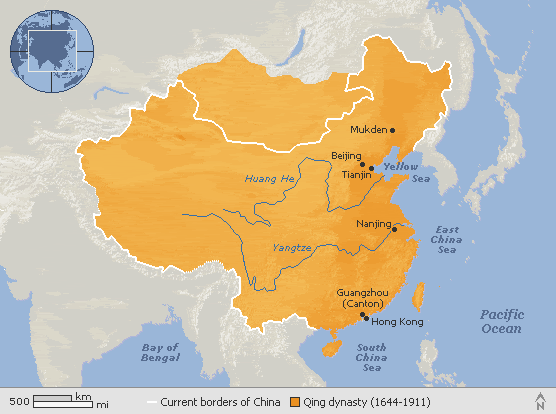
Due to “unequal treaties”, the weak late Qing emperors lost much territory to the Russian Tsar, ceding what is now the Russian far east and parts of Xinjiang in the far west. When the Communists took power in 1949, it inherited a total of 23 territorial disputes, mostly with states along its contiguous land borders including most importantly the Soviet Union and India.
In 1962, a one-month border war was fought between China and India resulting in the latter’s utter defeat that still resonates loudly in the Indian national psyche. In 1969, border clashes broke out between the Chinese and the Soviets over Zhenbao (Damanskii) Island on the Ussuri River that defined part of the northeast border, a dispute that was later resolved with Russia in the 1990s and 2000s. In 1979, China launched an equally brief attack across the northern borders of Vietnam as reprisal against Vietnam’s invasion of Kampuchea (Cambodia). Vietnam was seen by the Chinese as a surrogate for the Soviet Union in expanding throughout Indochina.
Soon after the implosion of the Soviet Union, China commenced negotiations with several Central Asian Republics – Tajikistan, Kazakhstan, and Kyrgystan – and Russia; continued marathon deliberations with the Indians; and moved to repair relations with Vietnam. By the late 2000s, China had settled all land border disputes save those with India and tiny Bhutan. In 17 disputes, points out M Taylor Fravel, a security expert at MIT, China offered significant concessions to accept “less than half of the territory being disputed”.
Srikanth Kondapalli, a China scholar at New Delhi’s Jawaharlal Nehru University, grudgingly agrees: “Whether China actually gave up territory or made a substantial concession is a debatable question (but China overall) has been liberal in border dispute resolution”. (Both scholars were cited in January 2011 Asia Times article “China Plays Long Game on Border Disputes” by Bangalore based journalist Sudha Ramachandran.)
China’s border negotiations with India have been the most vexing. A 1959 diplomatic note sent by Chinese Premier Zhou Enlai recognized a Line of Actual Control (LAC) that includes a section of the McMahon Line. A year later, he offered a swap to the Indian government: recognition of India’s sovereignty over territory south of McMahon Line in the eastern sector in exchange for recognition of China’s sovereignty over Aksai Chin in the western sector. But, this olive branch was summarily rejected. In 1981, paramount leader Deng Xiaoping offered a similar “package settlement” but eight rounds of talks proved futile.
On a state visit to China in 1988, Indian Prime Minister Rajiv Gandhi agreed to a joint working group on boundary issues but that too made little progress. Neither did a 1993 agreement to define the LAC. Three years later, both sides agreed to set up “confidence-building measures” to avoid border clashes. Although sporadic incidents have occurred along the McMahon Line to the present day, disagreements have been confined to within a kilometer of the LAC.
As for the settlement of the remaining six territorial disputes both on land (with India) and at sea (with Japan, Vietnam, Philippines, Malaysia, and Brunei), journalist Ramachandran suggests that China is now less likely to extend concessions to settle them but the possibility for the use of force is low. However, the role of the US in backing the Japanese on the Diaoyus and a closer military relationship between the US and India could become destabilizing factors.
CCBC Celebrates Air China
Air China received the Outstanding Enterprise Award-Bronze Prize at the 34th Canada China Business Council (CCBC) annual meeting in Montreal, Canada for its continuous efforts to improve products and services and contributions to relations between China and Canada. Mr. Xu Junhong, Air China Vancouver Office GM, received the “2011-2012 Outstanding Enterprise Award” plaque from Zhang Junsai, the Chinese Ambassador to Canada, in front of Canadian Governor General David Johnston and more than 300 guests from the business sectors of both countries.

CCBC is a non-governmental, nonprofit business association founded by Chinese and Canadian enterprises in 1978. It aims to develop deeper understanding of China-Canada trade, investment issues and establish business contacts. In 2008, it launched the biennial Outstanding Enterprise Award to recognize member companies that have promoted economic and trade relations between China and Canada. Prize winners are selected by an independent judging panel composed of experienced experts based on a set of stringent scoring rules.
Air China’s Vancouver Office has continuously improved its services on the China-Canada route. The Premium Business Class was launched in 2011 to meet the demand of high-end customers and enhance Air China’s competitiveness. Air China is also the first Mainland China carrier that has been granted Canada’s TWOV/CTT status. Additionally, the Office supports local communities by participating in activities organized by local associations and chambers of commerce. It has cooperated with the BC Provincial Tourism Board to take advantage of local tourism resources, and has promoted and developed Canadian travel packages. The Office has also worked with the Canada Chamber of Commerce to promote Air China’s Program for Small and Medium Enterprises.
Air China and the Vancouver Office’s achievements are widely recognized by partners and travelers.
– aero news network
Kungfu Master Fights Off Real Estate Thugs
Hats off to Master Shen and his son. The ruthless strongarm tactics of some developers have people around the country up-in-arms.
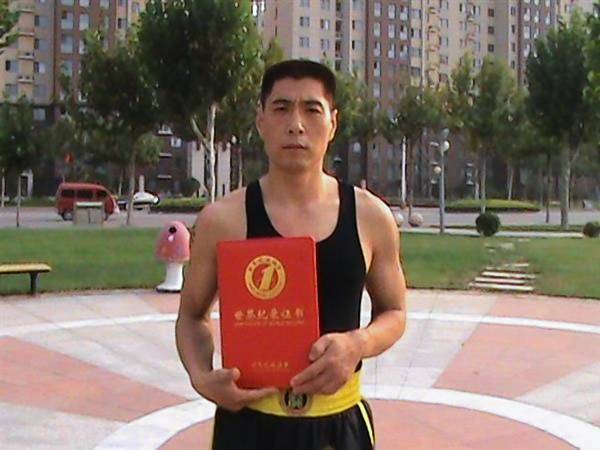 Shen Jianzhong and his son used kung fu to drive away thugs hired by developers who want the family’s land in Bazhou, China. (Los Angeles Times / December 29, 2012) Shen Jianzhong and his son used kung fu to drive away thugs hired by developers who want the family’s land in Bazhou, China. (Los Angeles Times / December 29, 2012) |
The men who barged through Shen Jianzhong’s door probably thought it was a routine assignment: Break in and beat Shen’s family into submission. Forced evictions to make way for real estate development are an everyday occurrence in China, and the family may have seemed no different from any in that situation.
It was only after they forced open the door, threw Shen’s wife to the ground and began to beat her that they learned the 38-year-old Shen and his 18-year-old son are kung fu masters.
“I take Bruce Lee very seriously,” said Shen in a telephone interview a month after the incident. Shen says he does not recall exactly what happened during the fight, but an eight-minute video of the aftermath shows seven of the hired hands piled in a motionless heap in Shen’s doorway. Blood pools around the cheek of one; another lies halfway through the doorway, crumpled on the curb. Survivors mill about unsteadily on the street, glaring at the camera.
The video, shot by Shen’s wife, has attracted nearly a million views and many admiring comments since it was posted online Oct. 30. It has turned Shen into a minor folk hero in China, where many villagers have been forced out of their homes by da shou (“beating hands” in Chinese) who work for real estate developers.
– latimes
Hourly Monitoring of Pollution in Major Chinese Cities
China plans to release hourly air pollution monitoring data in 74 of its biggest cities starting on New Year’s Day, state media said on Sunday, in a sign of increasing responsiveness to quality-of-life concerns among prosperous urban people.
Choking pollution and murky grey skies in Chinese cities is a top gripe among both Chinese and expatriates. Microscopic pollutant particles in the air have killed about 8,600 people prematurely this year and cost $1 billion in economic losses in Beijing, Shanghai, Guangzhou and Xi’an, according to a study by Beijing University and Greenpeace that measured the pollutant levels of PM2.5, or particles smaller than 2.5 micrometres in diameter.
The new monitoring will include not only PM2.5, but also sulfur dioxide, nitrogen dioxide, ozone and carbon monoxide, the Xinhua news agency said, citing a Friday announcement by the Ministry of Environmental Protection. Data will be collected from 496 monitoring stations, it said.
First Beijing, then other cities have become more public about their air quality data since the U.S. embassy in Beijing began publishing hourly data from a pollution monitor installed on embassy grounds in Beijing.
– Reuters
Canadian Writer Sets His Sleuth Stories in Hong Kong and Macau
Ian Hamilton burst onto the Canadian crime fiction scene in 2011 with The Water Rat of Wanchai. The novel introduced readers to Ava Lee, a jet-setting – and crime-solving – forensic accountant. Since then, he’s published three more Ava Lee novels, the most recent of which, The Red Pole of Macau, was published in September. With another instalment arriving just after Christmas – and Hamilton about to enter the U.S. market for the first time – Postmedia’s Mark Medley recently spoke to the Burlington, Ont., author about exotic locales, the evolution of his characters and what comes next.
http://www.vancouversun.com/Catching+with+Hamilton/7756648/story.html#ixzz2GUvvoPmr
China Third Tourist Destination
Going by trends, tourism travel to China should surpass the US by 2015 and vie for the top spot within a decade. In terms of international tourism receipts, China was 4th with US$48.5 billion in 2011 behind the US, Spain, and France. In 2010, if receipts for mainland China, Macao, and Hong Kong are added together, the figure approached totals for the US. (Figures were not available for Macao in 2011).
—————————
Topping the United Nations World Trade Organisation (UNWTO) Tourism Highlights 2012 list was France with 79 million tourist arrivals, followed by United States (62 million), China (58 million), Spain (57 million), Italy (46 million), Turkey (29.3 million), United Kingdom (29.2 million), Germany (28.4 million), Malaysia (24.7 million), and Mexico (23.4 million).
– thestar online (Malaysia)
Origins of the Diaoyu Islands Dispute
A previous post focused on the scarring memories of the Opium Wars and the series of humiliating and economically devastating unequal treaties that the late Qing Dynasty was forced to sign with foreign powers. China’s ongoing dispute with Japan over the uninhabited Diaoyu Islands off the northeast shores of Taiwan goes back to another historical disgrace, this time at the hands of the Japanese.
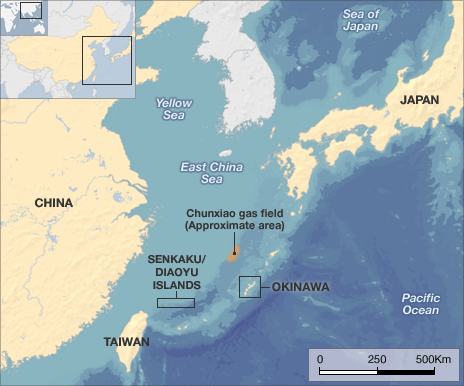
China claims the discovery and the control of the Diaoyus (the Senkakus in Japanese) since the beginnings of the Ming Dynasty during the latter half of the 14th Century. Since Japan paid tribute to the Ming court, the Chinese claim was never disputed for centuries by the Japanese. But, within three decades following the 1868 Meiji Restoration, Japan was able to rapidly industrialize and modernize its army and navy. Fighting primarily over the control of the Korean Peninsula, the First Sino-Japanese War (August 1984 to April 1895) erupted between the two countries resulting in yet another humiliating defeat for the feeble and collapsing Qing Dynasty.
The near total destruction of China’s northern fleet indicates the utter failure of the Qing to modernize its military and protect its sovereignty from encroaching Japan. The Qing government was subsequently forced to sign the 1895 Treaty of Shimonoseki that ceded control of Taiwan to Japan, not to mention the payment of indemnities. Even before the signing of the treaty, the Japanese government had already annexed the Diaoyu islands, which the Chinese claim as part of Taiwanese territory. For four decades, a bonito processing plant was set up on the island by Japanese interests that last until before the outbreak of the Pacific War.
After Japan’s unconditional surrender in 1945, Taiwan was returned to China under the 1951 Treaty of San Francisco but Kuomintang supremo Chiang Kai-shek did not raise the issue of the Diaoyus. In 1968, large undersea reserves of oil were discovered near the islands prompting a gradually escalation of the territorial dispute between China and Japan which had no official ties.
Even though the islands were named in the 1971 Okinawa Reversion Treaty passed by the US Senate relinquishing control to the Japanese the next year, Chiang muffled himself because he heavily depended on the US for political, economic and military support at the height of the Cold War. Later, the owners sold the islands to the Kurihara family of Saitama Prefecture.
In 1972, civil authority over the islands was granted to the mayor of Ishigaki, Okinawa, but the Japanese government forbade the city from surveying or developing the islands. Later that year, when Japanese Prime Minister Tanaka Kakuei re-established diplomatic relations with China following Nixon’s epoch-changing visit to Beijing, he and Chinese Premier Zhou Enlai agreed to put off a decision on the Diaoyus for the sake of bettering ties. However, references to temporarily shelving the sovereignty issue were expunged from the official record by Japanese Foreign Ministry officials. Not so the Chinese side.
The sovereignty issue laid dormant for nearly four decades until late 2010 when Ishigaki inappropriately commemorated the 1895 annexation of the Diaoyus, raising the ire of the Chinese. Oil was poured on the fire last spring when Ishihara Shintaro, the firebrand ultra-nationalist former mayor of Tokyo, pledged to raise public money to buy the islands for their current owners. Then, in September, in a bid to wrestle public opinion over the issue from Ishihara, the ‘the tail wagging the dog’, the Japanese government nationalized control of the islands by purchasing them from the Kurihara family for 2.05 billion yen (about $24 million). Not surprisingly, Sino-Japanese relations have since deteriorated to all-time post-diplomatic recognition lows.
This post will not dwell on the infamous Second Sino-Japanese War (1937 to 1945) during which the invading Japanese army committed numerous atrocities symbolized notably by the Rape of Nanking that resulted in the slaughter of 300,000 Chinese soldiers and civilians. Suffice it to say that Japan’s annexation of Manchuria and its 8 year invasion of China proper was the outcome of decades long imperial Japanese campaign to dominate China through the establishment of the so-called ‘Greater Asia Co-Prosperity Sphere’ that wreaked death and destruction throughout East and Southeast Asia.
Economist Magazine on the Ascent of Microblog Weibo
See the video interview with an Economist editor: