
Harper Calls NDP’s Mulcair an Extremist Against FIPA
Tom Mulcair was labelled an anti-trade, anti-business extremist Wednesday for threatening to rip up a controversial investment treaty with China.
But the NDP leader did not back down. Indeed, he ratcheted up the rhetoric against the Foreign Investment Promotion and Protection Act, vowing that an NDP government would not be bound to honour a treaty ratified by the Harper government.
“Let me be very clear,” Mulcair told the House of Commons.
“The Conservatives will not tie the hands of the NDP. We will revoke this agreement if it is not in the best interests of Canadians.”
Prime Minister Stephen Harper said the treaty is the product of almost 20 years of negotiations, designed to give Canadian investors in China the same protection that Chinese investors have in Canada. He ridiculed Mulcair’s threat to abrogate the deal.
“The leader of the NDP is saying he would revoke the hard-earned right of Canadian investors to be protected in a marketplace like China. That is precisely why Canadian investors, the Canadian business community and the Canadian public at large does not trust the NDP with economic policy,” Harper said.
“New Democrats support trade,” retorted Mulcair. “We just do not support selling out Canada.”
Harper countered that the NDP has opposed almost every trade deal Canada has ever struck with any country, including calling the free trade agreement with the United States a “sellout.”
“That kind of extremism on trade is why Canadians will never entrust economic policy to the NDP,” he declared.
– Canadian Press
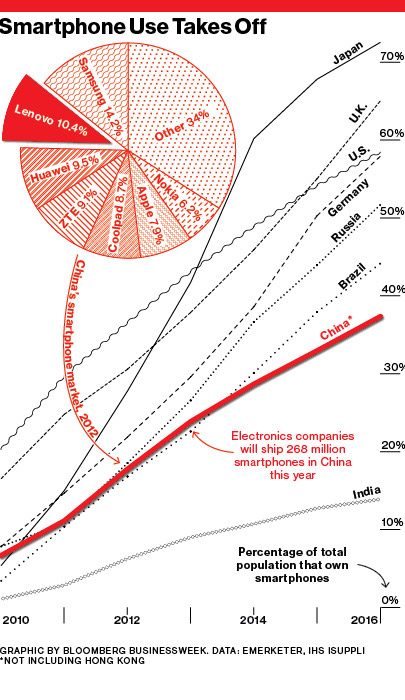
Infographic: China’s Smartphone Market
China is now the largest smartphone market with more than 270 million shipments expected this year and Lenovo, the world’s largest PC maker, is #2 in China in smartphones, ahead of Apple and Chinese competitors Huawei and ZTE. Smartphone ownship in China is still only around 38% of the total population, way below Western countries and Japan and even Russia and Brazil. But, expect that ratio to spike high within a few years.
– BloombergBusinessweek
Chinese Consumer Trends II
At the end of 2011, China had 185 million seniors above the age of 60, or 13.8% of the population (up 3% from the previous census) while 8.9% are older than 65 (up over 1.9%). China’s aging population is among the fastest growing in the world. The China National Committee on Aging projects the number of senior citizens to surge to 221 million by 2015 and skyrocketing to an astounding 487 million, or 35% of the population, by the 2050s.
Chinese seniors no longer save every penny toward a nest egg. They harbour new notions of living meaningful golden years involving more spending on recreation and a higher quality of life. Average incomes in the 55-64 bracket has been rising along with disposable portions for such activities as travel and sports. Just in the last two years, those who travelled within their home province grew by 7%; those who travelled outside the province grew by 18%; and those taking tours to Hong Kong/Macau/Taiwan grew by 10% with significant numbers voyaging beyond Greater China. Among this segment, mobile phone ownership is spiking as is participation in an assortment of recreational activities, pushing up demand for sports and leisure apparel, just to name a couple sectors.
Latest figures from tmall.com indicate that more than 1.3 million over 50s netizens shop online. While they currently form only 4% of the general senior population, there is obviously enormous potential for growth. Geographically, “Shanghai Aunties and Uncles” lead the pack with nearly 60,000 more than in Beijing. Surprisingly, senior netizens buy more clothing than anything else, especially women’s clothes. In the past year alone, they bought 8.59 million pieces of female apparel. During the “double holiday” of Mid-Autumn (Moon cake) Festival and National Day, tmall.com released a “My Father” video on its microblog calling on children to remember nurturing by their fathers. Of course, tmall wants children to respond in kind by teaching their fathers how to shop online, particularly during holiday periods!
Some of elderly are now into backpacking. Prior to the 2012 Olympic Games, video portal Youku and dairy producer Yili aired a series of micro-movies about the Olympic journeys of common Chinese people. “Happy Backpackers” inspired many consumers to take up the sport for a healthier life. Zhang Guangzhu and Wang ZhongJin are an Beijing couple who became minor celebrities on the internet and national TV gallivanting around the world having visited over 40 countries. They post real-time updates of their trips on their blog, mostly on people and culture. They travel on buses, visit farmers markets, and chat with the locals using broken English. Their widely publicized escapades were unthinkable for Chinese seniors just a decade ago.
Charity is another area gathering momentum for Chinese consumers. Today, a person’s stature is longer simply measured by money and power but bound up with how actively they engage in charitable and socially responsible activities. In addition to charitable acts and donations on their own, people can give through consuming or participate in activities organized by marketers. They can take part in microblog charities that allow them to “donate while purchasing” or “donate while forwarding (microblogs).” Through consuming and contributing, they raise both their self-esteem and image.
More and more marketers and promotions are also getting on the microblog bandwagon for charitable activities since information spreads quickly on the Internet, amplified by China’s hordes of microbloggers. Exhortations like “donate while you forward (your microblog)” and “donate by buying” are frequently used. These activities improve the image of companies and brands while raising awareness about and aiding the downtrodden.
In its second year, “an egg’s long trek” is jointly organized by MSN China and Shanghai United Foundation. Through trekking and collecting sponsorship money, volunteers in Shanghai were able to raise 2.14 million RMB for poor children in remote mountainous areas. Within a few months to spring 2012, their ranks have swelled from 122 teams and nearly one thousand registered participants to 208 teams with more than two thousand trekkers.
Other trends cited in the MEC/CIC survey include: micro-ads on 360buy.com, the popularity of rebate websites such as 51fanli.com, and the exploding trend of payments via mobile phones; the “kids too” and “parent and child together” phenomena, “Cloud Classroom” learning, and general splurging on early child education; the emergence of “go-betweens” where intermediaries step in to do things not done by consumers themselves – purchasing agents, carpooling and Happy Farm mentioned in Part I; and “crossover”, integrating online and offline platforms, celebrities joining forces with stars in other sectors, and merging the 2D world of anime, comics and games (ACG) with the physical world.
UBC’s Little Known Exchange with the DPRK
Two weeks ago, six professors packed up their dorm rooms at the quiet, Vancouver campus of the University of British Columbia, boarded aircraft at the city’s international airport and began the Jacob’s ladder of flights that would eventually return them home to North Korea.
Just as quietly as it began, the second phase of the Knowledge Partnership Program (KPP), North Korea’s only academic exchange program with North America, had come to a close.
It is the product of a little-known relationship forged even before Canada had opened relations with the Stalinist country, and the University of British Columbia is the only academic institution in North America — and possibly the West — to host regular delegations of North Koreans. Little is known of the program and details are carefully guarded from public scrutiny, but just as a U.S. ping pong team helped open Maoist China to the West, proponents contend that one of UBC’s most obscure international programs may hold the key to opening the borders of one of the world’s most closed countries.
This program just started, so it’s good to keep it low-profile. “Particularly when we do not have active interactions between Canada and North Korea, I think academic exchange is really needed,” said Kyung-Ae Park, a UBC political scientist and founder of the KPP.
She called the KPP an early step toward “bilateral relations” with the nation known officially as the Democratic People’s Republic of Korea.
From June to December, professors from three North Korean institutions underwent a study program of English, international trade, finance and economics at UBC, enrolling in standard undergraduate and graduate-level courses.
The group was following in the lead of another sextet of professors who arrived in June 2011, and returned home just in time for the country-wide mourning kicked off by the death of North Korean leader Kim Jong-il.
Both times, the professors lived in dorms, attended regular classes and were slotted into work groups with other members of the student body. “They’re just like any other students on campus … there’s no special treatment or special space for them,” said Ms. Park.
During downtimes, the group even headed out on field trips to Toronto and Vancouver to sit down with bank managers, corporate directors and the other actors of Canada’s free market economy. “We just asked them to explain how they do business in Canada,” said Ms. Park.
In short, the KPP students are given a surprising amount of flexibility. At both the Beijing and London Olympics, by contrast, members of the North Korean Olympic team were barred from socializing with other athletes or even leaving the Olympic Village to go sightseeing.
– National Post
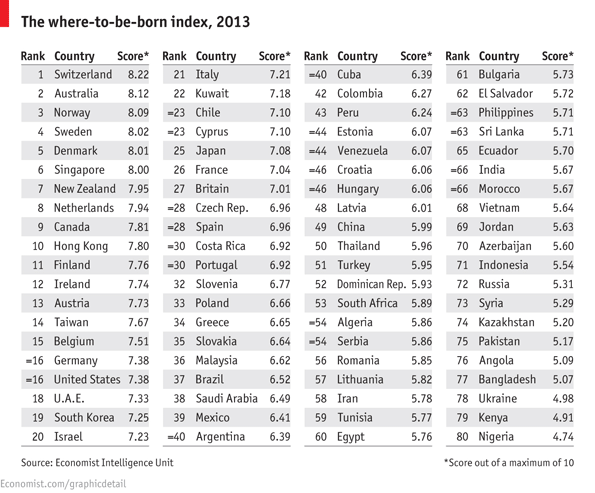
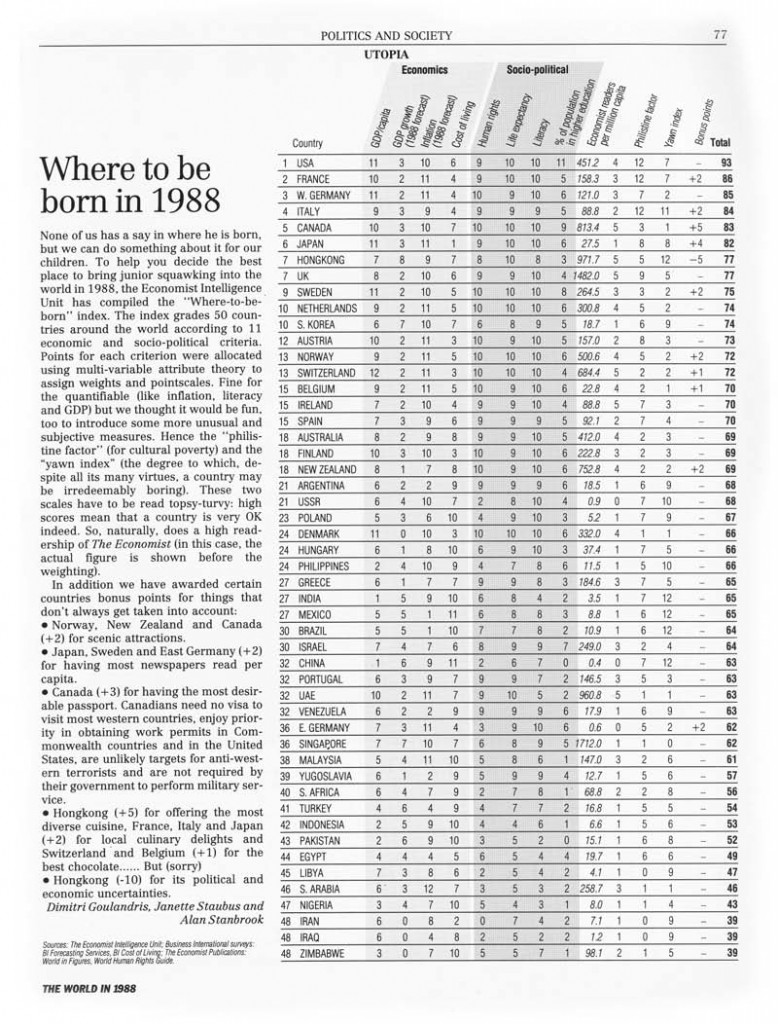
Economist Chart: Canada 9th Best Country to be Born in; China 49th
If you believe in such rankings, what a difference 25 years make.
Back in 1988, of the 50 countries cited in the Economist Intelligence Unit’s (EIU) then lighthearted “Where to Born In” chart, USA was on top of the world; in the latest (2013) chart, it’s tumbled to 16th. Canada was 5th; in Greater China, Hong Kong tied with the UK for 7th (Taiwan wasn’t not included); and China came in 32nd. The USSR placed 21st and India 27th.
25 years later, of 80 countries in the EIU’s more serious where-to-be-born index ranking, Canada is down a bit to 9th, followed by Hong Kong at 10th and Taiwan 14th while mainland China is much further down at 49th. Other BRICS states didn’t fair so well either: Brazil (37th), South Africa (53rd), India (66th) and Russia (72nd).
____________________________
A QUARTER of a century ago, The World in 1988 light-heartedly ranked 50 countries according to where would be the best place to be born. Then, America came top (see chart on left). Now the Economist Intelligence Unit has more earnestly calculated where would be best to be born in 2013. Its quality-of-life index links the results of subjective life-satisfaction surveys—how happy people say they are—to objective determinants of the quality of life across countries. Being rich helps more than anything else, but it is not all that counts—things like crime and trust in public institutions matter too. In all, the index takes 11 indicators into account. Some are fixed, such as geography; others change only very slowly over time (demography, social and cultural characteristics).
Here are the top 10 countries, according to the survey:
- 1. Switzerland
- 2. Australia
- 3. Norway
- 4. Sweden
- 5. Denmark
- 6. Singapore
- 7. New Zealand
- 8. Netherlands
- 9. Canada
- 10. Hong Kong
Canpotex Lowers Potash Price for China
Is this the beginning of a trend, given China’s ever growing appetite for the resource?
———————-
Canada’s potash cartel Canpotex Ltd. has struck a deal to sell one million tonnes of potash to China’s Sinofert Holdings Ltd., but at a much lower price than last March, the Globe and Mail reported over the New Year holiday break.
Canpotex, the offshore marketing company controlled by Potash Corp. of Saskatchewan Inc. (POT.TO), Agrium Inc. (AGU.TO), and Mosaic Co. ( MOS ), said on Monday that the new contract’s per-tonne price is US$70 less than its last Chinese deal, reached in March. One analyst believes this is a 15% drop.
– nasdaq.com
Google Chairman To Visit North Korea
Don’t know what he’s been smoking.
—————————
Google’s executive chairman is preparing to travel to one of the last frontiers of cyberspace: North Korea.
Eric Schmidt will be traveling to North Korea on a private, humanitarian mission led by former New Mexico Gov. Bill Richardson that could take place as early as this month, sources told The Associated Press on Wednesday. The sources, two people familiar with the group’s plans, asked not to be named because the visit had not been made public.
The trip would be the first by a top executive from U.S.-based Google, the world’s largest Internet search provider, to a country considered to have the most restrictive Internet policies on the planet.
North Korea is in the midst of what leader Kim Jong Un called a modern-day “industrial revolution” in a New Year’s Day speech to the nation Monday. He is pushing science and technology as a path to economic development for the impoverished country, aiming for computers in every school and digitized machinery in every factory.
However, giving citizens open access to the Internet has not been part of the North’s strategy. While some North Koreans can access a domestic Intranet service, very few have clearance to freely surf the World Wide Web.
It’s highly unlikely Google will push to launch a business venture in North Korea, according to Victor Cha, a former senior Asia specialist in the administration of President George W. Bush.
“Perhaps the most intriguing part of this trip is simply the idea of it,” said Cha, an analyst with the Center for Strategic and International Studies think tank in Washington. Kim Jong Un “clearly has a penchant for the modern accoutrements of life. If Google is the first small step in piercing the information bubble in Pyongyang, it could be a very interesting development.”
It was not immediately clear who Schmidt and Richardson expect to meet in North Korea, a country that does not have diplomatic relations with the United States. North Korea has almost no business with companies in the U.S., which has banned the import of North Korean-made goods.
– AP
China Set to Make More Cars Than Europe in 2013
China is forecasted to manufacture 19.6 million cars and other light vehicles in 2013 compared to 18.3 million in Europe.
The projections for Europe include countries such as Russia and Turkey apart from the European Union.
In 2012, Europe produced 18.9 million cars and related vehicles, while China made 17.8 million. Global car sales are valued at about $1.3tn a year. According to the projections, car manufacturing in China in 2013 is anticipated to be 10 times higher than in 2000.
Since the 2008-09 economic downturn, the European car companies saw decline in production as they found severe difficulties to produce, sell and market.
– The New Statesman
Ten Chinese Consumer Trends: Report
Consumption is charging ahead in China with all social classes and age groups increasingly combining online and physical platforms to maximize accessibility and convenience. This is the conclusion of Consumption Trends China 2013, a joint survey and analysis by MEC, a major international media agency and CIC, a leading social business intelligence provider in China.
The study identified 10 major trends that are likely to shape Chinese consumption for years to come. Most interesting among them are Chinese concerns about food and product safety, emerging ‘highbrow’, ‘nostalgic’, and hedonistic tastes, spending by and catering to singles and the ‘gray-haired’, along with charity and altruistic pursuits.
Here is Part I of a two-part summary:
Consumer safety scandals involving tainted food and faulty products are upper most in the minds of consumers, prompting many to “pay for safety” – paying premium prices for organic foods, buying property and auto insurance, and posting microblogs on food and road safety. Last summer, CCTV’s hugely popular A Bite of China documentary on Chinese food culture engendered a revival in regional cuisine but also evoked memories of when food was simple, natural, and safe. The series inadvertently spawned sarcastic remarks on microblogs about the state of food safety in China.
In addition, websites like www.zzcw.info (throw it out of the window) organized by a group of volunteers in 2011 provide information on poisonous and harmful foodstuff reports going back to 2004. On May 3, a couple weeks before the airing of A Bite of China, the site crashed temporarily because it was getting too much traffic, revealing the extent of concern at the grassroots.
In part due to the food scare, middle class consumers are renting plots in the suburbs to grow their own food. Happy Farm, a micro-farming website, lets subscribers rent a small plot to grow their favorite vegetables and fruits. Renters tend to the plots themselves or have the farm manager and his team help out. Netizens experience firsthand harvesting the fruits of their labour or they can ask the farm to harvest and deliver the produce. The remarkable thing is that growth of their vegetables can be monitored online.
Chinese consumers also desire more culture in their improving lives. They like the arts, gourmet food and travel, and are eager to show off their “cultured life” on social media. The ‘foodie’ phenomenon has infected Chinese consumers even more severely than in the West, especially given the depth of Chinese food culture. Sitting at a table with scrumptious dishes, instead of gobbling them up straight away, the first impulse is to pull out mobile phones and take pictures to send to friends or post on weibo. Many Chinese foodies have accumulated large portfolios that are shown to like-minded fans around the world.
What used to be haute culture is now more accessible to the general public. Consumer spending on highbrow cultural events and performances has grown steadily over the past few years and not confined to the large cities, attested by rising expenditures in tier 3 and 4 cities. And providers have been quick to catch the wave. Since the end of 2011, for example, the Shanghai Grand Theatre has made each third Sunday a month a discount ticket day for diverse and multi-genre performances. Two rounds of discount ticket sales at the beginning of 2012 attracted long queues of enthusiasts. Similar programs have been introduced in Beijing and other major centers.
On the Internet, sites catering to “backpackers” and “tour pals“ are another expression of the Chinese craving for developing “cultural temperament”. Travelling is as much about culture and people as it is about scenery. On weibo, there are legions of netizens following the corporate accounts of travel agencies and hotels. For those who like to record their experiences in artistic ways, picture-taking is a favourite medium. Not counting smart phone picture takers, aficionados carry single-lens reflex (SLR) cameras with them wherever they go. Within a couple years, household ownership of SLRs has gone from 10% to 14% in 2012 and the proliferation of photo sharing platforms encourages even more people to participate.
The institution of marriage is not as sacred as it used to be as China’s population of single men and women increases year by year. The “singles culture” and “singles effect” is a much-talked about topic on microblogs. Singles are unburdened by family responsibilities and are by definition hedonists willing to open their wallets for immediate gratification. Compared to other groups, they go to the cinema more often with a date, with friends or on his/her own. Cooking for one, singles tend to frequent nearly convenient stores rather than busing or driving to supermarkets for major grocery shopping. Products and services specifically designed for singles are thus on the up and up.
In China, like traditional Valentine’s Day for couples, singles have their own Singles’ Day (November 11). Chinese numerology considers 11-11-11 the most auspicious Singles’ Day of the century. Last year, Taobao.com launched a campaign offering free delivery and 50% discounts on many famous brands. The resulting turnover reached 960 million RMB, setting a record for B to C e-commerce. Revenues this year topped a whopping US$3 billion, double Cyber Monday revenues in the US that ComScore estimated had hit $1.5 bn. Black Friday, November 23rd, barely passed the $1 bn mark.
Discussions centering on keywords “retro” and “nostalgia” have been surging on weibo. In 2012, tweets involving “retro” grew 10-fold to 22,588,671. Retro is the new fashion in which consumers find deep emotional resonance. Scribbled Warrior Shoes and sailor’s stripe shirts, all the rage in the sixties and seventies that combine retro and modern elements are back in vogue. ‘Educated Youth’ canteens targeting students who were sent down to the countryside during the 1960s and 1970s and “post-70” and “post-80” (people born in the 1970s and 1980s) restaurants draw crowds reminiscent about the innocence of youth. In the hustle and bustle of the daily grind, dining on era dishes in a setting surrounded by memorabilia, people cannot but be overcome by nostalgia and a longing for simpler times.
Statscan: China Among Top Ten Travel Destinations for Canadians
Canadians travel frequently but when it comes to knowing where we went and where we’re going, it’s not rocket science. In fact, dozens of organizations conduct surveys on the subject. But like on election day, when voting is the only poll that matters, the only surveys that provide a comprehensive snapshot of our actual cross-border movements are the ones done by Statistics Canada.
Statscan knows when — and how — we leave the country, where we go, how long we stay, when we return, and approximately how much money we spend while we’re away.
And while complete statistics for 2012 won’t be released until next year, and I can’t rank the Top 10 destinations with 100% certainty, I am pretty confident we have, and will, remain true to form in where we went and where we will go in 2013. As a nation, we are quite loyal and our Top 10 foreign destinations have not changed much in the past decade. Barring war, political upheaval or major natural disasters in those places, they likely won’t change much in 2013 either.
The United States will remain No. 1. It was No. 1 when our dollar was worth 65¢ US, and now that the loony is on par, almost par, or above par, the number of trips south of the border has soared to some 20-million-plus per year.
Our top states, are — predictably — border states and sunshine states: New York, Florida, Washington, California and Michigan in that order. Visits to New York, Washington and Michigan tend to be one to three-days, while visits to California and especially Florida are much longer.
As for the rest of the places on our Top 10 list, sometimes their rankings change but the destinations themselves remain pretty much the same.
Sun destinations continue to be wildly popular with Mexico, Cuba and the Dominican Republic being Canadians’ fave places to hit the beach.
These are accented by our favourite European destinations — the United Kingdom (always in the top five, even when the British pound is much higher than it is now), France, Italy, Germany and the Netherlands.
China is our preferred Asian destination, and the only country from that part of the world to make into the Top 10.
– canoe.ca/Travel