
China’s Beidou Navigation System Servicing Asia-Pacific
This is big for China’s ambitions to take a big chunk of the global positioning business. Plus, China’s home-grown system cannot be turned off by a foreign power in times of conflict.
——————————–
China’s domestically-produced navigation system aims to take 70 to 80 percent of the now GPS-dominated domestic market by 2020, a spokesman for the system said Thursday.
We hope industries based on the BeiDou Navigation Satellite System (BDS) will hold 15 to 20 percent of the market share by 2015, according to BDS spokesman Ran Chengqi, also director of the China Satellite Navigation Office, at a press conference on the official launch of the system.
|
China successfully launched another satellite in |
 to space for its indigenous global navigation and positioning network at 11:33 pm on Oct 25, 2012 from the Xichang Satellite Launch Center in the southwestern province of Sichuan. [Photo/Xinhua]
Ran announced that the BDS began providing positioning, navigation, timing and short message services to civilian users in China and surrounding areas in the Asia-Pacific region on Thursday.
Ran said the general functionality and performance of the BDS is “comparable” to the GPS system.
He further explained that the BDS open service is currently available and features positioning accuracy of 10 meters, velocity accuracy of 0.2 meters per second and one-way timing accuracy of 50 nanoseconds.
The BDS offers more conveniences for navigation system users with equipment that is compatible with multiple navigation systems, as they will no longer have to rely on a single service, said Ran.
A 2011 report said 95 percent of satellite navigation equipment in China relied on GPS services, while industrial statistics show that the total output of China’s navigation service sector will top 120 billion yuan (19.2 billion U.S. dollars) in 2012.
China launched the first satellite for the BDS in 2000, and a preliminary version of the system has been used in traffic control, weather forecasting and disaster relief work on a trial basis since 2003.
– China Daily
Canada’s ‘Haves’ and ‘Have Nots’ Map Changing Dramatically
The China (and Asian) driven commodities boom has been a godsend to Saskatchewan and Alberta. 9 of the top 20 cities with the highest per capita incomes are in western Canada.
—————————
http://www2.macleans.ca/2012/12/19/interactive-canadas-richest-cities/#tips
The commodity boom is rewriting the list of the “haves” and “have-nots” in Canada. Toronto is nowhere near the top of Canada’s rank of wealthiest urban areas, while Montreal and Vancouver don’t even make the cut. Small and mid-sized cities are clearly winning the day.
The biggest dots on our map are, of course, in Alberta, with tiny Fort McMurray, right next to the Athabasca oil sands, topping the charts.
One needn’t look much further east to find more stories of vertiginous growth, happy realtors and chronic labour shortages. Welcome to Saskatchewan, the only province planning to run a budget surplus this fiscal year. The resource boom that started a decade ago is now prominently on display in Regina and Saskatoon, which boast, respectively, the lowest unemployment and highest population growth rates of any metropolitan area in Canada.
Commentary: US Should be Nicer to China
Mr Lee’s commentary hits the spot.
Michael Justin Lee, a lecturer in the department of finance and the Center for East Asian Studies at the University of Maryland, is author of the new book, “The Chinese Way to Wealth and Prosperity: 8 Timeless Strategies for Achieving Financial Success.”
The Humiliation of the Opium Wars
Recently, there has been a spate of articles in the Western press hammering China’s ‘selective teaching of history’ that one FT piece labeled as “cultivating a nationalistic, anti-Western mentality among younger Chinese”. It is interesting how BBC History, in its latest introduction, portrays the First Opium War (1839-1842): “…thousands were killed in the name of free trade” (sic.), although it admits in the next sentence that the trade in contraband was a “lucrative but illegal business”.
I have posted on the supposed Chinese ‘victimization’ syndrome derided by the foreign press but it may be useful to revisit some of the major events in modern Chinese history, particularly the Opium Wars, that are so deeply etched into the Chinese psyche since before the 1911 Republican Revolution.
In his review of Julia Lovell’s newly released history the First Opium War, veteran British China-watcher Eric Gordon, wrote in the Independent newspaper’s Camden New Journal: “Once, the British establishment behaved not all that differently from the Columbian drugs lords who are poisoning the US today…(opium) brought great riches to our merchants and sowed the seeds of two bloody wars as well as, ultimately, helping to create the country’s national pride of today. This is a slice of our island’s history that Education Secretary Michael Gove probably doesn’t want taught in our schools”.
While Ms Lovell and Mr Gordon are correct in pointing out that the Qing Emperor and many of his officials contributed to the tragic outcome, there should be no mistake in who the culprits were – the Scottish scoundrel traders William Jardine and James Matheson, the British East India Company that supplied the drug, and the gunboats of the Royal British Navy (later to be joined by the French and others).
By the end of the 18th Century, the British thirst for Chinese tea was so immense, consuming some 6 million pounds per year, that it lead to a huge deficit in Britain’s terms of trade with China. Over a 50 year period, the British paid 27 million pounds in silver to the Chinese but sold only 9 million pounds in British goods. The British longed for a way to reverse the flow of silver.
The practice of mixing opium with tobacco was introduced into China by the Europeans in the 17th Century. Jardine and Matheson and others saw their chance after the British Empire conquered Indian Bengal where large amounts of opium were harvested. During the 18th Century, opium smuggling had increased 20 fold to more than 4,000 chests (256 tons) annually but ballooned to 30,000 chests a year by 1836, four years prior to the First Opium War.
In 1838, Emperor Daoguang dispatched famed mandarin Lin Zexu to Guangzhou, the gateway for the smuggled drugs, to rein in the illicit trade. He quickly arrested Chinese opium dealers and seized 20,000 chests of opium along with 42,000 opium pipes worth 2 million pounds.
Outraged by the seizures, Jardine lobbied Foreign Secretary Lord Palmerston to strike back. Since the opium trade yielded a significant portion of British India’s tax receipts, the British government hardly flinched at sending a fleet of 16 warships and 27 transports carrying 4,000 men to the Pearl River Delta.
Chinese defenses were no match for Britain’s far-superior firepower and over the next two years, British bombardments killed up to 25,000 Chinese while only a few dozen casualties were sustained by the British.
Brought to its knees, the Qing government signed the Treaty of Nanking, the terms of which were dictated by the British. Five treaty ports were opened for foreign trade and the British were paid 21 million silver dollars as an indemnity. Low fixed unilateral tariffs were set and foreigners in China were granted extraterritoriality. There were also demands for a most-favored nation clause and diplomatic representation in Beijing. But, the jewel in the crown was the acquisition of Hong Kong Island which would be used as a hub for increased opium trade.
In the ensuing years, the weak, corrupt, and inept Qing government balked at the legalization of the opium trade, transport duty exemptions for foreign imports, accepting foreign ambassadors, along with several other demands. It also obstructed the trade clauses of the treaties and disputes erupted over the treatment of English merchants in the ports and at sea, setting the stage for the Second Opium War (1856-1860) that involved the joint expeditionary forces of Britain and France.
In 1860, British envoys, soldiers and a journalist were imprisoned and tortured resulting in 20 deaths. In retaliation, Lord Elgin, the British High Commissioner, ordered the destruction of the massive and exquisitely beautiful Old Summer Palace, Yuan Mingyuan, whose ruins are preserved to this day.
Once again humiliated at the hands foreigners, the Qing government was forced to sign the Treaty of Tientsin, followed by similar treaties with the US and France that became infamously known as the Unequal Treaties, symbols of China’s “century of humiliation” along side the Opium Wars.
At the end of its introduction, the BBC quoted Dr Zheng Yangwen, a professor at the University of Manchester about the long memory of the Chinese: “Textbooks from elementary school, to middle school, to university highlight the wrong doings of the so-called imperialists. We have become part of what they call the Patriotic Education Program, to educate Chinese youths like me so that we remember what you have done to us”.
I wonder, if the tables were turned, would such indignities be etched into the minds of the British?
Report: China’s R & D Spending to Surpass US in 10 Years
A study released last week predicts that 2023 may be the year that America loses its global R&D leadership. Based on current trends, China is on track to overtake the U.S. in spending on research and development in about 10 years, as federal R&D spending either declines or remains flat.
The U.S. today maintains a large lead in R&D spending over China, with federal and private sector investment expected to reach $424 billion next year, a 1.2% increase. By contrast, China’s overall R&D spending is $220 billion next year, an increase of 11.6% over 2012, a rate similar to previous years, according to the 2013 Global R&D Funding Forecast prepared by Battelle, a research and technology development organization, and R&D Magazine.
“The U.S. still has a significant lead and advantage in R&D over all of these countries,” said Martin Grueber, one of the authors of the report and a lead researcher at Battelle, “but the concern is R&D is a long-term investment, and as these other countries continue to grow their R&D capabilities … how long can we maintain that advantage?”
A major share of R&D research in the U.S. is funded by the federal government, which is expected to budget $129 billion for R&D next year, a decline of 1.4%. This figure could decrease even further if Congress does not resolve its budget impasse.
Government R&D spending is seen as particularly important because, unlike the private sector, it funds basic research. This is research that often takes years or decades to yield results, but it can also lead to new industries and jobs.
Other emerging economies, besides China, are also spending more on R&D. India, for instance, will invest about $45 billion next year in R&D, an increase of just over 12%.
President Obama has called for national R&D expenditures equal to 3% of GDP, which includes private and government investment. The forecast for next year is 2.66% of GDP, according to the Battelle forecast.
The White House also believes that China may overtake the U.S. in R&D spending. “China’s investment as a percentage of its GDP shows continuing, deliberate growth that, if it continues, should surpass the roughly flat United States investment within a decade,” said the President’s Council of Advisors on Science and Technology.
– Computerworld Singapore
Infographic: 2012 World Internet and Mobile Trends
These are 2011 figures which indicate that Chinese users were already more than 22% of world totals and could top 25% by end 2012. At mid-year, China’s netizens had increased to over 538 million. As for 3G mobile subscribers, the graphic grossly understates the numbers. Last May, China’s Ministry of Industry and Information technology (MIIT) cited 152 million.
 – pcmag.com
China’s Maritime Strategy
Despite the provocative title, this Strategy Page article has it right on China’s motivations for building a strong navy – protect international sea lanes for its burgeoning maritime commerce and shipping. http://www.strategypage.com/htmw/htlead/articles/20121223.aspx
New 500 RMB Bill to be Introduced Next Year
New 500, 100, 50 and 10 RMB bills. First time for a 500 RMB bill. Had thought they were going to come out with a 1000 RMB bill.
OJPC Report: Ontario Must Expand Exports to Emerging Markets
Ontario seems to finally get it, that diversifying trade with emerging Asia and especially China will be a key strategy for the province’s long-term future prosperity. That’s the first of several conclusions of this week’s Ontario Jobs and Prosperity Council’s (OJPC) Advantage Ontario report.
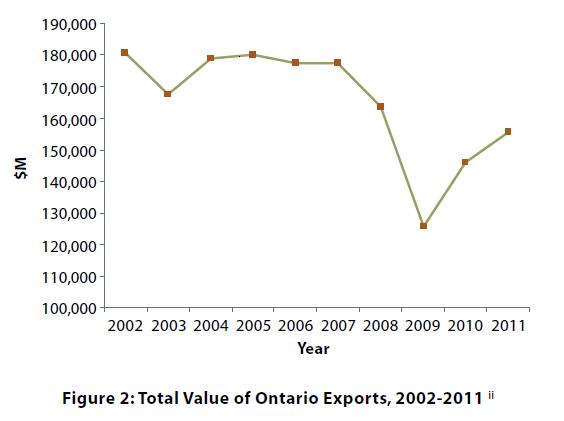
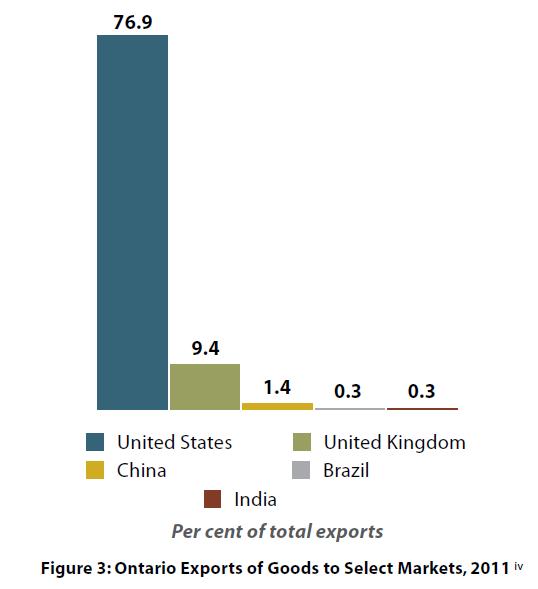
For decades, as the manufacturing heartland of Canada, Ontario has been shipping most of its products south of the border. In fact, fully 77% of the province’s exports went to the US to the tune of some $150 billion last year. While the US remains Ontario’s (and Canada’s) biggest customer, OJPC points to the rapidly rising middle class in Asia and other regions of the developing world that will drive most of global consumption of higher value-added goods and services going forward. In a short decade or more, citing a report by Morgan Stanley Smith Barney, over 50% of global consumption will be from there as the US and EU continue their slide.
But, Ontario firms have been slow in diversifying export markets. While Ontario’s exports to the US have steadily declined over the past ten years plummeting to $127 billion in 2009 from the peak of $180 billion in 2002, only 1.4% of Ontario products and services goes to China and a paltry 0.3% to India, underscores OJPC.
The Council urges the Ontario government and firms to work together and focus on sectors where the province possesses inherent advantages and where global demand is rising – agri-food, advanced manufacturing, tourism, health care, education, housing, infrastructure, financial services, natural resources, IT, and life sciences. While manufacturing remains by far the mainstay of Ontario’s exports (85%), Ontario must increasingly concentrate on advanced manufacturing on a global scale. The export capacity of Ontario firms is under-utilized and they must do more to leverage Asian and other ethnic communities in tapping into global markets.
In addition, in light of major mineral discoveries such as the massive Ring of Fire chromium and other base and precious metal deposits, OJPC says the province must open up undeveloped regions of the north to Chinese and other Asian firms for resource extraction while promoting northern tourism. The Canadian Press reports that China bought over 50% of world’s ferrochrome (for the making of stainless steel) supply last year that ensures stable demand from emerging markets over the coming years.
But, especially worrying for OJPC is the lagging export performance of Ontario’s small and medium-sized enterprises (SMEs). Only a small fraction of them export (a mere 6.4% in 2008) and the average value of the products they do export remains very low. Given the limited resources of most SMEs to explore and develop emerging global opportunities, the OJPC proposes the creation of a simple, integrated one-window online portal for SMEs to access government information and support.
The government should also boost partnership programs such as the Global Growth Fund that spotlights the building of Ontario SME export capacity. A coinciding recommendation is to set up large “reverse trade missions” centered on key emerging markets in partnership with the private sector. Reverse trade missions combine current efforts at building export capacity (market seminars, incoming buyers’ sessions and market studies, and so on) into bigger, integrated and high-impact events aimed at key markets.
Ontario SMEs should also take advantage of the under-utilized “soft innovation infrastructure” embodied in the Ontario Network of Excellence (ONE) that includes public-private-academic consortia like MaRS, Communitech and Invest Ottawa to support ‘born global” start-ups and accelerate their export growth. Finally, in addition to drawing upon recent immigrants and international students for export expansion, OJPC advocates significantly increasing the number of international students at post-secondary institutions and expanding programs to keep the most talented and entrepreneurial after they graduate.
OJPC hopes the Ontario government will reconvene the Council within a year to review progress and update Ontarians.
Lhasa’s Central Barkhor District to Get a Face-Lift
The government of Tibet’s capital city has begun a seven-month, 1.2 billion yuan ($196 million) project to help preserve Lhasa’s ancient heart.
State-owned China Tibetan News, citing a city government news conference from Friday, said the project will update the Barkhor area’s infrastructure, including water, sewer and electrical lines. The government also will build heating facilities, remove fire hazards, improve sanitation services, regulate signs and dismantle illegally built structures.
Believed to date back to the seventh century, the Barkhor has been built around Tibet’s holiest shrine, the Jokhang Temple. It is one of the most vibrant areas in Lhasa, where monks, pilgrims, residents and tourists mingle. Barkhor Street — which circles the temple — is a pilgrim route, but it is also known for shopping among tourists as it is filled with vendors selling traditional and religious artifacts.
The city will provide free space to 2,956 Barkhor vendors at one of the city’s prime locations to help minimize losses during the construction, China Tibetan News said.
– AP