
US Report: The Educational Challenge from China and India
A previous post looked at some aspects of Canadian and Chinese general and higher education as US researchers continue to sound alarm bells about the state of education in America. Recently, two think-tanks, the Center for American Progress and the Center for the Next Generation, came out with their joint report The Competition That Really Matters: Comparing US, Chinese and Indian Investments in the Next Generation Workforce, calling for the incoming administration to boost America’s investment in education.
It presented some sobering indicators of declining US human capital development: Half of American children do not receive early childhood education. More than 1/4 of them have some sort of chronic health condition such as obesity or asthma that could impede learning. In 2010, more than 22% of US children lived under the poverty line, up 3% from 2007. More than half of post-secondary students drop out without completely a degree. Since the Great Recession, gaps in educational attainment and achievement have become more entrenched between income and race groups that portends ill for future US competitiveness, the report underlined.
In contrast, China and India are rapidly increasing enrollment in all levels of education. Here, I will focus on the report’s discussions of developments in China that neatly supplement the last post.
China has ambitious goals for 2020: a 50% increase in preschool enrollment to 40 million and 3 years of preschool for at least 70% of children; 9 years of compulsory education for 95% of youths, 90% enrollment in higher middle school (up from 80% today), while making sure that no child drops out of school; more than doubling enrollment in higher education and doubling the higher educated workforce to 195 million, 57% of America’s projected population of 341 million by that time.
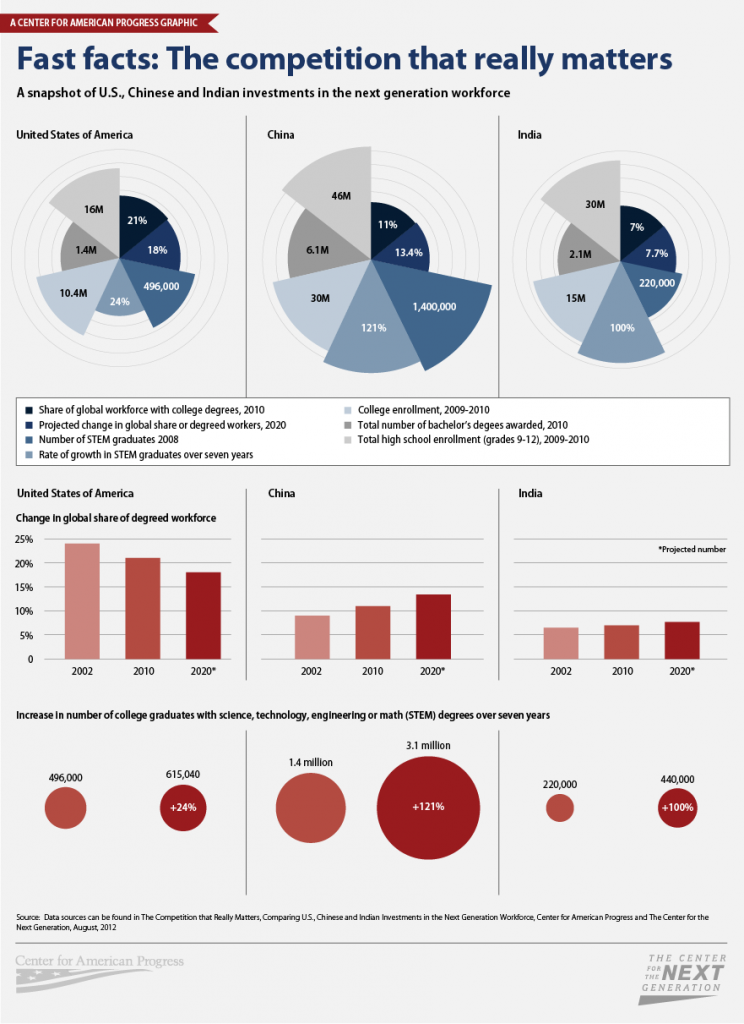
Since 2010, China is the world’s largest provider of higher education and ranks sixth in the number of its universities in the world’s top 500. By 2030, China will have graduated 200 college students, more than the entire US workforce. Teacher quality is also improving rapidly with already almost 2/3 of primary school teachers holding a higher degree. China has doubled the number of secondary school teachers to 6 million in 30 years and quadrupled the number of university level instructors.
While noting the many challenges facing China in terms of rising inequality, inferior educational quality in poor areas, along with insufficient access to schools in the countryside and among migrant workers, the report states: “China’s momentum and education-focused economic strategy will make the country increasingly competitive in sophisticated industries – precisely those where US workers now lead the competition”.
To help meet the challenge posed by China and India, the report recommends borrowing readymade ‘best practices’ from other developed countries to promote innovation and related strategies: The UK provides universal free preschool and has one of the best family support systems in the world that has served to improve child social behaviour, boost learning skills, and encourage family support for learning since the late 1990s. In terms of quality of teachers, Finland has refined a system in which top students become teachers and the profession highly selective, prestigious, and rewarding.
Germany’s federalization of education standards since 2000 has resulted in vast improvements in math achievement. Within 9 years, 17% of German students became competent in advanced math, compared to only 10% in the US. In addition, Germany’s ‘dual education’ system that focuses on the attainment of working experience, channels 2 million students into 3-year apprenticeships in over 400 occupations.
It has been 23 years since President George H.W. Bush convened the first National Education Summit with state governors that set in motion a more active federal role and inter-state cooperation in education. The authors call upon the incoming president to organize another summit to refocus on educational reform, particularly to raise teacher quality and effectiveness, provide state support for a national early education system, and integrate efforts with the goals of Common Core national education standards.