
Sports Scholar: Beijing Games Changed the Olympics and the West
London and Beijing Olympic Games opening ceremonies
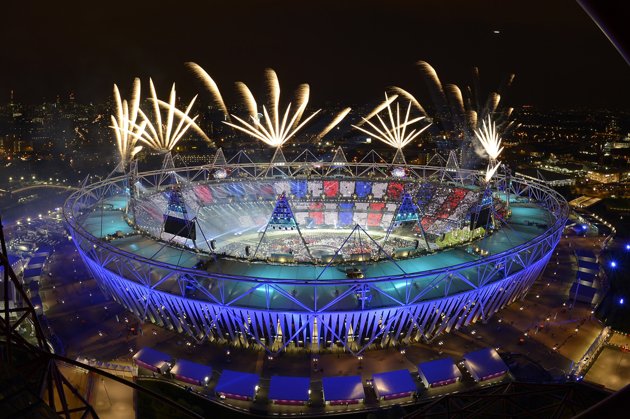

Atlantic Monthly online featured an enlightening Asia Society interview with sports anthropologist Susan Brownell who has written extensively on sports in China and China and the Olympics. She disparaged Western ‘self-centeredness’ that pervaded in the lead-up to, during, and after the 2008 Beijing Olympics on whether and how much China would be changed by the Olympics. Instead, she suggests, the question should be stood on its head – how much has China changed the Olympics along with Western perceptions and biases?
“Westerners seemed so concerned about the question of whether hosting the Olympics would push China toward Western-style political reforms, and no one seemed concerned about the question of whether, instead of us changing China, China might actually change us. I felt that many of my Western listeners needed to be awakened out of their self-centeredness”, she said pointedly.
So, did China change the Olympics and Western views and behaviour? She gives a resounding ‘yes’. First, the importance afforded Beijing’s hosting of the Games by China’s leaders forced their Western counterparts to take notice and attend the opening ceremonies. (Despite notable snubs like Stephen Harper’s, George Bush was among the dignitaries in the Bird’s Nest.) This time round, both Mitt Romney and Michelle Obama are present, precisely because of the political and economic importance attached to Olympics since Beijing. Moreover, Beijing’s opening ceremonies and Games management are a hard act to follow that set a new standard for others.
Thus, depending how the London Olympics turns out in all its facets – pre-Games lead-up, opening ceremonies, day-to-day management and operations, athlete performances, transport and traffic, ticket sales, security, etc. – Professor Brownell anticipates discussions on the merits and weaknesses of games held in liberal democracies in contrast to the virtually ‘unlimited’ human and financial resources that the Chinese threw at Beijing.
[London’s opening ceremonies will cost some US$42 million compared to more than $100 million for Beijing. Overall costs: Total Beijing investment in buildings and infrastructure, including Capital Airport’s Terminal 3, is around $40 billion. London’s costs are disputed: The British House of Commons Public Accounts Committee puts the figure around 11 billion Pounds ($17.31 billion); Games Monitor calculates costs at 13 billion Pounds ($20.45 billion); but a Sky Sports investigative report estimates that, including public transport upgrades, the price tag will be closer to 24 billion Pounds ($37.76 billion)]
Professor Brownell also had some trenchant words about media coverage ahead of Beijing versus London. On the positive side, counter to expectations, coverage in the lead-up to London is actually up from Beijing, partly because of the ‘Anglo-Saxon clique’ within the IOC but mainly because of the energy that Beijing engendered into the Games. On the negative side, media coverage of Beijing 2008 was a “product of a mutual production cycle” in which the Western media largely reported on reports and statements issued by human rights groups that were timed for release at regular intervals.
So, ‘news’ covered mainly those groups as opposed to concrete events. Ahead of the London Games, surveying the Anglophone media (via Lexis/Nexis), she found that in the week following the resignation of London Organizing Committee of the Olympic and Paralympic Games (LOCOG) sustainability chairman, there were only 21 reports about the scandal but at the same time, there were 17 reports about artist turned self-professed dissident Ai Weiwei.
“Apparently, criticizing the Chinese government is more popular than criticizing multinational corporations”, she pointed out.
On the US-China rivalry over gold and total medals, Professor Brownell thinks China will not be able to repeat its gold medal performance in Beijing, perhaps ending up with 35-39. (Her prediction dovetails with that of a Chinese official who projected that China would harvest 1/3 less golds than 2008 (51) and finish second overall.) More important, the debate should/could lead to a bigger dialogue on market-based versus state-supported sport, the support for women athletes and minor sports in the US versus China, and other bigger issues.
Finally, she had some critical advice for Western (American) journalists reporting on China generally and more specifically on China and the Olympics: “I wish that more journalists would approach their stories on China asking, ‘What does China do admirably, which we can learn from?’ One of the points I try to hammer home is that government-supported sport is more supportive of women than market-based sport, and that’s one reason China topped the US in the gold medals count in 2008. Americans don’t really want to hear that”, Ms Brownell contended.
For the entire interview, visit: http://www.theatlantic.com/international/archive/2012/07/a-new-kind-of-spectacle-how-china-changed-the-olympics/260407/