
Pew survey: Chinese Worried About Inflation, Food Safety and Corruption
In the run-up to the once-in-a-decade change in China’s leadership and the US presidential election next month, Washington-based Pew Research Center’s Global Attitudes Project released its survey of Chinese attitudes toward the quality of their lives along with their perceptions of other countries. Having skipped 2011 after four annual polls, Pew conducted face-to-face interviews with nearly 3,200 Chinese citizens, both urbanites and country folk, of all economic brackets last spring to come up with the results that, according to the pollster, have a margin of error of 4.3%.
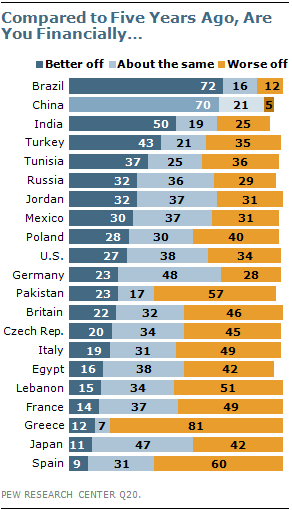
Respondents were overwhelming positive about advances in their standard of living. 92% said their lives are better than their parents’ at a comparable age, including 39% who said their lives were much better. Compared with their finances five years ago, only a small fraction (5%) said they were worse off while 21% said they are at parity, but 7 out of 10 saying they and their families are better off. Nearly 3/4 of the Chinese public believed they have faired better in a free market economy, an opinion that has remained basically consistent over the past decade since the first poll was conducted in 2002.
At the same time, Chinese citizens have become deeply concerned about inflation, with 60% rating it as a very big problem (albeit down from 72% in 2008). In the wake of food safety related scandals over the past few years such as melamine laced milk, contaminated foods, ‘gutter oil’, and others, food safety weighs heavily on the minds of Chinese citizens, up significantly to 41% from 12% in 2008. They were similarly concerned about the quality of manufactures and safety of medicines.
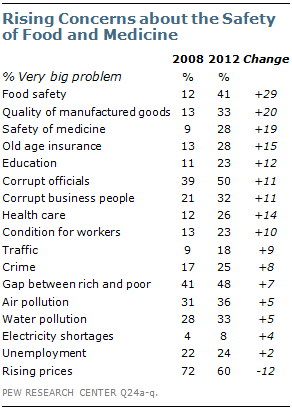
They Chinese public is also increasingly frustrated about official and business corruption (39% to 50% and 21% to 32% respectively) and the growing gap between the rich and poor (up to 48% from 41%). 8 of 10 Chinese believe the rich simply get richer and poor get poorer but a plurality (45%) still maintains that people can succeed if they work hard. Yet, a big minority (33%) says success is not guaranteed. Roughly half (51%) of all interviewees saw an active role for the state in helping the needy with 61% of those saying hard work is no guarantee of success expressing the same view, up 13% from 5 years ago.
As for Chinese views of major global powers, almost half (48%) held an unfavorable view of the US and the EU (50%) in contrast to positive views of Russia (58%). Those seeing China’s relationship with the US as cooperative is sharply down to 39% from 68% just two years ago while hostility has risen to more than a quarter of respondents (26%), up 8 percentage points.
They held the dimmest views for India and Iran (both 62% negative) and not surprisingly, under the backdrop of the ongoing territorial dispute over the Diaoyu Islands, their view of cooperation with Japan was very low (30%) with a significant plurality (41%) viewing the relationship as hostile. Their opinions of Pakistan (52% negative) were more or less on par with those for the EU.
As in previous polls, although people were more negative on the US than positive, they still admired certain aspects of Americana such as scientific and technological prowess (73%), democratic ideals (52%), American business (43%), American culture (43%), and the spread of American ideas in China (43%). With the exception of S & T capabilities and American-style business, which were both down from 2007, all other attitudes were up with younger people, those with higher education, better income and living in the cities holding more positive views.
In terms of its own image in the world, of 20 countries surveyed in a previous Pew poll last June, majorities or pluralities in 9 countries gave China the thumbs up, primarily among predominately Muslim nations and Russia. The reverse is the case in 6 countries including India, Japan, the US and the EU while opinions were roughly divided in another 5.