
On the Canada-China Economic Complimentarities Study Part II
In this post, the focus is on three sectors that exhibit among the biggest opportunities for Canadian companies in China.
Aerospace and Transport Infrastructure
Aerospace is a sector at which Canada excels, especially in regional and business aircraft, helicopters, engine parts, landing gear, structural assemblies and avionics, not to mention services, training, and maintenance, repair, and overhaul (MRO)). On the other hand, the Chinese travel market is experiencing brisk growth that is expected to continue for years if not decades to come.
Geneva-based Digital Luxury Group estimates that China’s travel market already hovers around US$232 billion. China’s international travelers made over 80 million trips (including to Hong Kong and Macau) last year, a bump of 22% over 2010, according to the Annual Report of China Outbound Tourism. Despite the economic slowdown, mainlanders still made nearly 39 million trips during the first half of this year.
By 2020, that volume is expected to top 100 million, pushing China past Germany and the US to become the largest outbound tourism market. Other studies forecast Chinese air travel to grow by 8% per year through 2028, necessitating purchases of some 3800 aircraft and 3000 civilian helicopters. The Commercial Aircraft Corporation of China (COMAC) aspires to become a high-end industry leader by 2020 with its C919 mid-sized airliner and other jets and turboprops. COMAC is extensively partnered with Bombardier to achieve that end. With Chinese airlines overhauling their fleets, moreover, the demand for MRO will only soar along with demand for new pilots, some 2500 a year to the end of the decade.
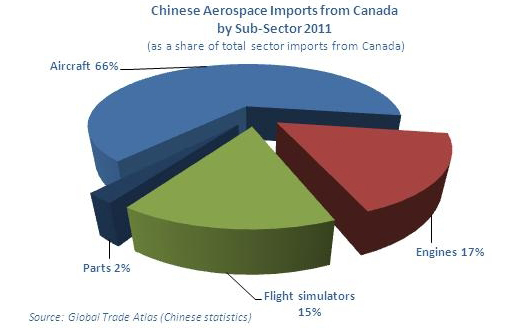
Another indication of China’s burgeoning needs is a State Council plan, announced in July, to add 70 smaller airports by 2015, mainly in under-serviced central and western parts of the country. Thus far, 11 projects have been approved with another 101 existing airports slated for renovation or expansion.
Mr Li Jiaxiang, Director of the Civil Aviation Authority, told the press recently that China has plenty more room for new facilities as there are only about 300 airports currently in operation. China’s aviation infrastructure isn’t even up to par with those of other BRIC countries, let alone the US, home to some 19,000 airports of all sizes, he said.
Clean Technology and Services
Opportunities abound for Canadian clean-tech companies in a number of areas: municipal and industrial wastewater treatment, solid waste treatment, air and water monitoring equipment, and bio-energy, renewable energy, and energy efficiency, including green buildings. Canada has also made considerable investments in carbon capture and storage and marine energy projects to demonstrate commercial viability.
The Chinese government has mandated that carbon dioxide emissions per unit of GDP be reduced by 40-45% compared to 2005 levels by 2020. During the 12th Five-Year Plan period (2011-2015), strong emphasis is put on clean energy, notably renewables, energy conservation, and clean vehicles with the central government committing 3.4 trillion RMB ($536 billion) for environmental clean-up and protection.
Plans are being drawn up to build 100 clean energy cities like Tianjin Eco-City, 200 clean energy counties, and 11,000 clean energy and solar energy zones and towns. In these areas, in addition to sales and service, Canadian clean-tech SMEs can play a special role in building technology incubators and engaging in venture capital exchanges.
Machinery and Equipment
Among the seven strategic industries afforded special focus under the 12th Five-Year Plan, high-end equipment manufacturing and new energy vehicles stand out. China’s machinery and equipment sector is expected to growth by 12% a year through 2015 with high-end equipment manufacture doubling that rate.
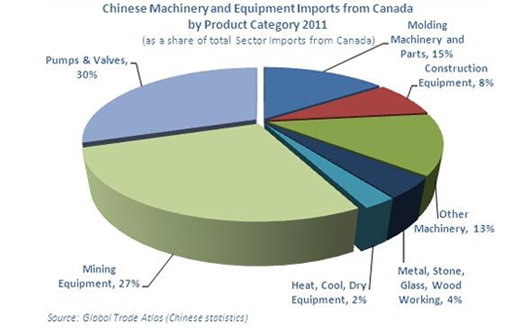
Given China’s increasing mechanization of agriculture and renewed emphasis on mining safety and environmental remediation, Canadian manufacturers are able to pursue unique opportunities with their cutting-edge technology and high safety standards. In addition, services tied to the machinery sector generate high profits and Canadian companies are eager to expand into a market that possesses the highest growth potential in the entire Asia-Pacific region.