
How Bad is China’s Corruption Anyway?
When it comes to China coverage, the Western (Canadian) press loves to accentuate the negative or overstate the evils to discredit China without any reference to how the government and society at large are trying to tackle the scourge. Last weekend, the National Post featured an ‘analysis’ of China’s corruption in connection to the on-going murder-plot investigation of former Chongqing Party Chief Bo Xilai and his immediate family.
Using disparaging terms like ‘surging’, ‘pervasive’, and ‘endemic’, the article sensationally describes a country inundated by graft, jobbery, bribery, extortion and other abuses from top to bottom. It paints a picture of the kind of ‘in-your-face’ corruption that prevails in many parts of Africa, Asia, Eastern Europe and Russia, and Latin America.
China’s corruption is indeed serious, condemned by none other than Premier Wen Jiabao. During his press conference ending the annual National People’s Congress session in late March, he warned that failure to act effectively against graft and income disparity could rekindle the tumultuous struggles of Chairman Mao’s Cultural Revolution that wreaked havoc on Chinese society for over a decade. The State Council website quoted the Premier as saying: “the greatest danger facing the ruling party is corruption…If this issue is not resolved, the nature of political power could change.”
But, how bad is China’s corruption really, compared internationally, noting that China is the world’s most populous nation still undergoing crucial stages of development and that 34 years ago was a Maoist cul de sac and economic wasteland. Systematic international comparisons of corruption are hard to come by but Transparency International’s (www.transparency .org) annual Corruption Perceptions Index makes a gallant effort. In its 2011 ranking of 183 countries, New Zealand came out on top with a score of 9.5 followed by several Scandinavian countries with North Korea and Somalia placing dead last (the higher the score, the higher the level of public-sector cleanliness).
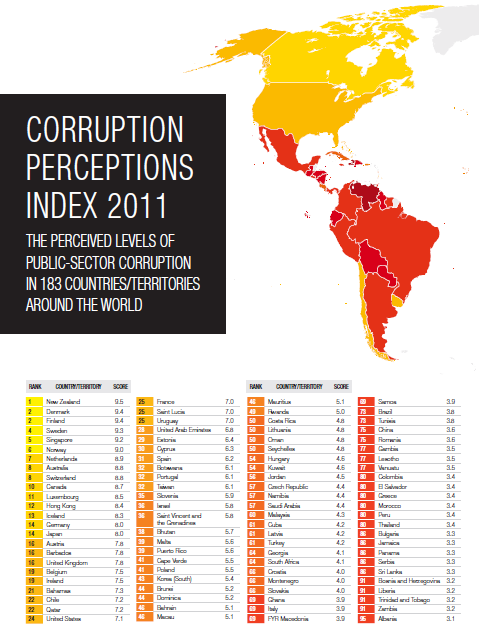
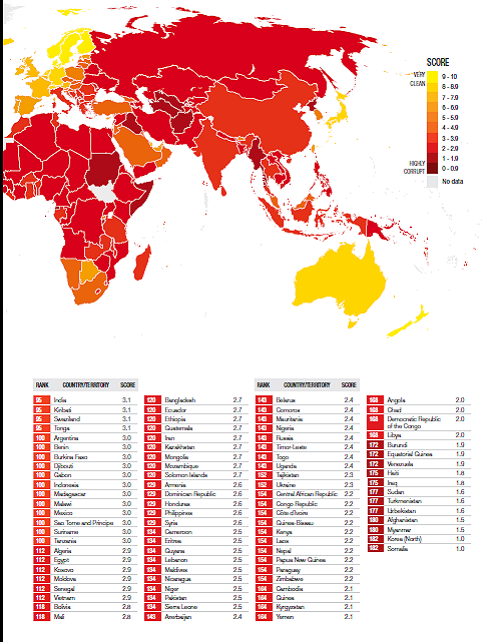
How did China fair in the ranking? Well, it landed somewhere in the middle, coming in 75th, with a score of 3.6, on par with Romania and closely behind Brazil (73, 3.8). Significantly, it wasn’t far behind Italy, a developed and Europe’s third largest economy (69, 3.9) and 10+ places back of emerging markets Turkey (61, 4.2) and South Africa (64, 4.1). In Greater China and Sinic (Chinese influenced) countries and regions, Singapore ranked highest (5, 9.2), followed by Hong Kong (12, 8.4), Taiwan (32, 6.1) and Macau (46, 5.1) while in East Asia, Japan reached 14th with 8.0 and South Korea 43rd with 5.4. Canada placed a very high 10th with 8.7, far ahead of the US (24, 7.1).
Most interestingly, however, is the ranking of China vis a vis India, touted by itself and the West as a vibrant democracy with an active civil society, well-functioning courts, and the rule of law. A comparison with India is more apt since the two countries are both at early stages of development with China ahead in reforms. While China’s score is nothing to brag about, India placed a full 20 spots behind China at 95th with a score of 3.1, in line with Albania, Kiribati, Swaziland, and Tonga. More important, India slipped 23 spots from its 2007 ranking when it shared the 72nd spot with Brazil, China, Mexico and others with a score of 3.5. So, while China slipped 3 places over the last 4 years, its score actually rose by 0.1 while India’s dropped by 0.4.
Even Sri Lanka faired better than India with a 86th placing and score of 3.3 and expectedly, Bangladesh and Pakistan ranked far worse with 120, 2.7 and 134, 2.5 respectively. In Indochina and Southeast Asia, with the exception of Malaysia (60, 4.3), rankings were invariably low: Thailand (80, 3.4), Indonesia (100, 3.0), Vietnam (112, 2.9), Philippines (129, 2.6), Laos (154, 2.2), Cambodia (164, 2.1), and Myanmar (180, 1.5), third from last.
Rukshana Nanayakkara, Transparency International’s Senior Program Coordinator for South Asia remarked that the performance of China and India showed much less efficacy in combating corruption as compared to developed countries. “In China, greater economic freedom has failed to bring along a framework that hinders corruption…(and) although India boasts a larger democratic space of public activism in countering corruption and opacity, little commitment has been delivered on the government’s part for substantive eradication”, Mr Nanayakkara wrote on the Transparency International website.
In my next post, I will take a closer look at how the Chinese authorities are dealing with the affliction and obstacles in their way along with efforts by civil society to expose the seedy side of Chinese government and society through the use of the Internet.