
The Machinations of Mike Daisey
By now, everybody has heard about US public radio’s The American Life renunciation of artist Mike Daisey’s early January one-man show “Mr. Daisey and the Apple Factory” depicting ‘inhuman’ working conditions at the Shenzhen and other plants of Taiwanese-owned Foxconn Technology Group, the OEM maker of iPhones and iPads for Apple and other major Western brands.
In his monologue, Daisey described young workers, some under-age, logging unbearable overtime hours and crippling themselves assembling Apple products at Foxconn’s towering factories that employ hundreds of thousands. Daisey claimed that some were even poisoned by hexane, used in glues for shoes, leather products, and roofing. The episode became the most popular podcast in the history of The American Life with 880,000+ downloads (750,000 being the norm) and 206,000+ streams to date.
But Mr. Daisey’s stage performance was pure theatre, not journalism, full of fabrications and misrepresentations; so much so that Ira Glass, the host of the public radio program devoted an entire subsequent episode simply called “Retraction” to repudiate Mr. Daisey. Mr Glass peppered Mr Daisey with questions in an interview for the episode and apologized copiously to listeners, ironically emerging more noble and trustworthy than before the incident, commented a writer for MacLean’s. Daisey admitted that he never met any poisoned workers and guessed at the ages of some of the workers he met. (Chinese/Asians tend look younger to the Western eye.)
In various press interviews and on stage, Mr. Daisey stated that he had travelled to Shenzhen and interviewed hundreds of workers from Foxconn who had suffered egregiously from their grinding work. He said that he even met a worker with hands maimed by a metal press in the assembly of iPads. “I know that people in charge know about these things and chose not to address them. And that’s hard to swallow when you see the damage it does”, he told the Associated Press last year.
A statement on the This American Life blog disclosed that following the initial program, public radio program Marketplace China Correspondent Robert Schmitz held certain doubts about Mr. Daisey’s story. Mr. Schmitz had reported much about the Foxconn Apple supply chain and had first-hand knowledge of the issues. He located and interviewed Cathy Lee (Li Guifen), Mr. Daisey’s Chinese interpreter, despite Daisey’s attempts at hiding her identity and her cell number. Cathy Lee disputed much of what Mr. Daisey had been telling to his audiences since 2010 and on the radio, in particular, the meeting of underage workers at Foxconn and the worker with the mangled hand.
On the same blog, Mr. Glass wrote: “…We are retracting the story because we can’t vouch for its truth. This is not a story we commissioned…Daisey lied to me and This American Life producer Brian Reed during the fact checking we did on the story, before it was broadcast…We’re horrified to have something like this onto public radio…Our program adheres to the same journalistic standards as other national shows, and in this case, we did not live up to those standards.”
Apple had refuted Mr. Daisey’s allegations for months to little avail. Salt was rubbed into the wound last January when the New York Times also published an investigative series of reports on dangerous working conditions of Apple workers in China, including an explosion at a iPad plant that killed 4 and injured 77.
Partially exonerated by the public radio retraction, Foxconn nonetheless refrained from suing Mr. Daisey in spite of taking a heavy hit to its reputation. “Our corporate image has been totally ruined…(However), we have no plans to take legal action…We hope nothing similar will happen again”, Simon Hsing, Foxconn’s spokesman, told Reuters.
Mr. Daisey’s shenanigans aside, scandals and tragedies have plagued Foxconn since 2010 with the spate of worker suicides that caught the world’s attention, putting Foxconn’s ‘militarized’ regimentation in the spotlight. In my next blog, I will take a closer look at Foxconn’s dark side and measures since taken to help curb worker dissatisfaction.
By now, everybody has heard about US public radio’s The American Life renunciation of artist Mike Daisey’s early January one-man show “Mr. Daisey and the Apple Factory” depicting ‘inhuman’ working conditions at the Shenzhen and other plants of Taiwanese-owned Foxconn Technology Group, the OEM maker of iPhones and iPads for Apple and other major Western brands.
In his monologue, Daisey described young workers, some under-age, logging unbearable overtime hours and crippling themselves assembling Apple products at Foxconn’s towering factories that employ hundreds of thousands. Daisey claimed that some were even poisoned by hexane, used in glues for shoes, leather products, and roofing. The episode became the most popular podcast in the history of The American Life with 880,000+ downloads (750,000 being the norm) and 206,000+ streams to date.
But Mr. Daisey’s stage performance was pure theatre, not journalism, full of fabrications and misrepresentations; so much so that Ira Glass, the host of the public radio program devoted an entire subsequent episode simply called “Retraction” to repudiate Mr. Daisey. Mr Glass peppered Mr Daisey with questions in an interview for the episode and apologized copiously to listeners, ironically emerging more noble and trustworthy than before the incident, commented a writer for MacLean’s. Daisey admitted that he never met any poisoned workers and guessed at the ages of some of the workers he met. (Chinese/Asians tend look younger to the Western eye.)
In various press interviews and on stage, Mr. Daisey stated that he had travelled to Shenzhen and interviewed hundreds of workers from Foxconn who had suffered egregiously from their grinding work. He said that he even met a worker with hands maimed by a metal press in the assembly of iPads. “I know that people in charge know about these things and chose not to address them. And that’s hard to swallow when you see the damage it does”, he told the Associated Press last year.
A statement on the This American Life blog disclosed that following the initial program, public radio program Marketplace China Correspondent Robert Schmitz held certain doubts about Mr. Daisey’s story. Mr. Schmitz had reported much about the Foxconn Apple supply chain and had first-hand knowledge of the issues. He located and interviewed Cathy Lee (Li Guifen), Mr. Daisey’s Chinese interpreter, despite Daisey’s attempts at hiding her identity and her cell number. Cathy Lee disputed much of what Mr. Daisey had been telling to his audiences since 2010 and on the radio, in particular, the meeting of underage workers at Foxconn and the worker with the mangled hand.
On the same blog, Mr. Glass wrote: “…We are retracting the story because we can’t vouch for its truth. This is not a story we commissioned…Daisey lied to me and This American Life producer Brian Reed during the fact checking we did on the story, before it was broadcast…We’re horrified to have something like this onto public radio…Our program adheres to the same journalistic standards as other national shows, and in this case, we did not live up to those standards.”
Apple had refuted Mr. Daisey’s allegations for months to little avail. Salt was rubbed into the wound last January when the New York Times also published an investigative series of reports on dangerous working conditions of Apple workers in China, including an explosion at a iPad plant that killed 4 and injured 77.
Partially exonerated by the public radio retraction, Foxconn nonetheless refrained from suing Mr. Daisey in spite of taking a heavy hit to its reputation. “Our corporate image has been totally ruined…(However), we have no plans to take legal action…We hope nothing similar will happen again”, Simon Hsing, Foxconn’s spokesman, told Reuters.
Mr. Daisey’s shenanigans aside, scandals and tragedies have plagued Foxconn since 2010 with the spate of worker suicides that caught the world’s attention, putting Foxconn’s ‘militarized’ regimentation in the spotlight. In my next blog, I will take a closer look at Foxconn’s dark side and measures since taken to help curb worker dissatisfaction.
China and British Columbia vow to further promote ties and trade relations
|
Harper wraps up China visit with panda pact
 |
|
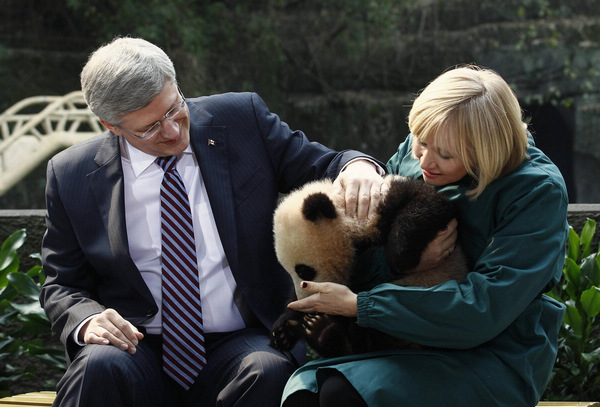
Canada’s Prime Minister Stephen Harper pets a panda with his wife Laureen at a zoo in Chongqing Feb 11, 2012. Harper announced two giant pandas, Er Shun and Ji Li, will spend 10 years in two Canadian zoos. [Photo/Agencies] |
BEIJING – Canada’s Prime Minister Stephen Harper wrapped up a visit to China by announcing Saturday that Beijing will loan two of giant pandas to Canadian zoos. The pandas are the first to travel to Canada in more than two decades.
Harper visited a zoo in Southwest China’s Chongqing municipality to say that the Chinese government is loaning the panda pair to Canada for the next 10 years, Harper’s press secretary Carl Vallee said.
News photos showed Harper looking on as his wife carried a squirming baby panda.
The pandas are expected to arrive in Canada early next year and will go to the Toronto and Calgary zoos for five years each.
Source: China Daily
Sino-Canadian ties to cover more sectors
President and vice-premier target stronger Canada economic relations
BEIJING – China is willing to increase imports from Canada and to boost cooperation in energy and other areas, Chinese leaders said on Thursday.
During a meeting with Canadian Prime Minister Stephen Harper, President Hu Jintao said cooperation should be strengthened across a range of sectors.
“The countries should enhance political dialogue to expand common ground,” Hu said.
To boost trade links, Hu suggested that the potential of both economies to interact be realized and cooperation expanded.
Vice-Premier Li Keqiang called for the countries to “promote energy trade”.
|
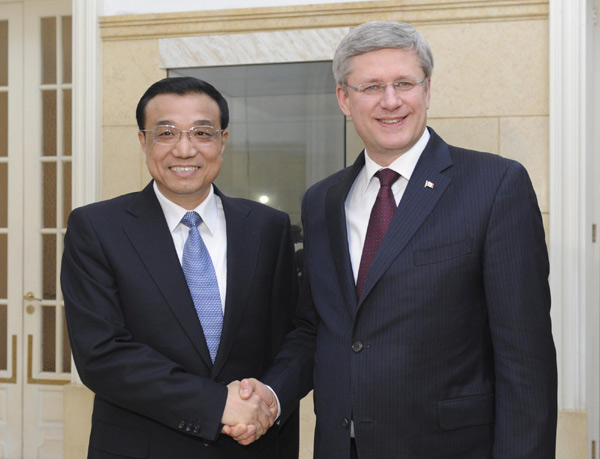 Vice-Premier Li Keqiang (L) shakes hands with Canadian Prime Minister Stephen during a meeting in Beijing on Thursday. [Photo/Xinhua] |
“Canada is a nation that has bountiful energy resources, and China is a stable and reliable consumption market”, he said in a keynote speech at a Beijing business forum.
And the two nations should also enhance energy cooperation, including renewable and nuclear, and promote joint oil and mining projects, he said.
“We should ensure a stable partnership in the field of energy resources,” Li said.
Harper is leading a delegation of more than 40 business executives during his visit as he endeavors to sell more oil to China, attract Chinese investment in Canada and win more access to China for Canadian companies.
Harper’s visit comes as Canada plans to diversify exports of crude oil to Asia, including China, and aims to speed up the regulatory-approval process for large energy projects. This comes on the heels of US President Barack Obama rejecting TransCanada Corp’s $7 billion pipeline to the US Gulf Coast.
“The potential for China-Canada economic and trade cooperation has never been bigger than today,” Li said.
“We are glad to see that Canada is diversifying its trade and investment and stressing the importance of the Asian market,” Li said.
“Asia is the most dynamic and potential region worldwide in terms of economic growth and China is a major economy in Asia.”
China plans to expand domestic consumption and develop strategic emerging sectors.
Harper’s visit has resulted in a number of deals on energy. Canadian businesses signed nearly $3 billion worth of deals with Chinese enterprises on Thursday.
Canada reached an agreement with China on Thursday to facilitate uranium exports by giving Canadian uranium producers more access to China’s civilian nuclear power industry.
China could start receiving Canadian oil as early as 2016 if a pipeline project from Alberta to Canada’s Pacific coast goes ahead, said Enbridge Pipelines chairman Patrick Daniel, who accompanied Harper on the visit.
Harper agreed with Li by saying that China-Canada economic relations are “reaching a new level”.
After meeting President Hu Jintao on Thursday, Harper said: “I think Canada-China relations are continuing along a very positive route.
“Canada has the resources, technological sophistication and geo-strategic positioning to complement China’s economic growth strategy,” he said.
“And China’s growth, in turn, complements our determination to diversify our export markets.”
China is Canada’s second-largest trading partner. Bilateral trade stood at almost $50 billion in 2011, up $6 billion from 2009. The two countries set a target of increasing bilateral trade to $60 billion by 2015.
“There is more room for us to enlarge bilateral trade, as it is still small,” Li said.
Premier Wen Jiabao said on Wednesday the two nations should discuss the possibility of signing a free trade agreement.
Two-way investment
“We welcome Canadian companies to invest in China’s western, central and northeastern regions. We also encourage Chinese companies to invest in Canada,” Li said.
On Wednesday, the two nations concluded negotiations on a foreign investment promotion and protection agreement, which began in 1994.
Canadian investment in China surged by 39 percent year-on-year in 2010 to $5 billion. Chinese investment in Canada totaled $14 billion during the same period, up by 9 percent from 2009.
China has been encouraging its enterprises to expand globally, and experts have said that the current global slowdown has provided a number of investment opportunities.
Source: China Daily
China, Canada boost strategic partnership
 |
|
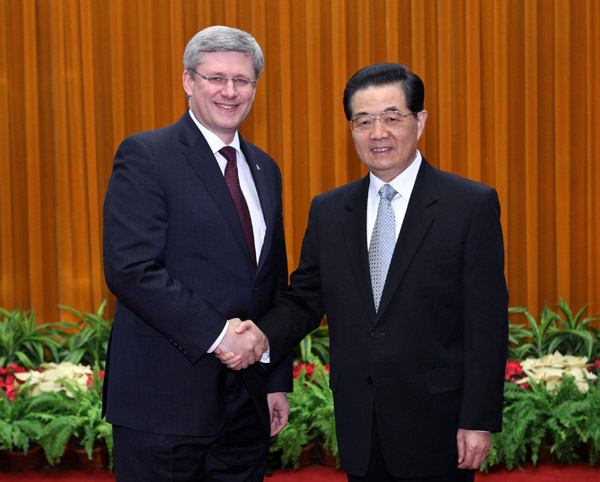
Chinese President Hu Jintao shakes hands with Canadian Prime Minister Stephen Harper before their meeting at the Great Hall of the People in Beijing February 9, 2012. [Photo/Xinhua]
|
BEIJING – President Hu Jintao and visiting Canadian Prime Minister Stephen Harper agreed on Thursday to further facilitate the bilateral strategic partnership and promote greater progress of cooperation in diversified areas.
The agreement was made during their meeting in the Great Hall of the People.
“The two countries should stick to the principle and spirit of the China-Canada Joint Statement and enhance dialogue in the political field in a bid to expand common ground,” Hu said.
The China-Canada Joint Statement was issued during Harper’s previous visit in 2009.
Hu called on both sides to respect each other’s development paths chosen by their people, and respect and accommodate each other’s core interests and major concerns.
To boost trade links, Hu suggested full play be given to the strong complementarity of both economies while expanding cooperative areas.
Hu also proposed the enhancement of youth exchanges between both countries and the strengthening of coordination in global and regional affairs in order to promote recovery and sustainable growth of the world economy.
Harper, on his second visit since taking office in 2006, applauded the new progress of bilateral ties in recent years.
He said the two countries have seen an increasing consensus and common interests on many major issues.
Canada is committed to developing a strategic partnership with China based on respect and mutual benefit and hopes to maintain high-level exchanges and political dialogue, and enhance cooperation in such areas as trade, energy and investment, he said.
Harper also vowed joint efforts with China to address global and regional issues, to safeguard world peace and to boost new progress of global economic governance.
In a meeting with top legislator Wu Bangguo, Harper said his government highly values Canada-China relations and is committed to cementing win-win cooperation in trade and other areas.
Harper brought to Beijing a large delegation of cabinet ministers and lawmakers, as well as a large business delegation with representatives from the energy, transport, and education sectors.
Wu, chairman of the Standing Committee of the National People’s Congress (NPC), said he regards parliamentary exchanges as an important part of the China-Canada strategic partnership.
“The NPC has set up sound cooperative ties with the Canadian Senate and the House of Commons. The regular exchange mechanism between the two countries’ parliaments has achieved positive progress,” Wu said.
He hailed the important consensus and progress the two countries made during Harper’s current visit, adding that these achievements will inject new vitality to the bilateral win-win cooperation.
Vice Premier Li Keqiang also met with Harper later on Thursday and both attended a trade seminar for enhancing two-way trade.
Harper came to Beijing on Tuesday for a five-day trip as guest of Premier Wen Jiabao. The two premiers had talks on Wednesday and witnessed the signing of several bilateral agreements regarding cooperation in trade, technology, education, forestry, energy and agriculture.
Harper will also visit south Guangdong Province and the southwest municipality of Chongqing.
China and Canada forged diplomatic ties in November 1970. They established their strategic partnership in September 2005 during Hu’s visit to Canada.
Canadian Prime Minister Steven Harper greets Chinese Premier Wen Jiaobao
”] BEIJING – Premier Wen Jiabao on Wednesday urged the forging of a long-term, stable and diversified partnership with Canada in the energy and resource sector.
“The negotiation on China-Canada investment protection agreement has concluded. We hope to sign the important document as soon as possible to facilitate two-way investment,” Wen told visiting Canadian Prime Minister Stephen Harper in the Great Hall of the People.
Harper came to Beijing Tuesday for his second China visit since taking office in 2006.
Calling the two economies highly compatible, Wen proposed to draw up an all-round plan on boosting bilateral economic cooperation based on joint research on economic complementarities.
He also urged discussions on the feasibility of signing a China-Canada free trade agreement.
“China is ready to expand imports of energy and resource products from Canada and enhance cooperation in clean and renewable energy, energy-saving, environmental protection, and the peaceful use of nuclear energy,” Wen said.
The two countries should also explore cooperation in the areas of the judiciary, culture, technology, agriculture, finance and the polar ocean, he added.
Harper, who is bringing a large business delegation to China, said Canada welcomes China to expand investment in his country and expects closer bilateral cooperation in trade, energy, resources, finance and culture.
He vowed closer coordination with China in global and regional affairs and to boost bilateral ties to a new level.
Harper told Wen that Canada-China relations are long-lasting with strategic ties based on mutual respect.
Wen spoke positively of the growth of China-Canada relations since the forging of diplomatic ties in November 1970, citing frequent high-level exchanges, enhanced two-way trade and investment, and increasing exchanges in the areas of culture, education and technology.
 |
|
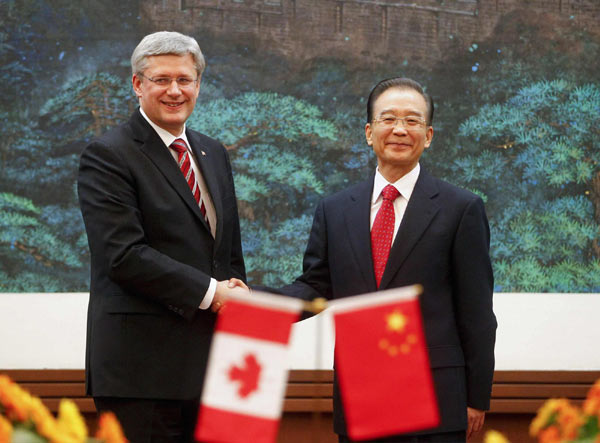
Canada’s Prime Minister Stephen Harper shakes hands with Chinese Premier Wen Jiabao after a signing ceremony at the Great Hall of the People in Beijing February 8, 2012. [Photo/Agencies] |
“Under the new circumstances, the two countries should implement the consensus reached in the China-Canada joint statement, maintain mutual respect, equality and non-interference in each other’s internal affairs and beef up understanding through dialogue,” Wen said.
The China-Canada joint statement was issued during Harper’s last China visit in 2009.
Prior to the talks, Wen hosted a welcome ceremony for Harper. They also witnessed the signing of several bilateral agreements regarding cooperation in trade, technology, education, forestry, energy and agriculture areas.
Besides Beijing, Harper will also visit south Guangdong province and the southwest municipality of Chongqing during his five-day trip.
Canada and China celebrated their 40th anniversary of diplomatic relations in 2010. China is Canada’s second-largest trading partner and a key customer for Canadian natural resources and agricultural products.
Canada unveils stamps to mark Chinese new year
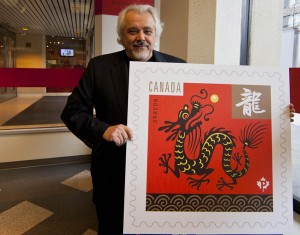
Canadian designer Louis Fishauf shows a poster of his new creation – stamps featuring the upcoming Chinese lunar new year, the Year of the Dragon, in Toronto, Canada, Jan 10, 2012. Canada Post issued the stamp to celebrate Chinese lunar new year, which falls on Jan 23, 2012. [Photo/Xinhua]
Ease of doing business in Canada
According to the World Bank’s International Finance Corporation Canada ranked # 13 in the world for ease of doing business. Canada was ranked # 3 in the world for starting a business, and 5th in the world for protecting investors. China ranked 91 overall. More information can be found at http://www.doingbusiness.org/rankings
Chinese rich are keen to emigrate
Source: China Daily
SHANGHAI – About 60 percent of the rich Chinese people, each of whom has a net asset of at least 60 million yuan ($9.44 million), said they intended to migrate from China, a report has found.
About 14 percent of them have either already migrated from China or have applied for migration.
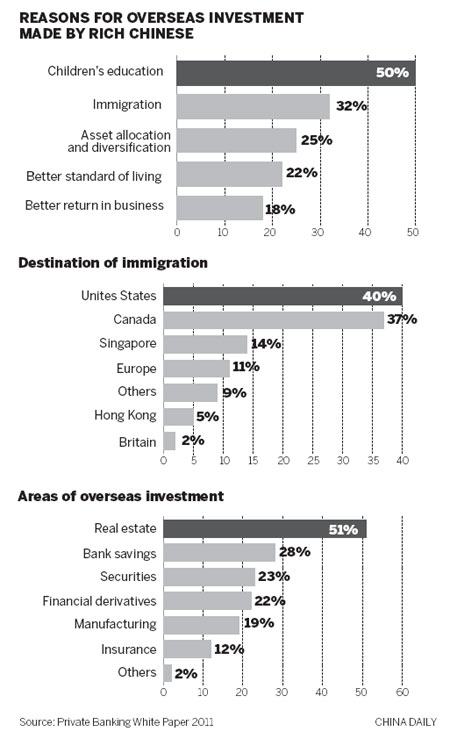
The three most favored destinations by the Chinese rich are the United States, Canada and Singapore. The US is the first choice of some 40 percent of the people interviewed, according to a white paper jointly released by Hurun Report and the Bank of China (BOC) on Saturday.
According to US Citizenship and Immigration Services (USCIS), the number of Chinese applicants for investment immigration has exceeded applications from any other country or region.
Last year, the USCIS issued 772 EB-5 visas, meant for investor immigrants, to Chinese people. They account for 41 percent of the total EB-5 visas issued by the agency.
“Among all the destinations in terms of investment immigration, the US always outstand all other options as the country does not impose any quota,” said Jiao Lingyan, a client executive of the investment immigration department of the Beijing-based GlobeImmi International Education Consultation Co.
“The minimum amount required for investment immigration to the US is $500,000. But it should be noted that this applies to investments in projects recommended by authorities in the US. People considering these projects should take into account that they may not make profits,” Jiao said.
“It is worth noting that the minimum amount for investment immigration will be raised in the coming years, because the number of rich people in China is rapidly growing,” she said.
Among the 980 people interviewed by Hurun Report and the BOC, one-third said they have assets overseas, which on an average account for 19 percent of their total assets.
While 32 percent of the interviewees said they have invested overseas with a view to immigrate, half of them said they did so mainly for the sake of their children’s education.
Zhang Yuehui, a Beijing-based immigration expert, said children’s education is also the top concern among those who want to immigrate.
“A growing number of parents in China have realized that children growing up in the examination-oriented education system in China will find it hard to compete in an increasingly globalized world,” Zhang said.
Wang Lilan, 38, a mother of two who immigrated to Australia from her home province of Fujian two years ago, was one of those parents.
“My 12-year-old elder daughter used to do her homework very late into the night. But here in Australia, she does quite a lot practical assignment, in a playful way. And she has more spare time to do the things she likes,” Wang said.
“I feel very delighted to see my children having fun while studying,” Wang said.
Chinese immigrants are also getting younger, with the largest group aged between 25 and 30, compared to the 40-45 age group in the past, Zhang said.
SHANGHAI – Having decided to move to Los Angeles with her husband, expecting mother, Xu Cong, 25, has been busy preparing the immigration documents and plans to leave for the United States in December.
“I’ve discussed our future with my husband and we reached the conclusion that if we want to provide better education to our children and have more career choices for ourselves, immigration is the best solution,” said Xu who studied in Britain for five years from 2003 to 2008.
They come under a category different from investment immigration, where applicants have to invest at least $500,000 in a targeted employment area to get a visa. Xu and her husband said they chose to register their own trading company by putting at least $800,000 as the starting fund.
According to the US Citizenship and Immigration Services, targeted employment area refers to a high-unemployment or rural area in the US. The minimum qualifying investment in such cases is $500,000.
Xu’s company will import gloves from China to the US and export water purifier and medical devices from the US to other countries.
In accordance with the rules set by the US Citizenship and Immigration Services, Xu also needs to create or preserve at least 10 full-time jobs for qualifying US workers within two years.
“The whole process of preparation is more complicated than we thought, especially we have to write the detailed business plans for the company on how to make enough profits,” she said.
Xu and her husband decided to move their date of arrival in the US forward, from March next year to December this year, to make sure that their baby will be born in the US.
“My children will receive better education and we will work for our company in the US Our parents will also be able to move to the US and live with us,” said Xu.
The Best Countries For Business
Source: Forbes
http://www.forbes.com/sites/kurtbadenhausen/2011/10/03/the-best-countries-for-business/
During the run-up to every U.S. presidential election, countless Americans threaten to move to Canada if their preferred candidate does not emerge victorious. Of course, few follow through with a move north. Maybe it is time to reconsider.
Canada ranks No. 1 in our annual look at the Best Countries for Business. While the U.S. is paralyzed by fears of a double-dip recession and Europe struggles with sovereign debt issues, Canada’s economy has held up better than most. The $1.6 trillion economy is the ninth biggest in the world and grew 3.1% last year. It is expected to expand 2.4% in 2011, according to the Royal Bank of Canada.
Canada skirted the banking meltdown that plagued the U.S. and Europe. Banks like Royal Bank of Canada, Bank of Nova Scotia and Bank of Montreal avoided bailouts and were profitable during the financial crises that started in 2007. Canadian banks emerged from the tumult among the strongest in the world thanks to their conservative lending practices.
Canada is the only country that ranks in the top 20 in 10 metrics that we considered to determine the Best Countries for Business (we factored in 11 overall). It ranks in the top five for both investor protection as well as lack of red tape, which measures how easy it is to start a business.
Full List: The Best Countries For Business
Canada moves up from No. 4 in last year’s ranking thanks to its improved tax standing. It ranks ninth overall for tax burden compared to No. 23 in 2010. Credit a reformed tax structure with a Harmonized Sales Tax introduced in Ontario and British Columbia in 2010. The goal is to make Canadian businesses more competitive. Canada’s tax status also improved thanks to reduced corporate and employee tax rates.
Canada leans on the U.S. economy heavily: it’s the biggest oil supplier to Uncle Sam and three-quarters of its exports end up in the U.S. each year. Yet while U.S. unemployment has stayed above 9%, it’s only 7.3% in Canada compared to the 25-year average of 8.5%. The eurozone unemployment rate is 10%.
Forbes leaned on research and published reports from the Central Intelligence Agency, Freedom House, Heritage Foundation, Property Rights Alliance, Transparency International, the World Bank and World Economic Forum to compile the rankings.
Denmark dropped from the top spot in 2010 to No. 5 this year as its relative monetary freedom declined as measured by the Heritage Foundation. Denmark’s stock market also fell 14%, which was the worst performance of any of our top 10 countries. Four other European countries in last year’s top 20 also dropped in the rankings, with Finland sliding to No. 13, the Netherlands to No. 15 Netherlands, Germany to No. 21 and Iceland to No. 23.
The U.S. ranked No. 10, down from No. 9 in 2010. The world’s largest economy at $14.7 trillion continues to be one of the most innovative, ranking sixth in patents per capita among all countries (No.7 overall Sweden ranks tops for innovation).
What hurts the U.S. is its heavy tax burden. This year it surpassed Japan to have the highest corporate tax rate among developed countries. The U.S. also gets dinged for a poor showing on monetary freedom as measured by the Heritage Foundation. Heritage gauges price stability and price controls and the U.S. ranks No. 50 out of 134 countries.
Bringing up the rear are three countries where the economies are smaller than $10 billion. No. 132 Burundi, No. 133 Zimbabwe and No. 134 Chad all fare poorly when it comes to trade and monetary freedom as well as innovation and technology. Chad has the highest GDP per capita of the three at $1,600, but scores last among all countries on both corruption and red tape.We determined the Best Countries for Business by looking at 11 different factors for 134 countries. We considered property rights, innovation, taxes, technology, corruption, freedom (personal, trade and monetary), red tape, investor protection and stock market performance.