
Chinese Netizens Love Japanese AV Girls
This is surprisingly interesting:
Last month Chinese state newspaper the Global Times asked 34,000 Chinese netizens what they liked most about Japan. Of those who answered, 32.9% said that they liked best the country’s adult videos and their female stars, referred to as AV and AV idol. Incredibly, that figure beat out Japanese dedication to work and politeness (26.6%) and animation products (13.8%).
These AV Girls appear to know the influence they have. One, Sora Aoi, who is also known as Sola Aoi, sent two messages of “Japanese-Chinese Friendship” from her Weibo account in September. The Weibo-watching blog Tea Leaf Nation reports that the majority of responses were negative, and Sora was called “a Japanese dog”.
– Business Insider
China’s Love/Hate for Kublai Khan
Interesting sweep of history themed on Kublai Khan’s rule of China – China’s love/hate for barbarians from all directions, foreign devils, and its ability to absorb alien cultures and things to become ‘quintessentially’ Chinese. But, in truth, China is a hodge-podge, a big mixing vat or melting pot of the local and foreign. And within the historical and geographical China itself, traditions and cultures are vastly different.
China’s ongoing reforms and economic development is the greatest example of integrating foreign ideas and manufacture with local notions and innovation to create something wholly new. China’s transformation is a micro-cosom of the transformation of the world.
World’s First Alpine High Speed Rail – Harbin to Dalian Line Begins Tests
China on Monday showcased the world’s first alpine high-speed rail line, which threads through the country’s three northeastern provinces.
A test train departed from Harbin West Station, located in the capital of Heilongjiang Province, on Monday morning for Dalian, a port city in Liaoning Province. With a trial speed averaging 300 km per hour, the train completed the 921-kilometer journey in about four hours.
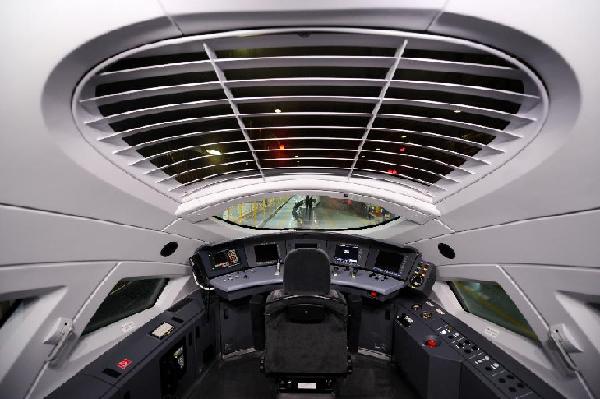
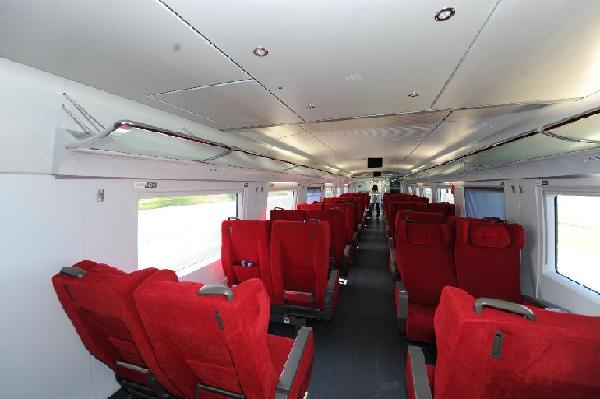
Engineers with the railway project said the rail track built using cutting-edge technology can accommodate temperatures between 40 degrees Celsius below zero and 40 degrees Celsius above freezing. Trains will be able to run at an average of 350 km per hour on the line after safety tests are conducted.
The rail line, featuring 24 stations, is expected to go into normal operation by the end of the year. Harbin West, the line’s originating station, has been designed with 10 platforms with a combined dispatched passenger capacity of 7,000 passengers per hour at peak times.
– Xinhua
Six Creative Chinese Cities
China is riding high on a wave of creativity that is set to take the country to a new level on the international platform.
CHINA has six cities listed in Unesco’s Creative Cities Network. No other country boasts as many internationally-acclaimed creative cities.
The cities are Shenzhen, Chengdu, Shanghai, Beijing, Hangzhou and Harbin. Shenzhen, Shanghai and Beijing are “Cities of Design” while Chengdu is “City of Gastronomy” and Hangzhou, “City of Crafts and Folk Art.” The northern city of Harbin is recognised for its musical creations and promotion of the music industry.

The rise in popularity and influence of China’s creative industry has gradually elevated the nation’s status as a powerhouse of creativity, shrugging off its old school label of “Made In China” or “world’s factory”.
http://thestar.com.my/lifestyle/story.asp?file=/2012/10/8/lifefocus/12065620&sec=lifefocus
– The Star Online
Golden Week Sales Hit US$127 Billion
China’s retail sales growth slowed during the Golden Week holiday, local media said on Sunday, providing a snapshot of increasingly important sources of demand in the world’s second-largest economy.
Overall retail sales revenue grew 15 percent to hit 800.6 billion yuan ($127.4 billion) during the National Day holiday, which coincided with the Mid-Autumn Festival to provide a rare eight-day break, China’s state television China Central Television said.
The Golden Week holiday, when millions of people take time out to travel and spend more than usual, brings huge discounts and promotions as retailers battle for market share.
– Reuters
US Report: The Educational Challenge from China and India
A previous post looked at some aspects of Canadian and Chinese general and higher education as US researchers continue to sound alarm bells about the state of education in America. Recently, two think-tanks, the Center for American Progress and the Center for the Next Generation, came out with their joint report The Competition That Really Matters: Comparing US, Chinese and Indian Investments in the Next Generation Workforce, calling for the incoming administration to boost America’s investment in education.
It presented some sobering indicators of declining US human capital development: Half of American children do not receive early childhood education. More than 1/4 of them have some sort of chronic health condition such as obesity or asthma that could impede learning. In 2010, more than 22% of US children lived under the poverty line, up 3% from 2007. More than half of post-secondary students drop out without completely a degree. Since the Great Recession, gaps in educational attainment and achievement have become more entrenched between income and race groups that portends ill for future US competitiveness, the report underlined.
In contrast, China and India are rapidly increasing enrollment in all levels of education. Here, I will focus on the report’s discussions of developments in China that neatly supplement the last post.
China has ambitious goals for 2020: a 50% increase in preschool enrollment to 40 million and 3 years of preschool for at least 70% of children; 9 years of compulsory education for 95% of youths, 90% enrollment in higher middle school (up from 80% today), while making sure that no child drops out of school; more than doubling enrollment in higher education and doubling the higher educated workforce to 195 million, 57% of America’s projected population of 341 million by that time.
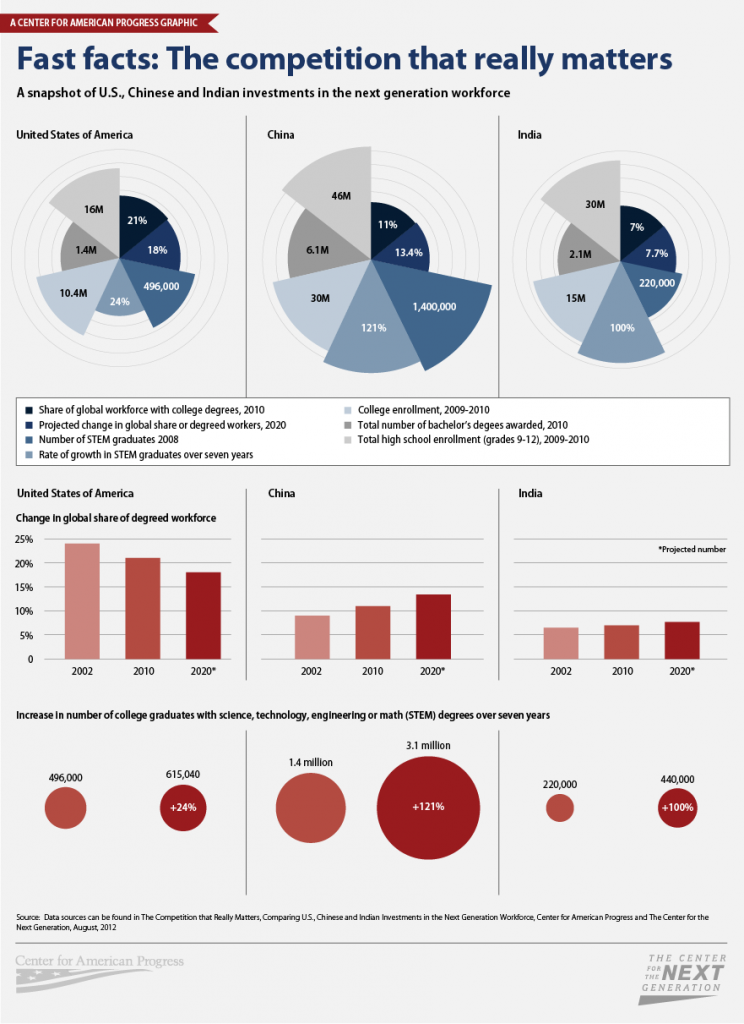
Since 2010, China is the world’s largest provider of higher education and ranks sixth in the number of its universities in the world’s top 500. By 2030, China will have graduated 200 college students, more than the entire US workforce. Teacher quality is also improving rapidly with already almost 2/3 of primary school teachers holding a higher degree. China has doubled the number of secondary school teachers to 6 million in 30 years and quadrupled the number of university level instructors.
While noting the many challenges facing China in terms of rising inequality, inferior educational quality in poor areas, along with insufficient access to schools in the countryside and among migrant workers, the report states: “China’s momentum and education-focused economic strategy will make the country increasingly competitive in sophisticated industries – precisely those where US workers now lead the competition”.
To help meet the challenge posed by China and India, the report recommends borrowing readymade ‘best practices’ from other developed countries to promote innovation and related strategies: The UK provides universal free preschool and has one of the best family support systems in the world that has served to improve child social behaviour, boost learning skills, and encourage family support for learning since the late 1990s. In terms of quality of teachers, Finland has refined a system in which top students become teachers and the profession highly selective, prestigious, and rewarding.
Germany’s federalization of education standards since 2000 has resulted in vast improvements in math achievement. Within 9 years, 17% of German students became competent in advanced math, compared to only 10% in the US. In addition, Germany’s ‘dual education’ system that focuses on the attainment of working experience, channels 2 million students into 3-year apprenticeships in over 400 occupations.
It has been 23 years since President George H.W. Bush convened the first National Education Summit with state governors that set in motion a more active federal role and inter-state cooperation in education. The authors call upon the incoming president to organize another summit to refocus on educational reform, particularly to raise teacher quality and effectiveness, provide state support for a national early education system, and integrate efforts with the goals of Common Core national education standards.
China and ASEAN to Set Up $474 Million Maritime Fund
Officials say China has offered a 3 billion yuan (US$474 million) maritime co-operation fund with the 10-member Association of Southeast Asian Nations, some of whose members have territorial disputes with Beijing.
Vietnamese Deputy Foreign Minister Pham Quang Vinh said China announced the fund Friday at the inaugural maritime forum of ASEAN and eight of its partners, including Japan, China, South Korea and the U.S.
Pham says ASEAN and China are discussing possible activities to finance. ASEAN and China co-operate in maritime issues including navigation safety, biodiversity and search and rescue.
– AP

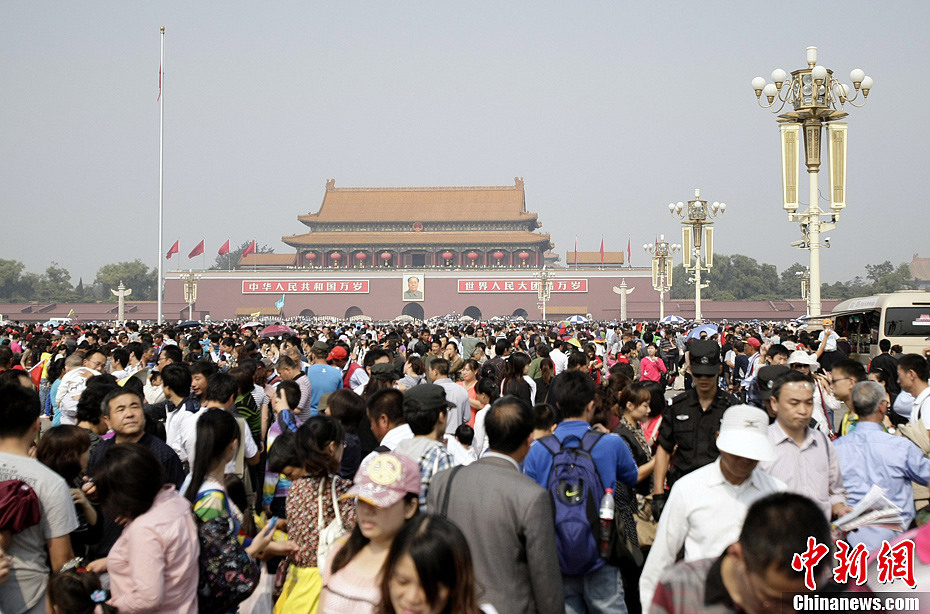
Wall to Wall People During National Day Golden Week
Is this fun?
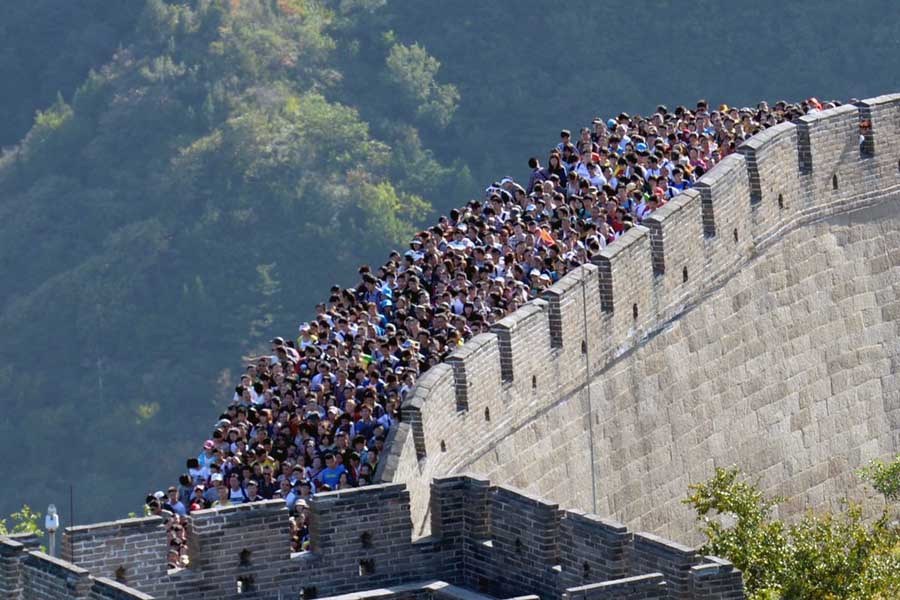
Chinese government departments and major corporations have already instituted paid leave for staff and the government has done away with the May Day Golden Week to allow employees more flexibility in taking holidays but because their children can only take leave on official holidays, parents are still forced to take vacations during those periods. The only way to avoid wall to wall people is to do away with golden weeks altogether and periodically provide days off at a stretch for school children.
Badaling section of the Great Wall a couple days ago
Tiananmen Square
‘Caught in the Web’ to be China’s Oscar Entry
It just may take Best Foreign Language Film next year. It’s a small-budget but must-see film about a minor incident whose accidental video went viral on the Internet demonizing a secretary leading to her suicide. It’s an indictment of sometimes vicious ‘human flesh searches’ in China.
Top Chinese film director Chen Kaige’s latest movie, Caught in the Web, a modern-day drama about cyber bullying, has been selected as China’s official contender for the Best Foreign Language Film award at the Oscars in 2013.
The film, adapted from an online novel of the same title and starring Gao Yuan Yuan, Yao Chen and Mark Chao, looks at how a woman becomes the subject of an online witch hunt after an episode in which she refuses to give up her seat to an elderly man on a public bus is secretly filmed and goes viral.
One of China’s most respected filmmakers, Chen Kaige is best known outside of China for his period dramas, including Farewell to my Concubine (1993), which received the Palme d’Or at the Cannes Film Festival.
This is the fourth time a film by the Chinese director has been selected to be China’s official Oscar entry in the Best Foreign Language Film category, the previous entries being Farewell to my Concubine (1993), Forever Enthralled (2009) and The Promise (2005). The last Chinese film that took home a foreign-language Oscar was 2002’s Hero, directed by Zhang Yimou.
According to the Chinese-language website news.cn, Caught in the Web, which was released in July in China, took in nearly 180 million yuan ($28 million) at the domestic box office, a record high for a Chinese art film in the country.
The movie received mostly positive reviews by movie critics in China, with many calling it the director’s best work after Farewell To My Concubine in 1993, reported Chinese-language news daily Takungpao.
– AFP