
Chinese Herbal Medicine May Help Patients with Lung Cancer, IPF, and Influenza
Chinese herbs, including JHQG, BFXL, and BFHX, may show significant benefits for patients with non-small cell lung cancer (NSCLC), idiopathic pulmonary fibrosis (IPF), and influenza.
In three separate studies, researchers from China Academy of Chinese Medical Science in Beijing analyzed the health benefits of Chinese herbs on patients with NSCLC, IPF, and seasonal influenza. Researchers found that JHQG helped to prolong survival in patients with metastatic NSCLC compared with patients receiving standard care; was safe and effective in the management of IPF and could also help improve patients’ quality of life and activity capacity; and helped to reduce fever in patients with influenza compared with placebo.
Researchers conclude that Chinese herbs could be used as an alternative treatment for the aforementioned conditions. This study was presented during CHEST 2012, the annual meeting of the American College of Chest Physicians, held October 20 – 25, in Atlanta, Georgia.
– news-medical.net
FT: Corporate Bond Issues and Services PMI Suggest Healthy Chinese Economy
Good analysis by James Kynge, editor of FT’s China Confidential, on two developments that are often neglected by Western economists as indicators of the health of the Chinese economy – mid-term corporate bond issues indicating corporate resiliency and the rise of the services Purchasing Managers’ index (PMI) as compared to lagging manufacturing PMI. Mr Kynge declares that there is little chance of a hard landing of the Chinese economy this year going forward. An inflection point has been reached and the new face of the Chinese economy is starting to appear.
Medium term corporate bond issues exceeded medium and long term bank loans by 31% to reach 200 billion RMB in September indicating a shift toward capital markets for financing. Moreover, services PMI reached 52%, well above manufacturing PMI of 47.5%. (Any number over 50.0 indicates an improvement while anything below 50.0 suggests a decline.) This suggests that the services sector is growing rapidly in China, overtaking manufacturing as the biggest employer by a increasingly wide margin. He suggests the National Bureau of Statistics may revise GDP figures to correct the traditional under-reporting of services.
http://video.ft.com/v/1911614365001/China-s-economic-health-remains-strong
Pew survey: Chinese Worried About Inflation, Food Safety and Corruption
In the run-up to the once-in-a-decade change in China’s leadership and the US presidential election next month, Washington-based Pew Research Center’s Global Attitudes Project released its survey of Chinese attitudes toward the quality of their lives along with their perceptions of other countries. Having skipped 2011 after four annual polls, Pew conducted face-to-face interviews with nearly 3,200 Chinese citizens, both urbanites and country folk, of all economic brackets last spring to come up with the results that, according to the pollster, have a margin of error of 4.3%.
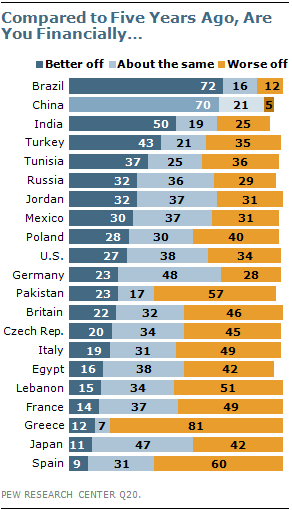
Respondents were overwhelming positive about advances in their standard of living. 92% said their lives are better than their parents’ at a comparable age, including 39% who said their lives were much better. Compared with their finances five years ago, only a small fraction (5%) said they were worse off while 21% said they are at parity, but 7 out of 10 saying they and their families are better off. Nearly 3/4 of the Chinese public believed they have faired better in a free market economy, an opinion that has remained basically consistent over the past decade since the first poll was conducted in 2002.
At the same time, Chinese citizens have become deeply concerned about inflation, with 60% rating it as a very big problem (albeit down from 72% in 2008). In the wake of food safety related scandals over the past few years such as melamine laced milk, contaminated foods, ‘gutter oil’, and others, food safety weighs heavily on the minds of Chinese citizens, up significantly to 41% from 12% in 2008. They were similarly concerned about the quality of manufactures and safety of medicines.
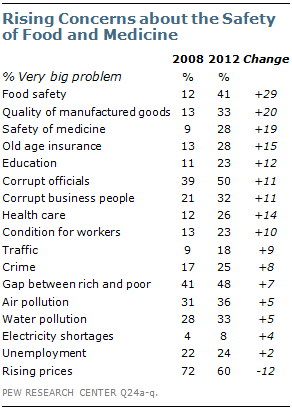
They Chinese public is also increasingly frustrated about official and business corruption (39% to 50% and 21% to 32% respectively) and the growing gap between the rich and poor (up to 48% from 41%). 8 of 10 Chinese believe the rich simply get richer and poor get poorer but a plurality (45%) still maintains that people can succeed if they work hard. Yet, a big minority (33%) says success is not guaranteed. Roughly half (51%) of all interviewees saw an active role for the state in helping the needy with 61% of those saying hard work is no guarantee of success expressing the same view, up 13% from 5 years ago.
As for Chinese views of major global powers, almost half (48%) held an unfavorable view of the US and the EU (50%) in contrast to positive views of Russia (58%). Those seeing China’s relationship with the US as cooperative is sharply down to 39% from 68% just two years ago while hostility has risen to more than a quarter of respondents (26%), up 8 percentage points.
They held the dimmest views for India and Iran (both 62% negative) and not surprisingly, under the backdrop of the ongoing territorial dispute over the Diaoyu Islands, their view of cooperation with Japan was very low (30%) with a significant plurality (41%) viewing the relationship as hostile. Their opinions of Pakistan (52% negative) were more or less on par with those for the EU.
As in previous polls, although people were more negative on the US than positive, they still admired certain aspects of Americana such as scientific and technological prowess (73%), democratic ideals (52%), American business (43%), American culture (43%), and the spread of American ideas in China (43%). With the exception of S & T capabilities and American-style business, which were both down from 2007, all other attitudes were up with younger people, those with higher education, better income and living in the cities holding more positive views.
In terms of its own image in the world, of 20 countries surveyed in a previous Pew poll last June, majorities or pluralities in 9 countries gave China the thumbs up, primarily among predominately Muslim nations and Russia. The reverse is the case in 6 countries including India, Japan, the US and the EU while opinions were roughly divided in another 5.
Big Showing of Canadian Schools at China Education Expo 2012
The China Education Expo 2012 kicked off yesterday in Beijing, attracting more than 500 overseas institutions and education bureaus from 38 countries and regions across the world, with new national faces stepping into the world’s largest recruitment market.
The number of national pavilions presenting their countries’ academic opportunities reached a record 21, including educational powers like Canada, the US, Britain, Germany and Spain, said Zong Wa, deputy secretary-general of China Education Association for International Exchange.
The annul expo wraps up its Beijing show on Sunday and moves on to tour six other major mainland cities (including Shanghai next weekend) before ending in Guangzhou on November 3.
Institutions from the UK and the US both numbered more than 80. And Canada, a longtime hot destination for Chinese students, had the most exhibitors with 94. The expo held at the China Exhibition Hall filled two floors, with schools from Canada and the US occupying the entire second floor.
About 20 regional education bureaus from Canada came to attract Chinese students for primary and high school education.
“Our schools already have a large number of Chinese students and there is not enough room. I think in the future we are going to select students, as opposed to recruiting anyone who applies,” said Shawn Silverstone, assistant manager of Surrey Schools international education department.
According to the Ministry of Education, the number of Chinese students studying abroad has seen an annual growth rate of 19.19 per cent, jumping from 118,500 students in 2005 to 339,700 in 2011. The number is expected to reach 400,000 this year.
– China Daily
Chinese to Live to Nearly 76 by 2015
The average life expectancy for the Chinese will reach 75.8 years by 2015, one year longer than the 2010 level, according to a health care development plan issued on Friday.
According to the 12th five-year plan for health care, a national medical and health system will be formed by 2015, allowing all Chinese to have access to basic public health care services. The plan also calls for substantially reducing the cost of doctor visits and enhancing the quality and efficiency of the medical service system, as well as boost public satisfaction with medical services and improve doctor-patient relations. The plan also calls for increasing the number of beds in non-public medical institutions to an amount equal to 20 percent of the total number of hospital beds in China.
To encourage more people to obtain medical insurance, China will raise annual subsidies for urban and rural residents from about 240 yuan (38 U.S. dollars) to 360 yuan by 2015, the plan says. The government will train another 150,000 general medical practitioners for local communities by the end of 2015, the plan says.
During the 12th five-year period, China will strive to develop non-public hospitals and medical institutions as well as consider social investment over government input. Enterprises, foundations and charities, as well as overseas investors, will be encouraged to run private clinics, according to the plan.
– Xinhua
Gaomi Officials Want to Transform Village After Mo Yan Nobel Win
Gaomi officials take the cake for economic opportunism.
——————————–
One week after Mo Yan became the first Chinese author to win the Nobel Prize, proud local officials rushed out a $110-million plan to transform his sleepy village into a “Mo Yan Culture Experience Zone.”
Until last week, the county of Gaomi in the eastern province of Shandong was a poor farming community. It was here that Mo ate tree bark and searched for wild vegetables to survive a tough childhood.
When reporters tracked down Mo, 57, to his family home, they found his 90-yearold father working the farm, unperturbed by the hullabaloo. But now, ambitious Communist party chiefs see a glorious future for the county as tourists flock to pay homage to the Nobel Prize winner.
On Tuesday, Fan Hui, a local official, paid a visit to Mo’s father to ask him to renovate the family home.
“Your son is no longer your son, and the house is no longer your house,” urged Fan, according to the Beijing News, explaining that the author was now the pride of China. “It does not really matter if you agree or not,” he added.
Fan has earmarked the family home as the main attraction of the Mo Yan Culture Experience Zone, but also has plans to create a theme park based on Mo’s 1987 work, Red Sorghum.
Unwanted and unprofitable, sorghum is no longer planted in the area, but this is not regarded as an obstacle.
Fan said the “Red Sorghum Culture and Experience Zone.” which includes the “Red Sorghum Film and Television Exhibition Area,” would encourage villagers to plant 640 hectares of the crop. “(We need to grow it) even if it means losing money,” he told the Chinese media.
He said the prize had been a boon. Without a mountain or a river, Gaomi had been too plain to be a tourist destination.
As Gaomi’s restaurants rush to add “Red Sorghum” to their signs, villagers have been instructed to raise a glass to Mo before meals, and Li Danping, a local poet, said the county was now “the higher ground of Chinese literature, the sacred land of the country”.
Mo’s books are widely sold-out and his fans are already descending in droves, suggesting there will be demand for the proposed development.
“One visitor dug up a radish (from Mo’s vegetable patch),” reported the Beijing News. “He slipped it into his coat and showed it to villagers afterwards, saying: ‘Mo’s radish! Mo’s radish!'”
“A visiting mother picked some yams and told her daughter, ‘I’ll boil them, so you can eat them and win the Nobel Prize, too!'”
Mo’s brother, Guan Moxin, was forced to intervene to stop the family’s corn harvest, which was left lying out in the sun to dry, being swept away by the village tidying committee.
Mo has been non-committal amid the excitement. Asked by China Central Television whether he was happy, he responded, “I do not know.”
Asked by Xinhua, the state news agency, whether his win would ignite a passion for literature in China, he said, “I think it will last for a month at most, maybe less, then everything will return to normal.”
He said he planned to use his $1.18-million U.S. prize money to buy a “big house” in Beijing. But then he realized that property prices have soared so high he could only afford a two-bedroom apartment.
His brother, however, suggested that he is unlikely to be thrilled at the plans for a tourist park. “He will oppose any renovations even though he has won the award. It is too public, people should be low key,” Guan said to a Chinese paper.
Mo’s wife, Du Qinlan, said the writer had not earned much money over his career, and his biggest treat is “a plate of dumplings’.
– Daily Telegraph
Qingdao Airlines to be Launched
China’s Qingdao municipal government is in negotiations with Air China (CA) and its subsidiary Shandong Airlines to launch Qingdao Airlines, according to Qingdao municipal transport committee deputy director Zhao Haibin.
According to industry analysts, the Qingdao government is seeking to partner with an established Chinese carrier as new Civil Aviation Administration of China standards for new entrants make it difficult to launch new carriers.
All major Chinese carriers have been forging closer cooperative relationships with local governments. Industry analysts say that subsidiaries enable China’s domestic carriers to receive cash support and enjoy favorable policies from different local governments.
China Southern Airlines last month launched Chongqing Airlines and entered into a joint venture agreement with government-owned Henan Civil Aviation Investment to launch a subsidiary, China Southern Henan Airlines Co.
– ATW Daily News
Unmanned Car Test Drive from Beijing to Tianjin
Chinese unmanned automobiles will embark on a test drive from Beijing to its neighboring city of Tianjin next year, covering a linear distance of some 120 km, according to the National Natural Science Foundation.
Without an onboard human presence, the vehicles are designed to perceive their environment, process it and respond accordingly with the help of GPS, ultrasonic radar and a variety of sensors.
In addition to the 2013 test, the vehicles are scheduled to undergo a longer test drive from Beijing to the city of Shenzhen in south China’s Guangdong Province, located some 2,400 km away, sources from the foundation said at a Thursday press conference.
– Xinhua
Photo Essay: Highway Changing Lives of Kyrgyz Nomads
Interesting pictures taken by Japanese photographer Go Takayama of former Kyrgyz nomads who are settling into apartment living along a planned highway in one of the remotest areas of far west Xinjiang Province.
CIC Interested in Canadian Resources and Infrastructure
China’s sovereign wealth fund China Investment Corp. is interested in investing in Canada’s resource and infrastructure sectors, a company executive told the official China Securities Journal.
CIC’s Toronto Chief Representative Felix Chee told the paper that CIC was most keen in Canada’s resource industry as the country has abundant mineral and petroleum resources. The investment company is interested in infrastructure projects as those are related to resource extraction and will help CIC retain a stable return on investment.
“Investment needs to be carried out at the right time, at the right price for the right asset,” Chee said.
Other areas of interest include manufacturing, technology and real estate, Chee said, adding that CIC prefers to find its own investment opportunities and invest early and quickly. CIC has a stake in an oil sands project with Canada’s Penn West Petroleum Ltd. In 2009, CIC took a 17 percent stake in Teck Resourcesfor C$1.74 billion ($1.77 billion).
– Reuters