
Canadian Agri-food’s Future in China
If Canadian agriculture doesn’t get its act together, its current status let alone growth in the booming Asian, and in particular, Chinese market, could fade, warned a recent paper from the Canadian Council of Chief Executives, a Ottawa based pro-trade group linked to the Liberal Party.
“Golden Opportunities and Surmountable Challenges: Prospects for Canadian Agriculture in Asia, penned by Michael Gifford, Canada’s former chief agricultural trade negotiator, notes that rising incomes, rapid urbanization, and growing populations in Asia are the main drivers behind spiking world agri-food demand in which China stands to become the single largest importer within the decade.
Shifting away from its export-led model to one based more on domestic demand, China (along with India and Indonesia) is climbing up the food ladder, consuming greater amounts of meats, fats, oils, and fruits. Not only does this bode well for global ‘rebalancing’ but creates abundant room for Canadian farmers and agribusiness to expand their presence.
With mounting strains on arable land and water resources, China increasingly relies on imports of feed grains and oilseeds, crops that Canadians excel at producing. Over the 2006-2010 period, Mr Gifford writes, Canada improved its share of the Chinese import market from 3% to 4-5% due to exports of oilseeds, primarily rapeseed/canola and canola oil, that accounted for roughly 3/4 of all Chinese agricultural imports.
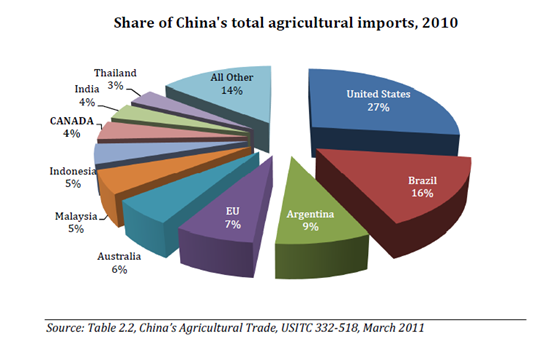
Reproduced from “Golden Opportunities and Surmountable Challenges”
Canada exports 90% of its oilseed crop which explains why canola production in the Prairie provinces has replaced wheat as the most valuable and the main reason why Canada is keeping pace in China agri-food trade. Wheat, on the other hand, has faired poorly in recent years. From 60% of wheat exports to China in the 1960s, Canadian exports there plummeted to zero in 2008 and to less than $150 million in 2010. Canada’s total food and agricultural exports to China nearly topped $3 billion that year.
Whether Canada will be successful in maintaining and growing its share of China’s agri-food import market depends not only on China’s agricultural policies that put heavy emphasis on self-sufficiency, but just as importantly, on future international trade agreements. China has already signed a number of free trade agreements with ASEAN, south Asia countries, and significantly for Canada and other Western exporters, with New Zealand. The agreement, signed 4 years ago, the first with a Western nation, provides preferred trading status in dozens of goods and services as well as eventual duty-free access for New Zealand dairy products.
Of much greater concern to Canada would be an agreement between Australia and China since Australia is a direct competitor on a number of agricultural fronts. Negotiations toward a pact are currently deadlocked but should the kinks be hammered out, preferential access for the Australians would come at the cost of Canadian grain, oilseed, and meat exports.
Prospects for a free trade deal between Canada and China were raised in a joint statement during Prime Minister Harper’s visit to China last February that committed the two countries to completing a joint economic study by May. But, speaking to the press, Trade Minister Ed Fast remarked that Canada was taking things one step at a time. “We’re not going to get ahead of ourselves…Our end game is to deepen our trade relationship in one of our key priority markets.”
Mr Gifford argued that the agricultural sector would further miss out if the federal and provincial governments remain paralyzed from allowing limited trade liberalization in certain import-sensitive industries, notably, poultry and dairy products. ‘Supply-management’ protection for milk and eggs, for instance, has become a major area of contention in Canadian talks to join the US initiated Trans-Pacific Partnership (TPP). The Harper government has pledged continued support for the status-quo in a bid to appease Quebec where Canada’s dairy industry is based, but privately, some officials have suggested room for compromise for the sake of TPP.
Mr Gifford concludes: “If Canadian agricultural producers are to maximize their export potential in Asia, they cannot allow themselves to be placed at a comparative disadvantage compared to other exporters. The most urgent trade policy challenge, therefore, is to ensure that Canada is not locked out of preferential trade agreements that will increasingly shape the future of trade in the Asia Pacific region….The rise of China, India, and other emerging markets has dramatically changed the outlook for Canadian farmers and agricultural producers.”