
America’s Love-Hate for China
A couple weeks ago, I put up a post on Washington-based Pew Research Center’s survey of Indian attitudes toward their country’s economic direction and other countries, notably China. Last week, Pew came out with its annual study of American attitudes about China and the Chinese. The poll, done in collaboration with a number of US and Chinese think-tanks, interviewed a thousand ordinary Americans as well as over 300 foreign affairs specialists last May.
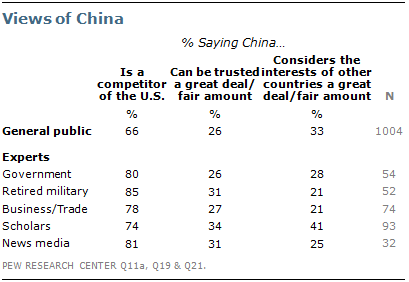
The results, similar to previous efforts, showed persistent American love-hate opinions of China. The good thing is that 2/3 of Americans see the bilateral relationship as good and China as a formidable competitor rather than a sworn enemy (15%). This perception is particularly widespread among college graduates (78%) and those with some college experience (67%). It is similarly strong among experts (nearly 80%), with the rest going a step further to say that China is an actual partner. Virtually no experts labeled China a foe.
This compares with a China Daily/Gallup poll of over 2000 US citizens conducted in late 2011 that found Americans nearly split in their overall view of China – 42% favorable and 44% not, with the rest expressing no opinion. Similarly, 45% saw China’s growing economy as a good thing while 48% said the opposite. Despite the mixed results, the vast majority (71%) acknowledged that strong relations between the two countries are important and 81% saw a close relationship with China as a “good thing”.
At the same time however, in the Pew survey, 68% of the general public felt China could not be trusted with only 1/4 (26%) holding the contrarian view. In the untrustworthy column, China shared low rankings with the US’s Middle-Eastern allies like Saudi Arabia but faired much better than US partner-in-anti-terror Pakistan. Mistrust also featured large in US expert opinion (65%) of China. Significantly, however, young Americans under 30 tended to view China in a more positive light than older, with 43% saying China is trustworthy.
It is interesting to contrast this with Chinese views of America and Americans. Also late last year, China Daily and Horizon Research Group surveyed 1,464 Chinese residents in seven major cities to find about 50% with a good impression of the US, a 15% decline from 2009. But, similar to the Pew poll, over 90% said China-US relations are important.
At the same time, more than 2/3 saw the US as the main culprit in bilateral problems but 10% more people than the previous year saw both countries as being responsible. The respondents used 5 key words/phrases to describe America’s national image: hegemony, developed economy, China-US relations, freedom and democracy, and war and military. More than 70% said American culture has a positive impact on China and high-tech products, movies, universities and sports defined American culture.
Commenting on the results, Ms Xiong Lei, a former Xinhua News Agency senior editor and panelist on a China Daily’s Digest China segment discussing Sino-US ties, reflected, “Especially Chinese younger generations born after the 1980s and 1990s can be more confident in handling the relationships between the two countries than the older generations, because they grew up in a stronger economy. With this confidence, they can be more independent in thinking”.
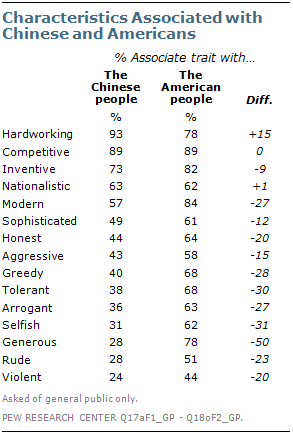
Meanwhile, in the PEW study, at least 7 in 10 Americans ascribed to Chinese people those very attributes they take pride in themselves – hardworking (93%), competitive (89%), and inventive (73%). They were also less inclined to attribute certain negative traits to the Chinese people than to themselves – aggressiveness (43%), greed (40%), arrogance (36%), selfishness (31%), rudeness (28%), and violence (24%).
Max Fisher, a columnist for the Atlantic Monthly wrote, “‘They are quiet, peaceful, tractable, free from drunkenness, and they are as industrious as the day is long,” Mark Twain wrote in his 1871 book Roughing It reinforcing some of the same racial stereotypes – positive, yes, but stereotypes nonetheless – that may still linger in American perceptions of Chinese today”.