
Asia’s best managed companies: China and Singapore
By FinanceAsia Editors | 17 May 2011
We reveal the results of our annual poll to find Asia’s top companies.
Today, China and Singapore.
We have tallied votes from more than 300 investors and analysts across the
region for our 11th annual poll of Asia’s top companies. The remaining
results will be published during the course of this week, before finally
revealing which companies are viewed to be the best managed in the region
in 10 key industries.
CHINA
Best managed company Votes
1 China Telecom 100
2 Lenovo 64
3 China Mobile 35
4 Sinopec 31
5 Tencent 21
6 Baidu 16
7= CCB 9
7= Alibaba 9
9= Comba Telecom 8
9= AAC Acoustic 8
Best corporate governance Votes
1 China Telecom 100
2 Lenovo 63
3 China Mobile 42
4 CCB 21
5 Tencent 20
6 Baidu 12
7 Sinopec 11
8= Comba Telecom 9
8= AAC Acoustic 9
Best investor relations Votes
1 China Telecom 105
2 Lenovo 65
3 China Mobile 42
4 ICBC 18
5 Sinopec 17
6 Tencent 15
7 China Unicom 14
8 Baidu 10
9= AAC Acoustic 9
9= TCL Tech 9
Best corporate social responsibility Votes
1 China Telecom 73
2 Lenovo 55
3 China Mobile 38
4 Tencent 19
5 AAC Acoustic 12
6 China Overseas Land and Investment 11
7 Comba Telecom 9
8= China Unicom 8
8= Baidu 8
Most committed to a strong dividend policy Votes
1 China Mobile 62
2 China Telecom 49
3 Lenovo 42
4 Comba Telecom 13
5 Sinopec 12
6 China Overseas Land and Investment 11
7= CCB 9
7= Tencent 9
9 China Unicom 7
Best mid-cap Votes
1 Comba Telecom 27
2 Focus Media 15
3 Haitian International 10
Best small-cap Votes
Not awarded
Best CEO Votes
1 Wang Xiaochu (China Telecom) 74
2 Yuanqing Yang (Lenovo) 32
Best CFO Votes
1 Wu Andi (China Telecom) 59
2 Wong Wai Ming (Lenovo) 32
Rise of China top news of the century
Media coverage related to the rise of China tops the biggest world news story list of the 21st century, according to a study released on Thursday.
The survey by the Global Language Monitor said the biggest news story around the world since January 2000 remains the rise of China as an economic and political power.
The China story has about 300 million citations to date, followed by the election of Obama to the US presidency with 123 million.
The British royal wedding has also become one of the top 10 news stories, but has already been eclipsed by media coverage of the death of Osama bin Laden.
Less than a week after US President Barack Obama announced that US forces had killed the al Qaeda leader in Pakistan, the bin Laden story had racked up more than 84 million citations in the global print and electronic media, social media sites and on the Internet.
The Global Language Monitor said the death of bin Laden was already the third biggest world news story of the 21st century.
By contrast, the April 29 marriage of Prince William to Kate Middleton ranked in 5th place with more than 63 million citations worldwide, ahead of the media blitz surrounding the 2009 sudden death of Michael Jackson with about 56 million.
The Texas-based Global Language Monitor (GLM) used an algorithm to track citations of the biggest news stories on the top 750,000 world print and electronic media sites, as well as citations on the Internet, blogosphere, Twitter, Facebook and other social media sites.
The top 10 news stories of the 21st century, according to the GLM are;
1) The rise of China
2) Election of Barack Obama
3) Death of Osama bin Laden
4) Wikileaks
5) British royal wedding
6) Death of Michael Jackson
7) Sept 11. 2001 attacks on the United States.
8 ) Japanese quake/tsunami/nuclear crisis
9) Arab Spring uprisings
10) Global economic meltdown
Source: chinadaily.com.cn/agencies
Billionaires
China Drives Growth in World’s Billionaires
On this year’s Forbes list of 1,210 billionaires, China nearly doubled its count to 115 not including Hong Kong and Taiwan, with BRIC countries producing half of the world’s 214 new listees, more than doubling last year’s 97 newcomers. However, China still trails far behind the US’s 413, which rose by 10 over 2009. China’s gains helped to push Asia-Pacific’s total to 332 billionaires, shooting past Europe’s 300.
Forbes commented the growth in China’s super-rich is the result of three decades of incremental market liberalization that has granted “more protection to private enterprise, creating a sound base for entrepreneurs to seize opportunities and build on success”. The story of Robin Li, charismatic young co-founder and Chairman of Baidu, China’s premier search engine and China’s new No.1 at US$9.4 billion, is a testament to the transformation of Chinese society by the Internet, wrote Forbes. His emergence symbolized the rise of a generation of internationally savvy, highly educated private business leaders.
Also sitting pretty in the top 200 were Liang Wengen, co-founder of heavy machinery colossus Sany, 114th with net worth of US$8 billion, and Zong Qinghou, the legendary Chairman of leading beverage company Wahaha Group, who came in at 169th with US$5.9 billion. Ma Huateng, Chairman of Tencent, whose wealth totalled US$5 billion, held the 208th spot while NetEase CEO William Ding finished 440th with US$2.6 billion. The last spot in the top 1,000 is held by Yu Minhong, founder and President of New Oriental Education and a newcomer. Other new inductees from the mainland include Han Junliang, Chairman of Sinovel Wind, Ma Xingtian, head of Kangmei Pharmaceutical, Zan Shengda of Jiangsu Yanghe Brewery, and Hui Lin Chit, Chief Executive of Hengan International.
Hong Kong claimed 36 listees with richest man, Li Ka-shing, leading the pack. His wealth surged US$5 billion to US$26 billion, making him 11th. As well, 25 Taiwan billionaires made the list, to help total 176 for Greater China. The top three giants remained Mexican telecom tycoon Carlos Slim Helu (US$74 billion), Microsoft’s Bill Gates (US$56 billion), and investment wizard Warren Buffett (US$50 billion).
– Forbes, China Daily, Bloomberg Businessweek, Reuters
Major Strides in China’s Higher Education
Major Strides in China’s Higher Education
Over the past five years, China has graduated 34.3 million students from its universities, more than the total in the 20 years before 2006, disclosed the Chinese Ministry of Education spokeswoman last month. The Ministry has set some lofty goals for 2020 to “…modernize education, shape a learning society, and turn China into a country rich in human resources”. Last year, there were about 31 million students enrolled in China’s institutions of higher learning and within a decade, this figure will reach 35.5 million. There were also 1.5 million graduate students along with about 5.4 million adult undergraduate students. Noting these numbers and trends, Mr Richard Levin, President of Yale University, described the expansion as the fastest in human history.
The number of foreign student registrations in China’s universities is similarly fast on the rise. In 2010, a total of 265,000 students from 194 countries enrolled in China, led by South Koreans, Americans, and Japanese. Thailand, Vietnam, Russia, Indonesia, India, Kazakhstan, and Pakistan round out the top ten source countries. The Education Ministry seeks to attract 500,000 students by 2020 as the US and China pledged to bring 100,000 Americans to study in China over the next four years. At the same time, almost 285,000 Chinese study abroad, more than 1/3 in the US. Last year, the Education Ministry and provincial education departments offered a combined 910 million RMB (US$138 million) in scholarships to 22,400 recipients. In addition, nearly 300 Confucius Institutes have been set up around the world to spread Chinese language and culture.
The quality of China’s elite universities has been rising quickly in international rankings. In the QS Quacquarelli Symonds 2010 ranking, one of the most authoritative released last autumn, Peking University placed 47th and Tsinghua University 54th, beaten by the top three Hong Kong institutions, University of Hong Kong (23), Hong Kong University of Science and Technology (40) and Chinese University of Hong Kong (42). In the Thomson Reuters rankings that came out about the same time, Peking U. placed 37th, University of Science and Technology of China 49th, ahead of Tsinghua U. (58th). A decade ago, mainland Chinese universities were nowhere to found in the top 100.
Interestingly, however, in Shanghai Jiaotong University’s Center for World-Class Universities 8th ranking last summer, China’s most authoritative, Peking University and Tsinghua University ranked considerably lower, within the tranche of institutions from 151st to 200th. Shanghai Jiaotong uses criteria such as number of Nobel prizes and Fields medals won by staff and alumni, the number of highly cited researchers, and the number of articles published in Nature and Science magazines. It seems that with the dearth of Chinese Nobel laureates and less frequent international journal citations, the rankings of mainland universities were severely affected.
Yet, in actuality, since the inauguration of the Ministry’s education and research revival plan 13 years ago, the number of Chinese scientific papers as a percentage of the world total has risen from 3.05% in 1999 to over 8% in 2008 and the pace is increasing. In terms of secondary education, the quality of Chinese learning has improved dramatically. In the latest Program for International Student Assessment (PISA) tests of 15 year olds around the world, students in Shanghai beat all other countries/regions in math, reading and science. The US ranked 31st, 17th, and 23rd respectively, causing President Obama to invoke the Sputnik analogy in a pitch to increase math and science education spending.
Chinese students spend less time than their American counterparts on athletics, music and other extra-curricular activities. In addition, teaching salaries have risen sharply in China and Shanghai educational authorities have undertaken curricular reforms, allowing more freedom for experimentation. Although Shanghai is not representative of all China, educators close to the tests predict that within a decade, most Chinese cities will equal Shanghai test scores. A former US Department of Education Official under the Bush Administration had been sceptical of PISA results but now considers them ‘unassailable’. He added that the results refute the commonly held hypothesis that China merely produces rote learning.
– Xinhuanet, BBC, NYT, People’s Daily Online, AP, AFP, world university rankings by QS Quacquarelli Symonds, Thomson Reuters, and Shanghai Jiaotong University
China to Become No.1 Tourist Nation
China to Become No.1 Tourist Nation
Tourism is good for both China’s transition to domestic consumption and a service- based economy as well as for efforts to improve its international image or ‘soft power’. Within 5-7 years, the country will become the world’s biggest tourism market both inbound and outbound, predicted Mr Taleb Rifai, head of the UN World Tourism Organization (UNWTO).
The deluge of world news coverage about China over the past decade has piqued the interest of global travellers, prompting Western travel and lodging companies to gear up for a piece of the rapidly expanding pie. Tour operators such as Thomas Cook and Club Med are eyeing acquisitions, opening resorts in China, and greatly expanding tour and resort offerings abroad. Already the biggest international hotel chain in China, the International Hotels Group (IHG) has more hotels in Shanghai than in New York and is planning to double its presence in China to over 250 hotels within five years.
The competitiveness of China’s tourism industry has improved markedly, leaping from 62nd to 39th place in just four years, according to a recent ranking by the World Economic Forum. Last year, the number of outbound Chinese tourists ranked third in the world and China has made major tourism and infrastructure investments at home. The report recommended further improvements in environmental protection with a strong focus on sustainable tourism. The top 10 countries named in the survey are Switzerland, Germany, France, Austria, Sweden, the K, the US, Canada, Spain, and Singapore in that order.
In terms of travel infrastructure, China plans to invest more than 1.5 trillion RMB ($228 billion) in the aviation industry over the next five years to keep up with swelling demand. The head of China’s Civil Aviation Administration of China (CAAC) said by 2015, China will operate more than 220 commercial airports and a fleet of over 4500 aircraft. Currently, China has 175 commercial airports, many in the red, and keeps 2600 planes. Within five years, Chinese travellers could make as many as 500 million air passenger trips annually, almost doubling trips made last year.
– Telegraph, People’s Daily Online, Manila Bulletin, and Reuters
China’s M&As and IPOs
China’s M&As and IPOs
Following strong performance over recent years, China’s M & As will continue to surge in 2011, accounting for 8-9% of global M & As, said the head of JPMorgan’s M & A unit. Last year, China’s inbound and outbound M & A deals totalled US$236 billion out of the world sum of US$2.8 trillion, or just over 8%. In the five years between 2003 and 2007, China’s M & As represented only 2-4% of global activity but shot up to a peak of 9% in 2009 due to relative inactivity abroad in the wake of the financial crisis, according to data analysis consultancy Dealogic.
This year, China’s domestic M & As should remain strong in consumer retail, real estate, healthcare, and chemicals and industrials while outbound M & As will be similarly upbeat on the heels of a record-setting year of US$54 billion in 2010. In 2008 and 2009, often small and taking only minority stakes, deals in mining, telecom, utilities, and financial services topped the list of outbound Chinese M & As. JPMorgan handled the largest volume of China’s overseas deals last year @ US$11.1 billion followed closely by Credit Suisse with US$10.7 billion.
Jack Perkowski, founder and Managing Director of JFP Holdings, a China-oriented merchant bank, explained to Forbes magazine why it has taken so long for Chinese industrial firms to venture abroad. First of all, and historically, they simply lacked cash, especially forex to invest abroad. Second, they faced the daunting challenge of managing operations in unfamiliar territory and vastly different cultures, sometimes proving to be more challenging than for US or European companies entering China.
Third, the shock of the financial crisis initially made Chinese companies reticent about going overseas. But much has changed in two short years. Chinese companies are now awash in RMB and forex from their own operations and they can easily raise funds on the Chinese A-share market, leveraging valuable real estate, and/or borrowing from the banks. In addition, transnational financial institutions are now more than willing to support Chinese firms’global forays.
In terms of IPOs, bourses on the mainland and Hong Kong are expected to continue setting the pace in global IPOs this year, forecast Ernst & Young’s Global IPO Trends Report 2011. In the first two months alone, the Shanghai and Shenzhen stock exchanges have raised a combined US$10.5 billion through 51 IPOs.
Fast becoming a cross-border platform for Chinese companies, the Hong Kong Stock Exchange continues to attract listings, particularly natural resource companies, to raise more than US$50 billion this year. Although Chinese state companies will lead the charge, many small and medium-sized consumer, infrastructure, clean technology and pharmaceutical firms are also hopping on the bandwagon.
– China daily, Forbes on Chinadaily BBS, Shanghai Daily, and businesswire.com
China’s Car Market Continues to Boom
China’s Car Market Continues to Boom
Driven by unprecedented urbanization, car ownership in China has risen from 1% to 13% over the past decade. In major cities such as Beijing, car ownership exceeds 30% per 100 households. Total sales rose from just over 2 million units in 2001 to 13.8 million units last year, according to the China Association of Automobile Manufacturers (CAAM). By comparison, US auto sales rebounded 11% to nearly 11.6 million vehicles, reversing a four-year slide. Overall vehicle sales, including trucks and buses, reached 18.1 million units, an increase of 32.4% year-on-year, spurred by tax incentives for small cars and rebates for farmers who traded their jalopies for more fuel-efficient models.
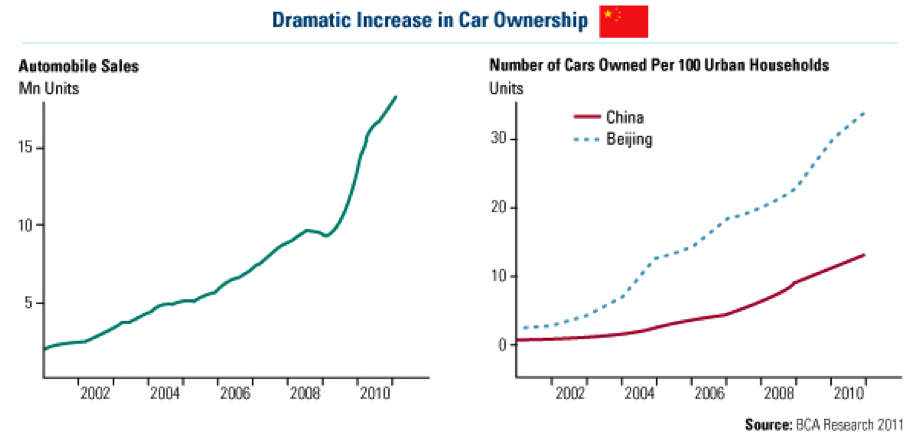
However, rising fuel prices, the scrapping of tax incentives, and measures to ease massive traffic congestion are putting a damper on car sales this year. The new vehicle registration quota of 240,000, 1/3 of the 2010 total, introduced early this year in Beijing and Shanghai’s measures to restrict out-of-town vehicles, for example, have helped bring down sales to 965,238 units in January, a moderate rise of 12.6% over the same period in 2009. Nonetheless, industry analysts and auto executives see car sales continuing to grow at a slower but more rational rate (for China) of 10-15% this year due to rising urban incomes and the largely untapped but potentially lucrative inland rural markets as well as third and fourth tier cities and counties.
Foreign automakers continue to dominate the market with General Motors setting the pace along with a major milestone. For the first time in its 102 year history, GM has sold more cars and trucks in China last year than it did in the US with a tally of 2.4 million vehicles. Its closest rival was Volkswagen, which makes only cars in China, sold 1.9 million units, including 228,000 of its best selling brand Audi. Korean makers Hyundai and partner Kia raked up 1 million as did Japan’s Nissan.
In spite of recurring labour disputes and embarrassing recalls, Toyota and Honda reported gains of 19% and 12.2% respectively. Ford, a late-bloomer on the China market, leaped 40%, ahead of all foreign makers. Six of the top nine sellers in January were joint ventures between foreign brands and Chinese companies. Meanwhile, domestic automakers are making major inroads too. Chery Automobile sold nearly 50,000 cars in January and BYD Automobile, a battery maker turned legendary car manufacturer supported by US billionaire Warren Buffet, did likewise although it missed its sales target for 2010.
– Reuters, AP, and Business Insider
China’s National Debt
China’s National Debt
China’s central government debt does not pose a systemic risk said an official from the UN’s Department of Economic and Social Affairs. China’s official data, basically corroborated by CIA estimates, indicates that its public debt stood at more than US$1 trillion dollars at the end of 2010, representing approximately 17% of GDP. Unlike European countries, China’s debt is mainly held by its citizens and domestic institutions, akin to the situation in Japan. But, the official added that China’s high savings ratio, the highest in the world and as high as 50% in places, assures the sustainability of central government debt.
On the other hand, however, the UN economist stressed that public debts of local governments are reaching critical levels, topping a staggering 2.8 trillion RMB by the end of 2009, in some localities, exceeding three times of fiscal revenue. A Northwestern University political scientist puts the estimate closer to US$1.7 trillion, more than twice the official figure of US$771 billion for 2010.
Local governments have set up financing vehicles to fund enterprises and infrastructure projects along with guaranteeing up to US$1.9 trillion in credit lines for local firms. Although these figures cited by the US based scholar are disputed, even official figures indicate the extent of indebtedness at the grassroots. Central authorities have since come down hard on local lending and banned government loan guarantees. Chairman Liu Mingkang of the CBRC said the CBRC would keep close tabs on risks brought on by local government financing vehicles over the next 3-5 years.
The CIA World Factbook’s 2010 ranking of public debt around the world puts Zimbabwe at top with debts of 241.6% of GDP, closely followed by Japan with 225.8%. The debts of Iceland, Italy, and Singapore all exceed 100%, those of Belgium and Ireland are in the 90%+ bracket, and France, Germany and England are between 76% and 84%. India is at nearly 60% while in Greater China, Taiwan sits on nearly 40%, Hong Kong 18.2% and mainland China 17.5%. Among large economies, Russia’s debt remains very low at less than 10%.
However, the Factbook’s estimate of US debt at nearly 60% discounts huge amounts held by foreign governments. This creates a misperception especially when the federal budget deficit is approaching the Congressional debt limit of US$14.3 trillion, which is well over 90% of GDP. By the end of the end of 2011, if Congress doesn’t shut down, that figure will exceed 100%, not counting municipal and state debt.
People’s Daily Online, chinaeconomicreview.com, and CIA World Factbook
China’s Banks Safe from the Housing Bubble
China’s Banks Safe from the Housing Bubble and China as No.1 Construction Market
Liu Mingkang, Chairman of the China Banking Regulatory Commission (CBRC), declared that Chinese banks faced little risk should a property bubble burst since only a small portion of their lending went to homebuyers. Moreover, mortgages in China are backed by sufficient down payments and total lending volume remained limited, he said. Last August, the CBRC demanded Chinese bank stress tests for up to a 50% fall in real estate prices in key cities. A state bank executive commented recently that Chinese banks could withstand a 40% plunge in prices. PBoC data indicate that new RMB denominated lending in February stood at 536 billion RMB (US$81.5 billion), lower than market estimates while M2, the broadest measure of the money supply, rose 15.7%, the smallest increase in over 2 years.
Last year, China crossed another major milestone, surpassing the US as the world’s largest construction market with a global share of 15%, 1% ahead of the US. A UK report forecasting trends to 2020 showed that housing construction accounted for 57% of all in China. More important, government measures to rein in real estate and build low-cost housing are exerting a palpable effect against the housing bubble.
Worldwide, China, India and the US will generate more than half of the growth in housing construction by 2020, which will rise 2/3 (by US$4.8 trillion) from US$7.2 trillion today. These three countries in combination with Indonesia, Canada, Russia and Australia will account for 65% of global construction growth by the end of the decade.
– China Daily/ANN and ENR.com
China Cools Real Estate
China Cools Real Estate and Builds Low-income Housing
China’s central government has taken a number of measures to curb property bubbles cropping up across its major cities, including limits on purchases, hiking interest rates, and raising bank reserve ratios. In addition, Chongqing and Shanghai have introduced property taxes with housing authorities in the capital waiting in the wings.
Beginning last month, these measures have started to pay off as prices saw declines along with a slowdown in growth. In a recent survey by the National Bureau of Statistics (NBS), 8 out of 70 cities surveyed registered month-to-month declines while 44 cities witnessed slowing growth trends. In Beijing, new housing prices rose by 6.8% in February, on par with the previous month while prices in Shanghai grew by 2.3% year-on-year, up from 1.5% in January. Until most recently, home buyers had rushed to acquire units over fears of more measures in the pipeline.
At the same time, however, government measures have also served to shut out first-time buyers and pushed up rental prices by about 12% in the first two months. In the longer run, rental prices should level out as more property owners choose to lease while waiting for better times to sell. But, the message is clear: speculators must not be able to profiteer at the expense of the average citizen.
It is with the interests of the general public in mind that the Housing Ministry announced 10 million apartments will be built or renovated for low-income earners this year at a cost of 1.3 trillion RMB (US$198 billion). Governments at all levels will provide more than 500 billion RMB with the remainder raised by companies and households who will benefit from the program. The authorities will also introduce favourable policies such as preferential loans, subsidies, and tax incentives to support construction.
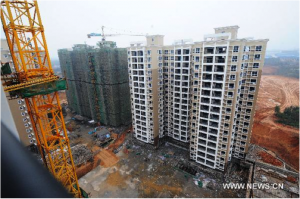
Affordable apartments being built in Changsha, Hunan Province, March 18, 2011. Hunan plans to boost affordable housing to 416,200 units this year from 2010's 262,700, including 261,100 refurbished houses for shantytown residents.
Premier Wen in his ‘state of the nation’ speech to mark of the opening of this year’s NPC sessions, underscored the government’s commitment to stabilizing prices, warning local officials who fail to do so and do not promote low-income housing construction will be held accountable. The Ministry of Housing further announced that in conjunction with other central ministries, it would monitor local construction plans and carry out inspections across the country during Q3. Last year, the government fell short of its target of building 5.8 million affordable homes.
– channelnewsasia.com, Yahoo News, China Daily, People’s Daily, and AFP