
A Couple Iconic New Buildings in China
Galaxy Soho Building, Beijing

(Photo: Hufton + Crow)
Given China’s reputation for bold and speedy construction, it’s no surprise that 2012 marked the arrival of this cool new building in the capital city of Beijing. Designed by Iraqi-British architect Zaha Hadid—the first woman to be awarded the Pritzker Prize—this 18-story office, retail, and entertainment complex consists of four domed structures connected by bridges and platforms, crafted from aluminum, stone, glass and stainless steel. Inspired by nature, the flowing lines and organic forms create a lusciously harmonious effect.
Ordos Museum, Ordos, Inner Mongolia

(Photo: Iwan Baan)
The copper-toned metal exterior and undulating shape of the Ordos Museum reflect the surrounding Gobi Desert of Inner Mongolia. It’s the brainchild of the Beijing-based architectural firm MAD, known for fluid designs and imaginative urban solutions. The company intended the large-scale museum as “the irregular nucleus” for Ordos, a newly developed town that, as of 2011, already has its first architectural icon.
Canadians Should Not be Fickle About Chinese Investment
The previous post rebuked a Business in Vancouver denunciation of CNOOC’s takeover of Nexen. The harangue also attacked University of Alberta professor Jiang Wenran for stating the obvious: “Canada is not the only game…there are places where the speed of projects is much more efficient and the returns much more profitable than the Canadian market…In other words, we will be fooling ourselves if we think Canada is the only dinner party in town and that the Chinese would stick around with only an appetizer’s tasting after we have invited them to buy a full dinner ticket”. This is taken by the author as a “silken threat” from “Chinese economic imperialism”.
Natural Resources Minister Joe Oliver has said development of Alberta oil sands would create 140,000 jobs and more than $600 billion in economic activity over the next 25 years but Canada does not have the financial wherewithal to achieve that by itself. As a Financial Post points out, Canadian companies are not stepping up the plate due to their inability to adjust to new market conditions and formulate a vision forward.
A major problem is the lack of new pipelines to rising markets in Asia, particularly China (Northern Gateway), and the US (Keystone XL). Tight pipeline space depresses oil prices while the oil sands are under constant attack from the environmental lobby and the First Nations, not to mention oppositionists in parliament. This forces Canadian companies to sell assets to or seek joint ventures with willing foreign partners like Chinese SOEs.
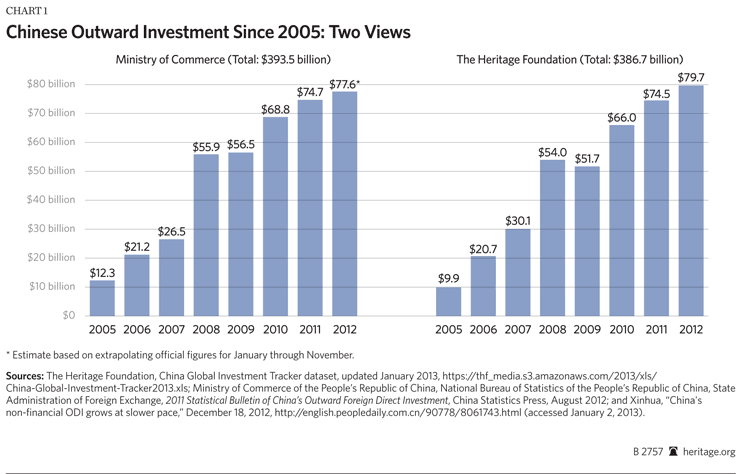
The conservative Washington-based Heritage Foundation’s public dataset of Chinese outward investment The China Global Investment Tracker has followed over 400 Chinese investments of $100 million or more from 2005 through 2012. The graphs below compare Chinese Ministry of Commerce figures with those compiled by Tracker scholar Derek Scissors, both of which show revived growth in Chinese outbound FDI since the 2008 financial crisis.
 According to the Tracker, the leading recipients of Chinese investment over the past 8 years have been Australia and the US followed by Canada, Brazil, Britain, and Indonesia. Last year, Canada topped the list thanks to the CNOOC takeover and North America as a whole attracted 40% of Chinese investment. Since 2005, North America has drawn the most Chinese investments followed by sub-Saharan Africa with energy leading the way in both direct investment and engineering and construction contracts. After energy is metals with finance not surprisingly stagnating over the past few years.
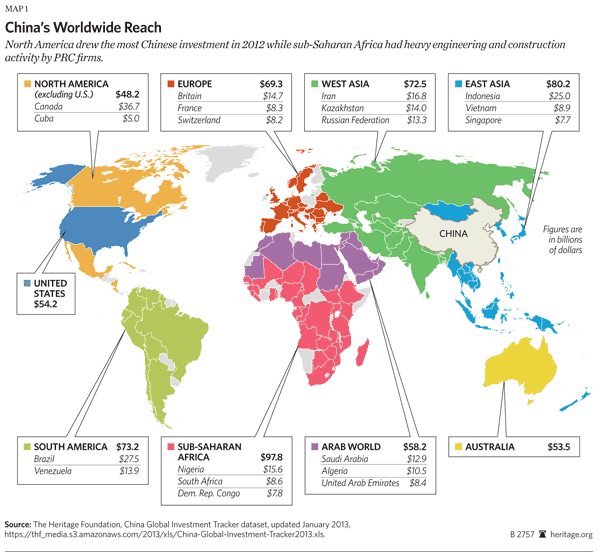
Although the current focus is North America and particularly Canada, Mr Scissors detects a pattern of Chinese SOEs and others moving in packs across continents. During the mid 2000s, large amounts of funds started moving to Australia but toward the end of the decade, sub-Saharan Africa received a spurt of investment before shifting to South America in 2010-2011. He predicts that if the form hold, Chinese investment should continue to stay in North America for most of 2013 but by year end could flow to other destinations such as Europe (depending how the debt-crisis plays out) and the oil producing states in West Asia.
Thus, Canadians must not be fickle about Chinese investment in Canada, allowing political opposition to hijack projects that benefit both countries. Talking to reporters last December following the announcement of new government guidelines for foreign SOE investment, Hou Hongbin, chairman of Sinpopec Daylight Energy, commented: “I think we need a little bit of time to understand fully the new rules, such as exceptional circumstances, which still puzzles me a bit”.
He added that Chinese SOEs will still consider joint ventures in the oil sands but Canada is competing with many other countries for Sinopec’s capital. “We only invest in commercially oriented projects…it all depends on commercial evaluation”, he underscored.
Rant Against “China’s Economic Imperialism”
A recent diatribe in Business in Vancouver was full of anti-China bile. Within a few short paragraphs, the author called China a neo-economic imperialist, a dangerous and remorseless dictatorship, an anti-democratic rogue state, a currency-manipulator, and an industrial spy-master, not to mention laying into Mao as a mass murderer. And, in the wake of the Harper government’s approval of CNOOC’s Nexen takeover deal, he lambasted that Canada is “kowtowing to Chinese economic imperialism without a peep”. Wow! Such putrid stuff from a guy still lamenting the end of the Cold War.
The point of this post is not to respond to his pubescent outbursts and unsubstantiated rants that the author himself writes “comes straight from a gnarled, bitter heart”. However, his tirade against the Nexen deal deserves a thorough rebuke. Citing a Alberta civil liberties writer, he suggests the takeover is inherently bad for Canada and CNOOC could trample the objections of the BC government, the First Nations and environmental critics if it became a lead partner or major investor in the proposed Northern Gateway pipeline. What a load of bunk!
The Globe and Mail reported last December that prior to approving the CNOOC takeover, the Harper government had negotiated a framework under which CNOOC would submit annual reports to Industry Canada on meeting commitments under the Investment Canada Act (ICA). Although the company did not include binding capital spending commitments beyond the roughly $3 billion a year Nexen spends on oil and gas development, CNOOC has promised to list on the TSX, retain Nexen management and employees to the largest extent, and support oil sands research and social and community projects currently pursued by Nexen.
CNOOC would also base its new headquarters for North and Central America in Calgary as well as incorporating Nexen’s Canadian and American operations and CNOOC’s own multi-billion dollar assets in the region. CIBC World Markets, cited in the G & M article, expects Nexen to spend as much as $3.9 billion on capital projects in 2013. Nexen has assets around the world, including Long Lake oil sands and BC Horn River’s unconventional gas fields. It also has projects in the North Sea, Gulf of Mexico, and Yemen.
Following its decision to approve Nexen, the Harper government insisted that it still welcomed investment from foreign SOEs, whether Chinese or other, but only as joint ventures or minority interests in the oil sands. Soon after, PetroChina announced that it would take a $2.2 billion 49.9% stake in the rich Encana shale gas project. By taking a minority position, the partners would be able to circumvent stringent reviews under the new restrictions. But, the Harper government said that it is examining the proposed deal to see if review is necessary under national security provisions of the ICA.
A recent Canadian Defence and Foreign Affairs Institute (CDFAI) policy paper Feeding the Hungry Dragon made a fair assessment of CNOOC’s foray into Canadian oil sands: “The relatively small role that Nexen plays in the oil patch, the limited size of its assets in Canada, the insignificant amount of Chinese investments in Canada in proportion to total FDI and the fact that any investor, Chinese SOE or otherwise, has to operate within the framework of established laws and regulations that exist in Canada should help put this debate into context. However, resource nationalism can trigger knee-jerk reactions bordering at times on the irrational. As a result, political decisions may be made that are not soundly rooted in economic realities.”
In a following post, I will focus on supposed veiled threats of ‘Chinese economic imperialism’ and the contention that although Nexen is a done deal, Canada should not welcome more Chinese investment in and out of the oil and gas sector. A recent backgrounder by the Washington-based conservative think-tank Heritage Foundation points to China’s global reach that presents it with numerous opportunities for where to invest beyond North America.
Infographic: China versus US on Meeting Students’ Technology Needs
Very interesting infographic by www.braintrack.com featured in Tech in Asia: 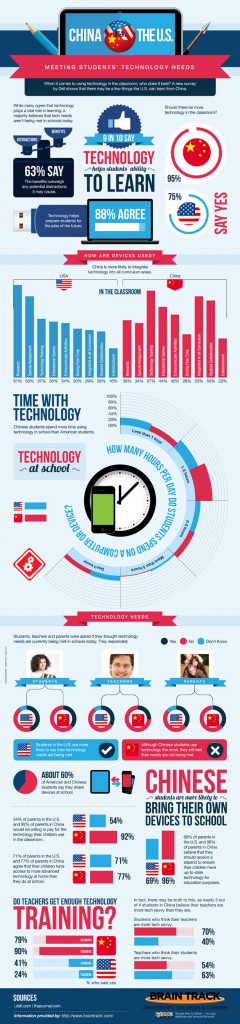
Chinese ‘Anchor Babies’ Landing in Canada
Even though it is legal, it is a very unsavory phenomenon with the potential of disrupting Canadian pregnancy care services. It is also happening in the US where the business is apparently thriving. In Hong Kong, companies catering to mainland parents bearing ‘anchor babies’ have taken advantage of policy loopholes that has generated much resentment among locals. ‘Birth tourism’ may change Canadian immigration rules, reported the CBC.
———————-
A number of Chinese tourists are giving birth in Canada as a way to circumvent their country’s strict one-child policy and to get their child a coveted Canadian passport.
There are even companies in some Canadian cities that specialize in bringing over pregnant women from China.
Although the practice may seem deceptive, one lawyer says it is perfectly legal.
– CBC
China’s Urbanization at 52.6%
China’s urban population accounted for 52.57 per cent of the total population in 2012, up 1.3 percentage points from a year earlier, latest figures showed today.
Over 52.57 per cent of the 1.354 billion people live in urban areas, according to data released by China’s National Bureau of Statistics (NBS).
Last year, China’s population increased by 6.69 million more compared to 2011, according to the data.
Chinese leaders have been pushing for rapid urbanisation as they believe it is a better way to provide basic amenities and employment to people.
China’s urban population is expected to reach 70 per cent of the total population by 2030 and the country needs to handle its fast urbanisation in the right manner, as it could create difficulties, especially environmental problems, World Bank said last year.
“Each additional percentage-point increase in urbanisation means over 10 million more rural residents becoming city-dwellers”, Zheng Xinli, Vice-Chairman, China Centre for International Economic Exchange said.
Each city-dweller will spur at least 100,000 yuan ($15,873) in investment in infrastructure, he said.
According to leading international consultancy firm McKinsey & Company, China is expected to have 221 megacities – 10 out of which would have a population of more than 10 million each – and an urban population of about one billion by 2025.
China Invests Heavily in Human Capital
This NYT article is spot on. China’s heavy investment in university research and teaching and greatly expanding the undergraduate base is fundamentally changing global competition in traditional and high-tech sectors. The author likens it to the US GI bill but China’s current drive is on a scale unprecedented in world history.
——————-
China is making a $250 billion-a-year investment in what economists call human capital. Just as the United States helped build a white-collar middle class in the late 1940s and early 1950s by using the G.I. Bill to help educate millions of World War II veterans, the Chinese government is using large subsidies to educate tens of millions of young people as they move from farms to cities.
The aim is to change the current system, in which a tiny, highly educated elite oversees vast armies of semi-trained factory workers and rural laborers. China wants to move up the development curve by fostering a much more broadly educated public, one that more closely resembles the multifaceted labor forces of the United States and Europe.
It is too early to know how well the effort will pay off.
While potentially enhancing China’s future as a global industrial power, an increasingly educated population poses daunting challenges for its leaders. With the Chinese economy downshifting in the past year to a slower growth rate, the country faces a glut of college graduates with high expectations and limited opportunities.
Much depends on whether China’s authoritarian political system can create an educational system that encourages the world-class creativity and innovation that modern economies require, and that can help generate enough quality jobs.
China also faces formidable difficulties in dealing with widespread corruption, a sclerotic political system, severe environmental damage, inefficient state-owned monopolies and other problems. But if these issues can be surmounted, a better educated labor force could help China become an ever more formidable rival to the West.
“It will move China forward in its economy, in scientific innovation and politically, but the new rising middle class will also put a lot of pressure on the government to change,” said Wang Huiyao, the director general of the Center for China and Globalization, a Beijing-based research group.
To the extent that China succeeds, its educational leap forward could have profound implications in a globalized economy in which a growing share of goods and services is traded across international borders. Increasingly, college graduates all over the world compete for similar work, and the boom in higher education in China is starting to put pressure on employment opportunities for college graduates elsewhere — including in the United States.
China’s current five-year plan, through 2015, focuses on seven national development priorities, many of them new industries that are in fashion among young college graduates in the West. They are alternative energy, energy efficiency, environmental protection, biotechnology, advanced information technologies, high-end equipment manufacturing and so-called new energy vehicles, like hybrid and all-electric cars.
China’s goal is to invest up to 10 trillion renminbi, or $1.6 trillion, to expand those industries to represent 8 percent of economic output by 2015, up from 3 percent in 2010. At the same time, many big universities are focusing on existing technologies in industries where China poses a growing challenge to the West.
– NYT on Yahoo Finance
For the entire article, visit: http://ca.finance.yahoo.com/news/next-made-china-boom-college-030958274.html
Official: China’s Wealth Gap “Relatively Large”
China’s statistics chief, admitting the country’s wealth gap is “relatively large”, released a recalculated indicator of economic inequality on Friday in the first time in several years that officialdom has addressed the sensitive issue head-on.
The Gini coefficient, a measure of income disparity widely used by economists, peaked in 2008 and has been narrowing since then, Ma Jiantang, the head of the National Bureau of Statistics, told reporters at a press conference on 2012 economic performance.
China’s Gini coefficient stood at 0.474 in 2012, down from 0.477 in 2011 and from a peak of 0.491 in 2008, Ma said.
“A Gini coefficient between 0.47-0.49 shows that the gap of income distribution is relatively large,” he explained.
China had not provided an official Gini coefficient since 2005, claiming that it was too difficult to calculate given rampant under-reporting of incomes, particularly by the wealthy.
The index ranges from 0 to 1, with the 0.4 mark viewed by analysts as the point at which social dissatisfaction may come to a head.
Ma said the World Bank put China’s Gini coefficient at 0.474 in 2008. The World Bank’s last published figure – 0.425 – was for 2005.
– Reuters
China’s High Speed Rail System to Pick Up Steam: Forecast
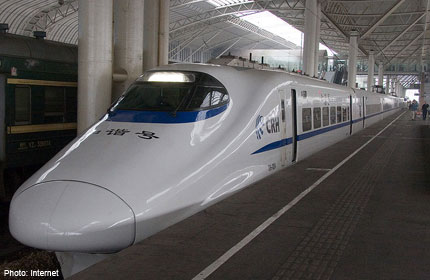
CHINA – About 5,209 km of new high-speed railways will be put into operation in 2013, 2,738 km more than last year, global financial services provider UBS AG forecasted.
In 2012, about 250 standard sets of high-speed trains were delivered in China, and UBS projected the Ministry of Railways will place new orders for 400 more trains this year upon completion of the high-speed railway network.
According to UBS estimates, 60 per cent of the trains will operate on 200 km per hour speed lines, and the rest will run at 300 km per hour.
“The Ministry of Railways has not signed large orders since it placed a gigantic order of nearly 100 billion yuan (S$19 billion) in 2009, and the major high-speed train orders should be used up in March,” said Richard Wei, head of UBS Asia transport research.
Wei estimated that about 20,463 km of high-speed railways will be in service by 2015, compared with 9,337 km at the end of 2012. To cope with the gigantic investment in railway network expansion, the Ministry of Railways must augment its financing avenues or it will face a severe capital shortage, analysts said.
The ministry is already burdened with more than 2 trillion yuan in debt, and the construction nationwide of high-speed railways will put new pressure on the ministry over the next few years, Wang Mengshu, a member of the Chinese Academy of Engineering, was quoted on Monday by the Economic Information Daily as saying.
Wang suggested the central government allocate more money for railway building as the railway plan is part of the State strategy. Local governments should also help finance railway projects because the new lines will boost economic development and create more jobs, Wang said.
“I think the three sides should jointly undertake the investment of railway construction. The ideal investment ratio is that the central government take up 40 per cent of total investment, the Ministry of Railways take another 50 per cent share, and the local government to pay 10 per cent,” Wang added.
A draft plan showed that 630 billion yuan will be spent on China’s railway construction in 2013.
– China Daily/Asia News Network
Report: China’s Lead in World Car Production to Widen
China will remain the primary driver of global vehicle production growth over the next four years, but the U.S. will remain the No. 2 vehicle producer in the world as North America continues to play a unique role in the automotive industry, according to WardsAuto and AutomotiveCompass.
The report comes from the newly released joint Global Light Vehicle and Powertrain Forecast service from WardsAuto and AutomotiveCompass. The new forecast also calls for auto makers to consolidate the number of platforms underpinning their vehicles while increasing the percentage of cars and trucks that rely on smaller engines.
The WardsAuto /AutomotiveCompass forecast, which is updated monthly for clients, projects growth in all global regions through 2018, with total vehicle output increasing 23 percent over the next six years. The report highlights the China-led Asia-Pacific region’s increasing dominance, especially through 2016, when production in China alone will climb to 26 million units; a 7.5 million unit increase from 2012.
By comparison, production in the U.S., the No. 2 vehicle producer, is projected to increase by 1.3 million by 2016, while production in the third-highest producing country, Japan, is forecast to decline by 875,000 units over the next four years, as capacity continues to shift to other locations.
– Automotive Fleet