
Peak Teams Up With Raptors
Chinese sports apparel company Peak Sports announced its new partnership with the Canadian NBA team Raptors in Toronto on Saturday.
Rapidly gaining ground in the international sporting world, the Chinese company is the sponsor of a number of NBA teams. This four-season long partnership with the Toronto Raptors is all part of the company’s international marketing strategy, said Peak Sports’ chairman Xu Jingnan.
This partnership marks the first time a professional Canadian sports team has ever been sponsored by a Chinese company. Xu said they’re hoping to introduce and establish their brand in Canada with the help of the Toronto Raptors.
“Internationalization has always been the main focus in the development of Peak Sports,” he said. “This partnership with the Toronto Raptors will help accelerate Peak’s business here in Canada and bring our product to Canadian consumers.”
Listed in the Hong Kong Stock Exchange in 2009, Peak Sports produces and manufactures goods in a variety of sports. But with basketball as their primary focus, the company has established strategic partnerships with a number of high profile NBA teams such as the Houston Rockets and the Miami Heat over the years.
With this deal, Peak will be exposed to Raptors fans who will see the company’s branding all over the Air Canada Centre where home games are held. Peak’s merchandise will also be available to Canadian consumers at the Raptors Team shop at the Air Canada Centre.
To mark the big announcement, Raptors guard Kyle Lowry, one of Peak’s featured endorsees, ran a basketball clinic and helped nearly 30 youth from local Chinese community get a head start in the sport.
Established in 1989, Peak Sports now has more than 6,000 stores in China.
– Xinhua
Domestic Consumption to Drive Chinese Growth
Expanding domestic consumption will drive China’s economic development next year, according to a statement issued at a key annual leadership meeting.
With export growth falling in November to 2.9 per cent year-on-year, down from 11.6 per cent in October, China’s new leaders are pinning their hopes for the world’s second-largest economy on fostering demand at home.
Sunday’s statement was issued at the two-day Central Economic Work Conference in Beijing.
But unlike after previous meetings, state media did not immediately report China’s much-anticipated target for gross domestic product.
China is expected to retain its 2012 growth target of 7.5 per cent for 2013.
Succeeding Hu Jintao last month, Communist Party leader Xi Jinping chose Shenzhen, the cradle of China’s economic reforms and opening-up policy, as the venue for his first official trip, in which he stressed the need for comprehensive and systemic economic reform.
The weekend meeting granted Xi his first official opportunity to make his mark on the mapping-out of key economic plans for 2013, including not just the target for economic growth, but also a range of measures involving the deficit, tax policy and urbanisation.
The Chinese economy relies on exports, government expenditure and investment, with leaders vowing to protect foreign investors’ rights, including intellectual property rights, according to the Xinhua news agency.
China also wants to encourage both private and public investment next year, including through increased investments in infrastructure projects.
China will also promote urbanisation, while retaining control of the property market, and will continue to implement a proactive fiscal policy and prudent monetary policy.
Convened by the Central Committee of the Communist Party and the State Council, the annual end-of-year conference usually takes three days to lay out the national agenda for the economy.
– The West Australian
First Subway to Cross Yangtse River
Here is a Xinhua photo gallery of the first subway line in Wuhan to traverse the mighty Yangtse.
http://news.xinhuanet.com/english/photo/2012-12/15/c_132043266.htm
Chang’e-2’s Pictures of Asteroid Toutatis
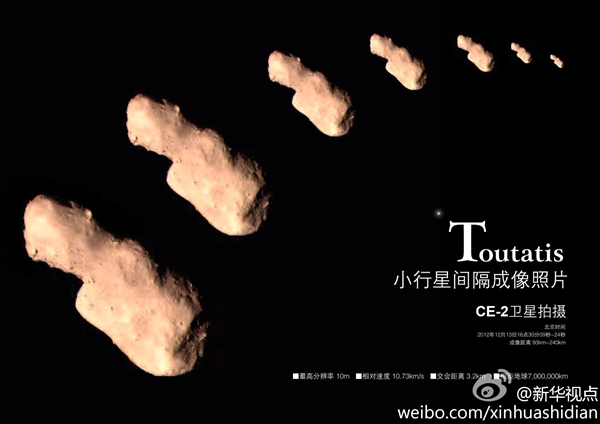
China’s space probe Chang’e-2 has successfully conducted a maneuver in which it flew by the asteroid Toutatis, about seven million km away from the Earth.
Travelling in deep space, Chang’e-2 made the flyby on Dec. 13 at 16:30:09 Beijing Time (08:30″09 GMT), the State Administration of Science, Technology and Industry for National Defense (SASTIND) announced on Saturday.
The flyby was the first time an unmanned spacecraft launched from Earth has taken such a close viewing of the asteroid, named after a Celtic god.
It also made China the fourth country after the United States, the European Union and Japan to be able to examine an asteroid by spacecraft.
– Xinhua
The Brave New World of 2030: NIC Report
This week, the US National Intelligence Council (NIC), a consortium of 17 US government intelligence agencies, came out with its landmark quadrennial report “Global Trends 2030: Alternative Worlds” (GT2030). On China, the report largely follows conventional, if not conservative, projections of its economic trajectory to surpass the US before that time but also sees America remaining tallest among midgets in international affairs.
The fifth in a series, the report does not profess to predict the future but rather provide food for thought to decision makers. It cites 4 megatrends, 6 game-changers, and 4 scenarios of a bold new world in 2030. This post focuses on the most relevant parts about China.
GT2030 states that “no country – whether the US, China, or any other large country – will be a hegemonic power”. Within two decades, Asia will have reversed the nearly three centuries of Western dominance with China re-establishing itself as the world’s premier economy. The megatrends of diffusion of power, empowerment of individuals, demographic aging in key countries, including China, and growing basic resource demands that may lead to conflict are underpinned by tectonic shifts, namely, economic power flowing to the East and South, growth of the global middle class, urbanization, and others that characterize China’s growth.
Elaborating on one game-changer – the shift to a crisis prone global economy – GT2030 seems ironically to lament the loss of America’s hegemony, the Hobbesian Leviathan that realist scholars argue is central to world stability. The prospect of declining US power and unwillingness to serve as the global security provider would be a key factor contributing to instability, the report underscored. Fear of China’s growing power and questions about the US’s sway would exacerbate insecurities among America’s allies in East Asia.
More and more, the world’s economic prospects will increasingly pivot on the performance of large emerging countries, foremost of which is China. According to the World Bank’s baseline modeling, China will contribute about 1/3 of global growth by 2025. But, the report also suggests, I believe wrongly, that China’s growth will slow to 5% per annum by 2020 and faces immense challenges in overcoming the so-called ‘middle-income trap’. While unlikely, says GT2030, an economically collapsed China would trigger domestic political unrest and shock the global economy.
China will continue to suffer from a ‘democratic deficit’. Within 5 years, China is slated to pass the threshold of US$15,000 (PPP) per capita that often triggers democratization. Here, the report delves in some wishful-thinking suggesting that a ‘black swan’ event such as Chinese democratization could trigger an immense ‘wave’ of democratization around the world. But, other experts contend that a democratic China could become more nationalistic with the electorate hijacked by jingoism and demagoguery.
Possibly the biggest game-changer is the crucial albeit waning role of the US. In spite of economic decline, the US is likely to remain the ‘first among equals’ in great power relations in 2030. At the same time, the “unipolar moment” in the immediate years following the collapse of the Soviet Union is over and Pax Americana that has defined international relations since the end of WWII is quickly coming to a close.
The report is right when it says in the next 15-20 years, power will become more multifaceted and more contextual and America’s role will be increasingly determined by how successful it is at helping to manage international crises. The report may also be on the right track when it suggests China will not be able eclipse the US as the preeminent superpower nor will a new international order be erected by the emerging world.
The report ends by positing four alternative worlds under which the West, particularly the US, declines to varying degrees: The worst scenario has economic engines in America and Europe stalling forcing turns inward and an unraveling of the euro zone resulting in a vacuum in international leadership. This in turn could cause inter-state conflicts in Asia, the center of economic activity, to rise owing to a new “great game”.
The next worst scenario is a “Gini out-of-the-bottle” world of clear-cut winners and losers where the EU barely functions as a single market and the US selectively disengages from policing world affairs. Meanwhile, the massive and growing gulf between the rich and poor, corruption, and other social issues in China causes social discontent possibly leading to unrest and even a split in the Party.
A third scenario involves the emergence of non-state actors and sub-national units such as megacities that share power with the nation-state. Authoritarian states would be fair worst but democratic countries too would face more difficulties in successful governance. This is a “patchwork” and uneven world but economically it is preferable to a stark divide between the haves and have-nots.
Finally, “fusion” would be nirvana in which China, the US and Europe coordinate closely to put out fires around the world. Over time, China’s credibility is bolstered through domestic political reform and a proactive role in the international arena. By 2030, the world economy could be as big as US$132 trillion (in today’s dollars) with the American Dream reinvigorated, a vibrant EU marketplace, and China successfully leaping over the ‘middle-income trap’.
Critical of reports like GT2030, a commentary in the Atlantic Monthly magazine nonetheless praised it for some usefulness: “The GT2030 report is important for how it’s changing the process and trying to encourage adaptive thinking about the future. It helps leaders understand not just the current trends but also how to be flexible enough to adapt to rapid change. Leaders should look at reports like GT 2030 and think how they can evolve current institutions to be more adaptable and flexible in the future”.