
Origins of the Diaoyu Islands Dispute
A previous post focused on the scarring memories of the Opium Wars and the series of humiliating and economically devastating unequal treaties that the late Qing Dynasty was forced to sign with foreign powers. China’s ongoing dispute with Japan over the uninhabited Diaoyu Islands off the northeast shores of Taiwan goes back to another historical disgrace, this time at the hands of the Japanese.
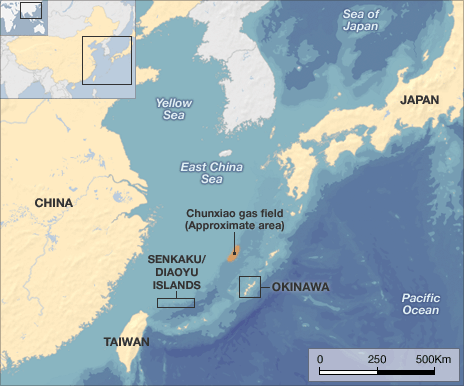
China claims the discovery and the control of the Diaoyus (the Senkakus in Japanese) since the beginnings of the Ming Dynasty during the latter half of the 14th Century. Since Japan paid tribute to the Ming court, the Chinese claim was never disputed for centuries by the Japanese. But, within three decades following the 1868 Meiji Restoration, Japan was able to rapidly industrialize and modernize its army and navy. Fighting primarily over the control of the Korean Peninsula, the First Sino-Japanese War (August 1984 to April 1895) erupted between the two countries resulting in yet another humiliating defeat for the feeble and collapsing Qing Dynasty.
The near total destruction of China’s northern fleet indicates the utter failure of the Qing to modernize its military and protect its sovereignty from encroaching Japan. The Qing government was subsequently forced to sign the 1895 Treaty of Shimonoseki that ceded control of Taiwan to Japan, not to mention the payment of indemnities. Even before the signing of the treaty, the Japanese government had already annexed the Diaoyu islands, which the Chinese claim as part of Taiwanese territory. For four decades, a bonito processing plant was set up on the island by Japanese interests that last until before the outbreak of the Pacific War.
After Japan’s unconditional surrender in 1945, Taiwan was returned to China under the 1951 Treaty of San Francisco but Kuomintang supremo Chiang Kai-shek did not raise the issue of the Diaoyus. In 1968, large undersea reserves of oil were discovered near the islands prompting a gradually escalation of the territorial dispute between China and Japan which had no official ties.
Even though the islands were named in the 1971 Okinawa Reversion Treaty passed by the US Senate relinquishing control to the Japanese the next year, Chiang muffled himself because he heavily depended on the US for political, economic and military support at the height of the Cold War. Later, the owners sold the islands to the Kurihara family of Saitama Prefecture.
In 1972, civil authority over the islands was granted to the mayor of Ishigaki, Okinawa, but the Japanese government forbade the city from surveying or developing the islands. Later that year, when Japanese Prime Minister Tanaka Kakuei re-established diplomatic relations with China following Nixon’s epoch-changing visit to Beijing, he and Chinese Premier Zhou Enlai agreed to put off a decision on the Diaoyus for the sake of bettering ties. However, references to temporarily shelving the sovereignty issue were expunged from the official record by Japanese Foreign Ministry officials. Not so the Chinese side.
The sovereignty issue laid dormant for nearly four decades until late 2010 when Ishigaki inappropriately commemorated the 1895 annexation of the Diaoyus, raising the ire of the Chinese. Oil was poured on the fire last spring when Ishihara Shintaro, the firebrand ultra-nationalist former mayor of Tokyo, pledged to raise public money to buy the islands for their current owners. Then, in September, in a bid to wrestle public opinion over the issue from Ishihara, the ‘the tail wagging the dog’, the Japanese government nationalized control of the islands by purchasing them from the Kurihara family for 2.05 billion yen (about $24 million). Not surprisingly, Sino-Japanese relations have since deteriorated to all-time post-diplomatic recognition lows.
This post will not dwell on the infamous Second Sino-Japanese War (1937 to 1945) during which the invading Japanese army committed numerous atrocities symbolized notably by the Rape of Nanking that resulted in the slaughter of 300,000 Chinese soldiers and civilians. Suffice it to say that Japan’s annexation of Manchuria and its 8 year invasion of China proper was the outcome of decades long imperial Japanese campaign to dominate China through the establishment of the so-called ‘Greater Asia Co-Prosperity Sphere’ that wreaked death and destruction throughout East and Southeast Asia.
Economist Magazine on the Ascent of Microblog Weibo
See the video interview with an Economist editor:
China’s Beidou Navigation System Servicing Asia-Pacific
This is big for China’s ambitions to take a big chunk of the global positioning business. Plus, China’s home-grown system cannot be turned off by a foreign power in times of conflict.
——————————–
China’s domestically-produced navigation system aims to take 70 to 80 percent of the now GPS-dominated domestic market by 2020, a spokesman for the system said Thursday.
We hope industries based on the BeiDou Navigation Satellite System (BDS) will hold 15 to 20 percent of the market share by 2015, according to BDS spokesman Ran Chengqi, also director of the China Satellite Navigation Office, at a press conference on the official launch of the system.
|
China successfully launched another satellite in |
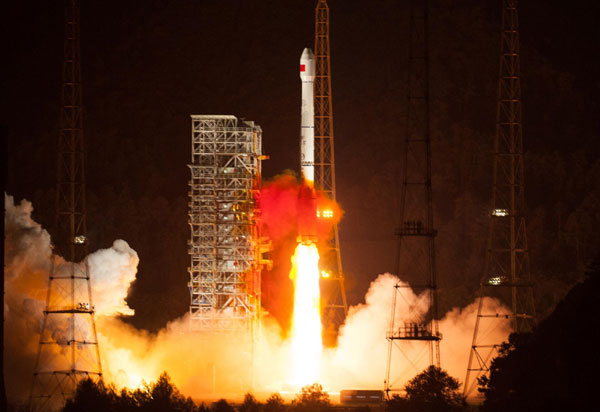 to space for its indigenous global navigation and positioning network at 11:33 pm on Oct 25, 2012 from the Xichang Satellite Launch Center in the southwestern province of Sichuan. [Photo/Xinhua]
Ran announced that the BDS began providing positioning, navigation, timing and short message services to civilian users in China and surrounding areas in the Asia-Pacific region on Thursday.
Ran said the general functionality and performance of the BDS is “comparable” to the GPS system.
He further explained that the BDS open service is currently available and features positioning accuracy of 10 meters, velocity accuracy of 0.2 meters per second and one-way timing accuracy of 50 nanoseconds.
The BDS offers more conveniences for navigation system users with equipment that is compatible with multiple navigation systems, as they will no longer have to rely on a single service, said Ran.
A 2011 report said 95 percent of satellite navigation equipment in China relied on GPS services, while industrial statistics show that the total output of China’s navigation service sector will top 120 billion yuan (19.2 billion U.S. dollars) in 2012.
China launched the first satellite for the BDS in 2000, and a preliminary version of the system has been used in traffic control, weather forecasting and disaster relief work on a trial basis since 2003.
– China Daily
Canada’s ‘Haves’ and ‘Have Nots’ Map Changing Dramatically
The China (and Asian) driven commodities boom has been a godsend to Saskatchewan and Alberta. 9 of the top 20 cities with the highest per capita incomes are in western Canada.
—————————
http://www2.macleans.ca/2012/12/19/interactive-canadas-richest-cities/#tips
The commodity boom is rewriting the list of the “haves” and “have-nots” in Canada. Toronto is nowhere near the top of Canada’s rank of wealthiest urban areas, while Montreal and Vancouver don’t even make the cut. Small and mid-sized cities are clearly winning the day.
The biggest dots on our map are, of course, in Alberta, with tiny Fort McMurray, right next to the Athabasca oil sands, topping the charts.
One needn’t look much further east to find more stories of vertiginous growth, happy realtors and chronic labour shortages. Welcome to Saskatchewan, the only province planning to run a budget surplus this fiscal year. The resource boom that started a decade ago is now prominently on display in Regina and Saskatoon, which boast, respectively, the lowest unemployment and highest population growth rates of any metropolitan area in Canada.
Commentary: US Should be Nicer to China
Mr Lee’s commentary hits the spot.
Michael Justin Lee, a lecturer in the department of finance and the Center for East Asian Studies at the University of Maryland, is author of the new book, “The Chinese Way to Wealth and Prosperity: 8 Timeless Strategies for Achieving Financial Success.”